Is Obamacare Keeping Costs Down?

Eric Morath calls attention to the first time that the medical cost index has posted a monthly decline since 1975:

The effects of the federal health care overhaul — the Affordable Care Act that passed in 2010 —and constrained government payments to doctors and hospitals seems to be trickling down to consumers, both those directly purchasing insurance plans and those buying drugs and treatments. “The slowing of healthcare inflation right now seems to be driven by onset of new policies,” said Alec Phillips, a Goldman Sachs economist who follows health care trends. “That is probably going to be a temporary factor.” In the coming year, the next phase of the health care overhaul will expand coverage and increase subsidy payments and could, in turn, push medical costs back up, Mr. Phillips said.

Drum throws cold water:

[M]edical inflation has been outrunning overall inflation by about 1.5 percentage points ever since the 1950s, and, roughly speaking, that’s still the case. There’s been a bit of a slowdown over the past decade, but only a bit.

Laurie McGinley examines a report that “concludes that if present trends continue Medicare savings will be $1 trillion more in the next 10 years than the savings projected by the Congressional Budget Office in May”:

The changes, Al Dobson said in an interview, are the result of marketplace pressures and the Affordable Care Act, which set new penalties for hospital readmissions, and included bundled payments and other incentives for hospitals and doctors to find ways to cut costs without hurting patients.

But why assume present trends will continue? For one thing, won’t the aging of the Baby Boomers drive up Medicare spending? The answer Dobson argues, is counter-intuitive: At least for the next several years, Baby Boomers will be the youngest people on Medicare, a positive trend, cost-wise. That gives the nation a “respite,” he contends, to figure out how to handle needed entitlements changes. “We have 10 years to figure this baby out,” he says. “If we don’t, it could be pretty messy.”


Tim Fernholz, meanwhile, profiles a firm that thinks keeping healthcare costs in check could be as simple as a little more transparency:

Castlight [is] a big data firm that launched a service to help big employers, from companies like Safeway to the state of Indiana, cut health insurance costs. Castlight uses each employer’s historical data on insurance claims and payments to develop price and quality comparisons for local health-care providers, from physicians to pharmacists. That data is provided to people on the insurance plan, who use web and mobile apps to find the best combination of cost and quality for their needs. That can mean big savings if the cost of a procedure like a colonoscopy varies by as much as a factor of seven. Right now, 4 million people use Castlight’s service, and the company is set to grow. But it can do better, according to its CEO and co-founder, Dr. Giovanni Colella, if it gets more data from the government.

A Poem For Wednesday

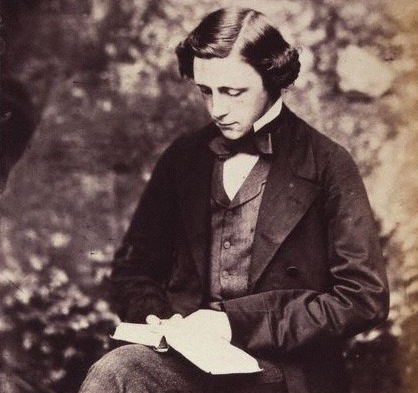
NPG P7(26),Lewis Carroll (Charles Lutwidge Dodgson),by Lewis Carroll (Charles Lutwidge Dodgson)

“The Lobster Quadrille” by Lewis Carroll (1865):

“Will you walk a little faster?” said a whiting to a snail,
“There’s a porpoise close behind us, and he’s treading on my tail.
See how eagerly the lobsters and the turtles all advance!
They are waiting on the shingle—will you come and join the dance?
Will you, wo’n’t you, will you, wo’n’t you, will you join the dance?
Will you, wo’n’t you, will you, wo’n’t you, wo’n’t you join the dance?

“You can really have no notion how delightful it will be
When they take us up and throw us, with the lobsters, out to sea!”
But the snail replied, “Too far, too far!”, and gave a look askance—
Said he thanked the whiting kindly, but he would not join the dance.
Would not, could not, would not, could not, could not join the dance.

“What matters it how far we go?” his scaly friend replied.
“There is another shore, you know, upon the other side.
The further off from England the nearer is to France.
Then turn not pale, beloved snail, but come and join the dance.
Will you, wo’n’t you, will you, wo’n’t you, will you join the dance?
Will you, wo’n’t you, will you, wo’n’t you, wo’n’t you join the dance?”

(Photo: A self-portrait of Carroll in 1856, via Wikimedia Commons)

How We Hear Humor

Richard Restak describes how the brain processes jokes:

All humor involves playing with what linguists call scripts (also referred to as frames). Basically, scripts are hypotheses about the world and how it works based on our previous life experiences. Consider what happens when a friend suggests meeting at a restaurant. Instantaneously our brains configure a scenario involving waiters or waitresses, menus, a sequence of eatables set out in order from appetizer to dessert, followed by a bill and the computation of a tip. This process, highly compressed and applicable to almost any kind of restaurant, works largely outside conscious awareness. And because our scripts are so generalized and compressed, we tend to make unwarranted assumptions based on them. Humor takes advantage of this tendency.

Consider, for example, almost any joke from stand-up comedian Steven Wright, known for his ironic, deadpan delivery:

—I saw a bank that said “24 Hour Banking,” but I didn’t have that much time.
—I bought some batteries, but they weren’t included. So I had to buy them again.
—I washed a sock. Then I put it in the dryer. When I took it out it was gone.
—I went into a store and asked the clerk if there was anything I could put under my coasters. He asked why I wanted to do that. I told him I wanted to make sure my coasters weren’t scratching my table.

In each of these examples, everyday activities are given a different spin by forcing the listener to modify standard scripts about them. Indeed, the process of reacting to and appreciating humor begins with the activation of a script in the brain’s temporal lobes. It is the brain’s frontal lobes that make sense of the discrepancy between the script and the situation described by the joke or illustrated by the cartoon.

This ability is unique to our species. Though apes can engage in play and tease each other by initiating false alarm calls accompanied by laughter, they cannot shift back and forth between multiple mental interpretations of a situation. Only we can do this because—thanks to the larger size of our frontal lobes compared with other species—we are the only creatures that possess a highly evolved working memory, which by creating and storing scripts allows us to appreciate sophisticated and subtle forms of humor. Neuroscientists often compare working memory to mental juggling. To appreciate a cartoon or a joke, you have to keep in mind at least two possible scenarios: your initial assumptions, created and stored over a lifetime in the temporal lobes, along with the alternative explanations that are worked out with the aid of the frontal lobes.

Speaking of standup, Patton Oswalt reflected recently on some of its most contentious aspects:

The comedians I’ve known who joke about rape—and genocide, racism, serial killers, drug addiction, and everything else in the Dark Subjects Suitcase—tend to be, internally and in action, anti-violence, anti-bigotry, and decidedly anti-rape. It’s their way—at least, it’s definitely my way—of dealing with the fact that all of this shittiness exists in the world. It’s one of the ways I try to reduce the power and horror those subjects hold for me. And since I’ve been a comedian longer than any of the people who blogged or wrote essays or argued about this, I was secure in thinking my point of view was right. That “rape culture” was an illusion, that the examples of comedians telling “rape jokes” in which the victim was the punchline were exceptions that proved the rule. I’ve never wanted to rape anyone. No one I know has ever expressed a desire to rape anyone. My viewpoint must be right. Right?

I had that same knee-jerk reaction when the whole Daniel Tosh incident went down. Again, only looking at it from my experience. And my experience, as a comedian, made me instantly defend him. I still do, up to a point. Here’s why: He was at an open mic. Trying out a new joke. A joke about rape. A horrible subject but, like with all horrible subjects, the first thing a comedian will subconsciously think is, “Does a funny approach exist with which to approach this topic?” He tried, and it didn’t go well. I’ve done the same thing, with all sorts of topics. Can I examine something that horrifies me and reduce the horror of it with humor? It’s a foolish reflex and all comedians have it.

Exploding Caskets

Lex Berko explains the dangers of trying too hard to preserve a loved one’s body:

Exploding casket syndrome, as it is known in the death industry, occurs when these decomposition processes are not given adequate space to perform. In her awesome “Ask a Mortician” series, mortician Caitlin Doughty says, “You really want a decomposing body to have access to some sort of air so it can then dehydrate. But if it’s one of those super sealed protective caskets, there’s really no place for all of that gas and fluid to go and so the body can kind of turn into sort of a bog.” Eventually, when the pressure builds high enough in that boggy tank of a casket, pop!

Taking Russia Seriously

Julia Ioffe cautions against dismissing the Russians out of hand:

If Russia cautions against arming rebels that are increasingly dominated by extremists, there’s a sort of knee-jerk reaction in certain quarters of Washington: those fucking Russians. And, yes, that’s fair. Those fucking Russians are part of the reason the conflict has gotten so bad to begin with, and why the forces fighting Assad have become increasingly radicalized: Had the Russians not defended Assad so staunchly back when it was just peaceful protests in Damascus, maybe Syria would have 93,000 more people walking undemolished streets today.

But by dismissing Russian concerns out of hand, we risk doing what the Russians do—if the Americans are for it, we must be against it—and turning the whole thing into a kind of Cold War mobius strip. … We also risk overlooking the merits of their arguments, however much they’re buried in their own Cold War shadowboxing mumbo jumbo. They have been right before, you know. Like, on Iraq.

2016 Tea Leaves

Allahpundit reviews Marco Rubio’s favorable polling numbers:

If you want to know why Rubio hasn’t walked away from the Gang of Eight bill yet, that’s why. He has no political incentive to do so. If he hangs in there and the bill passes, he’ll get all sorts of media love as the “new leader of the GOP,” a man who “makes things happen in Washington,” blah blah. You and I will pound the table and swear that we’ll never, ever vote for him in 2016, and that might be true— for awhile. But strange things happen.

Harry Enten believes that appearing moderate and cozying up to GOP elites will improve Rubio’s chances in 2016. Why he needs some moderate cred:

Rubio’s Senate record paints him as one of the most conservative senators. He was the seventh most conservative senator in the 112th Congress, sandwiched between Jim Inhofe and Ron Johnson. As I wrote before, it’s unlikely the Republican party will nominate a very conservative candidate in 2016. When it liked Barry Goldwater in 1964, and Ronald Reagan in 1980, the party had recently controlled the presidency. But when the party hasn’t been in the White House for eight years or more, it goes for a more centrist pick in order to win.

Meanwhile, Noah Rothman focuses on the “inevitability” of Chris Christie:

[He] is America’s favorite Republican. Unfortunately for Christie, he is also Republicans least favorite Republican.

But while some are ready to dismiss the governor’s presidential prospects on these grounds, don’t be so sure. Appeals to inevitability and electability have historically gone a long way towards getting a reluctant GOP primary electorate to hold their nose and vote for the candidate they do not love but think can win. … Polls like these help Christie to create and manage an image as the GOP’s most electable candidate. At a certain point in both the 2008 and 2012 election cycles, when the chips were down for both Sen. John McCain (R-AZ) and Romney, they appealed to the Republican electorate to support them on these very grounds. Ultimately, it was an effective argument. Christie can, and probably will, do the same.

Barro looks at how Christie has remained popular in New Jersey. Bottom line:

[H]is overall record is good because it’s built on skepticism, not cynicism, about government spending. If other Republicans started copying that approach, they might start copying his broad popularity, too.

Reihan, meanwhile, considers reports that Wisconsin governor Scott Walker will throw his hat in the ring:

The Republican 2016 contest already has a rough shape: several would-be candidates are crowding the rightward end of the spectrum (let’s say Ted Cruz, Bobby Jindal, Rick Santorum, Scott Walker), one or two are presenting themselves as problem-solving pragmatists with establishment support (Chris Christie and possibly Jeb Bush), and one or two are hovering in-between (this is where I suspect Marco Rubio and Paul Ryan would wind up, though I suspect Ryan is too wise to run). My gut sense is that Walker and Christie are the ones to watch.

Recent Dish on Rand Paul speculation here.

Where Does Performance Enhancement End?

Jacob Beck, who dismisses most of the arguments against legalized performance enhancers in sports, fears that ending the ban would “generate a vicious arms race”:

Even players who wanted to compete drug free would be coerced into taking [performance‐enhancing drugs (PEDs)] to keep up with their peers. And there is no stable stopping point. If two players are competing for a starting spot on the Yankees, neither player can rest content with yesterday’s pharmaceutical technology. Each one needs to get the latest and greatest PEDs or risk losing his job to the other. And so they’re off to the races, with the finish line set only by the ingenuity of bioengineers.

Increasing the number of home runs is not in itself a good thing. If it were, Bud Selig would order the outfield walls moved in. Moreover, PEDs carry health risks, particularly when there is pressure to adopt the newest and strongest drugs even before they have been properly tested. As I wrote above, a concern about safety is ordinarily not a sufficient reason to ban something from a sport. But in the context of an arms race–in which the only benefit the “arms” provide is relative to one’s competitors–it is.