Whither The Weaponry?

Marc Herman wonders how well the US will be able to keep tabs on the weapons it has committed to Syrian rebels. He notes that we’re still trying to figure out how many foreign weapons “ended up in Libya in violation of their original terms of purchase”:

Scholars who study small arms proliferation have looked at the 2011 war in Libya as a guide and found evidence of illegal arms transfers and poor tracking of weapons. More than a year after the war ended, no overall accounting exists of the total amount of lethal material allies like France and Qatar imported to Libya.

The doesn’t mean the same will be true in Syria. And the U.S., which has some of the world’s most stringent weapons tracking rules, was not a key supplier of lethal material to Libyan rebels.

But the parallels worry scholars. In a series of interviews begun last year, several investigators who follow small arms transactions argued that weak international rules for tracking transfers make it nearly impossible to account for weapons sent to non-government actors—like rebel militias in Libya and, now, Syria.

Is Obama Through The Storm?

Obama Job Approval

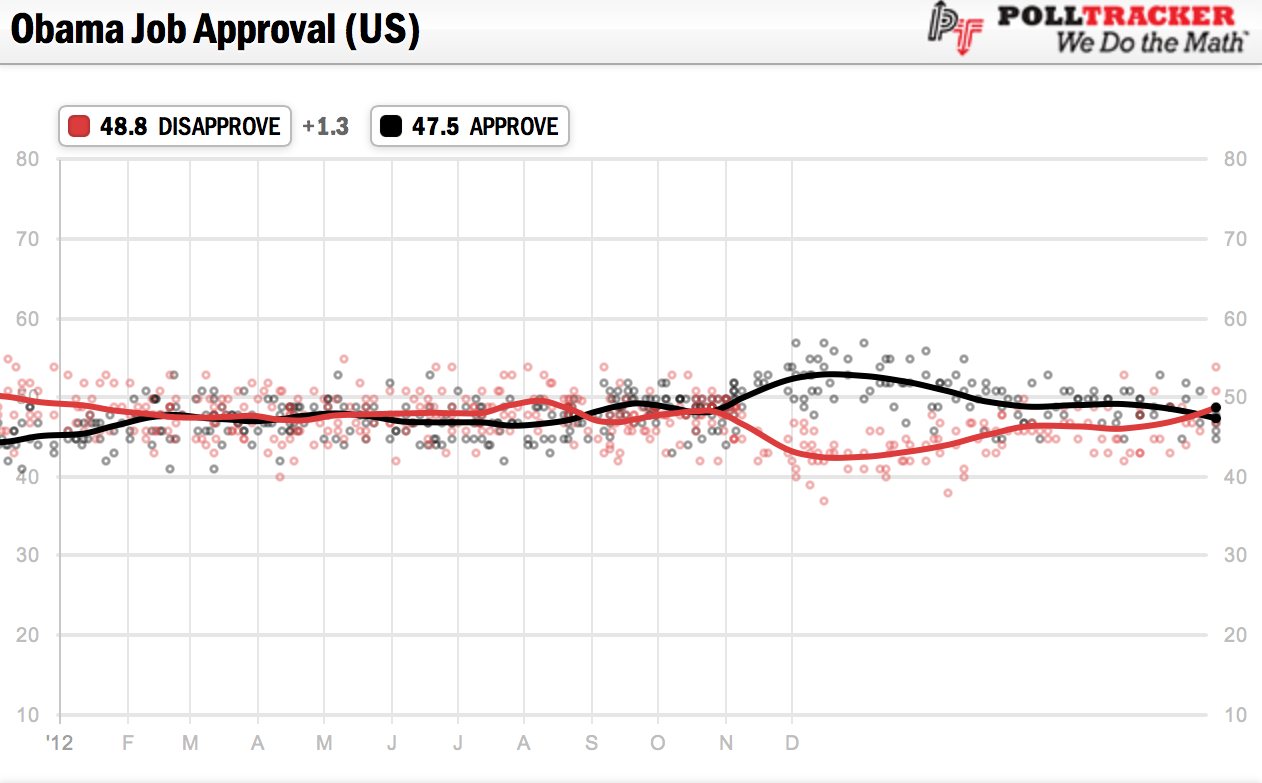
John Sides thinks Democrats should be concerned about Obama’s declining approval rating:

I estimated a model of presidential election outcomes from 1948-2012 that included change in gross domestic product over the first two quarters of the election year, presidential approval as of June of the election  year, an indicator for whether the incumbent is running, and the interaction of approval and incumbency.  This model suggests that when the incumbent is not running, a 7-point drop in approval is associated with a 1-point drop in the incumbent party candidate’s share of the major-party vote.  If I were Hillary Clinton or any other Democratic hopeful, I’d want Obama to be as popular as possible when he leaves office.  And if I were Obama and I wanted the legislative achievements of my presidency to last, I’d want a Democrat to win in 2016.

Nate Cohn isn’t worried about the slide continuing:

Without additional bad news, a recovery seems likelier [than a long-term decline]. So far, there’s not much evidence that the “scandals” or controversies of the last few months have much staying power. With the NSA dominating the news of the last few weeks, you could be forgiven for forgetting about Benghazi, IRS targeting, or the AP leaks. The sequester, which prompted an initial decline in the president’s approval ratings, might have also slipped your mind.

Without additional revelations, what’s going to keep the NSA controversy alive? My hunch: nothing, just like the controversies that preceded it. The NSA controversy might be especially likely to dissipate, since Republicans don’t appear keen on mounting a sustained attack on a program they have a record of supporting.

What would worry me is this:

The number of Americans who think he is honest has dropped nine points over the past month, to 49%.

Part of this is because of a concerted campaign from Fox News to portray him as guilty until proven innocent on the IRS, and then to challenge him (for purely factional reasons) on the NSA. But part is the fact that many Obama supporters (including me) have been critical lately. When Obamaites take the president to task, it helps legitimize the criticism in a way Sarah Palin wouldn’t. But his core strength has been the fact (I would say) that he has maintained an honest and straightforward image with Americans for a long time. It is one of his greatest assets. Losing that makes winning the argument on the Hill far harder. And the big drop in millennial support is also a structural shift. Maybe it will perk up. But the drop was sharp.

(Chart from TPM)

Silver vs Politico

This made me very happy this morning:

It’s striking how preoccupied Harris and VandeHei are with the perception that Politico is too “insidery”. My personal critique of their work cuts a little deeper than that, however. It’s not that they are too “insidery” per se, but that the perceptions of Beltway 447px-Rose_champagne_infinite_bubblesinsiders, which Politico echoes and embraces, are not always very insightful or accurate. In other words, the conventional wisdom is often wrong, especially in Washington.

Now, it would be one thing if Politico were to describe the conventional wisdom and then hold it up to a critical examination. That would be extremely useful and interesting. I thought Ben Smith, back when he wrote for them, had a real knack for that. And they have a few other journalists who I really enjoy reading. But in most of the “Behind the Curtain” pieces, by contrast, there’s a lack of perspective — in particular, a lack of perspective about the role that Politico plays in formulating the conventional wisdom which they then “report” upon.

Furthermore, Harris and VandeHei seem to lack very much curiosity for the world outside of the bubble.

Harris claims it’s not worth his time to read 538, and VandeHei characterizes my work as “trying to use numbers to prove stuff”. Instead, what 538 is really about is providing a critical perspective, and scrutinizing claims on the basis of evidence (statistical or otherwise). In order to do that, you have to believe that there is some sort of truth outside the bubble — what would be called the “objective” world in a scientific or philosophical context. Politico, by contrast, sometimes seems to operate within a “post-truth” worldview. Some people think that is the very essence of savvy, modern journalism, but my bet is that journalism is headed in another direction – toward being more critical and empirical.

I am, of course, with Nate. The distortive effect of Politico actually corrodes democracy, in my view, because it constantly prioritizes the 6-hour news cycle and the higher inside-bullshit to tell us allegedly what is happening in Washington. We can mistake that for what matters in Washington for the 300 million people it’s supposed to represent. That’s an after-thought to these Beltway courtesans.

There’s no perspective, very little history, precious little policy and no perceivable goal except financial success. It feels to me like a modern company which always works for the next earnings report, rather than a long-term strategy for actually contributing to democratic discourse.

We’d be better off if they disappeared into the ether. But, of course, they will continue to thrive.

How Immigration Saves America Money

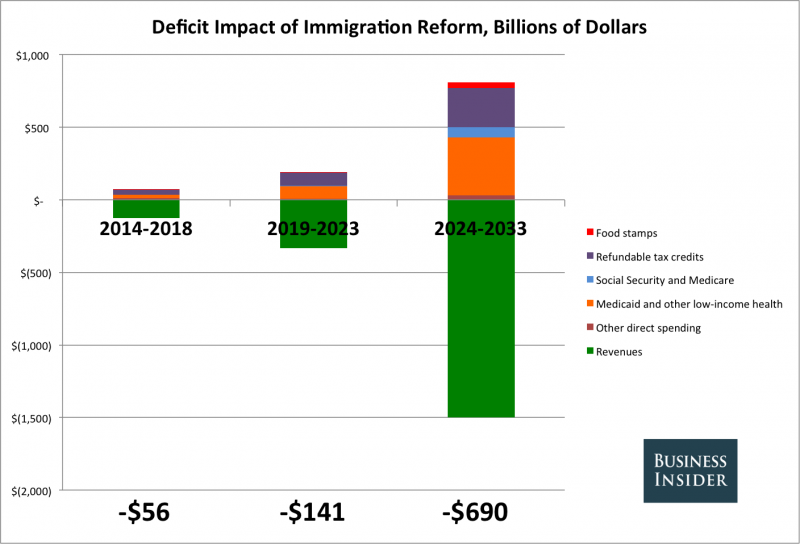
CBO Immigration Chart

A CBO report released yesterday found that the immigration reform bill would lower the deficit. Ezra unpacks the report:

How? In a word, growth. But in two words, population growth. CBO expects that passage of the bill would mean 10.4 million more U.S. residents in the next decade. To be clear, that’s not a measure of newly legal residents. CBO isn’t counting the newly legalized population — which they estimate at 8 million — as new residents. After all, those people are already here. The 10.4 million number only counts people who wouldn’t otherwise physically reside in the United States.

The basic math of the CBO’s report is that those new workers pay more in taxes than they take in benefits. To be precise, the bill increases government spending by $262 billion but increases revenues by $459 billion. And that’s before accounting for economic growth above and beyond the direct effect on population.

Zeke Miller and Alex Rogers have more details:

The bill would increase inflation-adjusted GDP relative by 3.3 percent in 2023 and by 5.4 percent in 2033. It also shows that average wages for the entire labor force would be 0.1 percent lower in 2023 and 0.5 percent higher in 2033, as the amount of capital available to workers would not increase as rapidly as the number of workers and because the new workers would be less skilled and have lower wages, on average, than the labor force under current law.

Allahpundit is unimpressed by the CBO’s numbers:

 If the entitlement regime is unsustainable long-term now, and you’re suddenly adding a huge population that’s likely to vote on balance to preserve that regime and promote the Democrats who protect it, then in 40 years all of this will be a, er, “net benefit for our economy.” I wonder what the average annual rate of GDP growth needs to be between now and, say, 2050 to make Medicare and Social Security able to shoulder that extra load.

Josh Barro, on the other hand, notes that the “CBO report may actually understate the deficit reduction due to immigration reform”:

Normally, CBO evaluates legislation on a “static” basis, meaning they don’t account for economic changes spurred by policy change. Here, they relaxed that practice to account for the rise in population that the bill would cause. They still did not account for broader economic benefits that immigration reform might produce, such as an increase in productivity or innovation.

And Chait puts the CBO report in context, noting that many of “Obama’s growth initiatives are also wrapped together in social goals, which have instigated political controversy and obscured their growth-generating goals”:

Immigration reform is one such example. Its base of support lies with immigrant communities motivated by its humanitarian goals. But immigration reform is also part of a national human capital strategy. The law would not only attempt to rationalize the currently illegal market for undocumented immigrant labor, it would also dramatically shift the composition of future legalimmigration. Most documented immigrants are currently admitted on the basis of family relationships. The law would alter that so that most were admitted on the basis of their labor skills. (The administration has been influenced by an economic paper finding that higher levels of college-educated immigrants boost innovation.)

Chart from Barro.

Beard Powerpoint Of The Day

slide-7

Mississippi State baseball coach John Cohen had a long-standing rule against his players sporting facial hair. In protest, one of his pitchers, Trevor Fitts, assembled a Powerpoint presentation titled “Why having a beard will help the Mississippi State baseball team go to Omaha [where the College World Series is held].” The rule was rescinded – and guess where they’re headed now?

The story of the presentation came out last week during a discussion about how much fun this team has (and how goofy they are). The loose style of play is what the players and coaches credit with their reaching the College World Series.

And beards.

(Hat tip: Mockingbird)

The Pregnant Workforce

Dwyer Gunn explores the challenges facing pregnant, working-class women:

[W]hile the [Americans with Disabilities Act] provides protections for pregnant women suffering from more severe pregnancy-related “disabilities” like preeclampsia, it doesn’t require employers to provide pregnant women with the kind of small modifications they may need to stay on the job, because pregnancy itself isn’t considered a disability. Technically, women like Yvette and B are supposed to be protected by either the federal Pregnancy Discrimination Act (PDA) or the sex and disability protections of the New York Human Rights law. In practice, it doesn’t work out like that for most low-income women. “There’s a gap in protection under the law,” explained Katharine Bodde, Policy Counsel at the NYCLU. “Courts have not interpreted the federal Pregnancy Discrimination Act to require employers to provide reasonable accommodations.”

E.J. Graff believes this gap could be closed with “a little bit of bipartisan cooperation” by passing the Pregnant Workers’ Fairness Act, which would extend disability protection to pregnant women:

The PWFA doesn’t have any active opposition—not in the Chamber of Commerce or among Republicans; its opponent is inertia and lack of knowledge. [Emily] Martin believes that the PWFA could be like the Americans with Disabilities Act, the beneficiary of a great deal of bipartisan support—if enough people come to understand that this is a problem—today, now—for thousands of women.

A few months, here and there. A stool, a water bottle, a bathroom break, a little help lifting now and then. What’s so hard about that? It’s stunning that we need a law to enforce what is simply considerate: letting people take care of themselves when they don’t feel well. You shouldn’t lose your job for having a family: How simple a rule is that?

Detroit On The Brink?

7436812494_55f1a2bd8d_z

Felix Salmon summarizes some of the stats contained in Detroit’s “unutterably depressing” Proposal for Creditors:

Detroit’s infrastructure is crumbling: 40% of its street lights are out of order, and it has 78,000 abandoned and blighted structures, of which 38,000 are considered dangerous buildings. Those buildings account for a large proportion of the 12,000 fires Detroit has every year. At the moment, firefighters are instructed not to use the hydraulic ladders on their firetrucks unless there is an immediate threat to life, because the ladders have not received safety inspections for years. Detroit also has just 36 ambulances, of which generally no more than 14 are in operation at any given time. And in terms of the city’s IT infrastructure — well, you can probably guess; suffice to say that a recent IRS audit characterized the city’s income tax system as “catastrophic”.

He describes the effect of the city’s emergency manager Kevyn Orr’s plan to “write down some of Detroit’s debt”:

[T]he real pain here is going to be felt by two main groups.

The first is the companies who provide wraps for municipal debt — companies whose muni arms somehow managed to escape the financial crisis largely unscathed, and which had to expect some losses on all the debt they were insuring. It’s hard to feel any sympathy for them. But the second group — Detroit’s municipal retirees — had much less choice about taking on their unsecured exposure to the city’s finances. Looking at the straits Detroit is in, the bond default makes sense. But it’s not being driven by stratospheric pension costs, and the swipe at pensioners does look rather gratuitous.

Walter Russell Mead considers the broader impact if the battle over pensions goes to court:

Michigan’s state constitution specifically protects pensions and retirement benefits, but that clause is in tension with federal bankruptcy law. The unions would likely argue that the 10th Amendment “trumps the notion that federal law is supreme.”

If the Supreme Court rejected that argument, it would deal a major blow to public sector unions across the country. According to bankruptcy lawyer Michael Sweet, “The last thing (union pension funds) may want is for a judge to rule on that….Because if the judge ruled against them, it would open the floodgates.” Every public sector union in the country would then be on notice that underfunded pension programs will ultimately be welshed on by cities and states. If the unions prevailed, though, federal bankruptcy law could be called into question elsewhere. Either way, it’s a major blow to blue model government: either states’ rights get a big boost or public sector unions take it on the chin.

Doug Mataconis wonders if “negotiations are being made more difficult by the fact that the creditors don’t necessarily believe that Detroit will pull the trigger and file a Chapter 9 [bankruptcy] petition”:

[S]uch a filing would constitute the largest Chapter 9 filing in recent history. Even if the city were to emerge from court in something resembling decent financial shape, the filing alone would do immense damage to the city’s credibility with creditors, contractors, and others who have done business with the city in the past. … In general, the city may end up finding that it would not be able to successfully emerge from bankruptcy because of the financial uncertainty the bankruptcy creates. That happens all the time in the corporate world, of course, which is why many companies that emerge from Chapter 11 find themselves on the steps of the Courthouse a few years later. In the case of a municipality, though, the consequences would be far more serious as the financial crisis that led to the Chapter 9 filing reemerged at a later date in a much more painful form. In the meantime, the brain drain that has exacerbated Detroit’s problems over the decades would likely only accelerate.

But at least the art is safe … for now.

(Photo from the interior of Detroit’s Farwell Building by Lotus Carroll)
What The Hell Is Happening In Brazil? Ctd

A reader writes:

I think the readers who wrote in about the protests in Brazil are somewhat biased. These protests are not like Turkey’s: President Dilma Rousseff has not restricted any liberties or tried to impose a moral code on her people. More importantly, they are not really about inequality or corruption; the GINI coefficient in Brazil has declined every single year since 2001.

Not to sound too much like Paul Krugman, but these protests are about simple economics. Over the past 10 years, Rousseff and her predecessor Lula Da Silva have presided over an amazing feat, engineering both rapid economic growth and a decisive narrowing of inequality. They did this by creating huge and revolutionary social welfare programs, like the Bolsa Familia. All of this has done amazing things in Brazil, but now the bills are coming due. The high budget deficits run by the governments and the low interest rates making credit available to poor entrepreneurs have led to scarily high inflation. As a result, the government has had to raise some revenue and decrease the availability of credit. Thus, the hike in bus fares.

I don’t blame the Brazilian protesters for being angry; economic stagnation is not very fun, especially after years of boom times. But Brazil remains a remarkably liberal country which continues to make amazing progress improving on inequality. The other choice for Brazil, to refuse to change any of its spending habits or raise revenue or interest rates, is to become like Argentina.

Why So Furious?

dish_legofaces

A study finds that the faces of LEGO Minifigures “are becoming increasingly angry and less happy”:

[Researcher Christoph] Bartneck obtained images of all 3655 Minifigure types manufactured by LEGO between 1975 and 2010. The 628 different heads on these figures were then shown to 264 adult participants recruited via Amazon’s Mechanical Turk online survey website. The participants’ task was to categorise the emotions on the heads in terms of the six main human emotions, and to rate their intensity.

There was ambiguity in the faces – each received an average of 3.9 emotion labels. Looking at historical trends – there was a massive increase in the variety of emotional expressions from early 1990s onwards, a process that continued up to 2010. The vast majority of figures have happy faces (324), but the next most common is angry (192), followed by sadness (49), disgust (28), surprise (23) and fear (11). And the trend is for an increasing proportion of angry faces, with a concomitant reduction in happy faces.

Rose Eveleth ventures a guess as to why:

This [trend] probably has to do with the increase in themed collections that go along with action movies and video games, many of whom are fighters. The researchers also found an increase in the amount of weaponry LEGO characters come with. Bartneck and his team express concern about how this shift to angry faces might impact children, writing “We cannot help but wonder how the move from only positive faces to an increasing number of negative faces impacts how children play.” Their research, though, didn’t attempt to investigate any links between angry LEGOs and angry kids.

(Photo by Flickr user Sunfox)