Do We Really Need The Self-Driving Car?

Kaid Benfield and Lee Epstein aren’t convinced that intelligent vehicles and automated highways are a good thing:

While it may be conceivable for bright engineers, planners and designers to come up with ways to fit such systems carefully and properly into people-first, walkable urban environments, at a minimum that fitting needs to be done as the systems are conceived and tested rather than as an errant afterthought.  Likewise for the possibility that these systems will exacerbate sprawl:  there are policy approaches that can moderate the spread and extension of highways, and/or to keep sprawling growth to a minimum – but, again, the track record is not inspiring.  These policies need to be considered, developed and adequately applied concurrently with the application of the new technologies, before the damage is inevitable. …

[J]ust because it’s high tech doesn’t make it better.

Indeed, there are lots of “old fashioned” things we need to get right about our cities, urban regions, and transportation systems before we play with expensive new technology that still doesn’t solve those basic problems: we would place a higher priority on ensuring that cities are safe, hospitable to all, walkable, a pleasure to be in, and green (both naturally, and existentially); on urban/suburban regions that have defined limits, conserving important resource lands around them; and on transportation systems that help us get efficiently from point A to point B, but which take fully into account the first two problems as effectively as they solve the last.

Lloyd Alter thinks they ignore the “larger, longer term implications” of self-driving vehicles:

Last year the Institute Without Boundaries put a lot of smart people in a room  to think about the issue. They concluded that the autonomous car is going to evolve into a very different vehicle. … Henry Ford is purported to have said “If I had asked people what they wanted, they would have said faster horses.” The autonomous car is at that “faster horse” stage, where we think of it as being pretty much what we have now, driven by robots. I suspect it is going to be as different a mode of transportation from what we are driving now as the car is from the horse.

The autonomous car will likely be shared, smaller, lighter, slower, and there will likely be about a tenth as many of them. Urban planners and theorists have to start thinking about this or we will screw it up again.

A Catastrophe For Keystone?

Kiley Kroh reviews the damage from a recent oil pipeline spill in Alberta:

massive toxic waste spill from an oil and gas operation in northern Alberta is being called one of the largest recent environmental disasters in North America. First reported on June 1, the Texas-based Apache Corp. didn’t reveal the size of the spill until June 12, which is said to cover more than 1,000 acres. Members of the Dene Tha First Nation tribe are outraged that it took several days before they were informed that 9.5 million liters of salt and heavy-metal-laced wastewater had leaked onto wetlands they use for hunting and trapping. “Every plant and tree died” in the area touched by the spill, said James Ahnassay, chief of the Dene Tha. …

Following initial speculation that the leak stemmed from aging infrastructure, officials from Apache Corp. revealed that the pipeline was only five years old and had been designed to last for 30. The incident comes on the heels of accusations from the provincial New Democratic Party that Alberta Energy Minister Ken Hughes is withholding the results of an internal pipeline safety report pending the U.S. government’s decision regarding Keystone XL.

Meanwhile, Rebecca Penty and Mike Lee describe TransCanada’s reluctance to implement new high-tech leak detection technology for the Keystone pipeline:

TransCanada Corp. (TRP), which says Keystone XL will be the safest pipeline ever built, isn’t planning to use infrared sensors or fiber-optic cables to detect spills along the system’s 2,000-mile (3,200-kilometer) path to Texas refineries from fields in Alberta. … Though the so-called external leak detection tools have been recommended by the U.S. Environmental Protection Agency for TransCanada’s Keystone XL pipeline, the Calgary-based company says they’re impractical for the entire project.

Writing Across The Ages

Craig Morgan Teicher finds the reasons for his devotion to poetry in the following passage from Walt Whitman:

And that my soul embraces you this hour, and that we
affect each other without ever seeing each other, and never
perhaps to see each other, is every bit as wonderful

Teicher comments:

I read and write poems to address and be addressed. To remember I am always a part of things that began before my life and will end after it. Whitman may well be the poet who, among all the poets ever in the world, addresses his words absolutely broadly, to all who do and do not hear them, and who manages to come close—as close, perhaps, as one’s own self—to each individual listener. Nowhere else but in Whitman do I know, as I know in the passage above, that someone distant and dead is speaking into the air with specifically me in mind—because it’s me he’s addressing—each of us is his “you”—a reader who he has never met and will never meet, who affects him because he believes—he knows—she or he will find his poems later, a reader who needs desperately at one or all moments to know she or he is not alone. That is most certainly me, and I hope that’s who, if anyone, reads my poems, because that’s who they’re written for.  We are never alone with Whitman; company like that is as much as we can ask from poetry.

The Best Of The Dish Today

In one of those strange confluences that sometimes occur on the Dish, suicide came up twice today – both Vice magazine’s disgusting attempt to get page-views out of fashion models dressed as famous women at the time of their deaths at their own hands – and a helpful study of the major actual causes of killing yourself – not a sudden impulse or cry for help, but unbearable and unrelenting emotional pain. I have to say that Stephen Fry’s confession of his own recent suicide attempt (see video above) is one of the more moving attempts to de-stigmatize bipolar disorder I have ever seen.

Bisexual readers added to the fascinating thread on whether they actually exist (yes they do!) and Dan Savage addressed ancient allegations that he is biphobic (no he isn’t!). Barack Obama’s face today was a study in conjugal love (and a certain resignation), and I posted the most effective defense of his Syrian straddle I’ve yet read – from a neocon Dishhead! Maybe I’ll be proven prematurely panicked … again.

Anyone who thought Bobby Jindal could ever be a serious political force for Republican reform got a reality check today: a near-parody of Rush Limbaugh.

The most popular posts today were my dismay at the resilient religious grip on the GOP (with a cameo from Sarah Palin), and the question of how effective bike helmets actually are, or aren’t. Obama’s Betrayal On Syria is now the second most popular post of the month.

See you in the morning …

What The Hell Is Happening In Brazil? Ctd


Dish readers supplied the initial context for the massive protests in Brasilia, Rio, and Sao Paulo. David Lavin zooms out:

Brazil’s public transportation is often slow, dangerous and crowded, and these fare increases come at a time when Brazil’s decade-long economic success has slowed dramatically. Inflation is on the rise and many basic services are woefully underfunded. For years, the economy grew, the middle class expanded and millions rose from poverty. After the country suffered through crushing hyperinflation in the 1980’s and 1990’s, inflation seemed to be finally under control.

But recently the economy has stalled, much-feared inflation is outside of targets, and rising prices on everything from food to transportation have made life more difficult for the average Brazilian. It is this contrast, between the massive investment in Olympic and World Cup infrastructure, and the lack of investment in the basics Brazilians depend on in their daily lives, that seems to be sparking the unrest.

Roberto Ferdman breaks down how badly the hikes are squeezing average Brazilians:

A fare price that sounds pretty minuscule in dollar terms actually takes up a huge chunk of Brazilian incomes for those at the bottom (and presumably, those who most need to use the bus). The $0.09 hike brought the price of a single bus fare in Sao Paolo up to $1.47. Assuming Brazil’s city dwellers ride the bus twice daily—to and from work during the week, and to and from anywhere during the weekend—that’s $82.46 a month. For Brazilians making the minimum wage of $312.33 a month, that’s a whopping 26% of their income.

A reader quotes another to underscore the severity of the World Cup concerns:

The reporters also are lamenting that this is happening during the Confederate’s Cup, as it’s going to embarrass the country on the international level. It was a HUGE deal for Brazil to land the World Cup and Olympics because it meant tons of money was going to be pumped into the country to build infrastructure.

This is like saying Oakeshott is a good philosopher. Factually true, but greatly understated. The World Cup is, arguably, the largest cultural event on the planet.

Although occurring once every four years (like the Olympics, but not diffused by numerous sports). It appeals to anyone who has kicked a soccer ball, which means billions and billions of people, in every nation (unlike the Olympics, where most countries do not participate in all sports). In many places soccer (henceforth, football) is woven into the fabric of society and culture; it is the leading game for children and the leading subject of interest for adults. More so, it defines public identity.

One of the places where football is so woven is Brazil, home of the “beautiful game.”

Brazil is one of the few non-European nations with consistent football success on the world stage, in fact the most such success amongst those nations. Brazil is one of the leading nations of football, which is to say, one of the leading nations of perhaps the most important activity on Earth outside of producing and consuming economic goods. Only religion, treated collectively, stands higher, and unlike religion football is practiced in the same manner worldwide.

Economically, Brazil has risen to be a notable economic power, the strongest in South America. While any number of third-world countries stopped being “backward” some time ago, symbolically it has taken time for the perception to catch up with the reality. Hosting the World Cup is a chance for Brazil, and by extension South America, to present itself to the world anew.

So your reader further says:

Well, the money came and the infrastructure didn’t. So now you have tens, if not hundreds, of thousands of pissed off people on the streets.

It’s not just a lack of infrastructure. Stadiums are well behind schedule. And yet the world’s eyes are about to descend on Brazil, along with up to a hundred thousand travelers, perhaps to see a country, said to have built a strong economy, without the basics complete. Yes, the lack of infrastructure is pissing off people, but the prospect of humiliation looms. It could be a public relations, economic, cultural, and almost spiritual disaster of biblical proportions.

Update from another reader:

Three thoughts (from another native here in Brazil):

1. Most of the rioting is being done by teens who suffer and are humiliated on a daily basis at the hands of the PM, the Military Police, a very nasty legacy of the Dictatorship years. Young, poor men are routinely slapped, kicked and sometimes even killed for minor offenses, so there is a pretty large amount of latent anger already there. All the rest of the several hundreds of thousands of us that marched yesterday are just having a grand old peaceful time.

2. Some say that protesters want to “take advantage of this moment when we have foreign visitors”. Yep, they sure started out that way, but it has become something way bigger. Something big enough to take Brazil’s attention away from an international soccer competition being played at home. Believe me, that’s *big*!

3. Dilma’s “Workers’ Party” was always seen as both government watchdog and protector of the poor and huddled masses. But after Lula got to power, then Dilma, corruption and government overreach rose to (almost comically) absurd levels. From laws forbidding congressmen to stand trial to public officials being caught with thousands of dollars stuffed in their underwear, people are feeling mighty disenfranchised right around now.

So expect some “The View From Your Protest” pictures tomorrow, ’cause take to the streets again. We are happy, we are hopeful and most of all; we are acting.

#changebrazil

Face Of The Day

President Obama And Family Arrive In Berlin

U.S. President Barack Obama turns to his wife Michelle as they sit in their limousine after descending from Air Force One upon their arrival at Tegel airport in Berlin, Germany on June 18, 2013. Obama is visiting Berlin for the first time during his presidency and his speech tomorrow at the Brandenburg Gate is to be the highlight. Obama will be speaking close to the 50th anniversary of the historic speech by then U.S. President John F. Kennedy in Berlin in 1963, during which he proclaimed the famous sentence: Ich bin ein Berliner. By Sean Gallup/Getty Images.

How Much Of An Economic Engine Is The Internet?

Brian Merchant reviews recent research that draws a connection between scientific productivity and economic development:

New research published in PLoS One purports to show that the best way to determine how prosperous a nation is, and how wealthy it will be in, say, five years, is to analyze how productive its scientists are. “Scientific productivity is a much better predictor of economic wealth and Human Development of a nation than other variables tracked by a number of commonly used indices proposed worldwide,” the authors state. …

But the kind of science invested in is important, too. Nations whose scientists publish more papers in chemistry and physical sciences do better than those that focus on applied sciences like agriculture or medicine.

Meanwhile, Charles Kenny argues that the Internet was oversold as a source of economic growth:

[M]any of the studies purporting to show a relationship between the Internet and economic growth relied on shoddy data and dubious assumptions. In 1999 the Federal Reserve Bank of Cleveland released a study that concluded (PDF), “… the fraction of a country’s population that has access to the Internet is, at least, correlated with factors that help to explain average growth performance.” It did so by demonstrating a positive relationship between the number of Internet users in a country in 1999 with gross domestic product growth from 1974 to 1992. Usually we expect the thing being caused (growth in the 1980s) to happen after the things causing it (1999 Internet users).

In defense of the Fed, researchers at the World Bank recently tried to repeat the same trick. They estimated that a 10 percent increase in broadband penetration in a country was associated with a 1.4 percentage point increase in growth rate. This was based on growth rates and broadband penetration from 1980 to 2006. Given that most deployment of broadband occurred well after the turn of the millennium, the only plausible interpretation of the results is that countries that grew faster from 1980 to 2006 could afford more rapid rollouts of broadband. Yet the study is widely cited by broadband boosters. Many are in denial about the failure of the IT revolution to spark considerable growth.

Epistemic Closure Watch

NRA Gathers In Houston For 2013 Annual Meeting

In Politico, Bobby Jindal attempts a rallying cry for Republicans:

At some point, the American public is going to revolt against the nanny state and the leftward march of this president. I don’t know when the tipping point will come, but I believe it will come soon.

Why?

Because the left wants: The government to explode; to pay everyone; to hire everyone; they believe that money grows on trees; the earth is flat; the industrial age, factory-style government is a cool new thing; debts don’t have to be repaid; people of faith are ignorant and uneducated; unborn babies don’t matter; pornography is fine; traditional marriage is discriminatory; 32 oz. sodas are evil; red meat should be rationed; rich people are evil unless they are from Hollywood or are liberal Democrats; the Israelis are unreasonable; trans-fat must be stopped; kids trapped in failing schools should be patient; wild weather is a new thing; moral standards are passé; government run health care is high quality; the IRS should violate our constitutional rights; reporters should be spied on; Benghazi was handled well; the Second Amendment is outdated; and the First one has some problems too.

Barro sighs:

I’ll grant Jindal one thing: He certainly didn’t ration the red meat in that paragraph. This is a big reason the Republican party can’t change. So many of its members have a warped vision of what liberalism is. They think it’s something so mind-bendingly awful that they cannot fathom how voters could willingly choose it. It must be some mistake. And sooner or later, mistakes get fixed.

Ezra piles on:

The upside of this theory is that it frees Jindal and the rest of the Republican Party from having to do the hard work of rethinking and renewing its own governing agenda. The downside of this theory is that it’s utter nonsense. And the most damaging part of this theory is that it’s utter nonsense aimed at Jindal’s own base. … That’s how the GOP becomes the stupid party: Republican Party elites like Jindal convince Republican Party activists of things that aren’t true. And that’s how the GOP becomes the losing party: The activists push the Republican Party to choose candidate decisions and campaign strategies based on those untruths, and they collapse in the light of day.

Larison views it as another step in Jindal’s decline as a serious figure in the party:

Jindal seems to be retreating here from his previous very mild recommendations for Republican reform, and seems to think that there’s nothing ailing the party that can’t be fixed by a redoubling of effort and a more combative attitude. Jindal is right that public opinion can change, and a party’s political fortunes can revive when the public tires of the party in power, but that doesn’t mean that one can simply wish away a party’s political weaknesses. No one would seriously accuse the GOP of having suffered from an “excess of navel-gazing” in the last few months. Most Republican pundits and politicians can’t bring themselves to face up to the bankruptcy of the party’s economic and foreign policy agendas, and they are even less interested in a remedy.

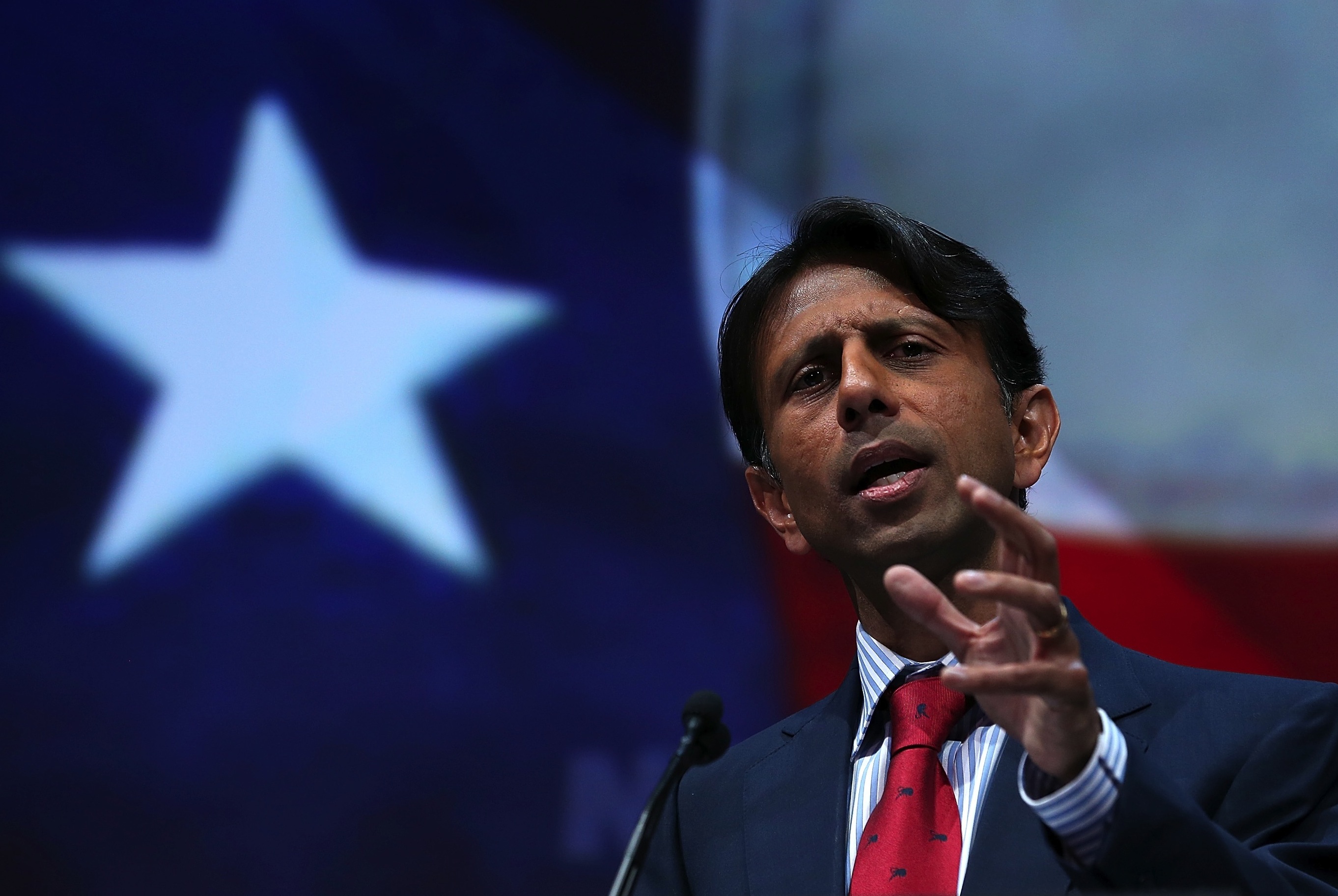
(Photo: Louisiana governor Bobby Jindal speaks during the 2013 NRA Annual Meeting and Exhibits at the George R. Brown Convention Center on May 3, 2013 in Houston, Texas. By Justin Sullivan/Getty Images)

An Evolving Valediction

Krystal D’Costa accounts for why we sign emails with “Thanks” instead of “Sincerely”:

Email offers a speedier means of contact than an actual letter (and in some cases, a telephone), but that speed also means we’re sending more messages through this medium both for personal and professional reasons, and reading and responding to these messages requires a commitment of time. So it’s more important that the sender recognize the burden that they’ve placed on the recipient.

In a time when letters took time to write, send, and respond to, it was important for the sender to attest to her reliability. Responses and actions were not so easy to take back. “Sincerely” and “Yours truly” which were meant to build trust between communicants. Credibility was an important determinant of whether a response would be issues. Today, as the web enables stranger to contact each other with little effort, credibility is less of a factor in determining responses (SPAM mail aside) when weighed against time.