“A New Golden Age Of Maps”

dish_openstreetmapworld

Will Oremus heralds it:

Once the province of big, professional operations like Rand McNally and National Geographic, cartography is becoming a more democratic realm thanks to publicly available data and software tools. Thanks to online marketplaces and crowdfunding platforms, amateurs and hobbyists can now draw up maps with a niche focus and a geeky appeal and make a little money in the process.

So now we have maps like David Imus’ hand-drawn opus, which has found a market thanks to a rave review from my colleague Seth Stevenson. We have issue-focused maps like Alfred Twu’s fantasy high-speed rail map, which reignited a debate over the country’s stalled high-speed rail plans. We have interactive online maps that make a point or provide a public service, like Slate’s gun-deaths map or ProPublica’s impressively detailed New York flood-insurance map, which lets you compare FEMA’s official maps to the actual damage from Hurricane Sandy.

And then we have people making maps for the sheer fun of it. In that category is Simon Schuetz’s Kickstarter project to create a global “bucket list” map, filling in the borders of the world’s nations not with road markings and city names, but with lovingly scrawled illustrations of the one-of-a-kind sights you can see there.

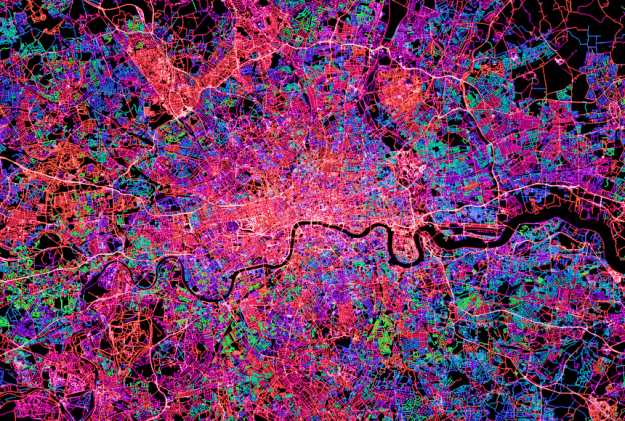
Elsewhere, OpenStreetMap, a crowdsourced cartography project that has been open to contributors since 2004, recently held its annual State Of The Map conference. The project’s 2013 report yielded a meta-map, seen above, that illustrates the dates of map edits by color (green marks the oldest edits and white the newest, with blue and red in between):

While [mappers] were taking stock, it turns out the global open mapping effort has now mapped data on more than 78 million buildings and 21 million miles of road (if you wanted to drive all those roads at, say, 60 miles an hour, it would take you some 40 years to do it). And more than a million people have chipped away at this in an impressively democratic manner: 83.6 percent of the changes in the whole database have been made by 99.9 percent of contributors.

A close-up of edits to a London road map:
dish_openstreetmaplondon

Previous Dish referencing OpenStreetMap here.
Stylized Suicide For Page-views

https://twitter.com/jetpack/status/347051650537635840

“Maximum trolling” is how Michele Filgate characterizes “Last Words,” Vice‘s June fashion spread depicting models as famous female writers, such as Virginia Woolf and Sylvia Plath, at the time of their suicides. Vice removed the photos from the website today, but not before igniting heated debate. Filgate fumes:

When should art infuriate, and when is something just so offensive that it’s not even art? Art can and at times should be provocative — there’s no doubt about that. Yet this isn’t art. This is an editorial decision to get more pageviews — and perhaps to appear cool and above outrage, while simultaneously stoking it — and it’s more pathetic than anything else. … If we glorify suicide, we’re contributing to the problem. We’re also making light of an incredibly painful subject—one that many people are way too familiar with.

At Jezebel, which republished the photos, Jenna Sauers emphasizes that “suicide is not a fashion statement”:

And while time doesn’t necessarily lessen the grief of suicide, it’s perhaps especially distressing that some of the people Vice depicts died very recently — [Iris] Chang in just 2004 — leaving still-living loved ones behind. These weren’t fictional characters; these were real women, who lived and struggled and died, and to treat their lowest moments as fodder for a silly fashion spread is shameful and sad.

Stacey Goguen provides links for those who would like to learn more about suicide or are personally affected by suicidality. Rebecca Wait elaborates on the danger of trivializing the subject:

Glamourising suicide is deeply irresponsible. As the [British support organization] Samaritans’ website states, “certain types of suicide reporting are particularly harmful and can act as a catalyst to influence the behaviour of people who are already vulnerable”. It points out that over 60 research papers have noted this link between the depiction of suicide in the media and imitative behaviour.

Helen Lewis believes Vice‘s display warrants further condemnation:

As a journalist, covering suicide is always hard because there is a fine line between raising awareness of a vital public health issue and contributing to a spectacle that could harm vulnerable people. Which of those two was the feminist website Jezebel doing when it decided to republish Vice‘s pictures, alongside outraged commentary? And have the thousands of tweets on the subject, not to mention this article, simply told Vice that it has found a tender spot in our collective consciousness, which it can jab to great effect?

I don’t have the answer to that and it is easy to find things to be outraged about these days. But this one is worth being angered by, because tonight, there might be one less Vice reader in the world.

That reader won’t be Ryan Kearney, who thinks critics are “overstat[ing] Vice‘s influence in the real world” and is surprised that editors took down the online photos:

The critics will claim victory, but Vice has won again: “Last Words” got all the pageviews it was going to get, and now the company can appear to care about giving offense. Meanwhile, readers are rushing out to get their hands on a print copy. I hope it doesn’t inspire anyone to hurt themselves, but if it does, I won’t blame Vice.

Be Literary And Multiply?

6908080437_343b8718b6_z

Lauren Sandler suggests that the success of female writers is linked to them having only one child:

It was only when I was working on a book investigating what it means to have, and to be, an only child that I realized how many of the writers I revere had only children themselves. Alongside Sontag: Joan Didion, Mary McCarthy, Elizabeth Hardwick, Margaret Atwood, Ellen Willis, and more. Someone once asked Alice Walker if women (well, female artists) should have children. She replied, “They should have children—assuming this is of interest to them—but only one.” Why? “Because with one you can move,” she said. “With more than one you’re a sitting duck.”

Author Jane Smiley pops up in the comments section to dispute Sandler’s premise:

The key is not having one child, it is living in a place where there is excellent daycare and a social world that allows fathers to have the time and the motivation to fully share in raising kids.

Zadie Smith adds that she could “really go on all day” with her rebuttal:

I have two children. Dickens had ten – I think Tolstoy did, too. Did anyone for one moment worry that those men were becoming too father-ish to be writer-esque? Does the fact that Heidi Julavitz, Nikita Lalwani, Nicole Krauss, Jhumpa Lahiri, Vendela Vida, Curtis Sittenfeld, Marilynne Robinson, Toni Morrison and so on and so forth (i could really go on all day with that list) have multiple children make them lesser writers? Are four children a problem for the writer Michael Chabon – or just for his wife the writer Ayelet Waldman? The idea that motherhood is inherently somehow a threat to creativity is just absurd.

What IS a threat to all women’s freedoms is the issue of time, which is the same problem whether you are a writer, factory worker or nurse. We need decent public daycare services, partners who do their share, affordable childcare and/or a supportive community of friends and family. As for the issue of singles versus multiples verses none at all, each to their own! But as the parent of multiples I can assure Ms Sandler that two kids entertaining each other in one room gives their mother in another room a surprising amount of free time she would not have otherwise.

Earlier Dish on Sandler’s new book on single children here. On the image seen above:

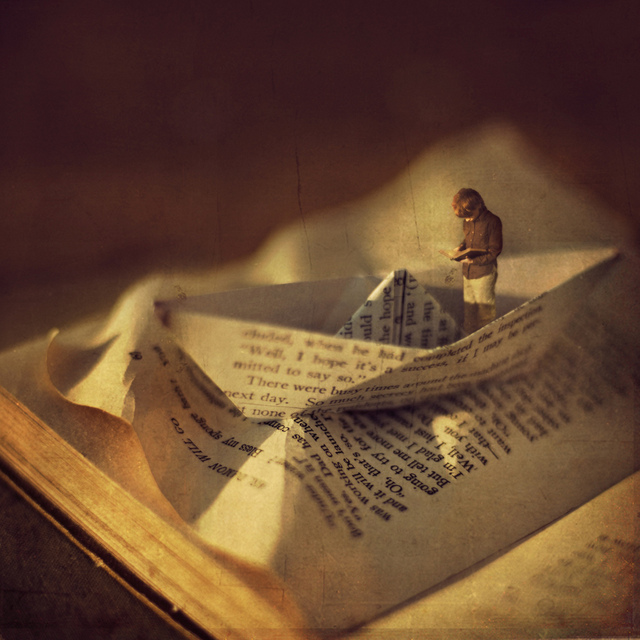
14-year-old Zev from Natick, Massachusetts, has taken the photography world by storm with his surreal photo manipulations. Better known by the nickname of ‘fiddle oak’, Zev presents a highly imaginative portfolio of surreal self-portraits, which he created together with his sister Nellie (aged 17). His work seems to mirror the transition from the fairy-tale childhood worlds into those that are way more complicated and still unknown.

Website: fiddleoak.wordpress.com, flickr

A Temporary Victory For Voting Rights

On Monday the Supreme Court invalidated an Arizona law passed in 2004 that requires people registering to vote to provide proof of citizenship at the time of registration. But, as Lyle Denniston explains, Scalia’s majority opinion suggested a way around the ruling:

On the particular point at issue in this case — Arizona’s requirement of proof of citizenship before one may register to vote or actually vote — the Scalia opinion said that a state was free to ask the federal government for permission to add that requirement.  And, Scalia said, if that doesn’t work — either because the federal agency that would deal with such a request is either not functioning or says no — then a state would be free to go to court and make an argument that it has a constitutional right to insist on proof of citizenship as an absolute qualification for voting, in all elections.

Arizona officials have already begun (pdf) to pursue this suggestion. Emily Bazelon zooms out:

As Jonathan Alter points out in his new book, The Center Holds, voter ID and other impediments led to a backlash against Republicans in 2012, energizing minority voters to go to the polls in the key states of Pennsylvania, Ohio, Virginia, and Florida.

[University of California, Irvine, law professor Rick] Hasen cautions against getting too giddy, however. “It’s a mixed bag,” he says of the current state of make-it-harder-to-vote laws. A lot of the voter ID laws that spruced up versions of the voter ID laws that were on hold in the last election will probably be enforced next time around, including in Pennsylvania, Texas, and Wisconsin. Take a look at this handy map and you’ll see that 11 states require photo ID to vote, and 19 states impose other kinds of requirements. Monday’s Supreme Court ruling doesn’t change any of that. It knocks down four states’ extra requirements for one form of voter registration. But to actually show up and cast a ballot, in a lot of places, you still have to prove who you are.

Pumped-up Politics, Ctd

Chris Mooney builds on the study showing how more assertive political views correlate to physical strength:

Cortisol: This stress hormone may also influence us politically, according to recent research by Hibbing and his collaborators. “You can see people’s cortisol levels go up dramatically when you stress them out,” Hibbing says—for instance, by requiring them to prepare to give a speech that is going to be videotaped. “We are finding there are relationships between cortisol and not voting. Those people who don’t vote are the people who tend to have fairly high cortisol levels. Because politics is pretty stressful.”

Testosterone. “There is genetic variance in how much testosterone someone has at birth, and there are certain things that can enhance or diminish that,” explains Brown University political scientist Rose McDermott, a prominent researcher on the science of ideology who authored a recent book chapter on hormones and politics. “One of those things that enhance that is muscle mass—if you build muscle mass, you enhance” your testosterone levels.

What might this have to do with politics? While direct research linking testosterone to ideology is lacking, researchers have recently published data tying muscle mass to political preferences. One study shows that rich men with large biceps are more opposed to wealth redistribution than rich men with small biceps. Another study finds that weightlifting ability correlates with support for, er, a more muscular foreign policy. Plus, get this: Men with wider faces (an indicator of testosterone levels) have been found to be more willing to outwardly express prejudicial beliefs than their thin-faced counterparts.

What’s A Bisexual Anyway? Ctd

In our latest Ask Anything video from Dan Savage, he defends himself against charges of biphobia:

Another reader adds to the ongoing discussion thread:

I’m a bisexual woman, so I guess I should speak up. There aren’t enough bisexuals who do, IMO, and we don’t get enough role models, fictional or otherwise. And we are often derided by both sides – from the gays for “being in the closet”, and by the straights, for whom we aren’t straight enough. The irony is, bisexuals are the ones who are confused by all this angst over sexuality. Both totally-gay and totally-straight people get “disgusted” by the idea of physical love with (whichever they’re not). But we don’t know what the fuss is all about, since we’re not “disgusted” by any of it.

Here’s what I wanted to write about, though: for circumstances having nothing to do with my sexuality, I’ve been celibate for several years. And it’s been interesting to note that on my own, with no outside influence of whom I’m dating at the time, my desires will flip back and forth between men and women. For a few weeks or months at a time, I primarily desire men, and then for another few weeks or months, women. It’s enough that I’ll think, “You know what? I’m really straight,” or “I’m really a lesbian.” After a few years of this, I’ve decided that yes, I’m definitely bi, because the other side of me always comes back. It’s been very curious to witness this in myself, and I wouldn’t have discovered it without celibacy. Curious.

Another:

Like the original reader, I am male and have had occasional sexual experiences with other men. My wife of 15 years is aware of these experiences and more often than not has been involved in them. Similarly she has had sexual experiences with women. I suppose we are what Dan Savage calls “monogamish.”

Here’s the thing though:

while technically I guess I am bisexual, I do not identify that way, or see it as integral to who I am. You’ve said in the past that homosexuality is an emotional identity. I accept that this is true, but perhaps bisexuality is not.

Or, more likely, perhaps Kinsey was right and there is a fluid scale to human sexuality and some people are emotionally bisexual (and would be comfortable in a relationship with both men and women) and some people are “predominantly heterosexual, with only incidental homosexual contact.” Incidentally, most of the guys we have encountered that engage in sexual activity with other men consider themselves straight. A few of the younger guys have started using labels like “heteroflexible” to identify themselves. Chris Ryan, whom you previously profiled on your site with a series of “Ask Anything” questions, has a new relationship site, Kotango, where in addition to straight, gay and bi, users can identify as heteroflexible, homoflexible, queer or pansexual.

I agree that for some bisexuals, blending in with the straight community is easier than identifying as a often victimized sexual minority, essentially hiding in plain site. On the other hand, for me and my wife, this is just something we like to do behind closed doors, but that doesn’t really define us emotionally. Most people aren’t out about their sexual proclivities. Their parents and friends don’t know about their open marriages, foot-fetishism, interest in BSDM, cosplay or that they’re secretly furries. I’d argue this is the case for some bisexual, or heteroflexibles as well. It’s not anyone’s business what we do, and we don’t believe it’s defining to who we are, so why talk about it?

As always, thank you for initiating a frank and provoking discussion I’m quite certain would be impossible to find anywhere else on the web.

Read the whole discussion here. My recent conversation with Dan about sex and marriage at the New York Public Library is here. His previous Ask Anything answers are here. Our full AA archive is here.

Wi-Fi From On High

Derek Markham highlights a potential solution for the lack of Internet access in developing countries:

Google has a plan to deliver the internet to everyone, using balloons that fly in the stratosphere and use specialized radio frequency technology to offer internet connectivity to the ground surrounding them using solar power. … The Project Loon balloons, measuring 12 by 15 meters, are carried on the winds at about 20km above the surface of the Earth, and can be directed by ascending or descending to an altitude that has winds moving in the preferred direction. The electronics are powered by an array of solar panels that are situated between the balloon envelope and the hardware, and the Loons are said to be capable of providing an internet connection on the ground in a 40km radius around their location.

Lisa Wade applauds:

The very first launch of a gas balloon was in 1783.  Two hundred and thirty years later, the company aims to deliver what is arguably the defining feature of our age — the internet — with helium-filled balloons.  That technology will then bring almost countless other technologies, such as medical advances and agricultural information, to people who are largely excluded from them now.  A fantastical plan.

The Core Reasons For Killing Yourself

The first major study of suicidal motivations has found that “many motivations believed to play important roles in suicide are relatively uncommon”:

For example, suicide attempts were rarely the result of impulsivity, a cry for help, or an effort to solve a financial or practical problem. Of all motivations for suicide, the two found to be universal in all participants were hopelessness and overwhelming emotional pain. The study also finds that suicide attempts influenced by social factors — such as efforts to elicit help or influence others — generally exhibited a less pronounced intent to die, and were carried out with a greater chance of rescue. In contrast, suicide attempts motivated by internal factors — such as hopelessness and unbearable pain — were performed with the greatest desire to die.

Recently, Stephen Fry revealed that he attempted suicide last year:

‘You may say, “How can anybody who’s got it all be so stupid as to want to end it all?” That’s the point, there is no “why?” That’s not the right question. There is no reason. If there was reason for it, you could reason someone out of it. … Sometimes it’s the expression I imagine on my mother and father’s face – both of whom are alive and happy – that stops me. But there are other occasions when I can’t stop myself, or at least I feel I can’t.’

His full comments are seen above. Recent Dish on mental illness here, here, here, here, and here.

Tragedy Of The Musical Commons

Bob Ostertag explains why he no longer gives away music for free:

[E]veryone who is deeply into music has figured out how to download music for free, despite the best efforts of the record business to stop them, and has far, far more music downloaded to their laptops and iPods than they will ever have time to listen to in their entire lives. Gigabytes and gigabytes of meaningless data. These same students invariably report that they have actually listened to all the music they paid for. If a virtual tree falls in a virtual forest and no one opens the file, does it still make a sound?

For most people for whom new music is an important part of their lives … the most relevant commons has become iTunes, Spotify, Pandora and so on – Web sites that allow the user to begin from their favorite music and then link outwards to music that has been somehow identified as similar. College kids and fanatical collectors might work late into the night figuring out how to get their files for free, but for most people, the sites listed above are the main way they discover new music. And these sites do not accept music that is free. They are all about making money. By giving away my music for free, I seem to have shut myself out of the new “commons”.

Citing Ostertag, Frank J. Oteri suggests a way to reconcile the aesthetic and economic sides of music production:

[M]usic creators should look to the fair trade coffee movement of the past decade as a model for how to proceed. Many coffee drinkers are willing to pay more money for their coffee if they believe that their money will reach the farmers who actually produced the coffee. The creators of the music are like those farmers in that, as [songwriter] Eddie Schwartz put it, “We create the one essential element in an enormous value chain. Creators need to determine fair compensation; it shouldn’t be imposed on us from anyone else.”

(Hat tip: ArtsJournal)