When Will Ariel Become Part Of Our World?

The LARB continues its series on fairy tales, introducing Hans Christian Andersen’s 1836 story The Little Mermaid. Sarah Kuhn defends her motivations:

The Little Mermaid, no matter how her tale is told, is a heroine with the ultimate mundane dream: to be a boring human instead of the utterly fantastical creature she already is. She gets a lot of flack for transforming her body to pursue what is basically a crush, but I can’t help but feel her quest is bigger than that — a yearning for an unknown that seems fantastical to her because it’s the complete opposite of her daily existence.

A. N. Devers prefers the conclusion of Andersen’s original story – the mermaid dissolving into “a daughter of the air” – to the Disney-fied ending of the 1989 movie:

Andersen’s heroine may lose her soul, but Disney’s mermaid sacrifices her physical identity in order to claim her man. There’s no question that around the time this film came out there was a cultural shift. Is it a coincidence that the media started reporting stories about teens requesting boob jobs and liposuction for their birthdays around the same time as this film’s release? Maybe. Or more likely, Disney’s fairy tale reflected the contemporary culture that had already made a disturbing change. …

I wonder what the tale might look like decades from now, when it is adapted to reflect a new cultural moment. Instead of validating stereotypical gender roles and/or reflecting our culture’s acceptance and near-celebration of plastic surgery, I like to dream there will be a little mermaid who can have her man and keep her tail too.

LARB has also covered Cinderella and Beauty and the Beast.
You Are Worthless, Alec Baldwin

First off, let’s fisk the ridiculous statement:

My ill-advised attack on George Stark of the Daily Mail had absolutely nothing to do with issues of anyone’s sexual orientation.

The tweet:

If put my foot up your fucking ass, George Stark, but I’m sure you’d dig it too much … I’m gonna find you, George Stark, you toxic little queen, and I’m gonna fuck…you…up.”

Nothing homophobic about that, whatsoever. Move along, Nothing to see here:

My anger was directed at Mr. Stark for blatantly lying and disseminating libelous information about my wife and her conduct at our friend’s funeral service. As someone who fights against homophobia, I apologize.

Well, if it had nothing to do with homophobia and a reporter’s sexual orientation, then why didn’t he threaten to punch the guy in the face than sodomize him with his foot? And why apologize at all? He has nothing to apologize for, according to him. Then the get-out-of-being-a-violent-gay-basher card:

I have worked, periodically, with numerous marriage equality organizations, especially over the past couple of years, to achieve the very rights that gay couples are earning by recent court decisions. I would not advocate violence against someone for being gay and I hope that my friends at GLAAD and the gay community understand that my attack on Mr. Stark in no way was the result of homophobia.

Many Thanks, Alec Baldwin.

I’m sorry but you have to be deaf, dumb and blind to say that his attack on Stark was “in no way the result of homophobia”. It was one of the purest expressions of violent homophobia you can have. Then this:

I would not advocate violence against someone being gay.

But you just fucking did – in your own words. You called a mob out to beat the crap out of a “toxic little queen.” And the threat of violence makes it, as I said before, a potentially criminal statement, not a gaffe.

This isn’t an apology. It’s bullshit. And if you want to know why I regard GLAAD as so awful, just read their response. It begins:

Alec Baldwin speaks out in support of the gay community

Seriously. GLAAD then responded:

His words yesterday do not match his history of actively supporting LGBT equality. While Alec’s apology is a first step, this should not be the end of the dialogue. There are now other visible actions that he should take to fight anti-gay violence and GLAAD looks forward to working with him.

So he’s now going to do the GLAAD Stations of the Cross and they will milk him for more and more money to account for his raw bigotry. They’d rather get his money than call him out for what he actually said.

The double standard is blindingly obvious. Conservatives would be crucified for saying something like this. A liberal is given an easy exit. I’m not for punishing people for speech; but I am against excusing the threat of homophobic rape against a specific individual because the bigot says he pro-gay. Sorry, Mr Baldwin, but we await an actual apology.

The Stein Style

Assessing Paris France, Adam Gopnik describes Gertrude Stein’s “marked” writing style:

All marked styles—and any style that isn’t marked isn’t a style; what we call a “mannered” style is simply a marked style on a bad morning—hold their authors hostage just a bit. Stein’s style makes subtle thoughts sound flat and straightforward, and it also lets straightforward, flat thoughts sound subtle. Above all, its lack of the ordinary half-tints and protective shadings of adjectives and semicolons—the Jamesian fog of implication—lends itself to generalizations, sometimes profound, often idiosyncratic, always startling. It is the most deliberately naïve style in which any good writer has ever worked, and it is also the most “faux-naïf,” the most willed instance of simplicity rising from someone in no way simple. (E. B. White and Robert Frost were neither of them the simple Yankees their styles liked to intimate, but both were more like simple Yankees than Stein was ever like a simple San Franciscan, or a simple anything.) Stein’s style is to writing what sushi is to cooking—not so much an example as a repudiation of the whole idea that still manages to serve the original function.

Gopnik illustrates how Stein’s unconventional prose “can even be made to look normal”:

[A]ny sentence, no matter how many qualifications it contains, is almost always written by Stein in commaless, undivided form. This makes her thoughts seem plain even when they are very fancy. Reading Stein is a bit like reading Emily Dickinson before punctuation got imposed on her: both claim, in every sense, our undivided attention. Many of Stein’s sentences can even be made to look normal just by punctuating them normally. “It is nice in France they adapt themselves to everything slowly they change completely but all the time they know that they are as they were.” Simply inserting a period after the first five words and a dash after the next six makes the writing seem much less eccentric: “It is nice in France. They adapt themselves to everything slowly—they change completely but, all the time, they know that they are as they were.”

Previous Dish on Stein here.

The Literary Tourist, Ctd

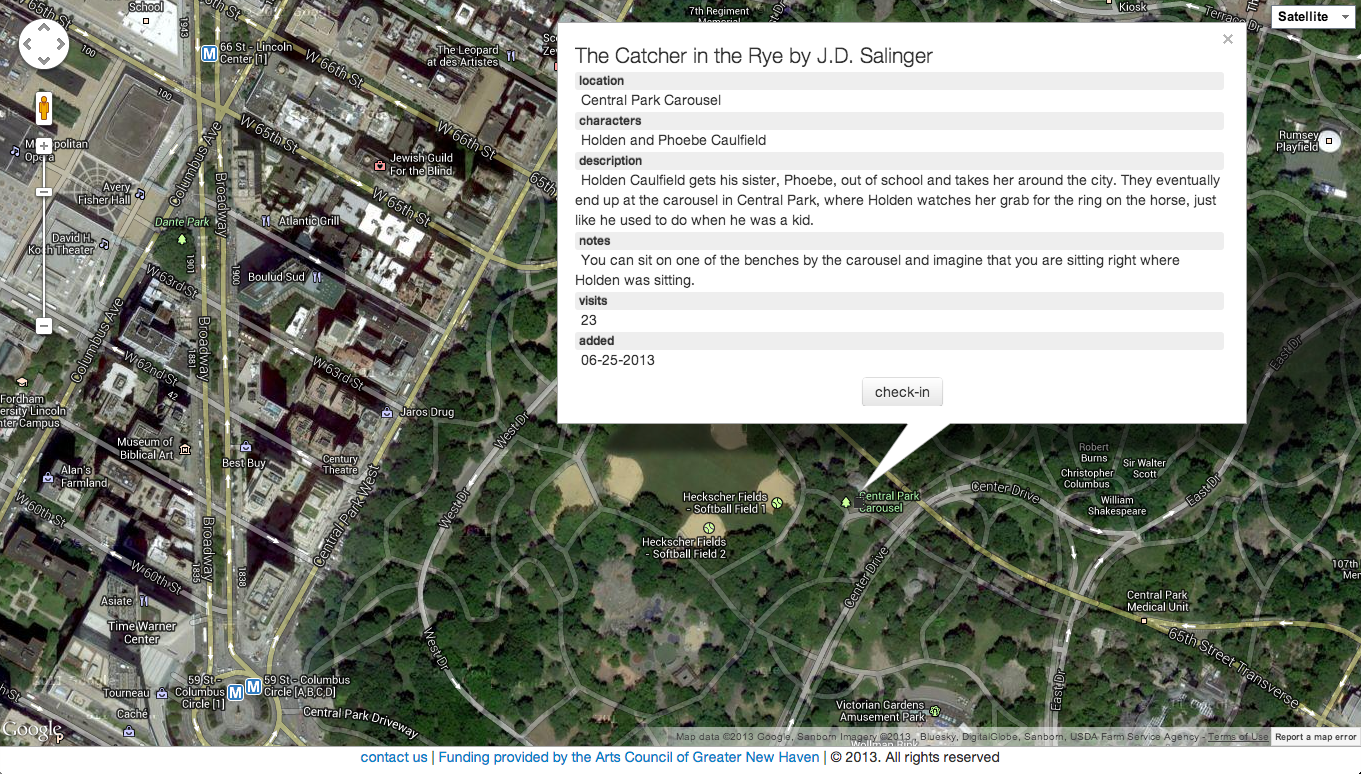
dish_catchermap

Placing Literature is a new interactive website that lets users map the whereabouts of scenes from fiction. Amanda Kooser explains the appeal:

One of the first things I did when I visited London a few years ago was to go on a Sherlock Holmes walking tour. I’m not the only avid reader compelled to seek out the real-life settings found in books. This desire is what has brought about Placing Literature, an interactive site dedicated to plotting scenes from books onto real-world maps. It’s like a heady mixture of a database, Google Maps, and the efforts of a bunch of literature geeks. Placing Literature started with a conversation between co-founders Andrew Bardin Williams (an author) and his sister-in-law Kathleen Colin Williams (a geographer). “I use a lot of real-world locations in my novels. We decided there was this great intersection between geography and literature that hadn’t been explored before,” says Andrew Bardin Williams. …

Crowdsourcing is key to the project. “The goal is to gather as much data as we possibly can, get people to share it, and get people to start exploring their neighborhoods and their communities,” says Williams. “We’re ready to turn it over to the community now and see what happens with it.”

Previous Dish on literary tourism here.

(Image: Screenshot of The Catcher in the Rye in Central Park on Placing Literature)

(Hat tip: Per Square Mile)

The View From Your Window Contest

Screen Shot 2013-06-28 at 5.54.40 PM

You have until noon on Tuesday to guess it. City and/or state first, then country. Please put the location in the subject heading, along with any description within the email. If no one guesses the exact location, proximity counts.  Be sure to email entries to contest@andrewsullivan.com. Winner gets a free The View From Your Window book. Have at it.

Suicide Is Contagious

“Suicide is an event of human nature, which, whatever may be said and done … in every epoch must be discussed anew,” said Goethe, as quoted in Alexandra Kimball’s thoughtful exploration of media coverage of suicide. She examines the idea that heightened coverage – including social media – correlates with increased suicide rates:

What gets lost in the discussion of suicide coverage is the logic behind contagion—why news of one suicide might cause a domino effect, especially in young people.

On a sunny day in May, I returned to Kids Help Phone to interview my old boss, Alisa Simon, VP of counselling services, and the new director of Program Development, Carolyn Mak. “Young people have specific vulnerabilities,” Simon tells me; contagion jibes with what we know about adolescent psychology and the way young people process stories. Young people tend to identify with prominent cultural narratives, to position themselves in the stories they hear most often. And “developmentally, [young people] don’t necessarily understand what the outcomes of their [actions] might be,” Mak explains. “Do kids understand the finality of death? Do they really get that?”

Think about it, Simon says: you’re young, “you’re struggling with significant challenges, and part of that is feeling like nobody cares, you’re not noticed. [Then], you see that another young person has taken an action that is getting them attention, and the attention you potentially want… Their picture is all over the place, there are thousands of people expressing grief and making admiring comments.” When enough stories about teen suffering end in suicide, she says, death begins to seem like a natural solution. “One of Rae’s pet peeves,” wrote Leah Parsons on a Facebook memorial page for her daughter, Rehtaeh, “was that when someone passed away, suddenly they were liked and people cared.” The risk is that readers will understand suicide as a type of redemption.

But there is another narrative to be told:

Suicide contagion is often called the “Werther effect,” after the rash of suicides that followed the publication of Goethe’s novel [The Sorrows of Young Werther], but there is another phenomenon named after Papageno, a character in Mozart’s The Magic Flute. In the opera’s final act, Papageno is dissuaded from suicide by three spirits who invoke images of the future. Clinicians use the term “Papageno effect” to describe how stories about people who choose against suicide can actually reduce the suicide rate.

[Dr. Jitender] Sareen sends me links to a number of recent studies, the most interesting of which is a 2005 Austrian study that compared how different kinds of suicide narratives link up with suicidal behaviour. Repeated exposure to traditional kinds of media suicide coverage, including stories that focused on suicide epidemiology or expert opinions, were positively associated with suicide. But one type of suicide story was negatively associated with suicide, meaning people who consumed it were less likely to take their lives than people who heard nothing: the “mastery of crisis” narrative, which describes people who think about suicide but, like Papageno, decide against it. Understood thusly, the tendency of young people to identify with dominant narratives can be harnessed for good.

Recent Dish on suicide here and here.

A Poem For Saturday

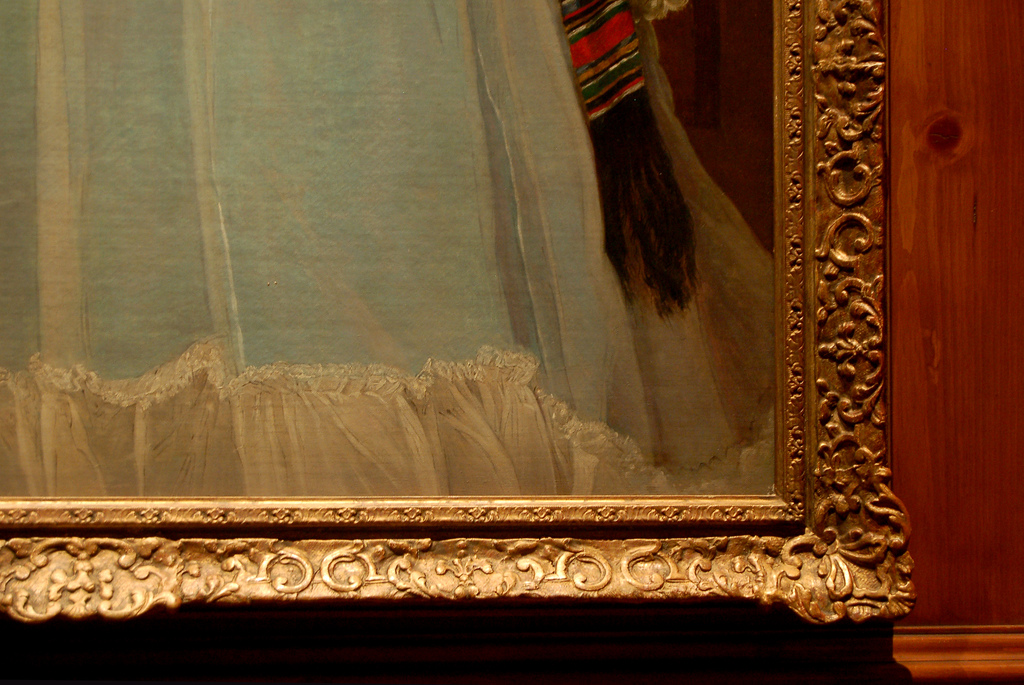
hemdress

“Little Sonnet to Little Friends” by Countee Cullen:

Let not the proud of heart condemn
Me that I mould my ways to hers,
Groping for healing in a hem
No wind of passion ever stirs;
Nor let them sweetly pity me
When I am out of sound and sight;
They waste their time and energy;
No mares encumber me at night.

Always a trifle fond and strange,
And some have said a bit bizarre,
Say, “Here’s the sun,” I would not change
It for my dead and burnt-out-star.
Shine as it will, I have no doubt
Some day the sun, too, may go out.

(From Countee Cullen: Collected Poems, The Library of America, 2013, ed. Major Jackson. Poems © Amistad Research Center, Tulane University. Reprinted by permission. Photo by Brooke Raymond)

Revisiting Jurassic Park

Ari Schulman extols an enduring story:

Although [Michael] Crichton viewed his tale as a general warning that “science is too important to leave to scientists,” as he put it in a 1993 interview, he was particularly worried about the explosive and largely unchecked growth in the biotechnology industry that was already evident by the 1980s. Crichton, like so many since, saw the primary danger of man’s attempted power over nature as one of unintended consequences: the power is always to some extent an illusion. This is the real fear about “playing God” that several of Crichton’s characters articulate, and that the movie powerfully depicts from several angles: there is nature’s intrinsic power; man’s original vulnerability before it; his ability to overcome and harness it; and his ultimate vulnerability again before it.

In one scene, when the visitors are first introduced to the dinosaurs, [paleontologist character Alan] Grant collapses to the ground in shock, and then slowly gazes back up, with an expression, all but perfectly portrayed by Sam Neill, that manages to evoke each of these ideas at once. He is filled with awe and terror at the power he is witnessing — just whose power neither he nor we are quite sure.

But what is all but absent from a movie and a novel that purport to warn us about the excesses of the biotech industry is any sense of the true ultimate aim of that enterprise. The real biotech future will not be defined by genetic engineering of hardier crops and exotic pets, or even animal cloning and de-extinction. It will be, and in many ways already is, defined by bringing these powers to bear not on external nature but our own natures: by genetic enhancement of ourselves, selection of our children to fit our preferences, babies made not just in petri dishes but artificial wombs, children drugged out of normal behaviors in order to be easier to manage in schools, the medicalization and subsequent “treatment” of anything about ourselves and others we see as disadvantageous or simply dislikable.

Previous Dish on Jurassic Park here.

The Underemployment Crisis

Peter Orszag is troubled by new research on college graduates taking low-skilled jobs:

It’s a parent’s nightmare: shelling out big money for college, then seeing the graduate unable to land a job that requires high-level skills. This situation may be growing more common, unfortunately, because the demand for cognitive skills associated with higher education, after rising sharply until 2000, has since been in decline. … This reversal in demand has caused high-skilled workers to accept lower-level jobs, pushing lower-skilled people even further down the occupational ladder or out of work altogether.

He considers the drivers of the change in demand:

One possibility, as I’ve previously written, is that the effects of a globalizing workforce are creeping up the income scale. Many jobs that once required cognitive skill can be automated. Anything that can be digitized can be done either by computer or by workers abroad. While the “winner take all” phenomenon may still mean extremely high returns for workers at the very top, that may be relevant for a shrinking share of college graduates. Whatever the explanation, the Beaudry team argues that an excess of skilled workers has led them into the “routine” job market — such as sales and clerical jobs — reducing wages there and pushing less skilled workers into “manual” jobs in construction, farming and so on. …

The cold comfort I can offer is this: Going to college may still be worthwhile — if not to be sure of qualifying for skilled jobs, then at least to avoid the even worse prospects of those who don’t get a degree.

Yglesias distinguishes between a college education and skills that prove useful in the workforce:

[I]f there’s more and more automation, more and more job opportunities will end up having that quality where it’s not that you couldn’t be replaced by a machine (because soon everything will be in the category “can be replaced by a machine”) but because sometimes people just strongly prefer to interact with an authentic human being.

At that point your wage is going to be determined primarily by your customer service skills. Are you pleasant to deal with? When people think to themselves that they’d rather interact with a human being, they typically don’t have a grumpy and dyspeptic human being in mind—they’re thinking of a nice, cheerful, helpful human being. And obviously this is a real skill. We’ve all had really good customer service experiences in our lives and also had really bad ones. But I’m not sure this is a skill that’s well-acquired by getting a high SAT score and then hanging out with other people who had high SAT scores for four years while listening to lectures from very distinguished academic researchers.

Cruel And Unusual Nourishment

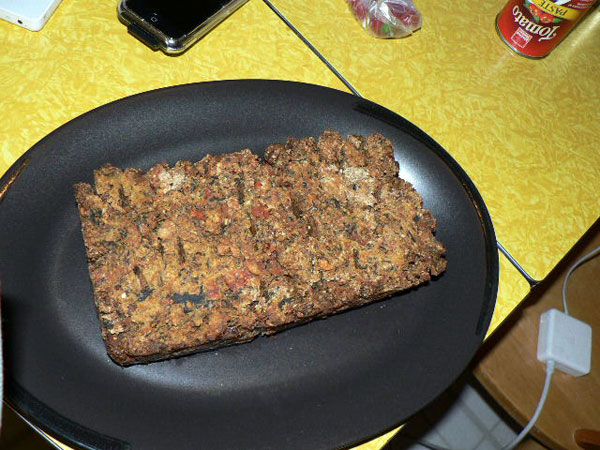
080619_JUR_nutraloaf2EX

Jesse Smith visits Philadelphia’s Eastern State Penitentiary to investigate Food-Loaf, or nutraloaf, a common prison food:

The idea is to create a food product that fulfills an inmate’s caloric and nutritional needs but does not require utensils. The goal is not to create a food product that tastes good. In fact, prisoners around the country have filed multiple lawsuits claiming nutraloaf violates their eighth amendment protection against cruel and unusual punishment.

But fight the nutraloaf and the nutraloaf wins … usually. Earlier this year, the Milwaukee Journal Sentinel reported on an inmate who sued Milwaukee County, claiming that rancid nutraloaf made him violently ill. Food service giant Aramark, who supplied the nutraloaf, settled out of court. … Pennsylvania is careful to avoid the suggestion that it punishes with its seasoning-free Food-Loaf. “Food shall not be used as a disciplinary measure,” according to the commonwealth’s Department of Corrections policy statement on food service (PDF). … Serving an inmate Food-Loaf … requires the written approval of the facility manager, who must first consult with the Corrections Health Care Administrator (CHCA). And the prison can serve an inmate Food-Loaf for only 21 consecutive days. If the inmate continues to demonstrate the same behavior that got him (or her, though in Pennsylvania and around the nation, usually him) on Food-Loaf in the first place, a seven-day extension can be granted. If he persists, the CHCA conducts a Mental Health Assessment. Still, it’s difficult to see how withholding salt is anything but punitive.

(Photo via Maggie Koerth-Baker)