Arming The Rebels Isn’t Realist. It’s Surrealist.

Noah Millman attempts to make sense of Drezner’s view that Obama’s wading into Syria is a realist calculus:

Longstanding conflicts don’t weaken extremist groups, they add to their resources – even as they drain the overall resources of the society. A prolonged civil war will certainly weaken Syria, but I don’t see how it will materially weaken Hezbollah in Lebanon. And I’d be curious to see numbers on just how much of a drain the Syrian conflict is on Iran, even in monetary terms. Most importantly, what about the radicalizing effect of a prolonged civil war on Sunnis in Iraq, Saudi Arabia, Yemen, Egypt, etc? I was under the impression that preventing that radicalization was a really big foreign policy objective. And last, there’s Daniel Larison’s point that if the goal is to prolong the civil war, it’s counter-productive to put American credibility on the line by publicly choosing sides. It would be far more sensible for us to covertly support the rebels while publicly advocating a peaceful resolution of the conflict. Drezner’s argument feels like an attempt to impose coherence on a policy that is driven by other factors.

I cannot see any sane realism here – just improvised weakness. Obama’s foreign policy seems, at this point, to be going in two directions at once. It both seeks to create the change we wanted – away from neo-imperialism and entanglement in places where our core national interests are not at stake – and yet simultaneously clings to Clinton-Bush remnants, i.e. obsessive paranoia about Iran, and impulsive humanitarian interventions like Libya. It feels like a transitional administration rather than one that has the courage of its own post-imperial convictions. Larison contends that the Ben Rhodes’ defense of the move is simply delusional:

According to the extremely broad definition, the U.S. has an interest in inflicting damage on Iran and its allies as part of a competition for influence in the region, and to that end the U.S. is supposed to aid anti-Iranian forces wherever they might be found. It treats Iran as if it were a major threat whose influence has to be rolled back. There is some internal coherence to this view, but its core assumptions are delusional. They are based on an obsession with limiting Iranian influence that doesn’t actually seem to promote U.S. or regional security, and as I believe we’re seeing in Syria this obsession is contributing to making the U.S. and the region less stable and secure. That is what many Syria hawks think the U.S. can and should be doing, and to the extent that the administration agrees with their underlying assumptions that is what explains Obama’s very bad decision.

Fred Kaplan isn’t worried about a slippery slope into war but remains skeptical of any realist interpretation of the move:

There is no notion here of a rebel victory; nor is Obama doing anything to suggest that this is his goal. A successful outcome, Rhodes said, would be a “political settlement”—preferably forged and imposed by the United States and Russia together—that pushes Assad out of power but “preserves some elements of the regime” while also bringing in “the opposition, who we believe speaks for the majority of the country.” This is, to say the least, far-fetched. Russia regards Assad as an ally, his regime as a bulwark of Russian geostrategic interests, and any opening to the opposition as a source of dangerous instability. In fact, regardless of one’s viewpoint or nationality, it is hard to imagine a “political settlement” that shares power between Assad’s henchmen and the various rebel factions as anything but a formula for continued murder and mayhem.


More Dish on intervention in Syria here, here, and here.

HIV Treatment As HIV Protection, Ctd

statistics_incidence_graph_550x345

A reader writes:

I read your piece on providing antiretrovirals to at-risk groups and was struck by the exclusion of a significantly large group who literally share your pain: African Americans, especially African-American women. There’s a legitimate argument that sexually active African-American women should be prescribed antiretros by their physicians too. New infection estimates for 2010 by the CDC put that group in about the same position as Hispanic men who engage in sex with other men [see above]. The infection rate for black women is 20 times that of white women. African-Americans are 14% of the US population and make up 44% of all current people living with HIV and 44% of all new infections (pdf). As with other social, medical, and economic ills, African-Americans are being hit the hardest.

My reader is right. I didn’t mean to exclude African-American women, for whom this could be a godsend. Another looks abroad:

The study demonstrating prophylactic effects of HIV medications is unquestionable good news, but your response was a bit off-putting. It’s very true that “AIDS and HIV are no longer terrifying for young gay men”, and that’s fantastic, but about 68% of all HIV cases are in Sub-Saharan Africa (pdf). Prevalence in adults is as high as 30% in places like Swaziland and Botswana – is everyone a gay man there? I thought relegating HIV as a “gay” disease was a thing of the past.

I was discussing the US and, as the graph above shows, gay men are still the likeliest group to get infected. But yes, prophylaxis in those countries could be part of a multi-pronged HIV prevention campaign. Just because you address one sub-group doesn’t mean you are actively excluding any other.

Even Fetuses Have A Wank?

That’s the stunning news from the latest Republican lunatic, Michael Burgess. He’s from Texas and he’s looked at male fetuses and is suspicious of what he sees:

“Watch a sonogram of a 15-week baby, and they have movements that are purposeful. They stroke their face. If they’re a male baby, they may have their hand between their legs. If they feel pleasure, why is it so hard to believe that they could feel pain?”

Even better, he’s a former OB/GYN. What strikes me as a Catholic is how this finding affects natural law. How can masturbation be unnatural if even fetuses do it – or try to? But I digress …

Sentenced To Unemployment

Alec McGillis encourages conservatives to fight against discrimination based on criminal records:

If conservatives are serious about prison reform–and the actual progress being made in states such as Texas suggests they are–then it’s not a stretch to see how they could also get behind efforts to rein in criminal background checks in hiring. Again, there are both fiscal and philosophical arguments for doing so. Ex-prisoners who find jobs are far more likely not to commit additional crimes and wind up back behind bars on the taxpayer dime. And a belief in personal redemption would seem to be in conflict with policies that, without any room for assessing individual character and circumstance, hold actions from years past against people who are trying to find a livelihood on the straight and narrow.

Geeks vs Nerds

Is there a difference?  Blogger burrsettles believes the terms “are related, but capture different dimensions of an intense dedication to a subject”:

geek – An enthusiast of a particular topic or field. Geeks are “collection” oriented, gathering facts and mementos related to their subject of interest. They are obsessed with the newest, coolest, trendiest things that their subject has to offer.

nerd – A studious intellectual, although again of a particular topic or field. Nerds are “achievement” oriented, and focus their efforts on acquiring knowledge and skill over trivia and memorabilia.

After running some statistical analysis based on Twitter data, he reaches a conclusion about the language each group tends to use:

In broad strokes, it seems to me that geeky words are more about stuff (e.g., “#stuff”), while nerdy words are more about ideas (e.g., “hypothesis”). Geeks are fans, and fans collect stuff; nerds are practitioners, and practitioners play with ideas.

(Hat tip: Ed Yong)

What’s A Bisexual Anyway? Ctd

Add your two cents to our anonymous poll:

This embed is invalid

Many more readers are sounding off:

I think bisexuals are not out as much as gay people because we can pass. Somewhere in this NPR segment is some data that most bisexuals eventually marry a person of the opposite gender. Like the previous reader said, my sexual experiences with women are not exactly fodder for Christmas dinner family discussion, and as I’ve not had a relationship with another woman, there’s not much to say. My husband knows I also like women, but I’m not technically out to my family.

Another:

I expect someone’s already pointed you at Lisa Diamond’s longitudinal study, Sexual Fluidity: Understanding Women’s Love and Desire, but I thought I’d note it just in case, as this book and the concept of remaining “unlabeled” was very meaningful to me.

Another quotes the original reader:

I don’t tell anyone because whom I fuck and how is my own business and nobody else’s. I don’t need support. I don’t want to be part of a sexual community. I just want to do what I want to do and not get any shit about it, which is 100% possible if I just keep it to myself.

That’s what all the closeted guys say. At least the kid in Arkansas terrified of his father has a good reason. The reader admits he identifies as straight because it’s more convenient. Those of us who are mostly or exclusively homosexual don’t have that luxury, which is why we come out. And coming out is the moral thing to do because it might help that kid in Arkansas knows he’s not a freak.

That reader sounds like one of the reasons a lot of gay guys don’t date bisexual guys. Many of them don’t want to publicly acknowledge their relationships, since they prefer the privileges that come with heterosexual relationships and heterosexual identity. By the way, does he keep it to himself to the exclusion of the women he dates and might eventually marry?

Another is far less resentful of that reader:

Thanks to your bisexual reader for reminding me that sometimes what is important to you may be virtually meaningless to someone else, a lesson which should be accepted with good grace. I’m a bisexual woman, but unlike your reader, my bisexuality is integral to my identity. Perhaps my family’s rejection of my sexual identity has something to do with this (I come from a very religious background, although I’ve since given up the faith). I’ve also been in serious relationships with both men and women, and while whom I fuck may not be anyone’s business, it is relevant if someone wants to get to know me.

I think what it comes down to is whether you view sexuality as self-defined (in which case your reader wouldn’t be bisexual) or based on sexual behaviour (which would mean your reader is actually in the closet, regardless of what he claims). But however you look at it, this issue creates a tension between bisexuals like me, who are tired of being lumped together (by both straight and queer folks) with people like your reader, with all the stereotypes that entails, and bisexuals like your reader who don’t want to be judged as disingenuous for occasionally straying outside the rigid sexual boundaries set by society.

Another bisexual woman tells her story:

I grew up in a very liberal household. My mother took pride in being one of the few white students in college in Louisiana who befriended the black students when they were admitted to the school. We were a household that welcomed “everybody.” So when I was raised to understand that “bisexuals don’t exist,” I believed it. I believed they were closeted gay people, just like my parents told me.

I was always attracted to men, but later in high school and in my early college years, I started having sex dreams about women occasionally. I talked to one of my boyfriends about this and he once asked me if I was bi. I became unnecessarily defensive. In my mind, of course I wasn’t bi. I just thought Eliza Dushku (Faith from Buffy) was very attractive.

In my late teenage years, I came to accept that bisexuals existed, but distanced myself from that label for early adulthood. I would occasionally kiss or fool around with a female friend when I had been drinking, but often felt like I needed to be a certain level of drunk for this to be acceptable, or excusable, behavior.

It wasn’t until last year, when I was talking to one of my best friends who is gay about his coming out experience that my parents’ words echoed through my head “bi people don’t exist.” At that moment, I finally realized I was, in fact, bisexual. I proceeded to awkwardly tell my husband and a few of my closest friends, but only a few people.

I still feel incredibly awkward about it, and will feel the hesitation when I use the word “bisexual” to identify myself. At the same rate, I’m frustrated that I only figured this out in my late 20s, and I believe I missed out by not having the opportunity to date women, since I’m now happily married.

I try to be vocal about my sexuality, in hopes that by me talking about bisexuals existing I might somehow help other younger versions of myself come to terms with their sexuality. I don’t like considering it a “coming out” process, because the situation is so different than what I know my gay friends have experienced, but it’s important for me to embrace it and be vocal about it.

I do agree with your reader that sexuality is a fluid thing, and most people I’ve told about my sexuality have said something along the same lines. However, I still fear the stigmas. How will people react when I tell them I’m bi? I’m a married woman who has only dated men. People will question me and doubt me and think I’m just trying to get attention. But it’s an important part of my identity, and so I try to talk about it, which is part of why I am sharing my story with you.

Another reader:

I’m fascinated (in a vaguely horrified way) at your reader who commented: “I have always believed, and almost all of my female friends agree, that women are, by their very nature, “bisexual” (unless they are gay), and that it is the rare woman who is 100% heterosexual.” Really? The “rare woman”? I guess I am one of those “rare women”.

I have had many sexual relationships and many friendships with other females. I have been involved in polygamous relationships (the hinge point of a V, or perhaps a multi-directional W, depending on how you look at it. And I am solidly hetero.

I love my women friends. As friends. As sisters. As who they are. I have even loved the partners of my sexual partners, albeit not in a sexual way. But I have no interest or desire in having sex with another woman. It is not a turn on for me, it is not a sexual attractant for me, and I have chosen to NOT be part of poly relationships where there was a need/want for bisexuality.

I believe that your reader is engaging in the Unicorn Belief System, a system whereby straight men believe that all women are bisexual and want nothing more than to get it on with both men and women for the pleasure of the man involved.

There are woman such as myself who has had an encounter with another woman and found it physically pleasurable and enjoyable for what it was, but recognizes that it’s not what they want/need going forward. That doesn’t make me “bi” any more than a gay man who sleeps with a woman to try to figure out his sexuality and has an orgasm while doing so is “straight”. That makes me a person who was exploring my sexuality before settling into what I found out I wanted and needed.

Do We Always Need Scientific Proof?

Last week, advocacy groups Friends of the Earth and GM Freeze released a study that claims to have detected traces of weedkillers in the urine of volunteers throughout Europe. Kara Moses considers the role that such “non-scientific” studies should play in the policy process:

The study was basic, the sample size was small, the report was unpublished. But could it point to an important issue for further investigation? Academics denounced the findings as “not scientific”, saying the results could not be taken seriously and that campaign groups should submit their work to peer-reviewed journals to provide a “genuine contribution to the debate”. Other scientists refused to comment on the study, saying that without it having gone through the review process there was simply no way of commenting on the findings. …

But charities and NGOs often don’t have the resources or expertise to undertake full scientific studies and publish them in journals. Is it even their role to do so? By producing snapshot studies that simply point to an issue, as long they don’t make any grand claims based on their findings, aren’t they simply doing their job of raising awareness of issues that affect society and the environment?

Chris Tackett agrees, distinguishing between the scientific and commercial realms:

It is important for science to maintain standards when it comes to experiment design and statistically significant sample size. But consumers, whether individuals or municipalities, shouldn’t feel the need to wait till there is overwhelming scientific consensus to decide that spraying toxic chemicals all over their lawns or town or crops is not the best idea. Similarly, we didn’t need to wait till there was overwhelming scientific proof to take action on climate change, yet here we are.

The point here is that scientific proof matters in science, but it shouldn’t necessarily be what determines our actions. We can intuit that some things are unwise or dangerous or against our values without needing reams of scientific data to back up our concerns.

Mark Hoofnagle, discussing a study that claimed a link between GMOs and cancer, worries that such thinking leaves environmental groups open to comparisons to climate skeptics:

In his promotion of the underwhelming evidence presented recently against GMO [genetically modified organism] corn and soy, Tom Laskawy wrote against the “GMO-lovers” (uggh it’s just like Warmist) “freaking out” over these results. Umm, no. Freaking out would suggest that a study had been performed that created enough evidence that the extensive literature on safety has in any way been put in doubt. This is not the case. … The study in no way suggests that GM might be harmful to us, because the study doesn’t suggest anything at all. The study authors might make that suggestion, but the results of the study are just as likely to be due to chance as from any effect of GM food. …

That won’t stop us all from being called a “shill” in every comment thread in which we express skepticism of the often outrageous, science-fiction claims of anti-GM advocates like Jeffrey Smith. So what’s this ideology that binds us all together on the ludicrous nature arguments made against GMO, other than a hatred of bullshit? So Laskaway is partially correct, on one side we have groups with a specific and obvious bias with a high probability of ideology clouding their reason on science. On the other side we have the AAASthe European Commissionthe Royal Society, the National Academy of Science Institute of Medicine, and a diverse group of skeptic and science writers from Richard Dawkins to PZ Myers to Dave Gorski and Steve Novella. Feel free any time to take these two weak papers that show nothing, wave them under our nose and call us the ideologues.

What The Hell Is Happening In Brazil?

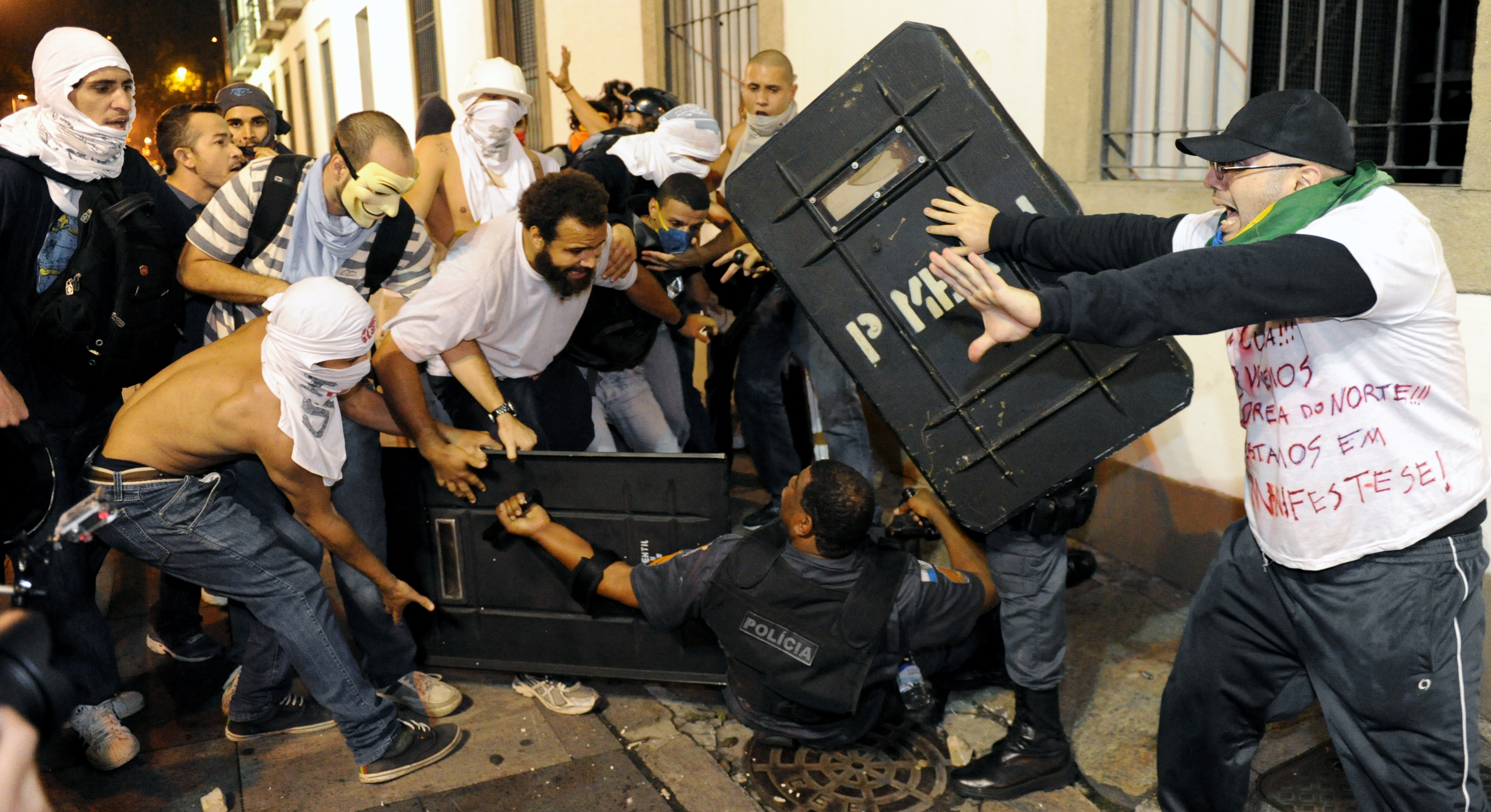
FBL-WC2014-CONFED-PROTEST

On-the-ground readers report:

Why nary a mention of the anti-government protests going on in Brazil? Tens of thousands of people are demonstrating in cities throughout the world’s sixth largest economy – certainly big news and something of this scale not seen in South America since the ’80s. Granted it’s not the Middle East. However, it’s a significant event worthy of some coverage/analysis on the Dish, IMO.

The IMO is admittedly biased. I just returned from marching with protestors along Av. Faria Lima in São Paulo. Things were quite peaceful, one could even say festive, as clowns trounced about, a man on stilts danced around (dusted them off before Carnaval it seems), and groups of drummers played classic samba rhythms. Much of this is simply indicative of Brazilian culture – the whole enjoying life and trying to have a good time part of it.

Nonetheless, the general message of the protests was not festive: “We deserve better from our government.”

I saw all sorts of signs and placards admonishing a corrupt government that heavily taxes its people with little to show in terms of public services (education and healthcare in particular). I believe your last post about Brazil was this in January – “Boom Times For Brazil”. There are two sides to every coin, so Dish readers should know that boom times don’t necessarily mean good times for the citizenry of a country that suffers from tragic and wholly resolvable social inequality. It will be interesting to see if the momentum of these protests continues.

On the cab ride home, the driver told me that he doesn’t think anything will be done by the PT party in response to this. Brazil’s President, Dilma Rousseff, was quoted simply saying, “It is natural for young people to demonstrate.” Whether this response throws more fuel on the fire is yet to be seen. Also, there were more than just young people in the crowd tonight.

Another gets more specific:

Things here in São Paulo are getting contentious and it looks as if it could be Taksim all over again. About two weeks ago, some small protests started on Paulista Ave in downtown São Paulo over a $0.10 increase in the bus fares. Of course, the protest was about more than a hike in fare though; it was about the horrible state of Brazil’s infrastructure, government corruption, high inflation and low growth – basically everything that’s dysfunctional about this place.

Predictably the police didn’t handle things well, so more people came out, fueling more protests. Last Friday police began firing on protestors and beating journalists – it looks like the government has finally woken the slumbering beast here. 230,000+ people are said to have headed out to the streets of São Paulo, with large protests in Rio and other major cities as well. Brazilians are apparently even going to protest in front of their embassies as far as away as Dublin and Berlin.

For videos and documentation of some of the violence from Friday, you’ll have to Google Translate this (check out number 9). Here is a good explanation of what the real issues are (like Taksim wasn’t about just a park, this isn’t just about bus fares). A Facebook event page for protests is here. And here is a list of 33 foreign cities Brazilians will also be protesting in.

Also worth noting is that the FIFA Confederate Cup is starting this week, which is basically like a trial run for next year’s World Cup. Brazil’s infrastructure is failing spectacularly there, with some people waiting up to six hours just to leave the airport. So this is basically the worst timing possible for the government, as the world’s attention is about to be on the country anyway.

I’ll be going down to the protest today. I can continue passing along info as I find it.

That reader follows up:

This video shows some of the protests over the weekend in Rio. The reporters in the video are trying to blame the violence on the protesters and are writing them off as just angry youth with nothing better to do – while the video shows police beating people and shooting tear gas at them. The reporters also are lamenting that this is happening during the Confederate’s Cup, as it’s going to embarrass the country on the international level. It was a HUGE deal for Brazil to land the World Cup and Olympics because it meant tons of money was going to be pumped into the country to build infrastructure. Well, the money came and the infrastructure didn’t. So now you have tens, if not hundreds, of thousands of pissed off people on the streets.

Another passes along this video as a good summary of the protestors’ grievances.

(Photo: Demonstrators clash with riot police during a protest in front of Rio de Janeiro’s Legislative Assembly (ALERJ) building in Rio de Janeiro, on June 17, 2013. Tens of thousands of people took to the streets of major Brazilian cities protesting the billions of dollars spent on the Confederations Cup – and preparations for the upcoming World Cup –  and against the hike in mass transit fares. By Tasso Marcelo/AFP/Getty Images)

Cut Beauty Queens Some Slack

Linda Holmes offers a measured defense of “Miss Utah” Marissa Powell, who fumbled a question about income inequality during the Miss USA Pageant:

These dumb questions aren’t intended to actually see whether you’re smart or not. Miss Utah USA might be smart and she might not be, but the last thing I’d use to guess at whether she’s smart is whether she can answer this kind of question “correctly.” Because “correctly” here just means smoothly, expertly, without hesitation or stammering. Had she said, “What it says is that we live in the greatest country in the world, and every day I get up and thank my lucky stars that I live in the United States of America,” she would not be in the news, despite having given just as irrelevant a non-answer. Had she said, “What it says is that family is the most important thing in the world, and we need to figure out how to help all families be happy families because it’s the most important thing in the world,” she would not be in the news. … She’s not a dumb person; she’s bad at public speaking. And if she were good at it, nobody would have ever heard of her.

PZ Myers agrees. Laura Bennett laments that “pageant shaming has become a part of our viral culture”:

[P]ageants theoretically used to be at least partly about female empowerment, even if that took the form of duking it out for the most canned, family-friendly commentary on world affairs and the most sculpted glutes. But now that the interview has become a public shaming ritual, it makes the whole ordeal of the pageant seem like a sadder spectacle. I doubt many people know who won Miss Teen USA in 2007, but far more remember Miss South Carolina and her geographical nonsequiturs. If the old pageant stereotype was the cutthroat behind-the-scenes catfighting of Drop Dead Gorgeous or the frivolous girliness of Miss Congeniality, now it’s the thousand-yard stare of a contestant realizing that her failure of poise is about to hit YouTube.

Marcotte’s view:

[T]he real problem here is that the question-and-answer period at beauty pageants is set up so the contestants really can’t win. As ever, pageant contestants know they have to project an image of bland inoffensiveness, which precludes having political opinions beyond a moderate support for sunshine and, in this case, education.