The Syrian Christians

53026747

Dreher counters my post chiding Rand Paul for bringing religion into the debate over Syria, arguing that “Paul makes a tremendously important point that is rarely heard in mainstream American political discourse”:

Middle East Christian communities are anonymous in American political life. We never pay attention to them. American Jews understandably focus their concerns about the Middle East on the welfare of Israel. I don’t blame them. I don’t blame American Muslims either for prioritizing the interests of Islamic countries when it comes to US foreign policy. …

As evil as Bashar Assad is, his regime has been a defender of Syrian Christians. If Assad falls, it will likely be a bloodbath for the country’s Christians, at the hands of Islamists. Even so, I don’t advocate intervening in Syria on behalf of the Christians. We cannot and should not fight every fight. That said, it is important for American Christians to understand what’s at stake in this fight. Sen. Paul was speaking to a Christian audience. It is perfectly legitimate, even necessary, for him to point out to that audience that by taking the side of the Islamist rebels, the US would be aligning itself against the interests of the country’s Christians, who have been a constant presence in Syria since the very beginning of the Christian faith. The baptism of St. Paul, one of the most consequential events in world history, happened in Damascus, on the street called “Straight,” which is still there.

And that war against Christians is being waged by a “liberal elite”? Please. This is a genuine issue – but if you believe Rand Paul wasn’t blatantly pandering, you need your rose-colored glasses adjusted a little.

(Photo: Brother Putros, a Syrian monk, swings incense durring mass in the church of the Monastery of St. Moses the Abyssinian east of Nebek, Syria on May 19, 2005. The 11th century Syrian monastery of St. Moses the Abyssinian (Deir Mar Musa el-Habashi) overlooks a harsh valley in the mountains east of the small town of Nebek, 80 km north of Damascus. The ancient monastery was restored in 1983 by an Italian Catholic priest Paolo Dall-Oelio, who in 1991 established a new monastic community devoted to, amongst other things, to Moslem-Christian dialogue. More than 50 000 people from their different religions and different countries visit the monastery every year. By Ghaith Abdul-Ahad/Getty Images)
“An Old Wound Which Must Be Healed” Ctd

Navid Hassanpour believes that Rouhani is willing to cut a deal on Iran’s nuclear program:

Rouhani is no stranger to negotiating with the U.S. and Europe. He is said to have been a member of the Iranian negotiating team during the Iran-Contra affair, and was the Iranian chief nuclear negotiator under Khatami as the secretary of the Iranian Supreme National Security Council. He is also the head of Center for Strategic Research, a policy research organization close to Rafsanjani. Three out of the final six presidential candidates this year have extensive experience—with mixed results—in international negotiations. This is a signal on where the Islamic Republic’s priorities lie at moment. During the past two weeks, Rouhani repeatedly mentioned he prefers to talk to the Europeans’ chief [sic] instead of wasting time squabbling with Europeans themselves. These words, as a window to Rouhani’s understanding of the World, can also be indicative of the nature of his foreign diplomacy in the next four years.

Paul Pillar is adamant that the West take advantage of this opportunity for a reset:

Rouhani’s election presents the United States and its partners with a test—of our intentions and seriousness about reaching an agreement. Failure of the test will confirm suspicions in Tehran that we do not want a deal and instead are stringing along negotiations while waiting for the sanctions to wreak more damage. Passage of the test will require placing on the table a proposal that, in return for the desired restrictions on Iran’s nuclear activities, incorporates significant relief from economic sanctions and at least tacit acceptance of a continued peaceful Iranian nuclear program, to include low-level enrichment of uranium. … Passage of the test also means not making any proposal an ultimatum that is coupled with threats of military force, which only feed Iranian suspicions that for the West the negotiations are a box-checking prelude to war and regime change.

Jonathan Steele agrees, and suggests Syria be the first topic of conversation:

[T]he first thing Obama should do is to drop US objections to letting Iran attend the proposed Geneva conference on Syria. If Washington is ready to negotiate with Iran on nuclear issues, it makes no sense to exclude it from the talks on Syria. The second thing is to accelerate preparations for the conference itself by putting sustained pressure on Syria’s rebel forces to come up with a negotiating strategy and take part. For Washington to change course here would send an important signal, not only that Iran has to be part of any solution in Syria and the region, but also that the anti-Iranian cancer that has affected American policy in the Middle East since the axis-of-evil speech has at last been excised.

Vali Nasr makes a case for new outreach and meaningful concessions:

To take advantage of Rowhani’s victory and break the logjam over nuclear negotiations, Washington has to put on the table incentives it has thus far been unwilling to contemplate. It will have to offer Iran sanctions relief in exchange for agreeing to Western demands. At a minimum, the United States would like Iran to accept IAEA demands for intrusive inspection of its nuclear facilities; cap its uranium enrichment at 5 percent, and ship out of the country its stockpile of uranium enriched to 20 percent. Iran in turn wants a formal recognition of its right to enrich uranium and, more immediately, the lifting of crippling sanctions on its financial institutions and oil exports. Ahmadinejad is faulted in Iran for wrecking the country’s economy. Populism, mismanagement, and international isolation have combined to put Iran’s economy into a downward spiral. Between 2009 and 2013, real GDP growth has fallen from 4 percent to 0.4 percent, unemployment has risen to 17 percent, and inflation has grown to 22 percent — and those are official numbers, which tend to downplay the gravity of the economic crisis. It is estimated that 40 percent of Iranians live below the poverty line. Reformists will grow in strength if they are able to show that they can reverse that trend by at least getting the West for the first time to offer negotiating away specific sanctions.

Jack Straw, who has sat across the negotiating table from Rouhani before, offers his take on the new Iranian president:

There are … two dangers. The first is to assume that nothing has changed – that Rowhani is merely a better-dressed Ahmadinejad. This is the essence of the belligerent comments from Benjamin Netanyahu, the Israeli prime minister, in the wake of Rowhani’s victory. They are unthinking and self-defeating.

The second danger is to assume that everything has changed, and to expect too much too quickly from Rowhani. Our Government should seek to re-open full diplomatic relations with Iran, but he won’t take office until early August. He has to choose a cabinet – and have his ministers endorsed by the parliament (far from a formality). He has to negotiate with the leader, and the powerful Revolutionary Guards, before he can negotiate with the West. While it will be a huge relief to do business with him, he is a Shia and an Iranian, and intensely proud of being both. But show him and his nation patience, respect and understanding, and there’s a possibility that the 10 years of “E3+3” meetings which started in south Tehran in 2003 might, just, have a happy ending.

You Are What You’re Named

Adam Alter offers an example of what he calls the “linguistic Heisenberg principle,” whereby naming something changes our perception of it:

People generally prefer not to think more than necessary, and they tend to prefer objects, people, products, and words that are simple to pronounce and understand. In 2006, my colleague Daniel Oppenheimer and I investigated the performance of hundreds of stocks immediately after they were listed on the financial markets between 1990 and 2004. We discovered that companies with simpler names that were easier to pronounce received a greater post-release bump than did companies with complex names. (I also wrote about this phenomenon for the New York Post.)

The effect was strongest during the first few days of trading, when investors had little information about the stock’s fundamentals and were more likely to be swayed by extraneous factors. (We also ran a series of additional analyses to rule out the possibility that the effect was driven by different naming trends across different industries, company sizes, or countries, and the possibility that successful stocks seem to have fluent names merely because they’re mentioned more often in the media.) Even stocks with pronounceable ticker codes (e.g., KAR)—the letter strings that investors use to refer to each stock—outperformed those with unpronounceable ticker codes (e.g., RDO) in the short run. An investor who placed a thousand dollars in the ten most fluently named stocks between 1990 and 2004 would have earned a fifteen-per-cent return after just one day of trading, whereas the same thousand dollars invested in the ten least fluently named stocks would have earned a return of only four percent.

What’s The End Game In Syria?

Hussein Ibish is actively hoping for “mission creep” in Syria in light of America’s new commitment of small arms:

For once, “mission creep” provides the hope of a successful outcome rather than a terrifying threat to a major foreign policy initiative. Typically, American hubris has meant overreaching, and “mission creep” has historically been synonymous with disaster. In this case, a new and uncharacteristic American risk-aversion has been crippling.

Crippling for whom? Not the US. Shadi Hamid figures Obama will have to up the ante soon:

The fact of the matter, and one the administration seems intent on eliding, is that the only way to help the rebels regain the advantage and force the Assad regime to make real concessions is with a credible threat of military intervention through airstrikes against regime assets and the establishment of no-fly and no-drive zones.

We’re told this is not Iraq – because it such a tiny intervention. Okay, then it’s Vietnam, in a country that is as chaotic as Iraq. Meanwhile, a new Pew poll released today shows that 70 percent of Americans are against intervention, though 41 percent of those opposed favor some form of humanitarian action:

The 20% of the public that favors arming anti-government groups in Syria also expresses concerns about the U.S. getting involved. More than half (56%) of those who favor arming rebels agree with the statement that U.S. military forces are too overcommitted to get involved in another conflict, and 55% agree that the opposition groups in Syria may be no better than the current government.

I’ve heard the ludicrous argument that the Obama surrender to the McCain-Clinton-Saudi position will somehow engineer a negotiated settlement with Assad. If anyone believes that, they need their head examined. The more you look at this, the more you realize that the only possible explanation for this is the president’s core weakness. No strategy; no end-game; and now, not even coherence.

“An Old Wound Which Must Be Healed”

IRAN-VOTE-ROWHANI

That’s what Rouhani said today about the relationship between Iran and the United States. That old wound, one has to remember, really struck deep in 1953, when the CIA ousted Iran’s first democratically elected government, because it nationalized the Anglo-Persian oil company. Even then, Iran’s desire was to control its own energy supply. We know the rest of the story by now, however tone-deaf so many have become to the role of history in determining that country’s psyche and culture.

No, he did not signal a shift toward direct talks with the US, and offered no opening on the nuclear weaponry potential of the theocracy. But it truly was striking how conciliatory he was to the Sunni Saudi regime:

The priority of my government’s foreign policy will be to have excellent relations with all neighboring countries … We are not only neighbors but also brothers. Every year hundreds of thousands of Iranian pilgrims visit Mecca. We have many common points with Saudi Arabia.

And this is surely encouraging:

First, we are ready to increase transparency and clarify our measures within the international framework. Of course our activities are already transparent, but still we increase it. Second, we will increase the trust between Iran and the world.

Yes, I’m well aware that he is not Moussavi or Karoubi – but they also backed the nuclear program (as does the opposition as a whole). And to immediately knock down any hope for some engagement with Iran seems to me to be insulting the perseverance of ordinary Iranians. The fact of US-Iranian governmental distrust and even hatred is, in the face of that country’s great history and youthful energy, a true tragedy. Jon Snow, who was reporting from Tehran over the weekend, offers a succinct portrait of the country as he now sees it, particularly in relation to the Western stereotypes:

[B]eyond the bugs in hotel rooms, the arrests, and strange people taking photographs wherever you go, there is something continuously absorbing and intriguing about Iran that renders the paranoia it provokes entirely unbearable.

The country is spectacular, the people are approachable, friendly and remain westward-looking. Many are highly educated and skilled, and 6,000 years after the country began, they are still building. In short, they are people the west used to and should still do business with.

For all its faults, Iran remains a haven of peace, surrounded by wars in which the West is deeply involved, and set to become more so after Barack Obama announced his intention last week to arm the Syrian rebels. By midnight on Saturday the Chamran highway that leads to the centre of Tehran was sporting a noisy three-car-wide, five-mile queue of families desperate to join the celebrations.

Meanwhile, Golnaz Esfandiari rounds up a collection of recent statements by the newly-elected Rouhani, including, “Using the Internet, I must say, is one of my hobbies regardless of whether I need it.” Along those lines, there are reports that the video-chat services Skype and Oovoo have now been unblocked for the first time in many months, allowing Iranians in and outside of the country to once again speak more freely with each other.

We should have no illusions that Khamenei is still in charge. But in two consecutive elections, the Iranian people have reached out to the world. We can and should find a way to reach back. In my view, that means a pragmatic path toward seeking more and more transparency in return for a very gradual ratcheting down of sanctions. We may have to go one tiny step after another. But the Iranian people deserve a response that is more than cynical. Look at them these past few days or four years’ ago. How can one be cynical in the face of that?

Previous Dish coverage of the Iranian election here.

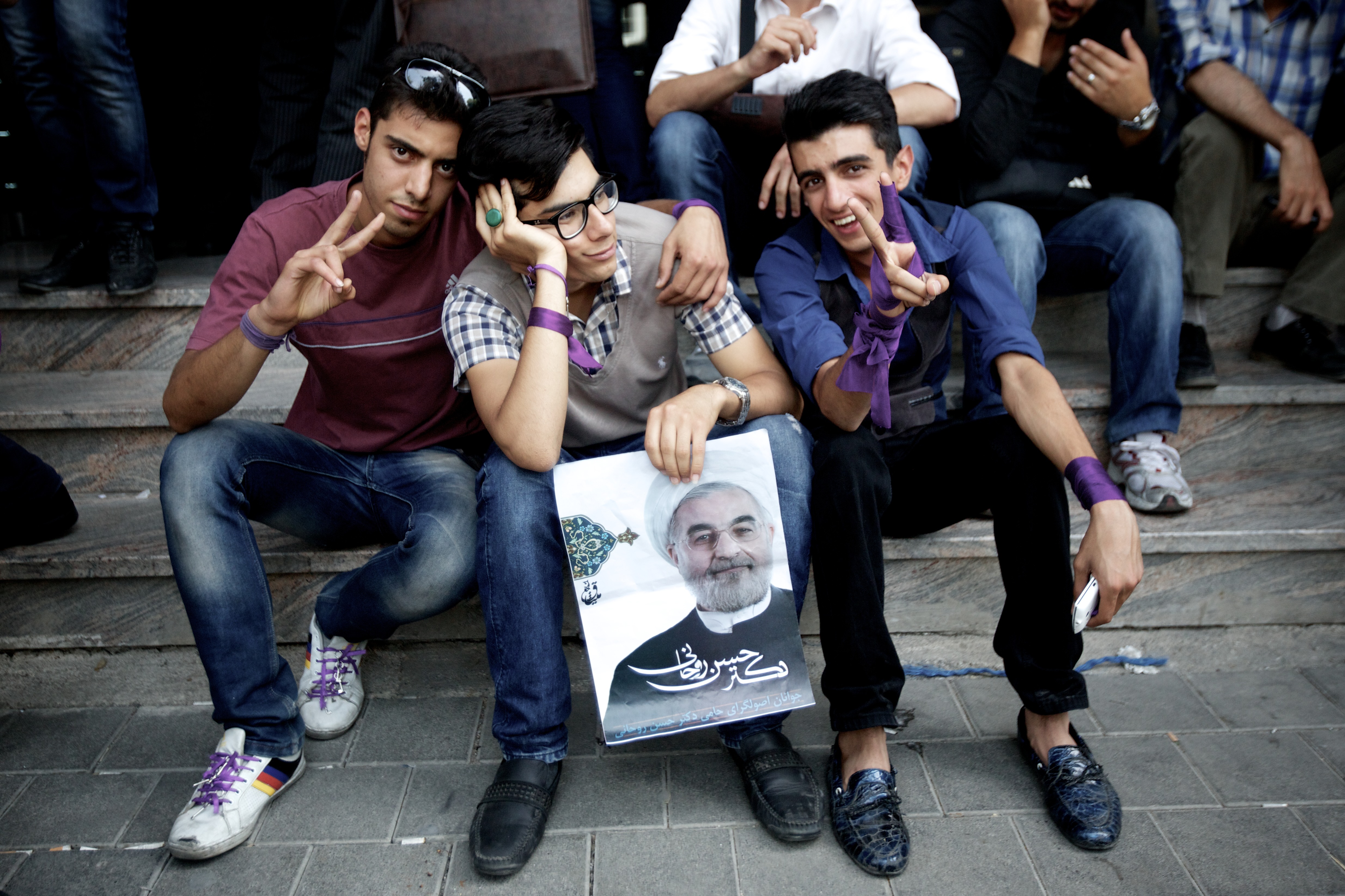
(Photo: Iranians supporters of moderate presidential candidate, Hassan Rowhani flash the sign of victory holding a portrait of him as they wait for the final results outside his campaign headquarter in downtown Tehran on June 15, 2013. By Behrouz Mehri/AFP/Getty Images)

A Criminal Factory

Brad Plumer spots new research suggesting that juvenile detention is counterproductive:

[T]o figure this out, Aizer and Doyle took a look at the juvenile court system in Chicago, Illinois. The researchers found that certain judges in the system were more likely to recommend detention than others — even for similar crimes. That is, it’s possible to identify stricter and more lenient judges. And, since youths were assigned to judges at random, this created a randomized trial of sorts.

What the researchers found was striking.

The kids who ended up incarcerated were 13 percentage points less likely to graduate high school and 22 percentage points more likely to end up back in prison as adults than the kids who went to court but were placed under, say, home monitoring instead. (This was after controlling for family background and so forth.) Juvenile detention appeared to be creating criminals, not stopping them.

The authors lay out a couple of reasons why this would be. Going to prison can obviously disrupt school and make it harder to get a job later on. But also, as other researchers have found, many people who end up behind bars end up making friends with other offenders and building “criminal capital.” Prison turns out to be excellent training for a life of crime.

Another troubling new report looks at sexual abuse in the country’s juvenile detention facilities:

Hundreds of teenagers are raped or sexually assaulted during their stays in the country’s juvenile detention facilities, and many of them are victimized repeatedly, according to a U.S. Department of Justice survey. The teens are most often assaulted by staff members working at the facilities, and fully 20 percent of those victimized by the men and women charged with protecting and counseling them said they had been violated on more than 10 occasions. …

The Justice Department survey—covering both secure juvenile detention facilities and group homes, the less restrictive settings into which troubled youngsters are often ordered—involved more than 8,500 boys and girls. In all, 1,720 of those surveyed reported being sexually assaulted. Allen Beck, the author of the report, said that the rates of staff-on-inmate abuse among juveniles are “about three times higher than what we find in the adult arena.”

But It Keeps Getting Worse …

I keep being told that the Christianist base of the GOP is calming down, they learned their lesson, they’re not that important, etc. Josh Barro said that in a recent Ask Anything. Ross and Reihan are always poo-pooing the notion. So why did everyone who’s anyone in the GOP turn up for Ralph Reed’s religion-fest last weekend? Rubio, Paul, Jeb, Ryan, to name four, along with the usual nutters. Even Rand Paul – the supposed libertarian – said that there was a “war on Christianity” being conducted by “liberal elites at home and across the world.” And Cain and Palin – two essentially ridiculous figures – are still taken seriously. Alleged sexual harasser Cain:

This train is running full speed down the tracks towards socialism and towards communism. Yes, I said it. Before we stop it and reverse it, we got to slow it down. That’s what we do in 2014.

The delusional fantasist Sarah Palin argued that the US was “becoming a totalitarian surveillance state.” Yep: totalitarian. And tomorrow, the House GOP will introduce the most restrictive anti-abortion bill proposed in a decade, after fetal-pain bills have been proliferating in the states. Marco Rubio recently argued that any attempt to address the issue of gay couples in immigration reform would mean it was over. The sheer contemptuous dismissal of any concern about the welfare of these human beings and citizens was striking.

I see no sign that Chris Christie isn’t right to seem to be sitting out 2016 in favor of 2020.

2012 was not a wake-up call. It was a snooze button.

Sponsored Content From The Archives

Well, blow me down. Maybe sponsored content isn’t that new-fangled. A reader writes:

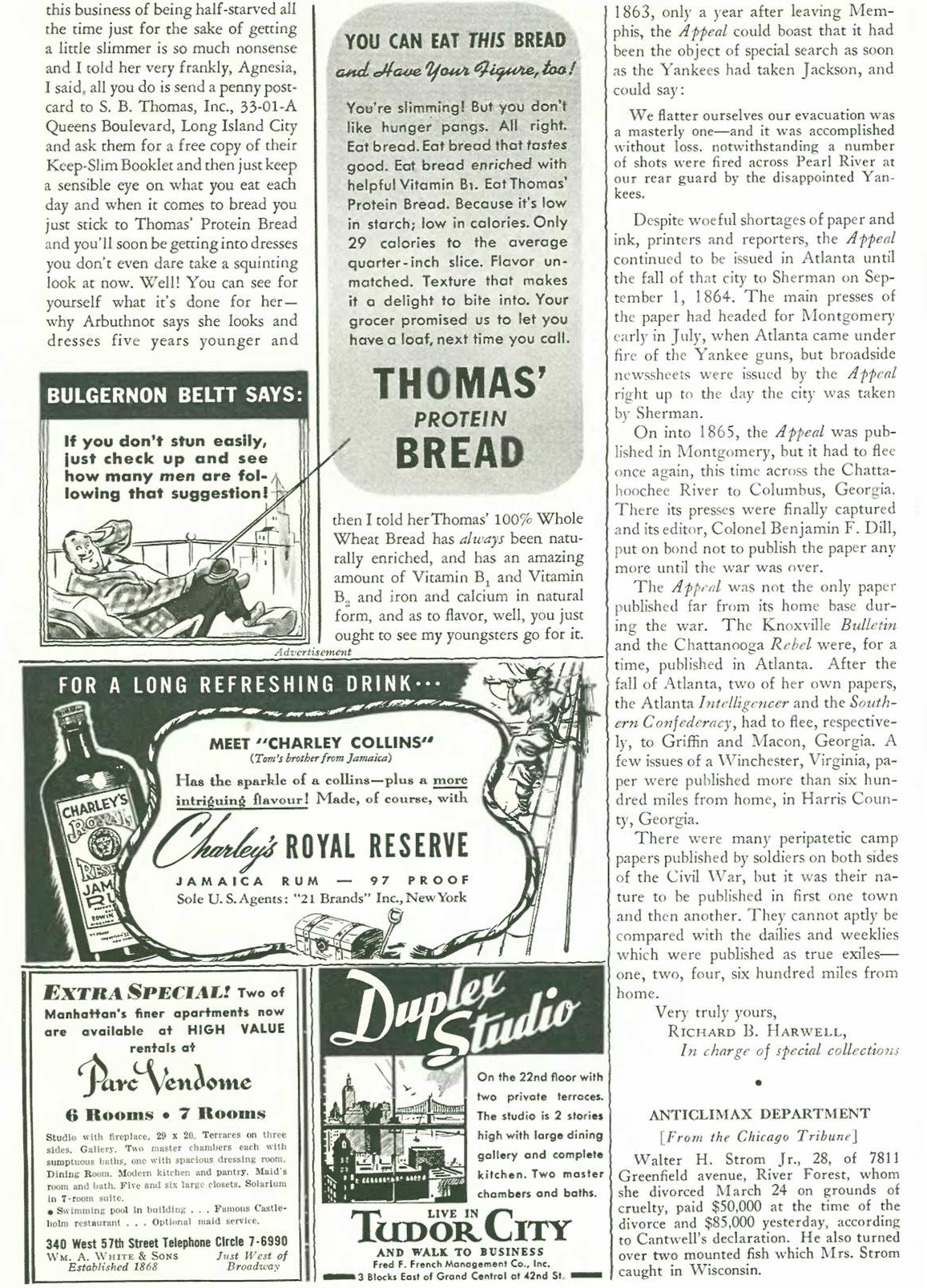
I was up at our cottage on the north shore of Massachusetts and came across a 1941 issue of The New Yorker, three months before Pearl Harbor. I was thumbing through it and found an article ipadthat had carried over from the previous page … except it hadn’t. They’d crafted it to look exactly like the other articles in the magazine, and wrapped the supposed jump text (about bread) around ads for the bread. In microscopic print at the bottom is the word “Advertisement.” Take a look at the attached screenshot I took of the archived version (it’s the entire upper left quadrant of the page).

It struck me, both because it was in The New Yorker, which we never associate with that kind of behavior, and because it was from so long ago, in what we like to imagine as the Golden Age of publishing, unsullied by today’s mercenary tendencies. But of course, it was ever thus …

Anyway, I don’t know if this fits with your general theme – it may be distinguishable because anyone can buy a quarter of a page and make it look how they please – but still I’ve never seen anything like that today except where it’s been explicitly approved by the publisher. I’m curious what you think of it.

I do notice, I must say, the word “advertisement” right there. That makes a difference. But it’s at the bottom of the page – not the top. And then I notice that the ad is both a classic one – with different font and background – and made to look like the regular font. I’d say it’s sponsored content all right – and deliberately confusing for the reader. But how many sponsored content articles have the word “advertisement” written on them?

Where They Met

I was reading about Chris Christie and Bill Clinton yukking it up at Clinton’s CGI event today, and stumbled upon this:

Mr. Christie and Mr. Clinton first met at the most recent wedding of Donald J. Trump, when Mr. Christie was United States attorney for New Jersey in the administration of then-President George W. Bush.

Look: I suppose I can understand why a rising Republican political star would think it might be smart politics to attend a big real estate mogul’s wedding. But a former president? And Trump? Every now and again, you get a reminder of how cheesy Bill Clinton always was and still is.