Rock And Roll’s 1%

Top Artists Sales

Neil Irwin recaps an “exceedingly rare” speech on music by White House chief economist Alan Krueger:

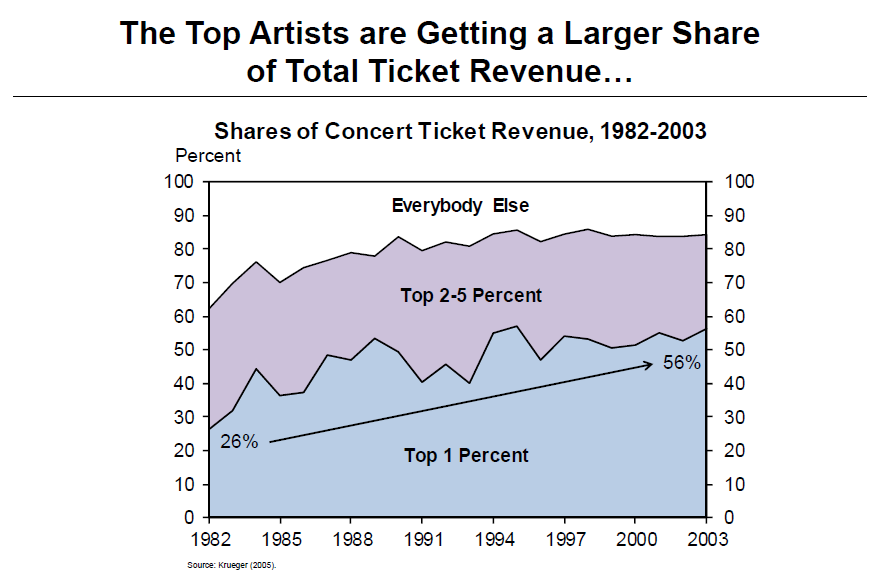
“The music industry is a microcosm of what is happening in the U.S. economy at large,” Krueger, chairman of the White House Council of Economic Advisers, says. “We are increasingly becoming a ‘winner-take-all economy,’ a phenomenon that the music industry has long experienced. Over recent decades, technological change, globalization and an erosion of the institutions and practices that support shared prosperity in the U.S. have put the middle class under increasing stress. The lucky and the talented – and it is often hard to tell the difference – have been doing better and better, while the vast majority has struggled to keep up.” …

A century ago, a musical performer could only reach as many people as his or her vocal range and travel schedule would allow. Now, high-quality recordings can be distributed to billions with the flip of a switch. The result: Everybody has access to the very best music, or at least the music that most precisely suits their tastes.

Which would be great if the music industry were a meritocracy. Unfortunately, it isn’t:

Luck plays a shockingly important role in which songs and artists become mega-successes, Krueger shows. He points to research by sociologists Matt Salganik and Duncan Watts. Participants in their study were able to log in to listen to songs and download those that they liked. The researchers played a little trick on them: Some of the participants saw an actual ranking of which songs had been downloaded the most previously. Others saw a random ranking. It turns out that just the appearance that something was popular drove more people to download the song. Rather than a pure meritocracy where the best songs rise to the top, music seems to have strange effects in which popularity breeds greater popularity.

How Much Do Helmets Help?

Probably less than you think:

People who are forced by legislation to wear a bicycle helmet … may not wear the helmet correctly, seeking only to comply with the law and avoid a fine. Secondly, their behaviour may change as a consequence of wearing a helmet through “risk compensation,” a phenomenon [where increasing safety measures will lead people to engage in more risky behaviors]. One study — albeit with a single author and subject—suggests that drivers give larger clearance to cyclists without a helmet.

Vaughan Bell notes how, in general, safety measures may be offset by the behavioral changes they inspire:

Known as self-licensing [this effect] is where people will allow themselves to indulge in more harmful behaviour after doing something ‘good’. For example, people who take health supplements are more likely to engage in unhealthy behaviours as a result.

Stations Of The Kryptonian

In a review of the latest Superman retread, Dana Stevens compares superhero blockbusters to medieval religious art:

Both rely on rigidly fixed iconographies drawn from a narrow range of canonical subject matter. The individual creator may vary the style, but the terms of the representation are governed by a larger divine or quasi-divine cosmic order: hence the endless variations on the Annunciation, the descent from the cross, the first appearance of the cape and tights, the final fistfight atop a skyscraper. Zack Snyder’s Man of Steel doesn’t aim to turn that cosmic order inside out; this is the work of a man of faith, a director whose whole career has been predicated on his love for the comic and graphic-novel form. But Snyder (300, Watchmen, Sucker Punch) provides an elegantly illuminated retelling of the origin story of that most saintly of superheroes, Superman.

Elsewhere, from a more humanist perspective, a team of psychiatrists concludes after examining Superman’s childhood that he is “more human than superhuman”:

According to Abraham Maslow’s hierarchy of needs, a person must first meet basic needs, like food and shelter, before focusing on such higher-level needs as relationships and career development. So, Superman’s near-limitless powers may actually free him up to focus on being super. An even higher-level need is self-actualization, or reaching one’s full potential. Superman’s self-proclaimed never-ending battle for Truth, Justice, and the ever-changing “American Way” seems to sum up his pursuit of self-actualization. The rub: the pursuit is never-ending. There are always more of Lex Luthor’s plots to foil, more invasions from Apokolips to stave off.

This experience isn’t unique to Superman; we are all works in progress. Whether Superman, at least, illustrates that despite the numerous challenges along the way, a path towards realizing one’s full potential exists. Indeed, as a character Superman transcends his own self-actualization by inspiring us – his fans – to achieve our own self-actualization and be the best people we can be.

Looking Back On “Paperback”

M.H. Forsyth explains how the retronym came to be:

Paperbacks were introduced in the 1840s to supply the newly literate lower classes with something on which to expend their literacy. They were sometimes called penny-dreadfuls (cost and quality) and sometimes called yellow-backs because they were printed in bright colours (often, as you may have guessed, yellow). Paperback is first recorded in 1843, but hardback isn’t recorded until 1954. Well, to be fair hardback was recorded in 1750 as the name of a kind of West Indian coleopterous insect, and in 1883 as the name of a central American fish. But hardback as a kind of book doesn’t appear until over a century after paperback, despite the fact that hardbacks were there first.

This is a classic example of the retronym. Organic food, live music and acoustic guitars were all there first. However, the introduction of pesticides, records and electric guitars meant that you then had to start specifying. It’s something I always consider when travelling on the London Overground.

(Hat tip: Sadie Stein)

Antarctica’s Future

dish_bedmap2

Joe Hanson explains the above image:

A new topographical reconstruction of the land mass beneath Antarctica may, for the first time, let [geologists] glimpse into our possible future. A warm, frightening future.

The British Antarctic Survey created Bedmap2, a detailed map of the terrain beneath the icy sheets of the South Pole. The permanent ice on our polar continent is fluid, mobile, and sensitive to our changing climate. Understanding its relationship to the Earth beneath it is crucial to predicting whether of our warming planet allows it to maintain its solid form, or if some of it could wash away into rising seas.

An interactive version of the map is here.  Recent Dish on climate change here, here, and here.

Pumped-up Politics

A study finds that more assertive political views correlate to physical strength, “as if disputes over national policies were a matter of direct physical confrontation among small numbers of individuals, rather than abstract electoral dynamics among millions”:

The professors look at a sample of individuals from the US, Argentina and Denmark and their socioeconomic level, physical strength (using bicep size as a proxy), and support for political policies that redistribute resources from the rich to the poor (as measured through questionnaires). They hypothesize that under their “evolutionarily-based theory of political orientation,” strong men will favor redistribution if they are poor and oppose it if they are rich. Just like in the primal past, they should expect to receive resources, but not to give up their own.

Their results support the hypothesis. A man’s strength correlated with his support for or opposition to redistributional policies depending on whether he was rich or poor.

Holding Your Cell Phone Isn’t The Problem

Distracted Driving

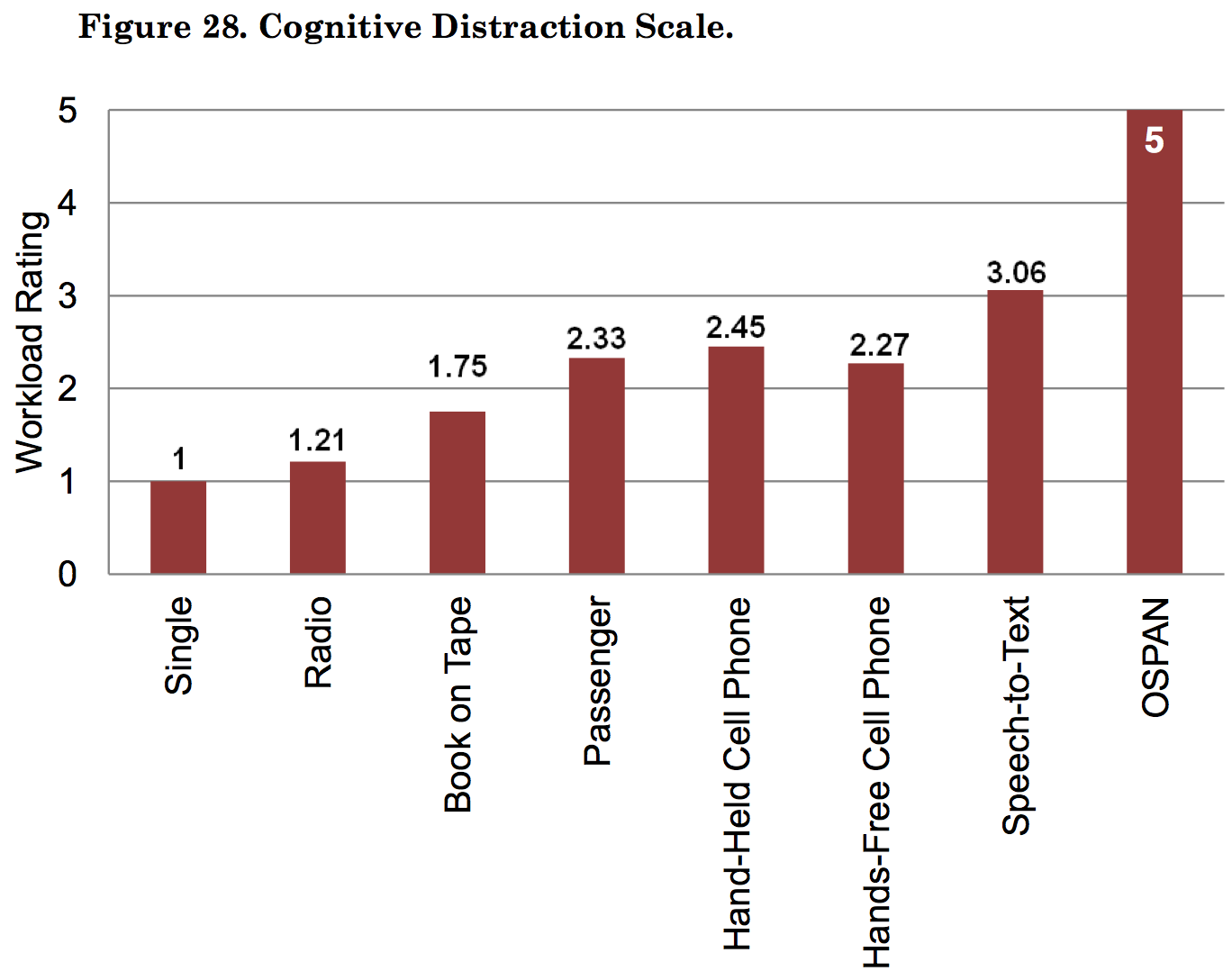
Derek Mead flags a study (pdf) that suggests “hands-free devices aren’t a safe alternative to chatting while driving”:

The study had 20 men and 18 women, all college aged, conduct a variety of tasks while driving in a simulator to measure just how much mental effort they had leftover for driving. The study includes a variety of metrics to quantify varying mental workload, but the graph [above] sums up the trends nicely.

Driving alone and without devices was given a baseline workload level of 1. You can see that adding in the radio or book on tape increases mental workload, while talking on a cell phone is about the same as talking to a passenger, while speak-to-text programs were even higher. (OSPAN is a specific cognition test you can read about here.)

Do Mascots Need Modernizing? Ctd

The popular mascot thread is still kicking:

I grew up in North Dakota, where there is a long history of sports teams with controversial  sports mascots.  Up until the 1970s, the mascot for Dickinson State University was the Savages (the school is 60 miles from an Indian reservation) and every year a white female student and a white male student would be elected homecoming chief and princess and don costumes to dress the part.  The current mascot for the school’s men’s teams is Blue Hawks and the women’s teams are called the Blue Chicks.  Today there is a small amount of controversy about the nickname of the public high school in Dickinson as the mascot for Dickinson High School is the Midgets.

For many years the mascot of Wahpeton High School was the Wops.  That nickname got changed to the Huskies.  I think it lasted as long as it did simply because there are so few people of Italian extraction in the state.

The mascot controversy at the University of North Dakota got a lot of national press.  The Fighting Sioux nickname has been officially retired and the school has no mascot at this time until tempers cool and a new one can be introduced (I think the Fighting Frackers would be a good option).  Things got really ugly in the state and the legislature got involved and it even ended up on a statewide ballot.  Some people felt so strongly about the Fighting Sioux mascot that they wanted to keep it even if it meant the school could not compete in NCAA tournaments.  It also did not help that one of the two Sioux tribes in the state voted to support/approve the use of the Sioux nickname … while the tribal council of the other Sioux tribe never permitted the members to vote.

Unfortunately for UND, the controversy overshadowed and diminished the really good work and huge investment the school has made in Native American higher education.

Another reader:

All this mascot talk got me thinking again about a very tearful, bitter school board meeting I attended with hundreds of my fellow students in 1986 in an effort to keep our principal and a group of evangelical Christian parents from changing our school mascot from The Diablos to The Bulldogs.

When Mission Viejo High School in southern California was founded in 1966, it’s mascot was The Diablo, aka “Pablo the Diablo.” I don’t really remember anyone ever referring to our mascot by its appended Spanish first name, especially since the color guard mascot at the time was always a girl dressed in a devil’s outfit . I definitely don’t remember anyone being offended by the ethnic/cultural association of naming the school’s mascot devil Pablo. But as evangelical Christians began to assert themselves in the local political and educational institutions of Mission Viejo at the time, the Diablo mascot became a primary target of their ire.

The student body was divided as parents and kids took sides in what became a city-wide controversy. I was on the pro-Diablo side, and for me personally it became friend against friend after my best friend started dating a born-again girl and he “converted” to maintain the relationship (she also convinced him to get a perm, but that’s another story). I remember the pro-Diablo student leaders speaking passionately about tradition and history at the school board meeting, but our side was ultimately outvoted. The pro-Diablo forces lost and the school’s mascot was changed to the Bulldogs.

I graduated in 1987 and never looked back and had assumed that the mascot remained the Bulldog ever since. The thread on mascots prompted me to do a little research and I discovered that the battle raged on and still continues today. The student body fought back in 1993 and after a campus-wide vote rechristened the school’s mascot as the Diablo (though the current cartoonish incarnation is a lot different than the illustrations I remember of our Diablo, who sported a Van Dyke and his eyes had a certain sinister gleam). Interestingly enough, the anti-Diablo forces in 1993 cited the separation of church and state as an argument against the mascot:

Bev Stephenson, a former school employee whose daughter graduated from Mission Viejo High last year, opposes the devil logo and fears an uproar from the local Christian community if a devil mascot wins–even a cute, smiling one. “We’re talking about the separation of church and state,” Stephenson said Tuesday. “We don’t put the Ayatollah Khomeini out there. We don’t put Jesus on the flag. We don’t use the devil either. There are many other positive depictions we can use.”

The mascot remains The Diablo at present although this rather lonely blog post suggests there are still those hoping to change it back:

Many parents and students have voiced concern over the mascot as the Diablos; saying that it is the one thing that bothers them about this High School. Today’s society is full of dark and evil messages that bring our children down. Let’s build our kids up and empower them with a Unified Mascot Change.

Almost defiantly, it seems to me now, the school website offers a “A Tour the Campus with Pablo the Diablo” page. I’m glad that subsequent students were able to get the mascot changed back after my classes failure to keep it. For me, the experience marked the first time I had ever encountered the political will of the evangelical Christian community and as I reflect on it now, the battle over the Diablo, as localized as it was, seems a harbinger of the cultural war that’s been waging ever since on a national level. I wonder how many of the Christian fans who oppose changing the mascot of the Cleveland Indians or the Washington Redskins would be in favor of changing either mascot to the Cleveland Satans or the Washington Devils?

The Best Of The Dish This Weekend

00525-11

We interrupted our usual coverage to focus on the resurrection of the Green Movement in Iran. Emails from the country arrived in the in-tray; tweets and tweets poured in through the night of celebration; and we compiled the stunned reaction from across the blogosphere. Of course, if you’re a true Dishhead, the amazing emergence of Rouhani was not a complete surprise. Like the first uprising, we saw it coming. Only the neocons were dismayed.

Meanwhile, almost all of Obama’s core supporters bemoaned his awful decision to enmesh this country in a Muslim sectarian war in the Middle East; and Zbigniew Brzezinski told it like it is. My worry is that if Obama cannot stand up to Anthony Blinken, how is he going to fare against the European allies in Northern Ireland tomorrow?

The most popular post of the weekend was my cri de coeur on Obama’s betrayal of his own presidency (and the American people) on Syria; and this face of unbridled joy and hope. Perhaps best to focus on the good news rather than the ominous return to the Clinton-Bush era. One reader summed up Bill Clinton better than I could.

I’m off to visit my old high school in England tomorrow. But I’ll be blogging from Blighty as well.

See you in the morning.

(Photo of Rouhani supporters celebrating in the streets from Arash Ashoorinia’s Photography)

Green To Purple, Ctd

A reader shares his firsthand perspective on Iran’s remarkable election:

I apologize for writing through the VFYW contest email address. I’m having a hard time getting around the Iranian blocks to find an actual contact address. Hopefully this is seen and found of some interest.

Four years ago I followed your blog on the last Iranian election, so it seems fitting I write to you about what I have heard here the last few days. I am an American currently on a tour of Iran. I’m writing from my hotel’s courtyard in Shiraz. This morning I was in Tehran. Our tour guide got a phone call from a friend last night that the election was about to be called. One of the things I keep hearing is why the election last time was called so fast, with so many more ballets that were suppose to be counted, but that this time there were less ballots but more time.

Our tour guide turned on the Farsi-only news and they announced that Rowhani had won. There were cheers in the lobby. This morning I was greeted by the hotel owner who, as he was returning  my passport, could not be more happy and more enthusiastic about his hope that this means America and Iran could be friends soon. He was so excited to be able to tell me that personally. Everyone I’ve talked to has this cautious hope that things will improve. People are realistic but there’s this relief that maybe, just maybe, things will get better.

(Video: Rouhani supporters celebrating in the streets and chanting “Mousavi, we collected your vote”)