Is The US Pro-Sunni? Or Pro-Shia?

This paragraph from the WSJ’s helpful account of all the forces combining to revive the foreign policy of George W Bush strikes me as salient:

King Abdullah, Saudi Foreign Minister Saud al-Faisal and Turkey’s Prime Minister Recep Tayyip Erdogan also argued to Mr. Obama that the U.S. was allowing three of its chief historic rivals in the Middle East—Iran, Russia and the Lebanese militia Hezbollah—to dominate the battlefield in Syria and help President Assad push back recent rebel gains. Mr. Assad’s survival, they said, would tip the regional balance of power in Tehran’s favor.

So fucking what? You’ll notice the usual suspects: Sunni autocrats ganging up on the Shiite resurgence. My point is and was: the US has no reason to side with Shia or Sunnis in the Middle East. The notion that the US needs to take a position on a question of doctrinal division within Islam is, in a word, absurd. Backing the torturing dictators of Jordan and Saudi Arabia and the man who just razed Taksim Square against the Shiite dictators in Iran, Syria and Qatar furthers no interests of the United States.

Face Of The Day

justinp_62

Joseph D.R. OLeary photographs the hirsute for his project and forthcoming book, Of Beards and Men.

(Photo: “Justin_62” by Joseph D.R. OLeary.  From July 3-27, the “Portfolio Showcase” exhibition will be on display at The Kiernan Gallery in Lexington, VA.  Opening reception on July 5.)

Einstein As “Papa”

Maria Popova spotlights a 1915 letter from Albert Einstein to his 11-year-old son, who was living with his mother (Einstein’s estranged wife, Mileva) in Vienna while the physicist worked in Berlin:

My dear Albert,

Yesterday I received your dear letter and was very happy with it. I was already afraid you wouldn’t write to me at all any more. You told me when I was in Zurich, that it is awkward for you when I come to Zurich. Therefore I think it is better if we get together in a different place, where nobody will interfere with our comfort. I will in any case urge that each year we spend a whole month together, so that you see that you have a father who is fond of you and who loves you. You can also learn many good and beautiful things from me, something another cannot as easily offer you. What I have achieved through such a lot of strenuous work shall not only be there for strangers but especially for my own boys. These days I have completed one of the most beautiful works of my life, when you are bigger, I will tell you about it.

I am very pleased that you find joy with the piano. This and carpentry are in my opinion for your age the best pursuits, better even than school. Because those are things which fit a young person such as you very well. Mainly play the things on the piano which please you, even if the teacher does not assign those. That is the way to learn the most, that when you are doing something with such enjoyment that you don’t notice that the time passes. I am sometimes so wrapped up in my work that I forget about the noon meal. . . .

Be with Tete [Albert’s brother] kissed by your

Papa.

Regards to Mama.

Did Music Help Us Survive?

Steven Pinker has downplayed music’s place in our evolutionary past, calling it “auditory cheesecake,” meaning that as “far as biological cause and effect is concerned, music is useless.” Psychologist Thalia Wheatley disagrees:

This embed is invalid

You can watch the entire video here, and subscribe to The Mind Report here.

The Anti-Quagmire President?

For balance, here’s an argument that Obama’s record of not sliding into intractable conflicts so far is a reason to trust him not to slide on Syria. I just worry that Rice and Power – combined with liberal interventionist Tony Blinken – is too strong a faction for the president to resist. He’s already foolishly committed himself rhetorically to war with Iran – rather than containment and engagement – if it gains a nuclear weapon; and his “red line” comment about Syria was red meat to the Clintonite tendency. Once a president has said such things, he can be dragged further into the mire.

To my mind, the key components of a successful Obama presidency – an actual change we can believe in – is the ability to resist war in Syria or with Iran under almost any circumstance. And I have to say I think he has put himself into a dangerous corner on both. After Libya and this execrable volte-face, I’m fast losing confidence he has the core strength to trust his own judgment against all the war mongers around him.

Obama’s Worst Foreign Policy Decision

US-POLITICS-OBAMA-LGBT

MoDo today summed up the wisdom of everyone who championed the Iraq war and endorsed those arguments all over again. As if it never happened.

She even cites its two most persuasive proponents, McCain and Clinton. The argument is that something bad is happening in the world and because you are the American president, you need to stop it. If you don’t, you are “a wuss”. Worse, other actors, like Putin and Khamenei are intervening in Syria, so we must too – or appear “weak.” The entire scope of this argument, as with Iraq, is limited to the moral posture of the United States, the existence of an evil, the imperative of acting, and then trying to sell the American public on the action. The argument is actually weaker than for Iraq, because at least Clinton and McCain insisted at the time that Saddam had weapons of mass destruction that he wanted to use against America; at the current moment, no one is saying that about Syria’s chemical arsenal. In fact, the only scenario in which the US might be the target of such weapons is if we do exactly what these “statesmen” are demanding: side with one faction or another. Then at least one side has a reason to hate us.

Does Dowd have any argument as to where such “leadership” would take us? Does she argue that arming Sunni Jihadists against Alawites and Shiites is a good thing because those Jihadists would never use such weapons or be an enemy of the US? No. Who does she want to win the Syrian civil war and why? She doesn’t say. Does she support the theological claims of Sunni Islam against Shiite Islam? I don’t know. In fact, she doesn’t explain at all what the point of her new war is, or what her preferred outcome would be. These are simply to be figured out, or in Clinton’s words, “sold” later. This foreign policy “doctrine”, if it even deserves such a designation, is essentially an endorsement of George W Bush’s presidency. Yes, MoDo hates Obama that much that in this column she has actually gone full circle and endorsed the arguments that gave us the catastrophe in a very similar country, Iraq.

Clinton also accuses the president of taking his previous, coherent and strong position on Syria not because staying out of this conflict is obviously the sanest thing to do; but because Obama is apparently just listening to the polls. The gall of Clinton of all people to accuse anyone of that level of cynicism! And the American people, he assumes, are obviously wrong. The job of a president is not to listen to them on matters of war and peace, especially if they have a collective memory longer than that of a gnat, but to ignore them, forget the lessons of the very recent past, wing it, and hope to “sell” the war later.

I write all of this in acute frustration, of course. Because I thought I understood Barack Obama’s strategy and obviously I don’t, and because I want this president to succeed and I cannot possibly see how this can lead to anything but failure. And I’m frustrated because MoDo is right about the substance and the timing of Thursday’s stomach-churning presser. How dare a sitting president delegate the explanation of such a dangerous, portentous step to anyone but himself? The sheer arrogance of that delegation of a core duty is shocking. Here’s what the president had to do that day that was more important, in his mind, than explaining why he had just committed the US to the folly of another war in another Middle Eastern country:

He spent time at an LGBT Pride Month celebration, a Father’s Day luncheon and a reception for the W.N.B.A. championship Indiana Fever basketball team.

I presumed at first this was another version of the Libya fiasco:

self-righteous hand-wringing followed by removal of a tyrant, leading to more regional destabilization and the murder of an ambassador and other Americans. Only this time, the president didn’t even muster his lame defense of the Libya mess. Or perhaps it was, as Marc Lynch calls it, a version of the Afghan surge – an act that sacrificed American lives for no conceivable end but face-saving for an exit and protecting his right flank at home. The Afghan surge remains, to my mind, morally cold. Sending mother’s sons to their death when you know it won’t work is not something even Niebuhr would endorse. But as Marc notes, at least that surge had an end-date. Not this time. So perhaps this was just a minor concession to the Sunni allies who want to win the war for their version of Islam or the European allies who keep stupidly wanting to pull off another Suez. If so, it’s an insult to them as well as to us. It won’t do anything to change anything, but will mean the US will find it progressively harder and harder to avoid more and more commitment.

So let’s posit “our side” wins. What good could possibly now come of a Sunni Jihadist victory? We’d see a mass slaughter of Alawites at best, and a metastasizing sectarian war across the Middle East in which the US would be entangled. By staying out, on the other hand, we make Putin and Iran the targets for Sunni hatred, we do not add fuel to the sectarian fire, and we do not hurt any of our strategic interests. I thought I had supported Obama over McCain and Clinton in 2008. Why are we now getting boomer-era interventionism?

For a kinder, gentler version of this screed, read Fareed. Or watch this space if and when the president deigns even to explain why he has just done what he promised never to do again.

Quote For The Day

“There is no need of knowing whether, by pursuing justice, we shall manage to preserve liberty. It is essential to know that, without liberty, we shall achieve nothing and that we shall lose both future justice and ancient beauty. Liberty alone draws men from their isolation; but slavery dominates a crowd of solitudes. And art, by virtue of that free essence I have tried to define, unites whereas tyranny separates. It is not surprising, therefore, that art should be the enemy marked out by every form of oppression. It is not surprising that artists and intellectuals should have been the first victims of modern tyrannies, whether of the Right or of the Left. Tyrants know there is in the work of art an emancipatory force, which is mysterious only to those who do not revere it. Every great work makes the human face more admirable and richer, and this is its whole secret. And thousands of concentration camps and barred cells are not enough to hide this staggering testimony of dignity.

This is why it is not true that culture can be, even temporarily, suspended in order to make way for a new culture. Man’s unbroken testimony as to his suffering and his nobility cannot be suspended; the act of breathing cannot be suspended. There is no culture without legacy, and we cannot and must not reject anything of ours, the legacy of the West. Whatever the works of the future may be, they will bear the same secret, made up of courage and freedom, nourished by the daring of thousands of artists of all times and all nations. Yes, when modern tyranny shows us that, even when confined to his calling, the artist is a public enemy, it is right. But in this way tyranny pays its respects, through the artist, to an image of man that nothing has ever been able to crush. My conclusion will be simple. It will consist of saying, in the very midst of the sound and the fury of our history: ‘Let us rejoice,” – Albert Camus, 1957

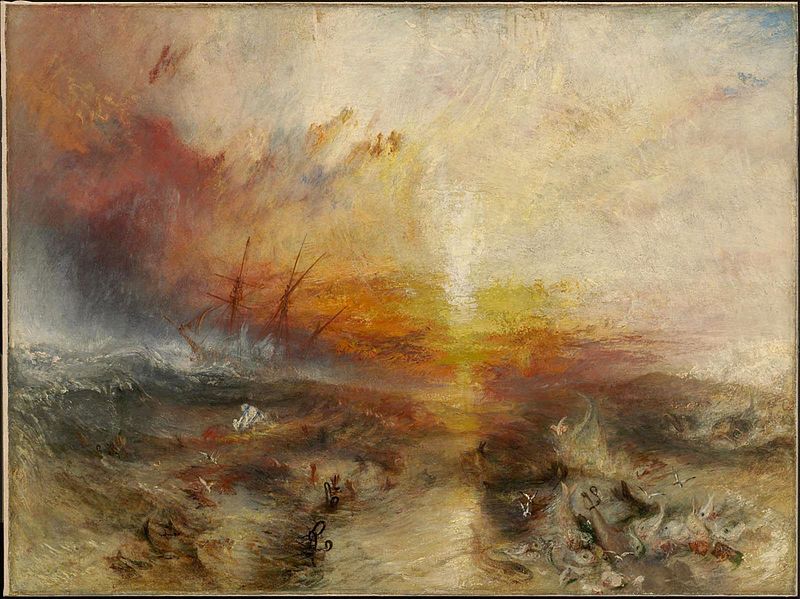
(Image: The Slave Ship by J. M. W. Turner, 1840 from Wikimedia Commons)

Chirpings Of The Soul

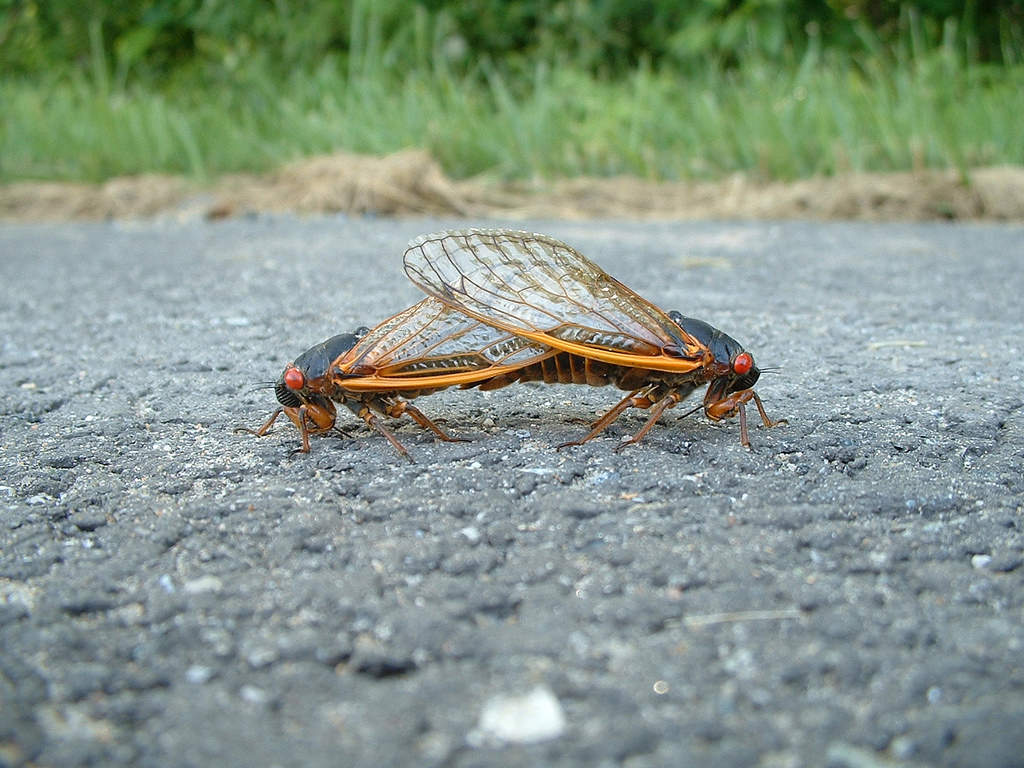
cicadas

Casey Cep offers a literary primer for the current cicada craze:

Cicadas are a global species and an ancient one. They can be found in “The Tale of Genji,” Plato’s “Phaedrus,” and even “Aesop’s Fables.” Time-lapse photography may have enhanced our understanding of their life cycle, but poets have been cataloguing their summer songs for thousands of years.

Take Robert Hass, who describes in “Between the Wars” how one could hear “the slightly / maniacal cicadas tuning up to tear the fabric / of the silence into tatters.” The poem’s speaker is reading Polish history, but finds himself disturbed by the insects’ furious activity. When male cicadas sing for females, they do, as Hass says, shred and torture silence. The tiny tymbals of the cicada buckle several hundred times a second, like mallets on a kettledrum, already a blast that only amplifies when billions of the males sing simultaneously, each trying to attract a mate. Jorie Graham describes the music of the cicadas as “kindling that won’t take.” Her poem “The Errancy” begins with the tymbals of the male cicadas crackling like wood under flame: “The struck match of some utopia we no longer remember / the terms of.”

One version of the forgotten utopia of cicadas can be found in Plato’s “Phaedrus.” When Socrates runs into one of his students walking outside the Athenian city walls, the two settle by a shaded stream to talk. Socrates notices that their conversation is competing with the shrill sound of cicadas. The eavesdropping insects listen as teacher and student debate the virtues of friendship over erotic love, the blessings of madness, the immortality of the soul, the art of rhetoric, and the superiority of speech to written text.

Alan Burdick, in an essay on the mating rituals of the insects, found cicada researchers David Marshall and John Cooley also waxing poetic about them:

As one gets older, the presentation of youth can begin to feel apocalyptic. It is always rising up, always gaining in number—insistent, heedless, both a memory and a premonition. “Working with seventeen-year cicadas brings the past into a different kind of perspective,” Marshall told me. “The last time this brood was out was seventeen years ago; a lot has happened since then. You’re having those moments with every brood that comes up; it’s always seventeen years ago. Every year, I’m saying, basically, ‘Ah, this is the brood from ’96, we were in this particular place.’ ” It’s like when you hear a song on the radio, he said: “It takes you right back to where you were.” He added, “It certainly makes me think how old I’ll be next time. That’s always where your thoughts go when you think forward from a brood.”

(Photo by Flickr user superbatfish)

Married To Different Gods

Martin Marty ponders the gritty realities of interfaith marriage. He finds Naomi Schaefer Riley’s recent book, Till Faith Do Us Part: How Interfaith Marriage Is Transforming America, a welcome exploration of the issues involved:

Ms. Riley herself and many reviewers are in “interfaith” marriages, and find much to affirm in many of them, but they are also aware of what social scientific data says about the causes of changes in marriage trends. Some data suggests that, among large communities, Mormons and Muslims are the most successful at holding off marriage “across the aisles,” to use The Economist’s terms.

Ask, in polls, which religion “other than your own” you view most positively, and the largest set of respondents lists Mormon and Muslim as problematic. Years ago Jews and Catholics were most feared and despised, but today they are most readily accepted by others! One reason for the change is interfaith marriage, and, alongside it, many other means of getting to know “the other.”

In an interview, Schaefer Riley describes what’s surprised her about her own interfaith marriage:

I told my husband on our first date that I plan to raise my children Jewish. In my survey, though, apparently, about less than half of interfaith couples actually talk about how they’re going to raise their children before they get married. So that wasn’t a big surprise. But I will say one of the interesting things is that I think most people getting into interfaith unions seem to think it’s kind of one discussion happens, somebody wins, and then you sort of move forward from there.

But I think it’s been a much more dynamic process. And, you know, you don’t really realize until you get to these various milestones in life, you know, how you’re going to feel about them. And little things can really affect the compromises that you’ve reached, you know. So you used to go to so-and-so’s for, you know, an Easter egg hunt, and it was completely an, you know, irreligious experience. You know, that person no longer hosted, and then you go to Uncle So-and-So’s, and he’s much more into talking about the real reason behind Easter. And suddenly, I think an interfaith family can get very uncomfortable.