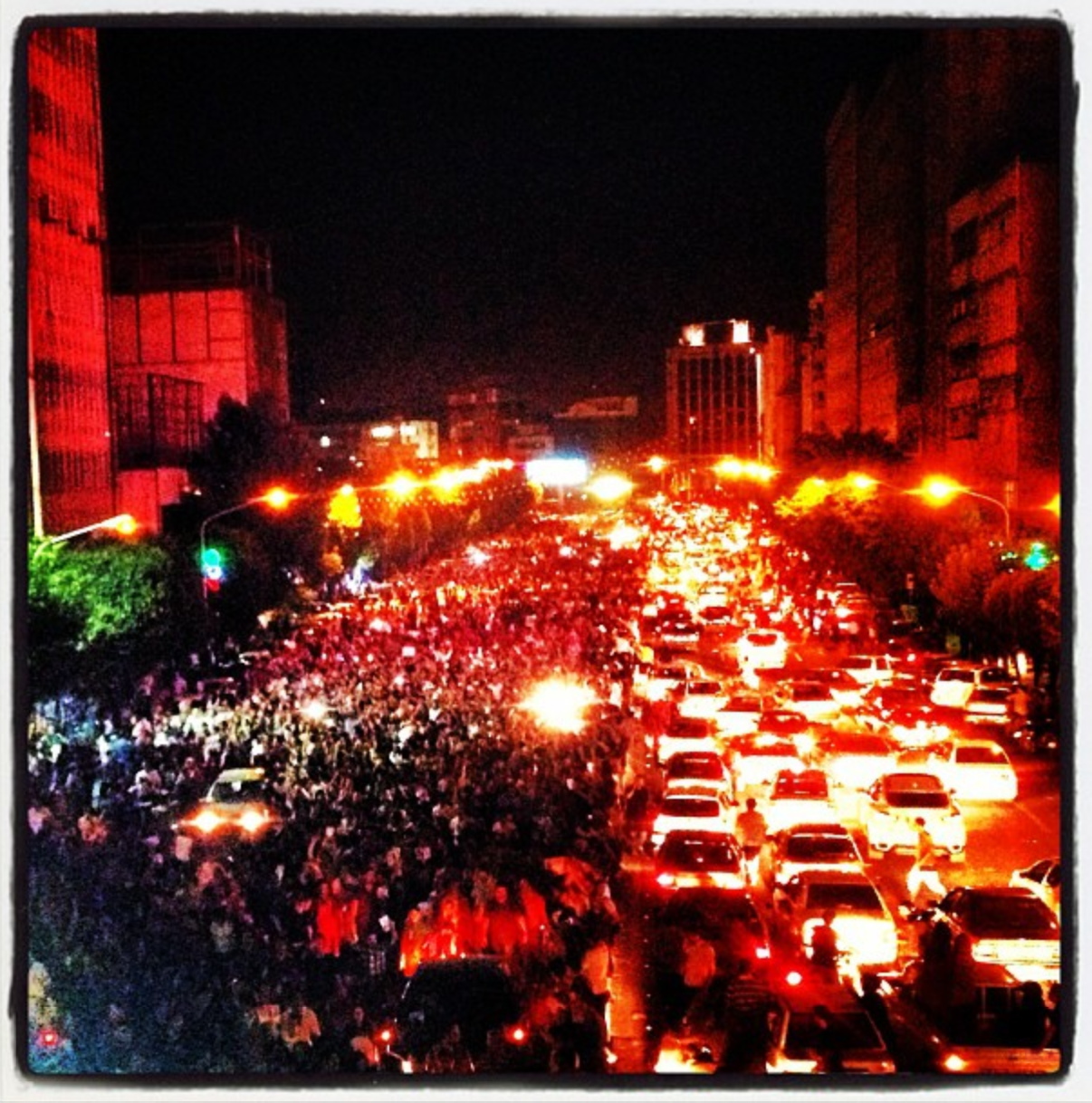
Green To Purple

iranelection-instagramed

More tweets from the celebration in Iran, going into the wee hours:

https://twitter.com/PoliticallyAff/status/346041698872336385

https://twitter.com/thekarami/status/346053260014141440

Iran’s semi-official Fars News Agency has a gallery up here. One from BBC Persia here. Mackey has been rounding up videos and tweets as well. Meanwhile, Thomas Erdbrink steps back (NYT):

[I]f the election, which electrified a nation that had lost faith in its electoral process, was a victory for reformers and the middle class, it also served the goals of the supreme leader, restoring at least a patina of legitimacy to the theocratic state, providing a safety valve for a public distressed by years of economic malaise and isolation, and returning a cleric to the presidency. Mr. Ahmadinejad was the first noncleric to hold the presidency, and often clashed with the religious order and its traditionalist allies.

The question for Western capitals is whether a more conciliatory approach can lead to substantive change in the conflict with Iran over its nuclear program. A willingness to talk does not mean a willingness to concede.

But this was no win for Khamenei either:

The election results put the supreme leader under pressure to allow changes to take place, or allow him to make the kind of changes that might be opposed by hard-liners if they controlled all the levers of power. For the supreme leader, a weak loyal president might be less threatening that Mr. Ahmadinejad, who over time alienated the ayatollah as he spread his own power throughout the bureaucracy. The ayatollah had exhorted Iranians to exercise their right to vote. Analysts are predicting at least some change. “There will be moderation in domestic and foreign policy under Mr. Rowhani,” said Saeed Laylaz, an economist and columnist close to the reformist current of thinking. “First we need to form a centrist and moderate government, reconcile domestic disputes, then he can make changes in our foreign policy,” said Mr. Laylaz, who, in a sign of confidence, agreed to be quoted by name.

Omid Memarian thinks the president-elect now has some debts to pay:

Rowhani could have never found much reception within the different layers of the society if two reformist and popular figures, Akbar Hashemi Rafsanjani and Mohammad Khatami, former Iranian presidents, had not supported him.

The popularity of Hashemi Rafsanjani and Khatami themselves has soared over the past few years, particularly after they put distance between themselves and Iran’s supreme leader, Ali Khamenei, following the intense crackdown on the people in the aftermath of the 2009 elections….

That Rowhani’s 18 million votes were followed by a 12 million-vote margin between him and the next candidate showed that Iran’s silent dissidents and suppressed civil society continues to own a very powerful voice. The urban middle-class vote, as well as the blue-collar vote, were cast in favor of Rowhani following the political and social suppression for which the supreme leader is responsible. Not to mention the public realization that the Iranian nuclear program could have continued without sanctions, and that Saeed Jalili, the supreme leader’s representative, has brought economic sanctions to Iran due to his incompetence.

In fact, the Iranian presidential election became a public referendum on the Iranian nuclear program, which for the past several years has been defined as an issue of national security. As such, the Iranian civil society and media have been unable to address and discuss it in their articles and analysis. The election results indicate that the Iranian people have strongly rejected the way the nuclear negotiations, led by Iran’s supreme leader, Ali Khamenei, have been taking shape.

But as Arash Karami reminds us, if Rouhani pursues reform, success won’t come easy:

Rouhani will be facing a litany of domestic and foreign issues, and on many fronts his efforts will be restrained by [the Supreme Leader], who not only controls foreign policy and the nuclear file but has increasingly interfered in the appointment of key cabinet positions under the administration. …

[S]enior policy analyst at Rand Corporation, Alireza Nader, believes that the cards are stacked against Rouhani in implementing meaningful reform. “It remains to be seen how the ultra-conservatives among the Revolutionary Guards and Basij react to Rouhani. There was a lot of hope that Mohammad Khatami could also solve Iran’s problems when he was elected in 1997. But Khamenei and the Guards managed to constrain him again and again. A key question is whether Khamenei will trust Rouhani … Rouhani is very closely associated with Ayatollah Rafsanjani, who was disqualified from the race [by the Guardian Council which is directly and indirectly appointed by the Supreme Leader]. This may not sit well with many of the Iranian hard-liners.”

Our ongoing coverage of the Iranian election, in reverse chronological order, is here.

(Image: Dish mashup of today’s Instagrams from Iran. Clockwise from the upper left – credits to: sh4hrz4dardalankaashkangiplasihommaa, ashkangiplasipedramveisi)

Meanwhile, Turkey Is Still Broiling

Tonight in Istanbul, police made good on Erdogan’s “final warning” this week and stormed Gezi Park, clearing out all demonstrators with more tear gas, water canons, and rubber bullets. Then came the demolition:

Bulldozers moved in afterward, scooping up debris as crews of workmen in hard hats and fluorescent yellow vests tore down the tents. Protesters put up little physical resistance, even as plain-clothes police shoved many of them to drive them from the park. White smoke billowed skyward as a phalanx of riot police marched inside the park on Saturday. They tore down protesters’ banners, toppled a communal food stall, and sprayed tear gas over the tents and urging those inside to get out.

The civilians under fire fled to nearby cafes and hotels to rest and tend to each other’s injuries. Before long, police entered the Divan Hotel and filled the lobby with tear gas (seen in the above video):

[P]olice stormed the hotel beating protesters, while a later assault left the lobby of the luxury hotel thick with gas. The Observer saw two elderly women who had passed out, being carried out on stretchers to an ambulance.

Recent Dish on Turkey’s unrest here.

Can Coffee Help You Sober Up?

Nope, not really:

[C]affeine can counteract the tiredness induced by alcohol, which might explain why a cup of coffee is popular in many places at the end of a meal. But it can’t remove feelings of drunkenness or some of the cognitive deficits alcohol causes. … It takes approximately an hour for the body to metabolise one unit of alcohol, although some people do it faster and some slower, depending on their genetic make-up, how much food they’ve eaten and how often they drink. Caffeine doesn’t speed up the process. However its effects vary according to which function you’re looking at. One study, for example, found a large dose of caffeine can counteract the negative effects of alcohol on memory, but that feelings of dizziness remain.

There are also suggestions that caffeine can make matters worse. If you feel tired you are more likely to realise that you must be drunk, but if the caffeine takes away some of that fatigue you might believe you’re sober when you’re not.

A Female Fap App

dish_hptinfographic

Tina Gong is developing HappyPlayTime, an app “that will teach female anatomy and provide lessons on masturbation techniques through a number of minigames”:

At the heart of all this is HPT’s mascot: the pink, fleshy, and gleeful personification of a vagina. When I inquired about the nature of the mascot, Tina explained that it goes back to rebranding our preconceived notions about masturbation. Teaching an anatomy lesson with a mission to educate about female masturbation is too much of a serious topic when taught in the traditional education model and it is difficult to separate the idea of empowering females to masturbate from a feminist perspective. HPT’s approach to education involves a quick demonstration of different masturbation techniques for each level, followed by a freestyle portion that has the player perform each technique on the mascot. Completion of each level builds up to a fantastically funny and wacky climax upon completion. … Tina also mentioned future plans for making an arduino-powered vibrator companion to work with HPT.

Previous Dish on female onanism here and here, and a recent Dish thread on self-love here.

Rated G Or Rated X?

Hillary Louise Johnson argues that an all-or-nothing approach to sexual expression on the Internet misrepresents how people actually behave:

The rise of the privately-held, terms-of-service-governed internet has cultivated a binary view of sex, in which all content is divided into two categories: porn and not-porn. As a result, I can have a G-rated profile on Facebook, and/or an X rated one on Fetlife. But you will not see overlap between those. No one on Fetlife talks about their kids or their day at work, no more than anyone on Facebook talks about putting on a leather pony costume and playing giddyup in the local dungeon on a Saturday night. On Fetlife, you post pictures of your genitals, but not of your face (lest a cousin or co-worker stumble across your profile, presumably), and on Facebook…well, it’s called Facebook, not Assbook. …

So as much as I love the internet, its rules of engagement do not satisfy my desire as an enlightened and liberal human being … to live on my own terms, which means openly acknowledging that I do, in fact, have a sexual identity that is not separate from other aspects of my identity, and that I may want to express and promote ideas that do not easily fall into the binary porn/not-porn baskets carved out for us by terms of service and content guidelines: I might want to write a review of an erotic art show that isn’t porn, or introduce my followers to my friend’s sex advice column, or publish a short story that includes graphic sex but isn’t porn or erotica—that gray area known in some circles as literature.

The First “Howl” On Record

Josh Jones posts the first recorded version of Allen Ginsberg’s “Howl,” read by the poet himself:

The story of Howl’s publication begins in 1955, when 29-year-old Ginsberg read part of the poem at the Six Gallery, where [Lawrence] Ferlinghetti—owner of San Francisco’s City Lights bookstore—sat in attendance. Deciding that Ginsberg’s epic lament “knocked the sides out of things,” Ferlinghetti offered to publish “Howl” and brought out the first edition in 1956. Prior to this reading, “Howl” existed in the form of an earlier poem called “Dream Record, 1955,” which poet Kenneth Rexroth told Ginsberg sounded “too formal… like you’re wearing Columbia University Brooks Brothers ties.” Ginsberg’s rewrite jettisoned the ivy league propriety.

Unfortunately, no audio exists of that first reading, but above … you can hear the first recorded reading of “Howl,” from February, 1956 at Portland’s Reed College. The recording sat dormant in Reed’s archives for over fifty years until scholar John Suiter rediscovered it in 2008. In it, Ginsberg reads his great prophetic work, not with the cadences of a street preacher or jazzman—both of which he had in his repertoire—but in an almost robotic monotone with an undertone of manic urgency. Ginsberg’s reading, before an intimate group of students in a dormitory lounge, took place only just before the first printing of the poem in the City Lights edition.

The text of the poem is here.  The Dish recently posted a recording of Virginia Woolf’s voice here and a purported recording of Walt Whitman here.

What It Feels Like To Be Plagiarized

Charles Hartman describes the discovery that David R. Morgan plagiarized his 1974 poem “A Little Song”:

When Morgan mutilated my poem, he was mutilating the tedious and fervent labour, the discovery of what I hadn’t known I meant to mean, and the reward of a single moment of high praise. ‘A Little Song’ has faults, including some melodramatic and opportunistic line-breaks. How would I feel if the thief had improved my poem? I’d be abashed, but I’d also be bewildered that someone who could do that would bother, rather than write a better poem of his own.

In the early rounds of emails, several people said: ‘Imitation is the sincerest form of flattery.’ I never knew that the aphorism was coined by Charles Caleb Colton (1780-1832), but it is now no more difficult to learn such a thing than to find out whether a particular poem has been published under more than one author’s name. It took me slightly longer to see why this response felt so off the mark. But of course plagiarism isn’t imitation. Imitation means trying to duplicate a process you’ve watched someone else go through.

Defining plagiarism is trickier than you might think, but most of the time we distinguish it from other kinds of copying (allusion, quotation) fairly easily: it’s plagiarism if the copyist hopes no one will notice.

“Jane Austen for Jews”

Reviewing the Israeli film Fill The Void, Yair Rosenberg argues that religious community is one of the last social spheres that produces the kind of drama captured in the 18th and 19th centuries:

As in a Jane Austen novel, social mores and communal expectations combine to create the moral dilemma at the heart of [ultra-Orthodox writer and director Rama] Burshtein’s film: should Shira marry Yochay, even if she does not love him, for the sake of healing her broken family? In fact, Haredi society is one of the few settings remaining where such a drama can still transpire. In Austen’s time, powerful yet unspoken social forces shaped the lives of both her contemporaries and her female protagonists, and pressures to marry for reasons beyond personal fulfillment were commonplace. But as modern society strips away the bonds of tradition, community, and financial necessity which previously imposed external obligations on individuals—particularly women—tragedies of manners like Austen’s or Charlotte Brontë’s Jane Eyre have become increasingly difficult to write. The only way to portray a protagonist beset by such outmoded responsibilities is to set the story in the historical past—or in an isolated traditional religious community.