Lead, South Dakota, 7.14 am
Lead, South Dakota, 7.14 am
Norm Geras challenges recent assertions that reading makes people more moral:
It may be the case statistically, for all I know, that avid and careful readers of good or great fiction become better people on the whole than they would otherwise be if they were not readers. But this isn’t the same thing as the claim that readers are invariably better people than non-readers are. We know from ordinary experience that that isn’t true, since there are plenty of people who don’t do much reading and are kind, helpful, compassionate and possessed of many other ordinary virtues, while at the same time there are some very well-read selfish bastards or worse than selfish bastards.
His other big point:
The thesis that reading makes us either human or more human – because it is ‘the most spiritual of all human activities’ – is more dubious still. What is one to say, then, about people who can’t read or can read but don’t? That they aren’t human, or aren’t fully human, or aren’t as human as (we) readers are? It isn’t a good way of talking. One method of defining human nature is – more or less empirically – as constituted by those characteristics which human beings share in common. On this basis, reading good fiction can’t be one of the constituents of human nature, given how many members of the human species haven’t read Proust, Tolstoy, F. Scott Fitzgerald or whoever else it might be.
Previous Dish on the subject here.
A reader writes:
I’ve been following this thread and I have to wonder: I’m a straight guy who is dying to have sex with a beautiful, 100% passable, pre-op transsexual. What in the bloody blue hell does that make me??? I’d love to know if there’s a term (or a “letter”) for me!
Another:
I am a bisexual male who has been completely comfortable with his sexuality for over 25 years. I exist, I am real, and I happily have sex with both men and women – sometimes separately, sometimes together. My experiences with each gender are very different, as is my role in each encounter. I would not be complete without both of them. I am not monogamous; I am not gay; I am not straight. In fact, my most satisfying sexual encounters have been with people who don’t identify as either male or female. These transgender people don’t fit within the binary, and explode the whole notion of being attracted to a single sex.
Another:
Argh! I both love and hate this discussion. Human sexuality is so wonderfully fluid. And all the pronouncements about whether there are true this or true that just drives me nuts!
For the record, I’ve long identified as a gay-identified bisexual (despite my occasional forays, I’m part of the gay community). I love having sex with women even if it’s not frequent. And as an HIV+ person, I find the opportunities more difficult given that:
1) there are more gay men with HIV expanding my horizons and 2) I prefer all-out sex that is stymied by either some women’s rejection of sex as fun or my own coding of women as not to be purely sexualized (I’m from the South and our coding of gender roles was strong). I recently dated a guy who is bisexual and had an easier time having sex with women but is dating men exclusively right now to get better at it. And I have recently been having sex with and dating a good many FTMs who identify as gay men. The crux of the matter is that I like, um, pussy. And I also like masculine energy – at least that part that sort of is animalistic and allows us to nearly devour each other.
What does that make me? A freak. And I’m quite fine with that.
Another:
What I’d like to reinforce from all of the comments about bisexuals is that sexuality is complicated, and complex. Sexuality is different from gender, yet we define it based on gender. I know I myself can’t find a label, but use bisexual because it’s the most encompassing.
I’m a male, but I tend to be attracted to women. More specifically, I tend to be attracted to boyish-looking women. Small breasts, small hips, short hair. Sometimes they’re butch, sometimes they’re trans men. And then there are the men I find attractive, which I can’t even define well. But I would say, as a whole, that it tends to be people that are not typically masculine or feminine, are gender-bending, or are non-gendered or androgynous.
I don’t know the term for this. I also know that butch women have been fetishized and I want to be aware of that. But at the end of the day, there’s my broad level “type”, and then there’s the individual who I get to know and have a relationship with. I call this being bisexual.
Another:
My husband and I are bisexuals, but we identify as gay. We have been together for over 20 years and are less promiscuous then we used to be, but in our younger days we did have several threesomes with female friends. While I find women attractive, I have a hard time forming emotional bonds with them. I am also attracted to individuals that defy gender stereotypes, particularly feminine men and masculine women.
Another:
It goes to show the connection to your audience that I’m writing these thoughts down for the first time. I’ve been married for over 15 years and yet here I share them with you.
I’m 35 years old and male. My earliest memory of an erection was seeing Christie Brinkley in Vacation on home video. That led to finding guy-on-girl porn in my dad’s extensive video and magazine collection. All through growing up, and looking back, my infatuation was with girls. I lost my virginity at 16, had only a few partners, then met my wife at 20 and have been monogamous ever since.
In the last few years I have found myself increasingly intrigued by anal play. But here’s the rub: I feel a longing in my prostate for stimulation. Over the last few years that need has started to grow more intense. Going back even five years I never had these feelings. The more I explore the area more convinced am that the biology is asking for things I haven’t felt since the first time I found masturbation. I suppose toys are the next step and asking my wife for a good hard pegging. The problem is that approach feels weird in a way that anal sex with a man does not. Toys have never been fun. I want human contact.
So am I gay? I love the thought of multiple female partners, which my wife and I have discussed. I can’t say I’ve ever been infatuated with a guy or would love a guy. But would I fool around with a guy in a threesome with my wife? I don’t see any reason why not. And I expect we’ll soon be talking about that. If I really enjoy that experience, what does it make me? Is a biological urge for stimulation reducible to identity? What if my prostate is simply enlarging with age and so now I’m now just more aware of the pleasure it can lead to.
Honestly, I don’t see why I need an identity here. I am happily married. And to this point our sex life has been more than I need. But here I am with biological urges that my wife doesn’t have the equipment to satisfy. Going outside the marriage for that satisfaction seems like an exploration in the same way that different drugs, foods or travel might be. I just don’t see the sexual categories as adding anything of substance for my life.
Isn’t it enough that we’re sexual beings, and in a way in which morality doesn’t apply among consenting adults?

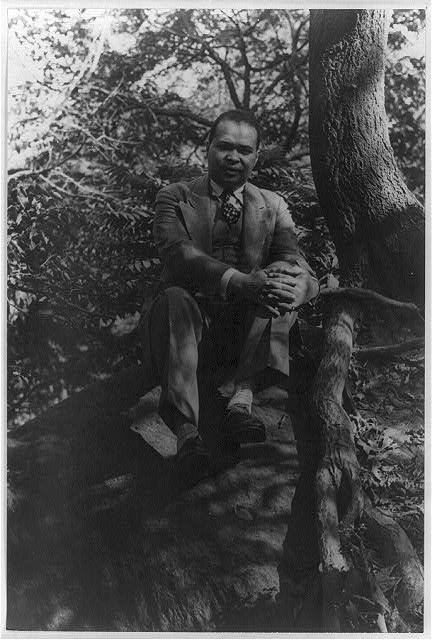
In 1925, Countee Cullen, a young star of the literary movement that came to be known as the Harlem Renaissance, was awarded the Poetry Society of America’s Witter Bynner Undergraduate Award. That same year, he graduated from NYU and published Color, his debut volume of poems. Major Jackson, the editor of the recently published Countee Cullen: notes in his wonderful introduction that Color sold two thousand copies in its first two years and that “as a result of his resolve to master the high literary tradition of poetry, Cullen emerged in the mid-1920s critically acclaimed by both black and white readers.”
Tomorrow at 3 pm, the Poetry Society of America and the Library of America present Yet Do I Marvel: ATribute to Countee Cullen just steps from Cullen’s grave in the 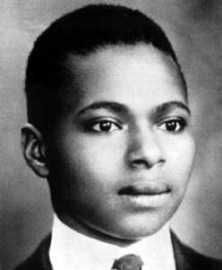 Bronx’s Woodlawn Cemetery, also the resting place of such luminaries as Herman Melville, Damon Runyan, Miles Davis, Irving Berlin, W.C. Handy, Judy Garland, and Joseph Pulitzer. The 400-acre rural-style cemetery is also a magnificent urban public park, easily accessible by New York subway at the last stop on the #4 line. Major Jackson, Rowan Ricardo Phillips, and Robin Coste Lewis will read poems in tribute to Cullen, with musical performances by the mezzo-soprano Alicia Hall Moran joined by guitarist Brandon Ross. For more details, check out the PSA’s event page here. We’ll be posting poems from the new volume over the weekend, beginning with his “Yet Do I Marvel”:
I doubt not God is good, well-meaning, kind,
And did He stoop to quibble could tell why
The little buried mole continues blind,
Why flesh that mirrors Him must some day die,
Make plain the reason tortured Tantalus
Is baited by the fickle fruit, declare
If merely brute caprice dooms Sisyphus
To struggle up a never-ending stair.
Inscrutable His ways are, and immune
To catechism by a mind too strewn
With petty cares to slightly understand
What awful brain compels His awful hand.
Yet do I marvel at this curious thing:
To make a poet black, and bid him sing!
(From Countee Cullen: Collected Poems, The Library of America, 2013, ed. Major Jackson. Poems © Amistad Research Center, Tulane University. Reprinted by permission. Photo via Wikimedia Commons)
If you’re in CA, you can go get gay married RIGHT NOW! Yaaaaaaay!!! http://t.co/S5QvkuTmXb #loveisequal
— Morgan Romine (@Rhoulette) June 28, 2013
Alyssa wonders if the passing of James Gandolfini marks the end of the Anti-Hero Age of television:
The anti-hero genre Gandolfini made popular has soldiered on in the years since Tony Soprano flipped to “Don’t Stop Believing” on the jukebox and Gandolfini went on to play generals, CIA directors, and kind-hearted monsters, leaving space for the legend of The Wire‘s Omar Little, the pathos of Mad Men‘s Don draper, and the rise of Breaking Bad‘s Walter White. But as Gandolfini is laid to rest, anti-hero television is showing some decided strain. If the purpose of The Sopranos was to ask how far we could sympathize with a man like Tony Soprano who was a criminal and the head of a family, a serial cheater who also loved his children, and a man whose closest friendships could end in blood and be bound up by murder, maybe in the intervening years, we’ve found our answers, and it’s time to move on to other questions.
In a later post, Alyssa ventures as to why few female anti-heroes exist:
There really isn’t an equivalent framework available for women, who get penalized rather than rewarded for displaying masculine traits like aggression, physical force, ambition, or selfishness. Efforts to create female anti-heroes with masculine qualities like Damages’ Patty Hewes (Glenn Close) have failed because those characters are initially seen as evil rather than admirable. And trying to make anti-heroism work in a distinctly feminine way, by giving heroines characteristics like weakness, indecisiveness, or self-absorption, as has been the case with Girls, doesn’t quite land either. Shows with difficult female heroines have to travel in a different direction than shows about difficult men do, dismantling distaste for their female characters and building sympathy for them, rather than moving toward a moral revelation about how we’ve fooled ourselves by worshiping that man.
Reason interviews a DC Rabbi who is opening a medical cannabis dispensary about the challenges facing his business, despite its legality under local laws:
Meanwhile, Walter Hickey chats with Kayvan Khalatbari, the owner of the “second oldest marijuana dispensary in all of Colorado,” about the importance of well-established local regulations:
As far as federal intervention, we haven’t had any in Colorado because it is the most regulated. You look at a state like California, the reason they’ve had such issues is they have no framework. They’re not vertically integrated, they have no clue where this product comes from, and there’s no oversight to it. You’ve got people growing in their homes and in their backyards and selling to these centers, that’s why they’ve had all these raids, that’s why they’ve had all these issues, there’s very little oversight even on a local level. Here in Colorado, we’ve got the most regulated system in the world. The only intervention we’ve had federally has been through IRS audits, those have not been debilitating to businesses. …
The other way they’ve gotten involved is by sending letters to places within a thousand feet of schools. While in California where they go in and raid these places, what they say in the letter is you have 45 days to move to another location. That’s the feds playing nice. In other states — Massachusetts, New York, Illinois — they’re going to be even more regulated than Colorado. I think that we can expect — hopefully, knock on wood — they’re going to to be pretty left alone.
Robert Bateman believes that the above exchange shows “what ‘Congressional Oversight’ is supposed to be about”:
Tammy Duckworth, who lost both legs and had her arm sewn back on, mostly, lays it down. A businessman is called out. It seems his company got something like $500 million in contracts from the government, primarily because his company was a “small business, disabled veteran owned.” His disability? When he was in prep-school, he twisted his ankle playing football. The prep school was the one at Monmouth, which is the feeder for West Point, but if you come in from civilian life, it has no military obligation at all. …
Representative Duckworth, who knows something about sacrifice to your nation, tears this man a new orifice. And I, for one, would ask that everyone, regardless of politics, forward the clip. This man, and those like him, hurt us.
RedState’s streiff blames the system, not Braulio Castillo:
Stipulated: the VA system is broken. Stipulated: an industry exists to help veterans get a VA awarded service connected disability rating. Stipulated: the military services are a part of that system. Regardless of what “Doctor” Duckworth might think of Mr. Castillo’s injuries, the facts are that he applied for the disability rating and the VA granted him that rating.
Marc Herman attempts to sort out why Castillo’s VA disability rating is higher than Duckworth’s:
How did Duckworth’s terrible injuries—she was hit with a rocket-propelled grenade—justify a lower VA disability benefit than Castillo’s old football knock? Well, the GAO has looked into how the VA assigns disability ratings several times over the past few decades, most recently late last year. It found the system to be pretty much a disaster, which is significant in a country where 2.4 million people have served in conflicts over the past decade-plus. Duckworth notes that the average wait for a disabled soldier to get a VA review of his or her injury is nearly nine months. … As long ago as 1988, the GAO looked into the matter, and found that the disability assessment system hadn’t been broadly updated since 1945. …
What sort of conditions might have shown up in a medical chart after 1945 but not before? Anything they’d invented by the time of the Vietnam war, say. Helicopters, for example. Or Agent Orange.
“Today, we recognize that French and Portuguese are different languages,” writes R.L.G., “but Arabs are not often sure (and are sometimes at odds) about how to describe ‘Arabic’ today”:
The plain fact is that a rural Moroccan and a rural Iraqi cannot have a conversation and reliably understand each other. An urban Algerian and an urban Jordanian would struggle to speak to each other, but would usually find ways to cope, with a heavy dose of formal standard Arabic used to smooth out misunderstandings. They will sometimes use well-known dialects, especially Egyptian (spread through television and radio), to fill in gaps. …
In Europe, we call “French” and “Spanish” “languages”, but in Arabic, we call these varieties “dialects”, despite the lack of mutual intelligibility. Some linguists make the point bald: these are different languages, they say. But Arabs themselves consider Arabic a single thing, with local variety. All educated Arabs learn the Koranic-based language that linguists call “modern standard Arabic”. It is used in political speeches, news broadcasts and nearly all writing—but nobody speaks it spontaneously in the marketplace or over the dinner table. Most people struggle to write it correctly.
 The Dish