
Goderich, Ontario, 12 pm
Goderich, Ontario, 12 pm
James Somers questions the value of his field:
We call ourselves web developers, software engineers, builders, entrepreneurs, innovators. We’re celebrated, we capture a lot of wealth and attention and talent. We’ve become a vortex on a par with Wall Street for precocious college grads.
But we’re not making the self-driving car. We’re not making a smarter pill bottle. Most of what we’re doing, in fact, is putting boxes on a page. Users put words and pictures into one box; we store that stuff in a database; and then out it comes into another box. … I do most of that work with a tool called Ruby on Rails. … And the important thing to understand is that I am merely a user of this thing. I didn’t make it. I just read the instruction manual.
Update from a reader:
I’ve been a web developer since the late ’90s. James Somers is accurately describing a small percentage of the web development world that is unfortunately blown out of proportion by lazy sensationalist writers. While I am sure that there are people burning VC money on lavish salaries for guys to put boxes on pages that’s not how it goes where I work. But hey, Somers is an expert who works in the industry so obviously his take on it must be accurate, right?
As Mr. Somers has observed in response to being called out for his poorly-written screed, there are a lot of companies out there doing real work, making products that perform valuable and necessary services, and without skilled web developers that wouldn’t be possible. Mr. Somers also falsely implies that all it takes to succeed in this field is the ability to read a manual. That’s a bit like saying all it takes for an attorney to be successful is to have the ability to read a law book, or for an accountant to be successful the ability to do math. Where I work the developers have to actually know how to think and solve problems, and they must pass non-trivial coding tests to get hired. It’s damn tough to find qualified applicants for our numerous open engineering roles, where we wade through dozens of resumes from wannabe web devs to find the few who know what they’re doing.
Another:
The thing about programming is if you’re good at it, it’s gonna be really hard to imagine why other people aren’t. There’s this problem that a lot of companies use to test candidates, writing a program that can play FizzBuzz, and a shockingly large number of applicants fail it. As far as I’m concerned you should be able to do that on your very first day programming, but there you have it. I suspect something similar is going on with Somers, along with the all-too-common refrain that if it’s not ground-breaking it must not be worthwhile. Even if he were right, there are still a lot of people in the world who need boxes put on their webpages and clearly not everyone can do it for themselves. (Otherwise, they wouldn’t pay a lot of money to hire web developers to do it for them.) Sometimes these boxes are in the service of something really important and sometimes they aren’t, and that’s completely irrelevant to whether web developers should be making that much money making them. They make that much money because their skills are in demand and supply is scarce. Either programming is harder than we think or other people have mysteriously failed to catch on.

[Re-posted from earlier today]
Well, we don’t yet quite know what’s in the works – but once you start arming one side of a civil war, you become part of that civil war; the other side may target you; and as this sectarian conflict deepens across the region, the US will be seen as a Sunni power fighting Shiites. I cannot think of a worse policy position for this country – to take stand on the sectarian fault-line of the Muslim world and back one side over another. You think the other side won’t notice? You think Americans wouldn’t be targeted for this kind of meddling? Let Putin get bogged down in this hell, if he remains so 19th Century he feels he must. But we should have zero interest in that ancient religious dispute; zero.
And you can say you’re only arming them with anti-tank weapons and the like. Ben Rhodes was very careful not to say too much. But of course he did say far too much. Once you have committed to one side in a civil war, you have committed. The pressure from the neocons and liberal interventionists to expand this war will only increase – because either you fight to win or you shouldn’t fight at all. Yes, it’s the same coalition that gave us the Iraq catastrophe.
My strong view, vented last night as I absorbed this stunning collapse of nerve, is that we shouldn’t fight at all. We are damn lucky to have gotten every GI out of Iraq, and the notion of being sucked back into that region again – and to join sides in a sectarian conflict – is a betrayal of everything this president has said and stood for. It’s a slap in the face for everyone who backed him because he said he wouldn’t be another Bush or McCain or Clinton. If he intervenes in Syria, he will have no credibility left with those of us who have supported his largely sane and prudent foreign policy so far. Libya was bad enough – and look at the consequences. But Syria? And the entire Middle East? Is he out of his mind?
And can you think of a dumber war than this one?
The man who said he would never engage in a dumb war is apparently preparing to join the dumbest war since … well, Iraq. And by the way: who would you rather have in control of chemical weapons – Assad or the al Nusra brigades? Because it will be the al Nusra brigades who would seize the country if Assad falls. And you think those fanatics have the slightest loyalty to us?
One reason I supported Obama so passionately in 2008 and 2012 was because I thought he understood this and had the spine to stand up to drama queens like McCain and armchair generals like William Jefferson Clinton. But it is beginning to appear that this president isn’t actually that strong. We voted for him … and he’s giving us Clinton’s and McCain’s foreign policy. If Cameron and Hollande want to pull another Suez, for Pete’s sake be Eisenhower – not Kennedy.
My cri de coeur is here. Don’t do it, Mr President. And don’t you dare involve us in another war without a full Congressional vote and national debate. That wouldn’t just be a mistake; it would be a betrayal.
(Photo: Saul Loeb/Getty.)
Chrystia Freeland asks today’s CEOs to take a lesson from Mark Mizruchi’s book The Fracturing of the American Corporate Elite, which tells the story of the Committee for Economic Development, a group of “engaged, moderate businessman from across the country” formed in 1942:
In order to maintain the system from which their privileges derived, they believed it would be necessary to attend to the welfare of the broader population. This meant supporting a high level of employment, the alleviation of poverty, the amelioration of racial disadvantage, and the provision of sufficient purchasing power in the population to consume the goods that American business was so proficient at producing.
This was the creed of the nation’s most influential corporate leaders, a group that supplied Cabinet secretaries to both Republican and Democratic Administrations. Today, with so much of the national economic conversation consumed by the budget deficit and which middle-class entitlements need to be cut to reduce it, that platform would place you on the left wing of the Democratic Party, and no leading business organization would advocate it.
Christopher Flavelle, meanwhile, is bothered by today’s chief executives “squandering their influence” by promoting partisan ideas rather than bridging the gaps:
The Business Roundtable, an association of chief executive officers of the largest U.S. companies, held a lunch for reporters this week on what’s wrong with the economy. A better question might be what’s wrong with the country’s chief executives.
In the face of persistently high unemployment and slow economic growth, the two executives hosting the lunch (the Roundtable insisted they not be identified) didn’t talk about this year’s government spending cuts, the best course for monetary policy or even reducing regulations. Instead, they talked about their plan to cut Social Security and Medicare, which they called a drag on economic growth. …
If business leaders really wanted to shore up Medicare, they could throw their weight behind cost-cutting mechanisms that are already in law but face enormous political opposition, such as the board of experts charged with limiting the rise in Medicare spending to just 1 percent more than gross domestic product growth. If they really wanted to ensure Social Security’s solvency, they could support eliminating the cap on income subject to the Social Security tax, which now stands at $113,700. That the Roundtable chose instead to push ideas that even Republicans seem to have quietly shelved says more about its members than the state of debate. It doesn’t matter whether these proposals are a heartfelt but unpromising attempt to fix the economy, or simply the Roundtable providing a soapbox for its members’ views about the role of government. The effect is the same: It isn’t likely to accomplish much.
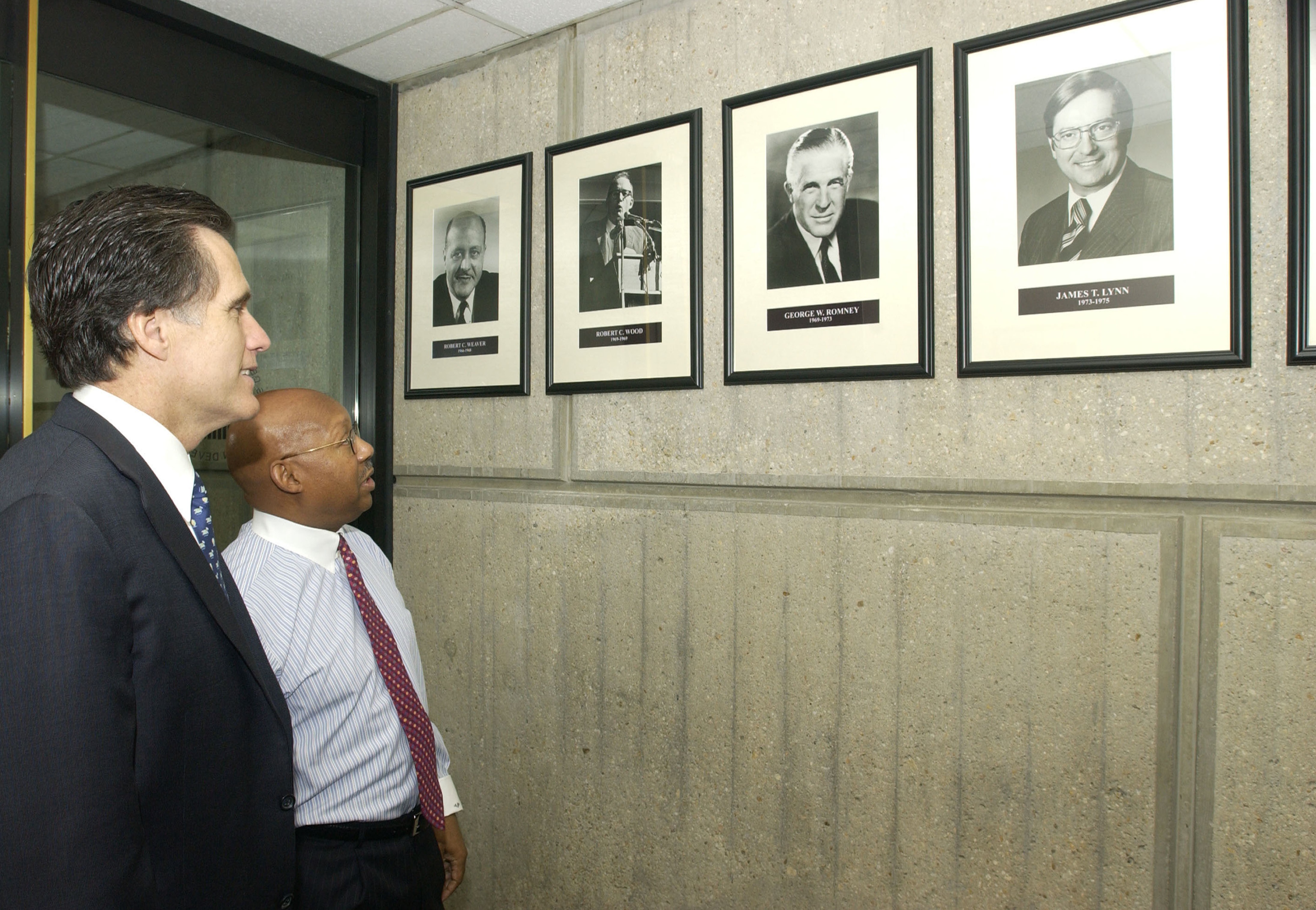
(Photo: American politician (and future Republican Party nominee for the US Presidency) Mitt Romney looks at a portrait of his father, former Michigan Governer and US Secretary of Housing and Urban Development (HUD) George Romney, with then-incumbant HUD Secretary Alphonso Jackson, in Washington DC on May 3, 2004. By PhotoQuest/Getty Images)
Following a recent court decision forcing Fox Searchlight Pictures to pay two interns from the movie Black Swan “because they were essentially regular employees,” Duncan Black applauds:
Aside from the “fetch my coffee for free” aspect, unpaid internships shut out people from less wealthy backgrounds from important, desirable, lucrative, and influential career paths.
Yglesias disagrees:
My worry would be that we’ll replace zero-salary work/training positions with what amount to negative-salary training in the form of graduate school.
Both the unpaid summer internship and the master’s degree in journalism are based on the idea that eight semesters worth of college leaves most people ill-qualified for a paying journalism job without some further seasoning. And while requiring people to spend months working for free does put a substantial barrier in the way of someone who can’t get financial assistance from his parents, requiring someone to spend a year or two paying many thousands of dollars to a school creates a much larger barrier.
Scott Lemieux objects to Yglesias’ argument:
[N]on-affluent people can borrow money for graduate school but can’t borrow money to work for free. This may not make sense, but this general framework is enormously unlikely to change. Because of this, a de facto requirement to do unpaid internships is in fact a much greater barrier to the non-affluent than the requirement to obtain a graduate degree is
Tom Jacobs explains a recent study that suggests big brand names neurologically “override” consumers’ usual patterns of judgment:
The researchers describe an experiment featuring 15 people ranging in age from 23 to 50. While their brains were scanned using fMRI technology, they were given a series of small drinks of cola. After each swallow, they rated how pleasurable it tasted on a scale of one to eight. They were told they were sampling Coke, Pepsi, River Cola (a generic brand sold in Germany), and a new drink created in a test laboratory, which was labeled T-Cola. In fact, they always received the same mixture of the first three brands. Participants rated the “Coke” and “Pepsi” samples as tastier than either the generic or the test brand. “We did not find a significant difference between Coca-Cola and Pepsi-Cola preference,” the researchers write.
Relatedly, Planet Money describes Coke’s new ad campaign in Burma, where, until recently, sanctions prevented Coke from selling its products. One of the strategies being used to sell “Coke to people who may not remember what it tastes like”:
[Shakir Moin, the head of marketing for Coke in Southeast Asia,] says he started to go back in the Coca-Cola archives. He was looking at how the company marketed its product before the internet, before TV, even before radio. Eventually he found his perfect model for Myanmar, place where nobody knew anything about Coke — Atlanta, 1886.
Back then the hot advertising trend was wall posters. Moin noticed that in the beginning, Coke didn’t use the posters to talk about friends or happiness or style. It talked about what the product tasted like. It simply described it. Moin pulled out two words in particular that would form the core of his Myanmar campaign — “delicious, refreshing.”
Those two words from the 1800s are now on the Myanmar bottle, and on the billboards and fliers that advertise the product.

An Iranian woman displays her ink-stained finger as she casts her vote in the first round of the presidential election at a polling station in Tehran on June 14, 2013. Iranians are voting to choose a new president in an election the reformists hope their sole candidate will win in the face of divided conservative ranks, four years after the disputed re-election of Mahmoud Ahmadinejad. By Atta Kenare/AFP/Getty Images.
TNC believes that Republicans suffer from a lack of diversity:
I’ve said this before but conservatives often perceive liberal attachment to diversity as a kind of “everyone’s a winner” cuddle party, where we sit around exchanging rice-cakes and hating on the military. But the great strength of diversity is it forces you into a room with people who have experiences very different from your own. It’s all fine and good to laugh at Sherrod Brown dancing to Jay-Z. But dude is outside his lane and he’s learning something. M.C. Rove should be so lucky.
If you are not around people who will look at you like you are crazy when you make stupid claims about other people’s experiences, then you tend to keep saying stupid things about other people’s experiences.
Dreher objects:
TNC’s point that we benefit from learning perspectives different from ours is perfectly valid, even anodyne. But it’s simply untrue that “diversity” in practice means what liberals say it means. If liberals meant what they said, they would push for “diversity” to include political conservatives, Southern Baptists, and others unlike themselves. How often does that happen? It seems that ”diversity” only applies to racial and sexual minorities. Conservatives understand perfectly well that the concept of diversity is an ideological construct that implicitly marginalizes them. That is the essence of the conservative resistance to “diversity” — that it’s a racket and a sham. TNC’s post prescribes diversity to conservatives to get them to be less “stupid,” and again, I agree that it’s always good to try to understand the perspective of others. But: every conservative has heard liberals say incredibly ignorant, stupid, untrue things about conservatives, but one rarely hears liberals worry about their own epistemic closure resulting from their monocultural liberalism.

San Francisco, California, 8.20 pm
Tina Casey applauds a new program that is reducing the military’s carbon footprint while providing job training to servicemembers and veterans:
The nonprofit career education organization Solar Energy International (SEI) has taken note of the surging interest in solar jobs among military veterans, and it has come up with a scholarship plan to help both veterans and active duty military jump-start new careers in the solar industry. The program is further evidence that the creation of a culture of energy awareness in the Defense Department is having a direct impact on service members and their home communities…
The need to create an energy awareness platform for deploying new technology effectively is best demonstrated by the Army’s new “The Power Is In Your Hands” energy awareness initiative, which notes that sustaining a Soldier in today’s battlefield takes more than 20 gallons of fuel per day, compared to two or less in World War II. Private sector companies are already taking note that military veterans can serve as powerful “green ambassadors” for introducing renewable energy technology to civilian communities, particularly in the solar industry, and the Army’s Net Zero program was designed in part to serve as a role model and best practices test bed for its host communities.
Jeff Spross agrees:
The new scholarship is a direct response to an uptick in demand, probably driven by the military’s big ongoing push into renewable power and energy efficiency. … [T]he military is pushing ahead with everything from geothermal projects, to electric vehicles, to solar cells that can be stitched into backpacks, clothing, tents, or that can even be rolled up or unfurled like placemats — thus relieving soldiers of the need to cart around much heavier battery packs.
Given all that, it’s little wonder there are more soldiers and veterans looking to carry those skills and experiences into the private sector.
 The Dish