What Do We Hope To Accomplish In Syria?

Prior to yesterday’s announcement, Marc Lynch asked, “What does it mean for U.S. policy to ‘work’ in Syria?” One strategy he outlined:

If Washington endorses the goal of bleeding Iran and its allies through proxy warfare, a whole range of more interventionist policies logically follow. The model here would presumably be the jihad against the Soviet occupation of Afghanistan — a long-term insurgency coordinated through neighboring countries, fueled by Gulf money, and popularized by Islamist and sectarian propaganda.

“Success” in this strategy would be defined by the damage inflicted on Iran and its allies — and not by reducing the civilian body count, producing a more stable and peaceful Syria, or marginalizing the more extreme jihadists. Ending the war would not be a particular priority, unless it involved Assad’s total military defeat. The increased violence, refugee flows, and regionalization of conflict would likely increase the pressure on neighboring states such as Turkey, Jordan, Lebanon, Israel, and Iraq. It would also likely increase sectarianism, as harping on Sunni-Shiite divisions is a key part of the Arab Gulf’s political effort to mobilize support for the Syrian opposition (and to intimidate local Shiite populations, naturally). And the war zone would continue to be fertile ground for al Qaeda’s jihad, no matter how many arms were sent to its “moderate” rivals in the opposition.

Questions For The Day

dish-giftsub-hz00-med

A reader writes:

Great idea on being able to give a Dish subscription for Father’s Day. Two quick questions: (1) the gift doesn’t automatically renew, right? To be sure, I have no doubt that your blog would be worthwhile in the years to come, but I’m loath to sign up for too many auto-renew things, and (2): does the recipient get an email right away noting the gift? If so I might hold off until Sunday morning.

The gift subscription does not auto-renew. And the recipient receives the gift email immediately upon purchase (though in the future we hope to give readers the ability to time its arrival). So if you want dad to get his present on Sunday, click here on Sunday morning or Saturday night. It will be up to him if wants to renew in a year’s time.

Quote For The Day

It’s from Juan Cole:

Clinton compared what the US could do in Syria to Ronald Reagan’s effort against the Soviets in Afghanistan in the 1980s. But that covert operation of giving billions of dollars and high-tech weaponry to Afghan jihadis was a huge catastrophe, contributing to the creation and rise of al-Qaeda and setting the background for the emergence of the Taliban. It surely would have been far preferable to let the Soviets try to build a socialist state in Afghanistan, as they tried in Uzbekistan. The whole thing would have fallen apart in 1991 anyway. (There is no truth to the notion that the Afghanistan war bled the Soviet Union or contributed to its collapse. Soviet military spending was flat in the 1980s). The Reagan jihad destabilized both Afghanistan and Pakistan and left us with a long term terrorism problem. We let the Soviets alone in Kazakhstan, and we never worry about today’s Kazakhstan.

You never, ever want to encourage the rise of private militias and flood a country with high-powered weaponry.

Unless you’re John McCain. What Bill Clinton did in backing McCain – and his wife’s neocon instincts – was a real case of the establishment fighting back. But that establishment – including both Clintons and McCain – backed the Iraq catastrophe. Funny they talk about Bosnia and Afghanistan in the 1980s but never mention that, isn’t it?

Obama’s Betrayal On Syria: Your Thoughts

SYRIA-CONFLICT

A reader writes:

I doubt the use chemical weapons was the sole “red-line”. My step brother is 82nd Airborne and he’s been drilling in preparation for Syria since last fall. I realize that sometimes we prepare for battles we’ll never fight. But he’s pretty certain we’re going in.

I’m with you – this is very concerning. I supported Afghanistan and the Iraq invasion. In retrospect, I believe invading Iraq was a mistake and not just because of the absence of WMD. On a larger scale, I believe the original sin in the War on Terror was the original authorization of the use of military force with no sunset provision or geographical limitation. We’ve decided to wage war against a tactic. I think that any president, regardless of party, will be tempted and strongly encouraged to maintain this perpetual war. And it is this perpetual war combined with advances in communication technology that is eroding our rights. As much as I respect Rand Paul, I wonder if even he could resist the temptation to continue this misbegotten war. No doubt Hillary will continue it. McCain would have continued it. And it’s no surprise to me that Obama has continued it. Only someone who can resist the temptation to punch back when we’re punched by radical islamist will stop this cycle. But I have no idea who that person is.

(To protect my step brother, please don’t publish my name … but I guess the NSA already knows.)

Another reader:

You asked: “Is there a conceivably dumber war to intervene in than Syria’s current civil one? I can’t see one.” I can: A war with Iran.  Consider this:

Right now Iran is going through their elections which have been widely derided as a “selection” because of the fraudulent nature of the whole process.  With the main opposition leaders silenced, this round may not turn into a rerun of the Green Movement but it’s definitely going to keep tensions simmering and probably stoke a fair amount of unrest.  In the past, one of the main ways that Iran has dealt with this is by playing around with its nuclear program and lambasting the West.

Now, suppose they follow that same script and Netanyahu starts to make noises towards military action against them.  In the past, Obama has been able to make the necessary promises to Netanyahu to stop him from being an idiot, but if Obama went back on his word in Syria because of the obvious quagmire, what assurance does Netanyahu have that Obama wouldn’t do the same thing to him?  It becomes much more likely for Israel to make a strike on Iran, and if that happens, we’d certainly get drawn in. I would submit that this is not at all a far-fetched possibility.

Another:

While I too don’t agree with arming Syria and ramping up our involvement there, one argument I’m not sure I see as being wholly relevant is your assertion that we shouldn’t be seen “(taking) a stand on the sectarian fault-line of the Muslim world and back one side over another.” This is true in principle, but in practice, our involvement in Syria isn’t what has already shown to the Arab world where we stand.

Who are the Shi’a’s in Syria that we are ostensibily fighting a proxy war against? Iran and Hezbollah. Does anyone really think that we weren’t already engaged in a shadow war with them? Through our loud support for Israel in the face of Hezbollah intimidation, through the sanctions we’ve inflicted on Iran, and our public assertions that we won’t tolerate them holding a nuclear program? Does anyone think that by having Saudi Arabia, Qatar, and Jordan as our three closest partners in the region that we haven’t already thrown in our hat with Sunni powers against Shi’a powers? Now, our complicated relationship with the Shi’a regime we helped prop up in Iraq complicates our relationship to the broader sectarian conflict, but no one has ever accused the United States’ relationship with the Middle East as not being rife with contradictions.

I think that arming the Syrian rebels is a mistake that opens the door for further mission creep, and that we are trying to take control of a situation we have no way of controlling. However, I don’t think that arming the rebels says anything new about our take on the game of power politics going on in the region. On the side of Assad are Iran, Hezbollah, and a Russian government that has actively sought to undermine our diplomatic initiatives. It won’t break new ground to say that we are coming out on the side of the Syrian rebels in this sectarian war when that has been the policy all along. It’s a different strategy, but it’s a policy shift meant to achieve the same ends that we’ve been actively pushing for behind the scenes for two years.

Another:

I found Bill Clinton’s comments on Syria yesterday shocking – feckless, narcissistic and condescending. He actually compares Syria to Afghanistan in the ’80s, as an argument for intervention, implying that if we’d only handled the war’s aftermath better, we wouldn’t have ended up with the mess that was a Taliban-run fundamentalist state and a murderous Al Qaeda led by our former BFF Osama bin Laden. It boggles the mind.

Another disagrees with my stance:

You make it sound as though President Obama just ordered 500,000 troops to parachute into Damascus by noon tomorrow. As far as we know, he has only agreed to ship arms – guns and stuff – to the ragtag Syrian rebels. I’m as wary of Middle Eastern involvement as you. However, if there’s ever a time to intervene in such a God-forsaken place, it’s when a dictator is using chemical weapons against his own people. That is evil and brutal by any calculation. Personally, had I been in the Oval Office, I would have ordered Daisy Cutters into the bedroom windows of every presidential palace in the country. Shipping a few thousand M16s and hand grenades? Humanitarians should be outraged at the flaccidity of this response.

Obama is not stupid. He knows his public is war weary and not willing to get embroiled in another Middle East quagmire. But he also knows that the killing in Syria is fundamentally, morally wrong. Still, this looks to me like a half-measure.

Am I all that thrilled about it? Nope. But I also recognize that there comes a time when a President believes that some level of intervention is the right – or the human – thing to do. He drew a line in the sand (at chemical weapons!), and is now tip-toeing into something that can be construed politically as action. I am only sad for the innocent men, women and children, who have been gassed by their own leader, for whom this “betrayal” you speak of is far too little, too late. I fear that this won’t change a thing in Syria, let alone the evil bastard who currently runs that shadow of a nation-state.

Of course, there may be a political calculus here: The McCain Wing of the GOP (whose fissure with the Rand Paul faction is turning into a full blown fault line by the day) has been screaming at him to “arm the rebels” since long before the election. Now he can say, “What else do you want? American boots on the ground? Really?” Is there some meep-meep potential here?

Another is also trying to stay positive:

Let me be clear that this is a reading based on hope, and that I think your reading of a slow cave to the imperialists is as likely or more likely to be the accurate one. The hopeful look for Obama is that he sees diplomacy and force through a completely different lens than the Bush administration did (and than Clinton and McCain do). Under Bush, diplomacy was a fig leaf. It was something you did in order to check the “tried diplomacy?” box before going to the UN and declaring that you were engaging in warfare after having “exhausted all other options” or some other white lie. All of the real action happens with boots on the ground, and if you don’t push over a government or kill some people, then nothing real happened.

If Obama is different, and I still have some hope that he is, force is a very heavy and unwieldy tool in the diplomat’s toolbox. Diplomacy, rather than a fig leaf, is the primary channel through which everything else, including force, operates. In the chess game that is trying to unwind the conflict in Syria, arming the rebels is akin to advancing the bishop into an attacking position. It’s something you don’t do lightly, but it’s also not the endgame.

If this reading is right (and again, I’m not convinced it is), then what Obama is doing is undergirding the credibility of the “credible threat of force” stick without overcommitting it, with the end goal remaining a diplomatic solution. I don’t agree with this tactic, and I don’t like it at all, but in it I see some hope that this isn’t the beginning of another imperialistic adventure.

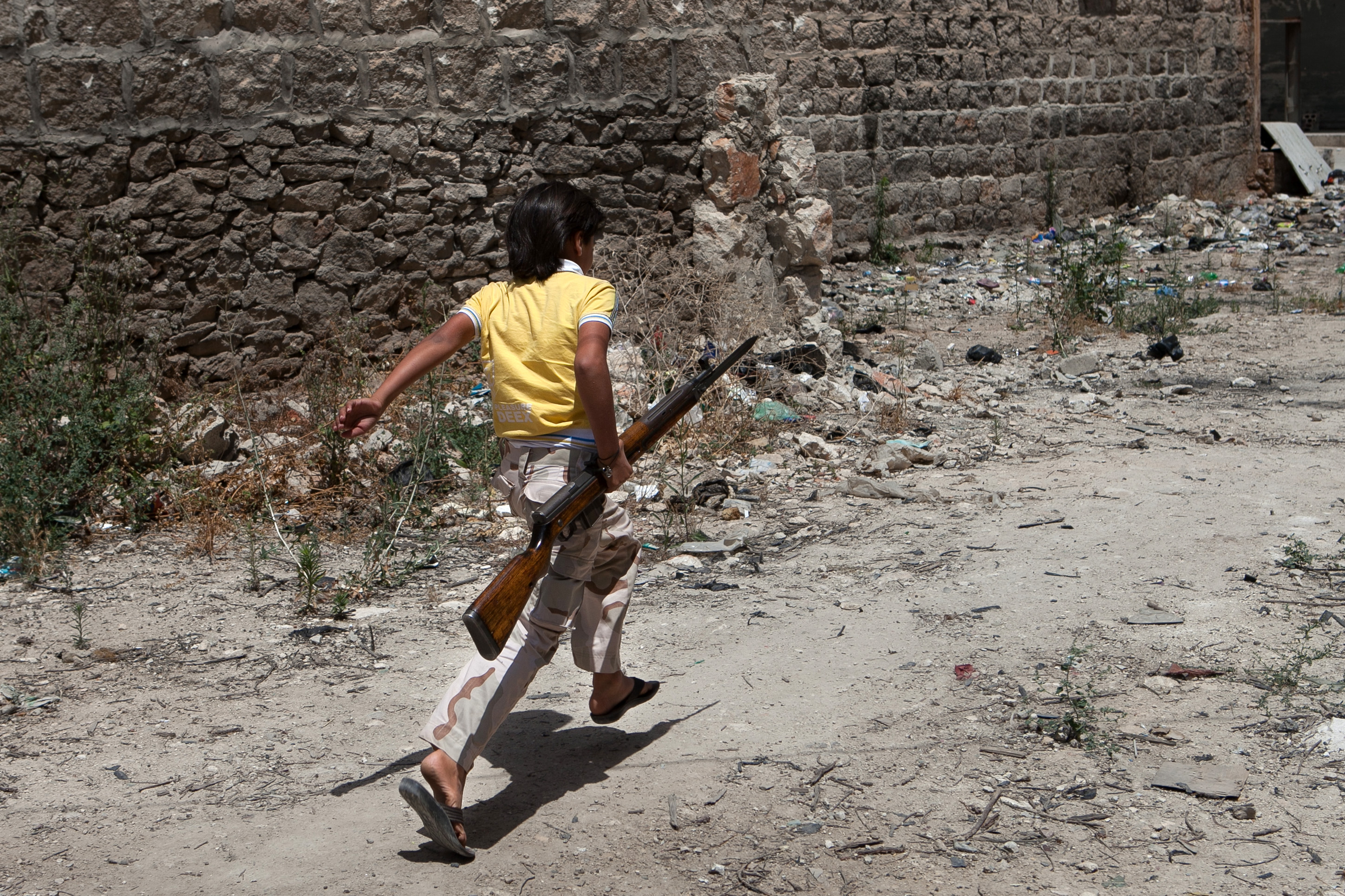
(Photo: A Syrian young boy runs holding an old rifle as he helps fighters belonging to the ‘Martyrs of Maaret al-Numan’ battalion on June 13, 2013 in the northwestern town of Maaret al-Numan in the Idlib province. By Daniel Leal-Olivas/AFP/Getty Images)

Iranian Election Update

https://twitter.com/Najmeh_Tehran/status/345523444387049472

https://twitter.com/Omid_M/status/345507376297832448

https://twitter.com/GEsfandiari/status/345545597866082304

Karim Sadjadpour reads tea leaves:

Those who trust the integrity of the electoral process — an increasingly small group — foresee a run-off between Rowhani and Ghalibaf. Those who believe that Khamenei’s decision is paramount project Jalili as the obvious winner. And perhaps for the first time, Khamenei may see his interests in conflict with those of the Revolutionary Guards. If past is precedent, however, there’s one thing we do know: predicting anything about Iran’s opaque politics is a fool’s errand. And, having never progressed beyond college calculus I am no Nate Silverzadeh. But if there’s something that seems like a good bet, it’s that the Supreme Leader will remain supreme.

Shervin Malekzadeh offers an aerial view:

It is not lost on Rouhani’s supporters (nor on Rouhani himself) that some 34 years after the revolution and the consolidation of clerical authority in Iran, voters are turning to the sole cleric on the ballot for change. That Rouhani, a regime stalwart, the close companion of Khomeini, and the former head of Iran’s National Security Council today embodies the leading edge of reform speaks to the peculiarities of Iran’s democracy. The righteousness of the revolution is at stake, as it always is, during these elections. Iran seeks not only to stand against the United States, but to prove that its version of democracy, Islamic democracy, is the true version. Whether or not this impulse is sincere, the aspiration leaves the regime exposed to reinterpretations of what it means to be righteous, democratic, and Islamic. The creation of new narratives like Rouhani’s occurs because of pressure from the Iranian public. The hustle for votes means finding and accepting new ideas into the old folds of ideology. Outside of another revolution, which is unlikely to occur, this is a considerable accomplishment.

Live blogs covering today’s voting at the Guardian and Enduring America. Al Jazeera is polling the tweets. This week’s previous Dish on the election here and here.

What’s A Bisexual Anyway?

A reader writes:

Thanks for pointing out that LGBT as an acronym refers to so much that it refers to nothing. And I totally do think that there are a large number of “closeted bisexuals” out there, if you define “bisexuality” as anyone who has had a same-sex experience and enjoyed it. That describes me perfectly. I date women, and am romantically interested only in women. I don’t even like sex with men 1-on-1. But sometimes I do see a guy and think he’d be fun to share a girl with, and sometimes in the heat of an encounter like that, I want to play with him directly as well. And I do. And I like it. And nobody in my life, not my family or closest friends, knows that about me.

Here’s the thing, though: I’m not “closeted”.

At least, not in the way a gay kid in Arkansas with an abusive, redneck father is “closeted”. My family consists of hippie liberals from the Pacific Northwest. They’d probably be thrilled that I was so open and free, especially since I’m probably still going to marry a girl someday. I don’t tell anyone because whom I fuck and how is my own business and nobody else’s. I don’t need support. I don’t want to be part of a sexual community. I just want to do what I want to do and not get any shit about it, which is 100% possible if I just keep it to myself.

I get the sense that there are TONS of people out there like me. Most of the guys I’ve been with are also in relationships with women, and “identify”, so far as they need to, as straight. I messed around with several guys in high school who are married with kids. I also knew TONS of women in college who drunkenly messed around with their friends sometimes, and are now married to guys. Are all of these people bisexual? Or is it more likely that any set of letters and specific categories cannot describe the fluidity of a human’s sexuality over time? I’d vote for the second.

This might make a good thread idea, no? Sort of a sexual “tales from the cannabis closet”. Just a thought. Thanks for airing such a frank discussion.

Beware The Oxymoron

You know, like “sponsored content” or “coercive interrogation.” I booked my Virgin Atlantic flight on a budget (now that I’m not earning a salary from blogging), and decided that I’d try a class called “Premium Economy.” It sounds like somewhere between coach and first class. What it actually means is they charge you almost as much as first class and treat you worse than coach. The check-in line was 20 minutes (in coach, it was around five); at security, you went to the back of the line; they turn you away at the lounge; and although Virgin Atlantic makes a big deal about offering wifi, none was available for more than six hours. When you’re a blogger, that’s not a good thing.

But I’m sipping tea and eating gluten-free toast and marmalade at my brother’s right now, so all is well.

Just get coach next time. Seriously.

Obama’s Betrayal On Syria: Reax

Zbigniew Brzezinski struggles to understand the president’s strategy:

Larison analyzes the news:

This move will almost certainly prolong and intensify the conflict, which will mean that even more Syrians on both sides of the war will suffer and die. It’s a serious mistake, and one that will probably lead to even bigger ones in the future. Because it will prove to be ineffective in changing the course of the war, as opponents of this measure have said for years, it will serve as an invitation to further escalation in the coming months and years. The Syria hawks agitating for increased involvement have managed to pressure the administration into this because of Obama’s own unforced errors and because there has been practically no one to stop this from happening. Let this be a lesson that there is no policy measure so ill-conceived or unwise that the constant, repetitive demand for it in public won’t eventually succeed.

Massimo Calabresi thinks prolonging the war may be the point:

The Assad regime is increasingly relying on Hezbollah to fight throughout the country. The rebels for their part are relying on jihadist and al Qaeda allies to fight back. Keeping two of the United States’ most active terrorist enemies fighting each other might be seen in some circles as not such a bad thing.

Drezner agrees:

To your humble blogger, this is simply the next iteration of the unspoken, brutally realpolitik policy towards Syria that’s been going on for the past two years.  To recap, the goal of that policy is to ensnare Iran and Hezbollah into a protracted, resource-draining civil war, with as minimal costs as possible.  This is exactly what the last two years have accomplished…. at an appalling toll in lives lost.

This policy doesn’t require any course correction… so long as rebels are holding their own or winning. A faltering Assad simply forces Iran et al into doubling down and committing even more resources.  A faltering rebel movement, on the other hand, does require some external support, lest the Iranians actually win the conflict.  In a related matter, arming the rebels also prevents relations with U.S. allies in the region from fraying any further.

Dexter Filkins sizes up Assad and his allies:

Now that the moment for American action has come, it is very late in the day. The war in Syria is not just a humanitarian catastrophe—the U.N. said on Thursday that the death toll had reached ninety-three thousand. Worse, the Assad régime appears, after months of stalemate, to have gained the upper hand. This is almost certainly due to a large-scale intervention by Hezbollah, the Lebanese armed group, which has sent as many as two thousand fighters into Syria to save Assad. Hezbollah fighters were decisive in the pro-Assad force’s recent recapture of the city of Qusayr, which, in turn, is central to Hezbollah’s existence. Qusayr sits on the main road leading into Lebanon’s Beqaa Valley, Hezbollah’s stronghold, and serves as the main conduit for Iranian arms and missiles that have made Hezbollah the formidable armed group that it is. Hezbollah’s intervention has been accompanied by a massive, ceaseless airlift from the Iranian government, which regards Assad as its closest friend in the Arab world.

Drum expects that US involvement will only deepen:

The next step, of course, is to cave in to the hawks and send the rebels the antitank and antiaircraft weaponry they want. I figure, what? Another couple of months before Obama decides to do that? Then the no-fly zone. Then….something else.

And Friedersdorf has stopped “trying to figure Obama out”:

[W]hether he is deliberately trying to escalate U.S. involvement, as Sullivan seems to think, or just prolonging the slaughter in Syria, as Drezner believes, his actions will be just the latest disappointment to the anti-war liberals who helped elect him. They’ll also be another example of a president making a decision that would be better debated and voted on by Congress.

My objection to intervention in Syria here.

In Partisanship You Trust

Partisan Shifts

Seth Masket defends partisans against claims of flip-flopping in their opinions on NSA surveillance:

 In my view, it’s hard for poll respondents to evaluate NSA surveillance, or any powerful government tool, without considering who’s in charge of it. When people are asked what they think about the government having this power, they’re implicitly being asked what they think about President Obama having this power. Is it really hackish for people to be more comfortable with a governmental power if they know someone they more or less trust is going to be in charge of it? Is it hypocritical to think that police state tactics are necessary when someone who shares your values is deploying them but excessive when someone hostile to your values is deploying them? Democrats are basically saying, “Yes, this is potentially problematic, but we trust Obama to do it right,” and Republicans said the same thing about Bush.

It never really came to a vote, but when Batman developed the technology to use all of Gotham’s residents’ cell phones as a giant crime detection device, I’m sure residents as a whole would have preferred Lucius Fox running that device than, say, the Joker doing so, even if they saw the device itself as morally questionable.

Regardless, Enten finds that the administration is losing trust:

Trust in government after these scandals has been falling. In the recent NBC/Wall Street Journal poll, 55% of Americans said the IRS targeting made them doubt the “overall honesty and integrity” of the Obama administration. Only 48% of voters in Fox News poll taken after the release of the NSA information said Obama was “honest and trustworthy” – the lowest level the poll ever recorded. More than a third (35%) of voters believe the administration has been less open than previous administrations – a record high.

(Chart from Pew)