Despite a torrent of engaging and passionate dissent in the in-tray, the Dish’s readership is pretty evenly split on the implications and seriousness of the latest NSA revelations. 65 percent thought the program should continue if it prevents terror attacks; only a third deemed Edward Snowden a hero; but 80 percent worried about the future growth of such meta-data gathering. Full poll results here – and you can still vote above.
Well, that’s how Sam Harris has often described me – so I might as well repay the back-handed compliment. But what makes Sam’s work about religion so compelling is that, unlike my old friend, Hitch, he actually grasps what faith can be at its best. He doesn’t dismiss it – or its spiritual aspirations – as somehow inherently absurd. In fact he has spent years of his life exploring the possibility of sublime spirituality without God. And his argument, it seems to me, is mainly with intolerant, fundamentalist forms of religion, of which Islam is easily the most troublesome at this point in history. Glenn Greenwald recently said that Sam could feel no empathy for Muslims, that his worry about Jihadism was a function of not getting their point of view, a sweeping generalization based in tribalism. Sam cannily responds in a post worth reading and listening to at length:
Let us see where the path of empathy actually leads…
First, by way of putting my own empathy on my sleeve, let me say a few things that will most likely surprise many of my readers. Despite my antipathy for the doctrine of Islam, I think the Muslim call to prayer is one of the most beautiful sounds on earth. Take a moment to listen:
I find this ritual deeply moving—and I am prepared to say that if you don’t, you are missing something. At a minimum, you are failing to understand how devout Muslims feel when they hear this. I think everything about the call to prayer is glorious — apart from the fact that, judging by the contents of the Koran, the God we are being asked to supplicate is evil and almost surely fictional. Nevertheless, if this same mode of worship were directed at the beauty of the cosmos and the mystery of consciousness, few things would please me more than a minaret at dawn.
Sam gets it because he’s been there, having engaged in thousands of rituals and countless hours in meditation for much of his adult life. This is why he of all the new atheists was the one I most wanted to have a dialogue with. (You can read it here.)
The whole new post is full of that sum of religious and spiritual experience. But this is what he also gets:
Islam marries religious ecstasy and sectarian hatred in a way that other religions do not. Secular liberals who worry more about “Islamophobia” than about the actual doctrine of Islam are guilty of a failure of empathy. They fail not just with respect to the experience of innocent Muslims who are treated like slaves and criminals by this religion, but with respect to the inner lives of its true believers. Most secular people cannot begin to imagine what a (truly) devout Muslim feels. They are blind to the range of experiences that would cause an otherwise intelligent and psychologically healthy person to say, “I will happily die for this.” Unless you have tasted religious ecstasy, you cannot understand the danger of its being pointed in the wrong direction.
I too understand that ecstasy, having experienced it myself in my life. There was a time as I was cast adrift in my teens when I clung to doctrine even more ferociously as a bulwark against shifts and changes I could not yet master. I see this now. I didn’t then. I believed God was telling me I had to enforce countless tiny things – avoiding cracks in the pavement, painting the Crucifixion repeatedly in art class, annotating my school books with little tiny crosses, praying constantly. I never reached the total subservience demanded by Islam, but I saw enough of why that appeals to be alarmed by it.
Belief, when severed from healthy doubt, when grasped as a psychological crutch to keep reality at bay, reaches inevitably for totalism. In fact, the bewildered and conflicted may need that totalism to keep their lives under any sort of order. Think of those 9/11 mass murderers, attending strip bars, then shaving their entire bodies, then flying planes into building.
Think of the staggering sectarian carnage now metastasizing in the Muslim Middle East. Think of how total your devotion must be to do the things some Jihadists do – like hacking a person down in the street and bragging about it.
To argue that we should not associate those actions with religious extremism, but be more aware of our own alleged Islamophobia, seems simply perverse to me. But – and this is a crucial qualifier – that does not mean that ratcheting up rhetoric against this fundamentalism necessarily helps. Nor does treating their crimes as different. Nor does invading Muslim countries, or torture. We can both recognize the unique threat Jihadism represents as the Muslim world attempts to navigate a modernity beyond their control – and we can be very cool, calm and collected in deciding how best to stymie it, defuse it, prevent it.
But we will not stop it. I suspect this phenomenon – and its concurrent violence – may last as long as the savagery of the European wars of religion in the sixteenth and seventeenth centuries. The difference is that this time, our technological capacity for mass slaughter is exponentially greater than it was four centuries ago. And the likelihood of a mass-casualty catastrophe occurring at some point is extremely high. We must simply hope it happens, if it must, somewhere other than here.
(Thumbnail photo: Minaret at sunset by Flickr user Dingopup)
Sushi Yasuda, an upscale restaurant in New York City, is attracting attention for its decision to get rid of tips for waitstaff. Instead of a line for diners to write in a tip amount on their receipts, Sushi Yasuda has printed the following statement: “Following the custom in Japan, Sushi Yasuda’s service staff are fully compensated by their salary. Therefore gratuities are not accepted.” Indeed, Sushi Yasuda’s waitstaff enjoy rare stability in an industry that justifies its long-standing minimum wage of $2.13 an hour by factoring in tips. …
Sushi Yasuda’s benefit package is also a rarity in the industry. Nearly 90 percent of servers do not get health insurance through their employer, a dangerous status quo many restaurant chains have fought hard to maintain in the face of new Obamacare requirements. Other upscale restaurants have also eliminated tipping, instead using a flat service charge that can then be distributed fairly among the staff. But it remains to be seen if this practice will become the norm or stay the exception in an unjust industry.
Pareene dissects the reasoning behind Redskins owner Dan Snyder’s reported hiring of Frank Luntz to conduct focus groups on the Redkins’ controversial name:
You hire Luntz not to merely poll, but to figure out how best to sell people on something. It seems reasonable to assume that team owner Daniel Snyder, who has vowed to never change the name, is working now on how best to convince people that his team’s name is not a repellent racial epithet. Luntz’s specialty is renaming things to sound more appealing, but in this case he’ll be crafting the best possible language to use when explaining why something shouldn’t be renamed. …
That Snyder is hiring Frank Luntz suggests a certain amount of concern that nationwide blasé acceptance of his team’s name may be coming to an end.
He certainly didn’t seem to take criticisms particularly seriously before — his team’s P.R. desk has usually just pointed to a couple of polls and dismissed critics as unimportant — but now he is writing letters to Congress and working out a P.R. strategy. That’s good. It means he’s losing. But it doesn’t mean he’ll lose. The team has successfully fought public pressure for decades, and the NFL has other high-priority P.R. nightmares distracting it from taking the controversy seriously. And soon we’ll begin hearing some much more convincing arguments in favor of the name, courtesy of Luntz and whatever other high-priced professional spinners Snyder hires.
We can expect his research to reveal that most Americans don’t think the name “Redskins” is especially offensive. (A recent ESPN poll has already concluded as much.) Then Luntz can write a strategy memo advising Snyder on the most effective way to deflect the controversy. Among other things, Snyder will surely want to avoid reminding the public of the history of the term “Redskins.” Football fans love tradition. But it’s hard to root for a team named after the bloody scalps of American Indians butchered by bounty hunters.
Prince worked as a therapy dog at Portage High School in Indiana for four years before retiring this spring. To honor the pup’s service, the school opted to include him in the yearbook among all the graduating seniors and let him lead the pack of students during the graduation ceremony last Sunday.
Sarah Kliff passes along new research suggesting that being a designated driver is “[e]asy in concept but apparently a bit difficult in execution”:
About one-third of designated drivers have at least one drink while carrying the title, according to a new paper in the Journal of Studies on Alcohol and Drugs. Twenty percent, breath tests showed, had a blood alcohol level higher than 0.05, enough to impair their driving skills. … As the researchers note, this study has limitations: It was done at a set of college bars with a relatively homogeneous population. It doesn’t speak to designated driving in other situations. Still, it does suggest that there’s at least a decent-sized segment of the population that doesn’t have a strict idea of what it means to be the designated driver.
J.K. Trotter notes the novelty of the “designated driver” concept as a possible explanation:
The concept of “designated driving” is actually a fairly recent invention — it originated in northern Europe before spreading to North America in the late 1980s, via Harvard’s famous Alcohol Project — so it’s conceivable that kinks still need to be worked out. But millions of Americans have been educated about the effects of alcohol, thanks in no small part to the lobbying power of Mothers Against Drunk Driving. Indeed, the Florida study’s authors suggest that their findings “identify the need for consensus across researcher, layperson, and communication campaigns that a [designated driver] must be someone who has abstained from drinking entirely.”
Nancy Shute explains why “not legally drunk” is a bad metric for DDs to use:
In Europe, a designated driver is widely considered to be the less inebriated driver, not an abstainer. And surveys of drivers in the U.S. have found that they think it’s fine for the designated driver to drink, as long as her or his blood alcohol level is below the legal limit.
But when people’s driving skills while drinking are tested in laboratories, they start getting messed up much earlier than many people think. Some studies have found driving skills impaired with a blood alcohol level of 0.02 percent — much lower than the 0.08 percent that’s the current legal limit across the U.S. At 0.05 percent, pretty much everyone’s unable to drive very well.
Daniel Fromson heralds the nationwide rise of the craft brewery:
The pioneering “microbreweries” of the seventies and eighties—among them Anchor Brewing, New Albion Brewing, Sierra Nevada Brewing, and the Boston Beer Company—were mostly founded in California and New England. Current trends reflect this history: twenty-seven of the country’s fifty largest craft breweries are located in California, Oregon, New England, or the Mid-Atlantic (with eleven in the Golden State alone). … But [as the map above shows] from 2011 to 2012, annual production grew faster in the South than just about anywhere else, with the fastest-growing producers including Alabama (first out of all fifty states), Tennessee (fifth), Florida (seventh), and Kentucky (eighth). Other rapidly growing producers include Minnesota, Nevada, and Oklahoma.
There are now more breweries in the US than ever before – 2,416 as of March 2013 (including 2,360 craft breweries) – according to the Brewers Association (“A Passionate Voice for Craft Brewers). Compared to the low of 89 US breweries in the late 1970s, there’s been a 2,600% increase in US breweries, primarily because of craft breweries.
Robert Frost’s influence on the generations that followed him seemed limited, but the last several decades have yielded renewed interest:
Narrative was the road not taken for Modernism, and Frost’s powerful examples were ignored by the few poets who did major work in the narrative mode. … Then, in the 1980s, just when it would have been safe to declare the matter of Frost’s narrative influence dead, something unexpected happened. A new generation of American poets began to revive verse narrative, and they chose Frost as their chief model.
Born seventy years after Frost and steeped in Modernism, they felt that he had opened up possibilities for a contemporary style of narrative poetry that had never been exploited. They admired both Frost’s technique (blank verse, conversational tone, understated diction, direct dialogue) and his powerfully psychological characterizations. “The New Narrative” became one of the signature movements of the period, and a significant group of young poets emerged, including David Mason, Andrew Hudgins, Mark Jarman, Marilyn Nelson, Sydney Lea, Robert McDowell, and Christian Wiman. All explored the Frostian narrative tradition—often in strikingly different ways. Some of their poems, set in rural locations, such as Lea’s “The Feud,” McDowell’s “The Pact,” and Wiman’s “The Long Home,” pay deliberate homage to their master. Others set in urban or suburban milieu adopt Frost’s techniques to new subject matter. His approach proved both fresh and flexible—a rich vein of Modernism that had remained untouched.
Jessica Grose is disappointed by the lack of interest in treating hyperemesis gravidarum, “otherwise known as unrelenting nausea and vomiting during pregnancy, or the Kate Middleton disease”:
[W]hy is there so little information about a malady that sends around 285,000 women to the hospital every year? Fejzo says that research stalled after the 1950s, when women with severe pregnancy nausea were given thalidomide, which turned out to cause major birth defects. “After that, studies with pregnant women pretty much came to a halt. Drug companies stopped doing research and so did universities.” Even though the thalidomide scandal was more than half a century ago, the research Fejzo does is funded through the Hyperemesis Education Research Foundation, which runs pretty much on donations. She was hoping Kate Middleton’s publicizing of the disease would help the cause, but so far there hasn’t been much movement. “It’s the second leading cause of hospitalization in pregnancy,” Fejzo says, but “it’s just not thought of as a serious problem.”
Dr. Wei-Ni Lin Curry published a first-person account documenting her own use of therapeutic cannabis to alleviate symptoms of hyperemesis gravidarum (HG), a potentially life-threatening condition characterized by severe nausea and vomiting, malnutrition, and weight loss during pregnancy. (While general nausea and vomiting, colloquially known as ‘morning sickness,’ is experienced by an estimate 70 to 80 percent of all expectant mothers, approximately 1 to 2 percent are struck with the persistent vomiting and wasting associated with HG.) Curry recounts:
“Within two weeks of my daughter’s conception, I became desperately nauseated and vomited throughout the day and night. … I vomited bile of every shade, and soon began retching up blood. … I felt so helpless and distraught that I went to the abortion clinic twice, but both times I left without going through the with procedure. … Finally I decide to try medical cannabis. … Just one to two little puffs at night, and if I needed in the morning, resulted in an entire day of wellness. I went from not eating, not drinking, not functioning, and continually vomiting and bleeding from two orifices to being completely cured. … Not only did the cannabis save my [life] during the duration of my hyperemesis, it saved the life of the child within my womb.”
Most recently, survey data collected by the directors of the Vancouver Island Compassion Society (The VICS) and the BC Compassion Club and published in the journal Complementary Therapies in Clinical Practice reported that cannabis is therapeutic in the treatment of both morning sickness and HG. Of the 84 women who responded to the anonymous questionnaire, 36 said that they had used cannabis intermittently during their pregnancy to treat symptoms of vomiting, nausea, and appetite loss. Of these, 92 percent said that cannabis was “extremely effective” or “effective” in combating their symptoms. Investigators noted that although most women chose to self-administer cannabis by smoking, many (31 percent) also reported consuming hempen edibles, and eight percent reported using cannabis-based oils or tinctures.
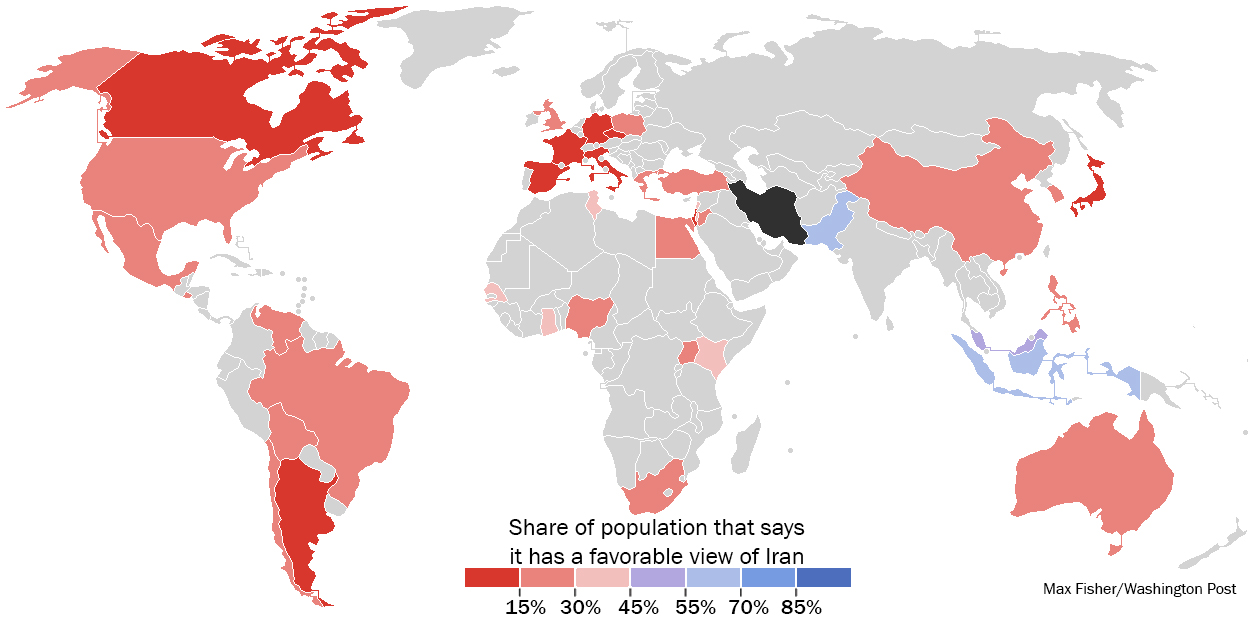
Max Fisher finds “bad news for Tehran” in the results of a recent Pew survey on views towards Iran:
Perhaps most consequential for Tehran are the negative views of Iran held in East Asia, particularly Japan and China, two crucial buyers of Iranian energy resources. While Asian economies have not joined the severe European and American sanctions against the Iranian energy industry and do not appear poised to do so soon, they do seem to be increasingly reluctant about importing from Iran.
Even the data from countries with a favorable view of Iran showed a troubling trend:
Pakistan, the one surveyed country where Iran is popular, appears to be slackening in its support for the fellow Islamic state and bastion of anti-Western resistance. The January Pew poll found that 79 percent of Pakistanis support Iran, but the new number is 69 percent. That’s still pretty high in both absolute and relative terms, but it’s hard to miss the significant quick drop in pro-Iranian attitude.


 The Dish