Poseur Alert

“What kind of hand job leaves you cleaner than before? A manicure, of course. Why does this joke work? Because of the tension between the conventional idiomatic sense of ‘hand job’ (a certain type of sex act) and its semantic or compositional meaning (in which it is synonymous with ‘job done by or to the hand’). When you think about it, virtually all jobs are ‘hand jobs’ in the second semantic sense: for all human work is manual work—not just carpentry and brick laying but also cookery and calligraphy. Indeed, without the hand human culture and human economies would not exist. So really ‘hand jobs’ are very respectable and vital to human flourishing. We are a ‘hand job’ species. (Are you now becoming desensitized to the specifically sexual meaning of ‘hand job’? Remember that heart surgeons are giving you a ‘hand job’ when they operate on you; similarly for masseurs and even tax accountants.)

I have in fact written a whole book about the hand, Prehension, in which its ubiquity is noted and celebrated.

I even have a cult centering on the hand, described in this blog. I have given a semester-long seminar discussing the hand and locutions related to it. I now tend to use ‘hand job’ in the capacious sense just outlined, sometimes with humorous intent.

Suppose now a professor P, well conversant in the above points, slyly remarks to his graduate student, who is also thus conversant: ‘I had a hand job yesterday’. The astute student, suitably linguistically primed, responds after a moment by saying: ‘Ah, you had a manicure’. Professor P replies: ‘You are clearly a clever student—I can’t trick you. That is exactly the response I was looking for!’ They then chuckle together in a self-congratulatory academic manner. Academics like riddles and word games,” – Colin McGinn, a philosophy professor who resigned last week from the University of Miami following allegations that he sent sexually explicit emails to a female graduate student. McGinn is a Dish Poseur repeat offender.

Dissents Of The Day, Ctd

This embed is invalid

Readers continue to vent their disapproval of the NSA program:

Add my voice to the throngs who find your shrugs over this week’s news distressing and unlike you.  I would argue that as a society we can’t possibly be protected 100% from persons who have decided to harm others, and that intrusive attempts to do so are neither fruitful nor worthwhile.  Stephen Walt is correct that this “making us safer” argument can and will be used indiscriminately and that the “insecurity industry” has far-reaching consequences. One of the reasons I take you seriously is your capacity to acknowledge when you’ve miscalculated.  I do hope to see such a change of heart on issues like these.  After all, it must be a little distressing to find yourself in agreement with Kristol.  Also, it would be illuminating to see a Dishhead poll, to see how many readers agree with you and how many don’t.

Poll available above. I understand the worries. They’re completely legit. But if they forbid the entire use of Big Data by government, let’s be clear what the consequences are. Those big drops in crime because of more targeted enforcement? Too invasive to allow:

The police say they are tamping down retaliatory shootings between gang factions by using a comprehensive analysis of the city’s tens of thousands of suspected gang members, the turf they claim and their rivalries. The police are also focusing on more than 400 people they have identified as having associations that make them the most likely to be involved in a murder, as a victim or an offender.

And what about the Obama campaign? They are a political organization that used vast amounts of Big Data to find specific likely voters and get them to the polls. Can you imagine the potential for abuse there? So ban it there too, I suppose. And if Big Data is inherently susceptible to abuse, then we also have to end the following:

Baseball teams like Billy Beane’s Oakland A’s (immortalized in Michael Lewis’s best-seller “Moneyball”) have embraced new number-crunching approaches to scouting players with remarkable success… And New York City has used data analytics to find new efficiencies in everything from disaster response, to identifying stores selling bootleg cigarettes, to steering overburdened housing inspectors directly to buildings most in need of their attention.

That’s from a fascinating review today of a new book, Big Data. Again, in every single case, private or public, someone could manage somewhere to abuse it – for a personal vendetta, or political smear campaign, and on and on. And this collapse of what we once called “privacy” is simply going to grow and grow while outraged defenses of the privacy we once enjoyed, while fully understandable, will become, if they are not already, effectively moot. That’s the conundrum, as Ross recently observed. It’s not a totalitarian police state; it’s a soft ubiquitous, private and public surveillance state that we either participate in or withdraw from society altogether. I don’t like this much, but I fail to see how it can be stopped. And it makes something like the Fourth Amendment in desperate need of re-interpretation. I guess what I’m saying is that the data is there and always will be. The question is simply who has access to it. If only private entities do, then we need to stop all the obviously productive and efficient innovations that Big Data has produced to make government better. Yes, we absolutely need to have firmer safeguards, and we need to end the secrecy about this. But the notion that we can somehow protect ourselves from all of this seems utopian to me. Another reader:

In this post you responded to a dissenter who expressed concern about the reach about the PRISM programBos: “As long as you’re clear about what you’re doing and will not complain about the government next time a Tsarnaev sets off a bomb, fine.” That might be a fine argument except you seem to have forgotten that the PRISM program was in effect before the Boston bombing – and the bombing still occurred. So, if we have to make those “hard choices” between security and privacy, what exactly have we gained?  It appears that Boston would have happened even if no one ever thought of PRISM.  The decision wasn’t between security and privacy; it was about privacy and no privacy. But, even if Boston didn’t invalidate the usefulness of PRISM, your argument points to its even greater danger.  Wait until a child is abducted, a drug lord is on the loose, a fraudster is preying upon the elderly.  The cries demanding we stop tying the hands behind the backs of authorities will begin and we’ll hear the same refrain:  If you’ve nothing to hide, what’s the problem?  “As long as you’re clear you won’t complain the next time a kid goes missing, fine.” And finally, I’m not comforted in the fact that Congress approved the program.  I have no doubt that the program fits within the bounds of legality given the collusion of the three branches of government, but given the lack of credibility and trust the American people have in Congress wouldn’t it be the right thing to do (even if not the legally mandated one) to be a bit more explicit in exactly what we as Americans were giving up?

Another:

Let’s think about what’s happened in the past few years. Bradley Manning managed to illegally copy and distribute massive amounts of classified data to a guy who doesn’t exactly seem like a fan of the US. We have the IRS picking out conservative groups for extra attention. We have a federal official leaking information about North Korea to James Rosen. We have the most recent massive leaks. This is not a bureaucracy that exactly has a comforting track record of late. This is who you trust to keep our information private?

Another:

Although I vehemently disagree with the massive-scale data mining being undertaken, that’s not what concerns me about your reaction. What I find especially disturbing is that after all we have now discovered, you still seem to be buying the government line. In March, DNI James Clapper emphatically told Congress that the intelligence community wasn’t data mining domestically. Now we know that was a bald-faced lie (if only he had been under oath…).  Now, however, when President Obama says that the content of our emails is not being read, you believe him … um, why? No matter how many times President Obama or his aides lie, you seem ready to believe their mitigating explanation.

Ending the absurd secrecy around this would avoid those legally mandatory lies. And I favor ending the secrecy.
Ask Fareed Zakaria Anything: Convincing China To Play Nice

Fareed offers some thoughts on the best and worst things the US could do in its relationship with China:

Recent Dish on the US/China summit here and here. Last week, Fareed also shared his thoughts on the situations in Turkey and Syria. His show, Fareed Zakaria GPSairs Sundays on CNN, as well as via podcast.  Zakaria is also an Editor-at-Large of TIME Magazine, a Washington Post columnist, and the author of The Post-American WorldThe Future of Freedom, and From Wealth to Power: The Unusual Origins of America’s World Role. Our Ask Anything archive is here.

About That Huge Public Outcry, Ctd

Bouie thinks that the American public’s attitude toward NSA surveillance shows that “there isn’t a large constituency for civil libertarian ideas”:

We have concrete examples of what happens when the federal government doesn’t make anti-terrorism a priority. The United States isn’t a stranger to civil liberties violations, but overwhelmingly, they’ve targeted the more marginal members of our society: Political dissidents, and racial and religious minorities. For the large majority of Americans, the surveillance state is an abstraction, and insofar that it would lead to abuses, they don’t perceive themselves as a target. And, in general, it’s hard to get people motivated when there isn’t a threat. Which is why it’s not a surprise to find that most Americans support the National Security Agency’s program of mass data collection. …

For civil libertarians to make surveillance into a political issue that will move votes, they’ll have to turn the abstract issue into something more concrete, cut through partisanship, and grab the attention of ordinary voters. It’s a tough challenge, which is why—in the short-term at least—I don’t expect much in the way of substantive change.

But what if they cannot? What if it is precisely the sheer scale of anonymous data that makes the surveillance less individually invasive than previous methods?

My hunch is that the biggest headache for the administration will be allies – whose foreign nationals do not have the protections that Americans have, but who are caught up in the same mass data. The Germans are getting very edgy, as are the Brits. Mataconis, meanwhile, analyzes a new poll on the NSA snooping that shows less support than the Pew one, with a 58 percent majority disapproving metadata collection when it is used on ordinary Americans:

When you break the issue down the way the CBS poll does, you find that people are opposed to the idea of the Federal Government monitoring the activity of “ordinary Americans,” but not similarly opposed to using those tactics against “suspected terrorists.” Quite honestly that makes more sense than the Post/Pew poll does, and it shows us how much more insightful a poll can be when the questions are less general and more specific.

Conor argues further that the public debate has really only entered its first phase:

[I]nformed Americans who vehemently dissent haven’t had an opportunity to mount legal challenges on the merits — rather, they’ve been thwarted from having their day in court by arguably illegitimate invocations of the state-secrets privilege. Relatedly, a lawsuit challenging the FISA Amendments Act was thrown out by the Supreme Court because, according to the reasoning in the ruling, none of the plaintiffs could prove they had standing. At the very least, this would suggest the troubling possibility that the national-security state’s behavior could be both unconstitutional and impervious to judicial challenge. To me, that seems like the sort of circumstance in which civil disobedience is defensible, especially if the act of civil disobedience obviates the state secret or standing obstacle.

A New Laptop

It doesn’t happen often in a blogger’s life but my MacBook Air, weighed down by way too much crap, gave up the ghost Monday night around 11 pm. So – don’t get too jealous – I’m typing now on a brand new MacBook Air – the version that was announced Monday. So far so great – my productivity just leapt a notch the thing is so much faster. If I didn’t live in Manhattan and have Time Warner cable, it would be a dream. Update from a reader:

Your post sounded very much like a letter to Grandma. “Dear Grandma, thank you for the new pen. I am using it to write to you right now. It will help me a lot with my homework.”

“Dear Dish subscribers, thank you for the new laptop. I’m writing on it right now. It will help me a lot with my blogging.”

Well, you’re very welcome, dear.  :)

A Dwindling War On Pot?

Arrestsobamaversusbushpicture

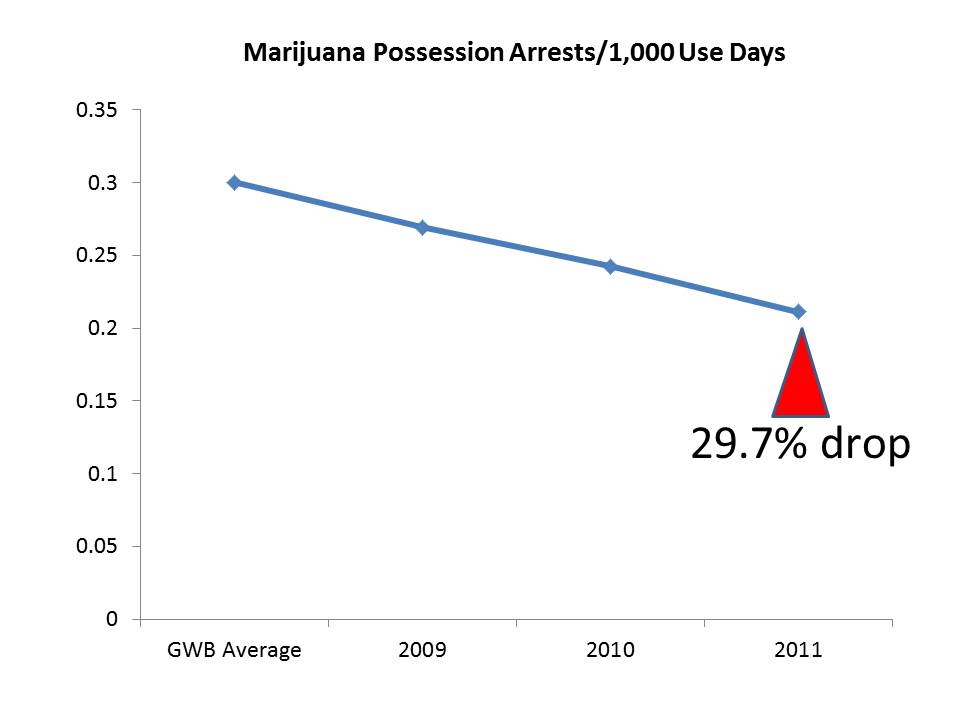
Keith Humphreys, focusing on the rate of marijuana arrests rather than the absolute number, finds that enforcement of marijuana possession laws is down under Obama:

As disappointed marijuana legalization advocates complained at the time, the first year of President Obama’s Administration saw an almost identical number of simple possession arrests (758,600) as did the last year of the George W. Bush Administration (754,200). But this represented a significant drop in enforcement intensity because Americans’ marijuana use increased by 10.6% that same year, from 2.55 Billion to 2.82 Billion aggregate days. As a result, in the first year of the Obama Administration, enforcement intensity was already lower than at any point in the GWB data. … For the last available year of Obama era data, 2011, enforcement intensity is down a remarkable 29.7% relative to the standard under the prior administration.

Pete Guither protests:

The first very obvious objection: the notion that arrests as a percentage of use is a statistic that has any relevance. There’s no evidence that law enforcement, all other things being equal, would actually arrest more people for marijuana possession if marijuana use goes up. So the fact that they didn’t isn’t evidence of some kind of lessening of enforcement emphasis.

Meanwhile, Doug Fine busts myths about marijuana legalization. He argues that legalization won’t lead to a major increase in marijuana use:

A 2011 University of California at Berkeley study, for example, showed a slight increase in adult use with de facto legalization in the Netherlands (though the rate was still lower than in the United States). Yet that study and one in 2009 found Dutch rates to be slightly lower than the European average. When the United States’ 40-year-long war on marijuana ends, the country is not going to turn into a Cheech and Chong movie. It is, however, going to see the transfer of as much as 50 percent of cartel profits to the taxable economy.

Kleiman thinks Fine is blind to the harms of legalization:

If admitting that cannabis in some form has medical utility makes it harder to persuade 14-year-olds not to get stoned all the time, I can make sense of parts the reluctance of parts of the prevention community to acknowledge the obvious, along with the reluctance of some enthusiastic anti-prohibitionists to admit that commercial availability and aggressive marketing will inevitably translate into higher rates of abuse.

Here’s what you tell 14-year-olds: yes, this is a legitimate and wonderfully relaxing drug, just like alcohol. But it really can harm the developing brain if you overdo it, and you’d be better waiting for adulthood before you try it. And look: I like it. As soon as parents admit their own pot use and talk rationally about it with their children, it will become infinitely less cool. I’m not blind to the possible problems, but the 14 year-old already has ways to find pot and every reason not to discuss it with parents. My view is that regulated legalization will make things safer for kids, not riskier.

(Image from Keith Humphreys)

Did Burke Support The American Revolution Or Just Americans?

A reader writes:

In your post on Josh Barro, you again claimed that Edmund Burke supported American Independence.  This is simply not true. While he was opposed to British policies and sympathetic to the colonists’ grievances, he never supported either independence or full representation for the colonies in Parliament. His proposals for conciliation with the colonies were always premised on their embrace of a subordinate status.

My reader is technically right. Let’s not miss that. But the reader fails, in my view, to grasp how deeply Burke believed that it was Britain, not America, which was at fault here; that he saw the revolution as justified under the circumstances; that he opposed the new taxes; and wanted to find some way to give the Americans a constitutional stake in the mother country. These were not popular sentiments, to say the least and were cited to note how complicated a “conservative” can be. And in retrospect, he saw the American revolution as different in kind from the French because it was based on concrete grievances, spoke to a shared cultural and political tradition, and was, in his eyes, an attempt to conserve a way of life he treasured, rather than an attempt to change the path of humanity overnight.

And yes, he was frustratingly nuanced on the question. Whig Tories can be – and that’s a strength, Freddie, not a weakness. But the core sentiment is clear:

“I do not know how to wish success to those whose Victory is to separate from us a large and noble part of our Empire. Still less do I wish success to injustice, oppression and absurdity.”

To repeat a phrase we’ve been debating recently: A hero or a traitor? Or something in between?

Beard Playoff Season

It’s back with an early mutton-chop, but I may just have a soft spot for someone whose last name is Jagr.

One great thing about the mutton chop? You get to shave the whitest bit of your beard, on your chin. But I think I may be finally accepting mine. I’m off to see my folks soon and my mum so hates the beard I’ve trimmed it right down for her (all moms, I’ve come to learn, want their sons to look permanently 14). The white – don’t let anyone tell you it’s gray – is now staring others in the face. And they say I look younger. I guess I should always listen to Aaron. And all of you.