What’s Cool About Classical

Mary Sydnor makes the case for opening up to classical music:

Many people shy away from classical music the same way they do fine art or quality wine. It seems an art form that you need to know something about in advance to enjoy it. I admit I have a hard time understanding this sentiment. To me, classical music is a simple experience — just sit back, listen, and take in your emotional response. Where, when appreciating abstract painting, for example, it helps to know painters were attempting to better depict reality by trading in traditional images for abstract, there’s no similar historical detail anyone really needs to enjoy any form of music.

She urges us to think about the variety found in classical music the same way we obsess about different covers of pop songs:

With most of our famous composers no longer around, it’s up to each orchestra and conductor to decide exactly how a piece is played. The differences between a performance of the same work by the New York Philharmonic as compared to the London Symphony Orchestra can be tantamount to Nirvana’s cover of “The Man Who Sold the World” versus David Bowie’s original.

Above is Poulenc’s Double Piano Concerto, which has been Sydnor’s “favorite piece of music since childhood.”

The Silent Mistreatment

David Berreby chronicles the plight of Sunnat, an Uzbek captured in Afghanistan at age 16 who was taken to Guantanamo Bay in 2002 – a situation made especially harrowing by his near total linguistic isolation:

Sunnat was, in many ways, simply unlucky. He spoke a language that was rare at Guantánamo. The camp had only six Uzbek speakers; none were housed near him. He was held for eight years not because he was dangerous but because no country, not even his native Uzbekistan, would accept him as a Guantánamo deportee. (The military was required to hold him until a nation agreed to take him.) In fact, his innocence isolated him further: once he was no longer deemed a threat, he ceased meeting with an Uzbek interpreter and an interrogator. Then he was denied materials to learn English or Arabic, because the detention center has a policy against helping the presumed-dangerous detainees communicate with one another.

Depriving a prisoner of linguistic company can be a strategy: it can increase a prisoner’s dependence on an interrogator, making him more likely to talk, or it can prevent prisoners from organizing resistance. More typically, cases like Sunnat’s are unfortunate consequences of policy and circumstance. Whatever the cause, Honigsberg argues in his paper, “Alone in a Sea of Voices: Recognizing a New Form of Isolation by Language Barriers, or Linguistic Isolation,” the psychological effects of solitary confinement through linguistic isolation are largely the same as those via lock and key: impaired impulse control, an inability to concentrate or think clearly, confusion, obsessive behaviors, paranoia, and even a state resembling catatonia. A growing body of evidence suggests that a few weeks of solitary confinement for a prisoner amounts to torture. “Isolation by language barriers,” Honigsberg writes, “should be recognized as a distinct human rights abuse.”

Quote For The Day

Dark Light

“Do we know what it means to be struck by grace? It does not mean that we suddenly believe that God exists, or that Jesus is the Saviour, or that the Bible contains the truth. To believe that something is, is almost contrary to the meaning of grace. Furthermore, grace does not mean simply that we are making progress in our moral self-control, in our fight against special faults, and in our relationships to men and to society. Moral progress may be a fruit of grace; but it is not grace itself, and it can even prevent us from receiving grace. For there is too often a graceless acceptance of Christian doctrines and a graceless battle against the structures of evil in our personalities. Such a graceless relation to God may lead us by necessity either to arrogance or to despair. It would be better to refuse God and the Christ and the Bible than to accept them without grace. For if we accept without grace, we do so in the state of separation, and can only succeed in deepening the separation. We cannot transform our lives, unless we allow them to be transformed by that stroke of grace. It happens; or it does not happen. And certainly it does not happen if we try to force it upon ourselves, just as it shall not happen so long as we think, in our self-complacency, that we have no need of it.

Grace strikes us when we are in great pain and restlessness. It strikes us when we walk through the dark valley of a meaningless and empty life. It strikes us when we feel that our separation is deeper than usual, because we have violated another life, a life which we loved, or from which we were estranged. It strikes us when our disgust for our own being, our indifference, our weakness, our hostility, and our lack of direction and composure have become intolerable to us. It strikes us when, year after year, the longed-for perfection of life does not appear, when the old compulsions reign within us as they have for decades, when despair destroys all joy and courage. Sometimes at that moment a wave of light breaks into our darkness, and it is as though a voice were saying: ‘You are accepted. You are accepted, accepted by that which is greater than you, and the name of which you do not know. Do not ask for the name now; perhaps you will find it later. Do not try to do anything now; perhaps later you will do much. Do not seek for anything; do not perform anything; do not intend anything. Simply accept the fact that you are accepted!’ If that happens to us, we experience grace. After such an experience we may not be better than before, and we may not believe more than before. But everything is transformed. In that moment, grace conquers sin, and reconciliation bridges the gulf of estrangement. And nothing is demanded of this experience, no religious or moral or intellectual presupposition, nothing but acceptance,” – Paul Tillich, The Shaking of the Foundations.

(Photo of Arizona’s Upper Antelope Canyon by Gautam Dogra)

The Beast Who Speaks

reeds

Daniel Dennett argues that it is language that really makes us human:

We are the only species whose members try to figure out why to do things, why we have done things, and why others are doing what they are doing. We represent reasons to each other, thereby influencing each other’s behaviour. Being movable by reasons in this way makes us fitting carriers of the burden of moral responsibility. No other species can commit murder, though many kill each other. And if we now see that it is appropriate to hold ourselves responsible for the well-being of other species, we also recognise that this sets us apart from them. They may be suitable bearers of moral value, but we don’t hold them responsible for maintaining, let alone improving, the well-being of others, even of their own species.

Or as Pascal memorably put it:

Man is but a reed, the most feeble thing in nature, but he is a thinking reed. The entire universe need not arm itself to crush him. A vapour, a drop of water suffices to kill him. But, if the universe were to crush him, man would still be more noble than that which killed him, because he knows that he dies and the advantage which the universe has over him; the universe knows nothing of this.

The question to me seems to be whether we embrace our strength as thinking reeds or our weakness; whether we live in the recognition of our limits or in the recognition or our spark of divinity. I am a Christian, in one way, because I believe that it’s only by embracing our weakness that we have the wisdom to be truly strong. And language is part of that spark of divinity. It came from us, from below, and yet it points so often above, to something beyond us. Does that in itself tell us something?

Real Men Love The Least Among Us

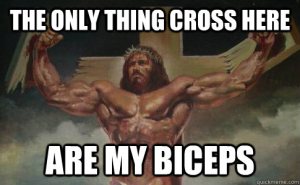
Responding to a number of recent debates about what it means to be a modern man, James Poulos asserts that “we do have a positive model for postpatriarchial masculinity—Jesus!”:

I don’t mean the Jesus who was turned into a convenient symbol of intolerance and hypocrisy by the buff-jesus1militant atheist crowd, or the twisted version worshipped by the Westboro Baptist crowd. No, today is a boom time in the making for the real Jesus: the one who told men that the single-minded pursuit of wealth or honor or even “family values” is sure to leave the soul barren; the one who told men that they should never be shocked when they feel despair or feel despised, because there is no rest or repose for us in this mortal world; the one who told men what he told the paralyzed guy in Mark 2:9—and this is why I have that verse permanently inked on my skin—take up thy mat and walk.

He continues:

We are created in a divine image and can choose to forgive one another and ourselves for being losers and failures—for malfunctioning, for going wrong, for defeating ourselves, for “deserving” disgust and disrespect by the standards of the world. The lesson of Jesus is a message about what it means to be human that’s so radical, it makes our petty squabbles about what it means to be a “real man” seem hopelessly animalistic and juvenile.

This analysis of the Gospel of Matthew seems dead-on to me:

Jesus radically challenges the leading male value of the ancient world – “honor”. He speaks of honor throughout the sermon on the mount, and “call[s] off the typical games whereby males pursued honor and physical, sexual, and verbal aggression …, and he demanded that his disciples on select occasions vacate the playing field where honor is claimed and awarded.” Thus “Jesus discredits conventional honor-gaining and honor-maintaining behavior. In this regard he challenges much of the prevailing male gender stereotype.”

During Jesus’ journey toward Jerusalem, Neyrey finds Jesus teaching “a new code of honor and shame,” one in which honor comes from taking up the cross and shame from lack of faith; honor comes from being like a child, while discipleship might require the shameful loss of a limb; honor comes from forgiveness of wrongs rather than engeance; honor comes from loss of wealth and power, and from renunciation of sexual aggression.

In short, Jesus is for Matthew the perfect public male figure, but at the same time a figure that radically undercuts the basis for ancient conceptions of masculinity.

Image: Meme generator.

An Education Made Of Glass

Kyle Baxter worries about the effects of Google Glass:

What I find most troubling is the philosophy underlying Larry Page and Sergey Brin’s thoughts on devices like Glass. They say that Glass’s goal is to get technology “out of the way,” but that isn’t it. The idea is that we will all be better off if we’re always connected to the web, always on, and have uninterrupted and instantaneous access to it and humanity’s “knowledge.” The idea that Page expresses is that if I can immediately learn about something I don’t know much about, I’ll be better off. I’ll be able to make smarter decisions and live a deeper, richer life by spending the time it would have taken to research and learn about something on more meaningful and substantive tasks.

I think, though, that is a terribly deluded and shallow understanding of what it means to “learn” about something.

When we — humans — learn about something, we are not simply committing facts to our memory so we can recall them in the future. That’s a very tiny part of a much larger and much more important process. To “learn” about something is to study the information (when historical events occurred, what happened, etc), find connections between it and other things we’ve learned and experiences we’ve had, and to synthesize it into something greater — knowledge.

Alan Jacobs thinks that college “students need to learn that they have been for almost all their lives the passive recipients of what the dominant culture around them designates as knowledge.” How technologies like Glass could make this harder:

[I]f awakening students from those slumbers has always been the task of the true educator, that task is all the more difficult in a time of technologies of knowledge, or “knowledge,” that asymptotically approach omnipresence. Google Glass, along with a whole range of similar technologies, enforces the very passivity which truly liberal education is concerned to defeat.

A Mom In The Middle

Maria Popova gives Jennifer Finney Boylan’s memoir about being a transgendered parent, Stuck in the Middle with You, the full Brain Pickings treatment, including this selection that captures the dynamic the book explores:

I was a father for six years, a mother for ten, and for a time in between I was both, or neither, like some parental version of the schnoodle, or the cockapoo. Of course, as parents go, I was a rather feminine father; for that matter I suppose I’m a masculine mother. When I was their father I showed my boys how to make a good tomato sauce, how to fold a napkin, how to iron a dress shirt; as their mother I’ve shown them how to split wood with a maul. Whether this means I’ve had one parenting style or two, I am not entirely certain. I can assure you I am not a perfect parent and will be glad to review the long list of my mistakes. But in dealing with a parent who subverts a lot of expectations about gender, I hope my sons have learned to be more flexible and openhearted than many of their peers with traditionally gendered parents.

I would like to think that this has been a gift to them and not a curse. It is my hope that having a father who became a woman has made my two remarkable boys, in turn, into better men.

The Faith Of A Horror Writer

In a recent interview with NPR’s Terry Gross, the novelist Stephen King opened up about his thoughts on religion and the afterlife:

It’s certainly a subject that’s interested me, and I think it interests me more the older that I get. And I think we’d all like to believe that after we shuffle off this mortal coil, that there’s going to be something on the other side because for most of us, I know for me, life is so rich, so colorful and sensual and full of good things, things to read, things to eat, things to watch, places to go, new experiences, that I don’t want to think that you just go to darkness.

I can remember as a kid thinking to myself, oh God, I hope I don’t die because I’ll just have to lie down there in that box and I won’t be able to play with my friends or go to baseball games or any of those things. As a kid, death seemed boring to me. As an adult, I think that it seems more like a waste of everything. Somebody once said every time a professor dies, a library burns.

And there’s some of that feeling. But as far as God and church and religion and the Buddy Rosses and that sort of thing, I kind of always felt that organized religion was just basically a theological insurance scam where they’re saying if you spend time with us, guess what, you’re going to live forever, you’re going to go to some other plain where you’re going to be so happy, you’ll just be happy all the time, which is also kind of a scary idea to me.

But King still believes in God:

If you say, ‘Well, OK, I don’t believe in God. There’s no evidence of God,’ then you’re missing the stars in the sky and you’re missing the sunrises and sunsets and you’re missing the fact that bees pollinate all these crops and keep us alive and the way that everything seems to work together. Everything is sort of built in a way that to me suggests intelligent design.

Hemant Mehta, an atheist, takes offense:

That’s entirely backwards. Losing your belief in God in favor of more rational, scientific explanations allows you to enjoy sunrises, sunsets, and the way nature works. Letting God take credit for all of that just cheapens it all — it makes everything just a part of someone’s blueprint instead of something that turned up naturally yet came together beautifully.

Brian Switek agrees:

There is no need for the supernatural to invoke or appreciate wonder. And rather than reducing nature to equations and graphs, I truly believe that science – our ability to actually understand why bees pollinate flowers, why mountains rise, and how remnants of ancient life became locked in stone – makes the world all the more exquisite by not only giving us clues, but new questions to ask.

Switek quotes a poignant passage from Darwin’s On the Origin of Species by Means of Natural Selection to illustrate his point:

It is interesting to contemplate an entangled bank, clothed with many plants of many kinds, with birds singing on the bushes, with various insects flitting about, and with worms crawling through the damp earth, and to reflect that these elaborately constructed forms, so different from each other, and dependent on each other in so complex a manner, have all been produced by laws acting around us. These laws, taken in the largest sense, being Growth with Reproduction; Inheritance which is almost implied by reproduction; Variability from the indirect and direct action of the external conditions of life, and from use and disuse; a Ratio of Increase so high as to lead to a Struggle for Life, and as a consequence to Natural Selection, entailing Divergence of Character and the Extinction of less-improved forms. Thus, from the war of nature, from famine and death, the most exalted object which we are capable of conceiving, namely, the production of the higher animals, directly follows. There is grandeur in this view of life, with its several powers, having been originally breathed into a few forms or into one; and that, whilst this planet has gone cycling on according to the fixed law of gravity, from so simple a beginning endless forms most beautiful and most wonderful have been, and are being, evolved.