Being Master Of Your Own (Christian) Domain

Rachel Held Evans hosted a symposium on “Christians and Masturbation,” highlighting a variety of theological perspectives on the matter. From Tara Owens’ contribution:

For the most part, we’ve been given two sets of unhelpful “rules” for what we should do with our sexuality: (1) respond to our sexuality as an appetite, like hunger, and feed appropriately or (2) avoid or subjugate our sexuality as something to be expressed only in covenanted conjugal relationship and ignored or sublimated at all other times. This is a false dichotomy, and both of these paradigms tend to end up in dysfunction. We either find ourselves at the mercy of our “needs” which leads to a low grade despair, or divorced from the life and pleasure that sexuality brings, living in a kind of discontented numbness.

Like many of the questions surrounding sexuality, I don’t think we can find simple answers—or any answers that hold together in real life situations—outside of the context of relationship.

For me, sexuality is broader than mere genital expression (intercourse, foreplay, masturbation, etc.), and encompasses all of the embodied ways that we desire connection with the world, with one another, and with God—as well as all of the ways we go about expressing that desire. While that definition can be taken to extremes, taking a broader view of sexuality allows us to see the ways that sexuality impels us to connection with one another. Taken in this context, masturbation and whether or not it is a healthy expression of sexuality for a particular individual become questions of whether or not the acts of masturbation at a particular season of life are drawing you deeper into isolation from others and from God, or into deeper connection and intimacy.

Copyranter discovered the hathos-filled PSA seen above:

Jesus yanking Christ, this is perfect.

– the non-judgmental acoustic guitar music.
– the “make love not war” sign on Ricky’s door.
– Mom being so kind, and interested on how good it felt.
– Ricky’s facial expression, especially during the slow zoom-in ending.
– I wonder who Ricky was thinking about? Farrah Fawcett? Lee Majors? The school nurse?

Catch up on the Dish’s popular thread on masturbation here.
In Other Words

Jessica Love observes a new study proving how much wording matters, even “boring tweaks, geeky English-major type tweaks we’d never suspect can make a difference”:

[R]esearchers presented hundreds of participants with a riddle like the following: A woman was traveling for the weekend. She was checking her ticket, boarding, and placing her luggage above her seat. The pilot did not show up, yet she and the other passengers were arriving at their destination without a delay. How?

Some people read the riddle with imperfect verbs (as in the example above), while others read it with perfect verbs (A woman traveled for the weekend. She checked her ticket, boarded, and placed her luggage above her seat…)

Amazingly, about 60 percent of participants who received the imperfect version identified the correct solution—that the woman was traveling by train or bus—while only about 40 percent who received the perfect version succeeded. In other words, the riddle was easier when the verb’s aspect encouraged you to focus on a part of the problem (the actions undertaken by a traveler) that was relevant to its solution (the mode of travel).

A Poem For Sunday

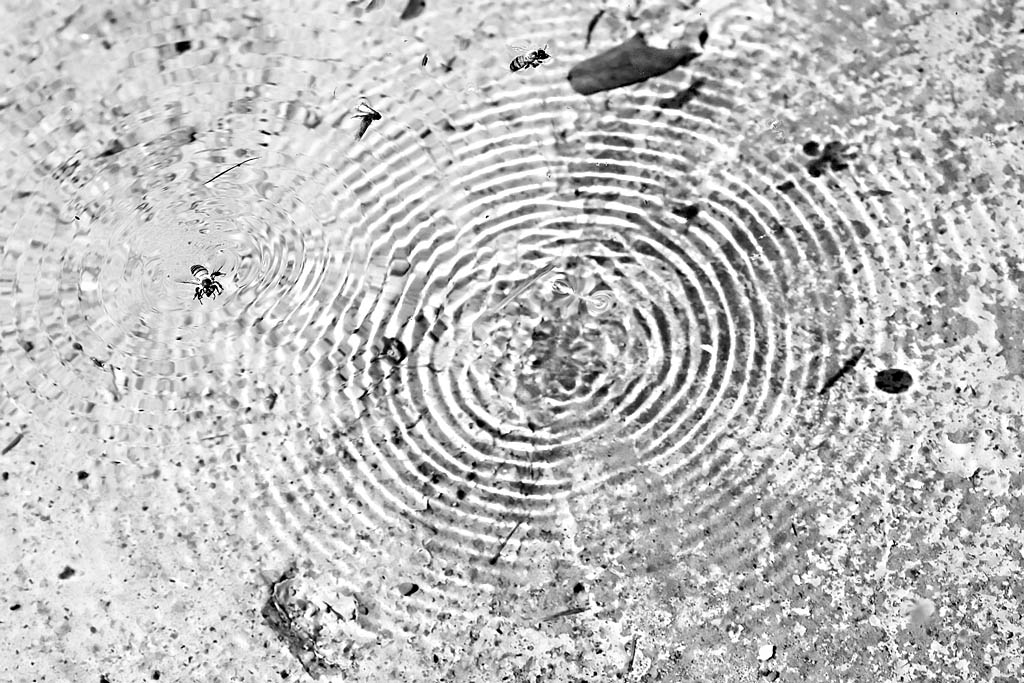
waterpoem

“I want to stay changeless for you.” by Quan Barry:

Where is it written that we should want to be saved?
What did the water feel like?  Where did constancy go?
How did the light fall through the trees?
In serrations?  In flat bands?
What part said, “I don’t want to have to.”
What didn’t you say? How did the earth respond?
When did you realize? Who let loose the shattering?

(From Asylum © 2001 by Quan Barry. Used by kind permission of the University of Pittsburgh Press. Photo by Flickr user laRuth)

“Life, Will Return”

Michael Popp, diagnosed with leukemia last December, chronicles the daily grind after surviving pneumonia for the second time:

Some days it seems unfair.  To have to endure this at any point.  You feel cheated.  A lot of people will speak of God to you.  They will mention how much he has done for you.  You nod and thank them.  But you know no God is with you.  No God absorbs your misery.  No God is curing you.  You know this because you suffer.  You suffer daily.  You undergo treatments that destroy your body cell by cell.  Treatments that will continue to ruin your body decades from today.  You submit to them.  You endure them.  You accept the consequences.  You think about your future and tell yourself, “This is saving my life.”  This is saving my life.  You repeat this when you pull your head from a bucket filled with bile.  Your face swollen.  Your eyes red and wet.  Your throat burning, you smile.  This is saving my life.  You cry all day every day without shedding a tear or making a sound.  You just cry on the inside as this sadness builds.  You just want to be better.  You just wish it would go faster.  You don’t pray.  You hope.  It isn’t even about your mortality anymore.  You haven’t been concerned with death in weeks.  This doesn’t surprise you.  It gives relief.  You understand you will live.  You repeat it.  I will live.  You don’t see another option.  I will live.  Sadness weighs on every cell in your body. Sadness becomes its own cancer.

Previous Dish on Popp’s struggle with the illness here.

Christianism Watch

“We live in the most interesting times in human history. These are the days spoken of in Scripture, the days of fulfillment. This is therefore an era of unprecedented spiritual activity on both sides as the conflict races to a head. Those who are in Christ are on the winning side. Part of what must happen during this period of great harvest for the kingdom of God is a massive wealth transfer. It is not going to happen by theft or governmental policy. It is going to happen supernaturally. Those invested in God’s market are going to reap a windfall. Make up your mind now to buy in,” – E.W. Jackson, Republican candidate for Lieutenant Governor in Virginia.

Notice the bald heresy that Jesus favors the rich and the prosperous and that believing in him will make you rich. Whatever else this is, it has nothing to do with Christianity. Notice too the apocalyptic nature of his worldview. Do we want theocratic nuts who believe the end is nigh to be making decisions for the generations to come? And who in the GOP will call out this foul, money-grubbing bigot?

Speaking The Word

Ben Myers ponders the way Origen, the third century Christian theologian and Church Father, struggled over writing about his faith:

When Origen was asked to respond to Celsus, a pagan writer who had attacked Christianity in a book called True Doctrine, Origen observed that a written response was not really appropriate for the Christian faith. “Now Jesus is always being falsely accused,” Origen says in the preface to Contra Celsum. “He is still silent in face of this and does not answer with his voice; but he makes his defence in the lives of his genuine disciples, for their lives cry out the real facts and defeat all false charges.” The only real apologetics is the life of Christ’s followers, not written arguments. Indeed Origen suggests that producing a written defence of the faith might actually diminish the vitality of the Christian community: “I would therefore go so far as to say that the defence which you ask me to compose will weaken the force of the defence that is in the mere facts, and detract from the power of Jesus.”

And yet Origen kept writing – by some estimates he produced almost 2000 works, most of them now lost. The reasons why?

He notes that the perfect Word of God is not “a multitude of words” but one single Word. A person who contradicts this Word is being loquacious; he says too much, and sins in what he says. But a person who speaks truthfully always speaks the one simple Word, “even if he says everything so as to leave out nothing.” You could talk forever and still be saying just one Word; and you could speak a pithy falsehood and be condemned for multiplying words. Truth is simple, falsehoods are multiple. As an example of the simplicity of truth, Origen notes that there are not four Gospels in scripture; rather “there is truly one gospel through the four.”

The Faithful You Don’t See

Ayun Halliday appreciates Ira Glass’s thoughtfulness and nuance in the above clip, in which he discusses the differences between the Christians he knows in his own life and those the media lavishes attention on:

The non-believing child of secular Jews does his tribe proud by volunteering the opinion that Christians get a bum rap in the national media. The portrayal of Christians as “doctrinaire crazy hothead people” doesn’t square with fond recollections of former public radio colleagues who kept Bibles on their desks and invited him to screenings of Rapture movies (At WBEZ? Really?).

You can watch the full interview here.

Bottom-Up Morality?

Beatrice Marovich uses Frans de Waal’s work on the moral lives of primates to question the way we typically think about religion:

Public debates about religion in the contemporary U.S. are still rooted in debates about belief. Prominent public atheists like Richard Dawkins speak about religion as though it’s something we need to understand rationally. How would these public debates change if we were to start thinking about the animal edges of religious life—the ways in which religious life has more to do with so-called animal instinct than we’ve often imagined? This is, precisely, where primatologist Frans de Waal’s new book The Bonobo and the Atheist (W.W. Norton, 2013) appears to be intervening into these hot-button conflicts.

People like Dawkins, says de Waal, are going about things in the wrong manner. “The question is not so much whether religion is true or false,” he writes, “but how it shapes our lives, and what might possibly take its place if we were to get rid of it the way an Aztec priest rips the beating heart out of a virgin.” What this violent metaphor is meant to gesture towards is “the gaping hole” that would be left by “the removed organ’s functions.” It seems to suggest that religion is some serviceable physiological element in the human body politic.

The broader drift of de Waal’s arguments:

The big targets for de Waal are what he calls “top down morality” and human exceptionalism. Top down morality is linked to the assertion that morality comes to human life from somewhere “on high,” which might be taken to mean that human life receives its morality from a transcendent, out-of-this-world, divine.

But de Waal notes that top down morality isn’t a purely religious problem. He attacks, for example, the philosophical presumption mentioned earlier, that morality is a matter of reasoning—that we reason our way “up” to moral action or decision. Likewise, de Waal takes issue with human exceptionalism—the idea that morality is something that only humans are capable of—regardless of its origin. Religion is a target, for de Waal, to the extent that it supports each of these presumptions.