Lessons From Woodrow

Michael Kazin explains why Woodrow Wilson, who took office 100 years ago, isn’t celebrated like FDR or even LBJ:

Despite his academic background and cerebral image, Wilson, like Obama now, was a masterful orator. Unlike nearly all his predecessors, he thought the public deserved to hear their elected 450px-TW_Wilson_Poznanleader explain, in a variety of venues, what he was doing and why. … He bet that a massive army and compelling ideals would cleanse the world of autocracy, empire, and, with the new League of Nations, perhaps even war itself. Yet Wilson famously lost that bet—as the other victorious Allies retained their colonies, the Senate voted against the U.S. joining the League, and the lethal movements of fascism and Communism emerged from the ashes.

That great failure was the last public act of Wilson’s life. It tarnished his reputation for years to come and is still the primary reason why he gets no love from liberals today. More than his dour demeanor, his excessive moralism, or his paternalistic racism, it demonstrates the peril of thinking that a war made by Americans can magically turn the world from the darkness of oppression toward the light of tolerance and democracy. Having gained the presidency as a critic of the disaster in Iraq, Barack Obama, another former academic, seems to grasp that truth.

(Photo: A monument of Woodrow Wilson in Poznań, Poland, via Wikimedia Commons)

The Animated Oscar Wilde

Josh Jones digs up an old cartoon version of “The Happy Prince”:

He uses the story to contextualize Wilde’s moral sensibilities:

Wilde was ridiculed for the many of the same reasons he was feted—his flamboyant public persona and devotion to aestheticism, which satirists caricatured as a kind of decadent navel-gazing. But careful readers of Wilde’s diverse canon of poetry, prose, and drama will know of his critical looks at solipsism and superficiality. Some of his best works as a moralist are his children’s stories, such as the 1888 book of fairy stories The Happy Prince and Other Tales. In the title story, a prince is transformed into a glittering statue on a pedestal high above a city, where residents look up to him as an example of human perfection. But the prince, we learn, spends his time weeping in compassion for the poverty and suffering he sees below him. Made in 1974 by Canadian company Potterton Productions, and featuring the voices of British actors Christopher Plummer and Glynis Johns, the animated short film above is a faithful rendering of Wilde’s story.

The text of the story is here.

What’s Left Of The Clef, Ctd

Krzysztof-Penderecki-Polymorphia1

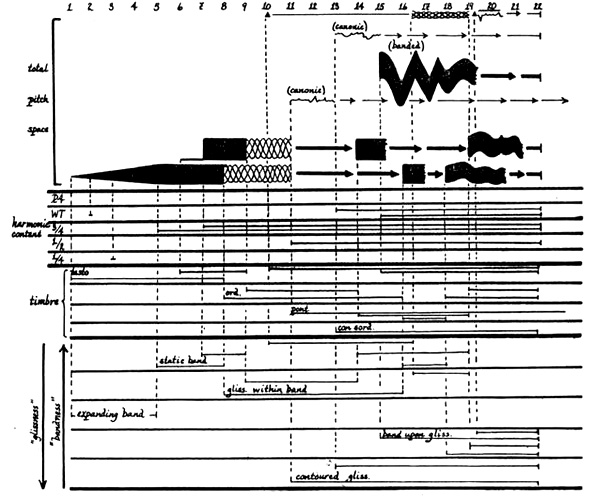
Jimmy Stamp reviews some of the stranger deviations from standard notation, like the sheet music to Krystof Penderecki’s “Polymorphia,” based on measurements of brain activity:

As the name suggests, the piece does indeed take various forms and changes dramatically from section to section. With “Polymorphia,” Penderecki was searching for new sonic possibilities and, if those possibilities include “terrifying haunted house music,” he absolutely nailed it. The composition is intended for 48 string instruments and emphasizes timbre rather than pitch, and the collision of sound generating bodies made of metal, wood, or leather – what music scholar Danuta Mirka refers to as the composer’s “primary materials”. The notation was inspired, in part, by electroencephalograms –visual measurements of brain activity. It eschews traditional measures in favor of a score divided into sections of variable length and, in some sections, further vertical divisions to mark each second, with a “total pitch space” describing the relative pitch of each instrument.

Earlier Dish on musical notation here.

The View From Your Window Contest

vfyw_6-8

You have until noon on Tuesday to guess it. City and/or state first, then country. Please put the location in the subject heading, along with any description within the email. If no one guesses the exact location, proximity counts.  Be sure to email entries to contest@andrewsullivan.com. Winner gets a free The View From Your Window book. Have at it.

You Probably Won’t Finish Reading This Post

Manjoo is on to you:

Only a small number of you are reading all the way through articles on the Web. I’ve long suspected this, because so many smart-alecks jump in to the comments to make points that get mentioned later in the piece. But now I’ve got proof. I asked Josh Schwartz, a data scientist at the traffic analysis firm Chartbeat, to look at how people scroll through Slate articles. Schwartz also did a similar analysis for other sites that use Chartbeat and have allowed the firm to include their traffic in its aggregate analyses.

Schwartz’s data shows that readers can’t stay focused. The more I type, the more of you tune out.

And it’s not just me. It’s not just Slate. It’s everywhere online. When people land on a story, they very rarely make it all the way down the page. A lot of people don’t even make it halfway. Even more dispiriting is the relationship between scrolling and sharing. Schwartz’s data suggest that lots of people are tweeting out links to articles they haven’t fully read. If you see someone recommending a story online, you shouldn’t assume that he has read the thing he’s sharing.

OK, we’re a few hundred words into the story now. According to the data, for every 100 readers who didn’t bounce up at the top, there are …

Hey, that’s what the Dish is for! We edit the web for short-attention spans. Longer form pieces really do belong on the tablet instead. But you can always dig deeper if you want. That’s what hyper-links are for. If you’re still with me.

Maps Of The Day

states combined

Seth Masket constructs the above maps, which show the median ideological score for state legislators (darker states are more extreme), taken from what he calls “one of the most important datasets on state politics, legislatures, and parties to be released in a long, long time”:

[T]hese graphs don’t really tell us why a state might have extreme or moderate legislators. The Republican parties of the deep South are probably very conservative because they represent some of the most conservative voters in the country, while the extremism of parties in more moderate states may be more an indicator of the strength of party organizations in screening out moderates in primary elections.

Still, this sort of data is extremely useful if we want to understand the political context of a state party and the politicians who emerge from it. Barack Obama was an Illinois state senator (yep, he’s in the dataset — ideal point of -.695), although they’re far from the most liberal group of Democrats in the country. George W. Bush got along famously well with Texas Democrats when he was governor, but those are among the most conservative Democrats in the land. How has Chris Christie survived in blue New Jersey? Well it probably helps that his state’s Republicans are moderate by national standards, keeping pressure off him to veer rightward.

Getting In The Muck


Anas Aremeyaw Anas went undercover to report on disturbing stories of crime and corruption in Ghana:

Certainly Anas’ immersive tactics can be extreme. While working on a story on the Accra Psychiatric Hospital, Anas played the part of the patient, taking prescribed drugs that left him impotent for a week after he left the hospital. And in his most recent story, on Nsawam Prison in Ghana, Anas shows footage of queuing for a “proper” toilet — a manhole in the middle of the yard, around which four men are squatting, back to back. The footage, which he showed for the first time at TED2013, also contains a harrowing shot of a room within the prison piled high with dead bodies.

In the TED talk seen above, Anas speaks from behind a wire mask to conceal his identity.  Below you can watch his short film, “Ghana’s Madhouse Story”:

How Do We Know What We Want?

Do college kids prefer Monet and Van Gogh to lulzy cats? UVA researchers asked two groups of students to rate five posters (two art posters, three humorous and cartoon- or cat-themed) and pick one to take back to the dorm. The test: how would results between groups differ if only one group of students was asked to reason about their preferences?

designall.dllThis “reasons” group liked the art posters less [than the control group] … and the humorous posters more. … Most of them still chose an art poster to take home, but it was a far lower proportion – 64% [vs 95%] – than the control group. That means people in this group were about seven times more likely to take a humorous poster home compared with the control group.

Here’s the twist. Some time after the tests, at the end of the semester, the researchers rang each of the participants and asked them questions about the poster they’d chosen: Had they put it up in their room? Did they still have it? How did they feel about it? How much would they be willing to sell it for? The “reasons” group were less likely to have put their poster up, less likely to have kept it up, less satisfied with it on average and were willing to part with it for a smaller average amount than the control group. Over time their reasons and feelings had shifted back in line with those of the control group – they didn’t like the humorous posters they had taken home, and so were less happy about their choice.

But Tom Stafford insists that “the moral of the story isn’t that intuition is better than reason”:

We all know that in some situations our feelings are misleading and it is better to think about what we’re doing. But this study shows the reverse – in some situations introspection can interfere with using our feelings as a reliable guide to what we should do.

And this has consequences in adulthood, where the notion of expertise can mean struggling to discern when introspection is the best strategy. The researchers who carried out this study suggest that the distorting effect of reason-giving is most likely to occur in situations where people aren’t experts – most of the students who took part in the study didn’t have a lot of experience of thinking or talking about art. When experts are asked to give reasons for their feelings, research has found that their feelings aren’t distorted in the same way – their intuitions and explicit reasoning are in sync.

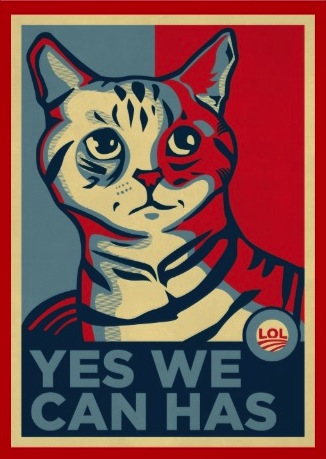
(Image: Lolcat poster available here)

Faces Of The Day

Floods Hit Germany: Elbe And Saale

The faces of two women in a window display advertisement peek out from floodwaters in a street flooded by the nearby Elbe river in the historic city center of Meissen, Germany on June 6, 2013. Eastern and southern Germany are suffering under floods that in some cases are the worst in 400 years. At least four people are dead and tens of thousands have evacuated their homes. By Sean Gallup/Getty Images.

Peak Faggot? Ctd

A reader writes:

I wonder whether your perception of “faggot” would change if you considered the continuing debate on reddit over the use of the “OP is a faggot” meme. This meme appears (and is usually upvoted to the top of the thread) almost without exception in cases where the original poster (OP) of the thread is suspected of wrongdoing – usually lying about the nature of the post, reposting old content without acknowledging the source, or making things up to get karma. These things happen a lot on reddit and so you don’t have to spend much time there to see “OP is a faggot.”

Many redditors will tell you that they are only using the term as you describe it – a “general term of abuse for straight women and straight men” that is “jokey” and “has been drained of any explicit homosexual meaning.” All you need to do to see the dishonesty of this claim is to look at one of the most popular ways to call OP a faggot – using an image meme. Search Google images for “OP is a faggot” for some representative examples. These images almost universally involve homosexual sex, gay stereotypes, or other direct allusions to a man being gay. Generally they consist of a man who has been caught in a situation that reveals that he is homosexual, with an arrow labeling the man as “OP.” And yet on the very same thread where they post and upvote these images, redditors will tell you with a straight face that “OP is a faggot” has “nothing to do with being gay!” and, often, what a faggot you are for ruining their fun by pointing out that it does.

Earlier perspective from readers on “No Homo” here.