The Best Of The Dish Today

The second shoe in government surveillance of meta-data dropped, this time through a leak to the Washington Post. I remained underwhelmed – but was glad this was now in the open so we can actually have the conversation David Foster Wallace wanted. The latest job numbers were between meh and yay; and with the emergence of a transgender former Navy Seal, a cultural watershed was passed, something one could not say about the new movie, The Internship (unlike TV’s Breaking Bad).

The most popular posts of the day were Fareed Zakaria on Turkey (again!) and The FBI May Have Your Phone Records. The most popular posts of the week were When Rape Triggers An Orgasm and my chat with Dan Savage on sex, monogamy, love and marriage.

Oh and I don’t hate Glenn Greenwald.

See you in the morning.

How Much Does Campaign Cash Really Matter?

US-VOTE-2012-DEBATE

Lee Drutman uses one of the Koch brothers to illustrate the difficulty of tracking political donations:

The case of Charles G. Koch is a nice lesson in just how hard it is to determine who is breaking and who is abiding by campaign finance limits. It’s hard to make accurate tallies of individual aggregate campaign contributions when the Federal Elections Commission doesn’t require donors to have a unique ID, and when campaigns don’t always reliably report donor names. … It’s also challenging because recount funds are exempted from aggregate individual donation limits, but the FEC doesn’t provide data in a form that makes it easy to separate out those contributions from ones that do count. The only way to effectively enforce the law is to spend endless hours hand-verifying individual FEC records. It’s almost as if the system were designed to make enforcement impossible.

Seth Masket, in contrast, wonders why we’re “still getting worked up over the Citizens United decision”:

A lot of political commentary, particularly that emanating from the combination of journalists, politicians, and activists he calls the “campaign finance community,” claimed that the growth of Super PACs and other well-heeled political organizations in the wake of the Citizens United case would overwhelm the voters’ voice. Yet despite unprecedented sums spent by these groups on behalf of Mitt Romney and many Republican congressional candidates, the votes ended up going almost exactly as we would have otherwise expected.

This isn’t a new pattern. It has generally been very difficult to pinpoint any specific effect of campaign spending on a general election outcome. … Now, none of this means that campaign spending doesn’t matter at all, of course. Even with very small effects, an absurdly huge expenditure of money could be critical. But there is a saturation point where you just can’t get any more ads in front of people’s eyes. And we really don’t have a sense of whether the ads put together by Super PACs are as effective as those aired by the campaigns themselves. … But the idea that voters can be bought with enough money just doesn’t hold water. And given that recent efforts to make campaign finance more fair just seem to result in more byzantine rules and less transparency, maybe we should stop trying to do that for a while.

I tend to agree that the wave of Super-PAC money didn’t alter the core dynamics of the campaign – a major relief, as well as a major blow to campaign finance reformers. Meanwhile, Kay Steiger makes the case that “the Citizens United ruling has led to to the unprecedented amount of state-level anti-choice legislation in the last several years”:

[Crow After Roe author Jessica Mason] Pieklo explained [on Democracy Now] that National Right to Life, Americans United for Life, Liberty Council and the Tomas Moore Center are groups whose goals are either to overturn Roe v. Wade, making abortion once again illegal, or to make abortion so inaccessible that abortion is legal “in name only.”

“One of the reasons that the book looks at the onslaught of legislation after 2010 is that there is an explosion at the state level, and that is in large part due to one of the driving forces, and that is James Bopp Jr., who is one of the legal forces behind the challenge that created the Citizens United decision,” Pieklo said. “He sparked — and his group, National Right to Life — sparked a lot of the initial campaign finance challenges through conservative groups, so as a result of unrestricted funding at the state level, that’s where we’re at right now as a result of it.”

(Photo: US business magnate Sheldon Adelson speaks on the phone after attending the first presidential debate between US President Barack Obama and Republican challenger Mitt Romney in Denver, Colorado on October 3, 2012. By Nicholas Kamm/AFP/Getty Images. Adelson shelled out more than $100 million on failed GOP candidates during the 2012 cycle.)
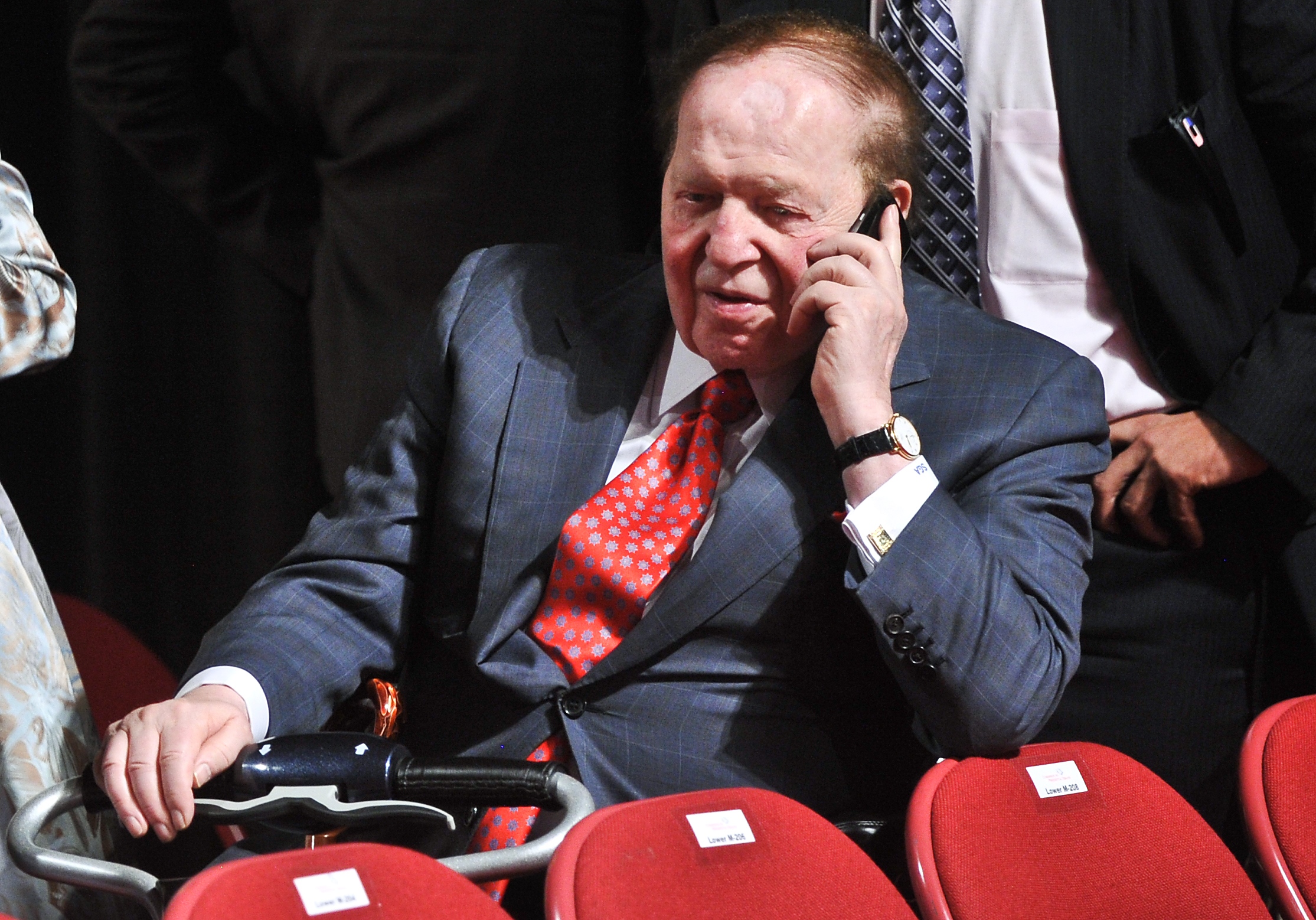
Chart Of The Day

Brian Merchant unpacks it:

The useful thing about this graph, though, is that we’re then treated to a window of how these carbon sources are tied to crucial industrial and social functions, and how closely interlinked and therefore how massively difficult to unlink they are. As David Roberts notes at Grist, “Industry uses coal for high-heat operations like coking for steel production and it’s difficult to replace that kind of thing with electricity.” That’s a tough one indeed.

The vast majority of our oil is pumped directly into the vast majority of our cars, and that’s another 15% of the problem. Energy-guzzling residences and commercial buildings are another 20%.

And, as you can see here a full third of global warming is caused by “direct” emissions—methane emitted by agriculture and waste degradation, and our nasty habit of chopping forests down, which releases the CO2 they were storing before we ship them off to Home Depot.

Whom Will Obamacare Burden? Ctd

Josh Barro sees the “rate shocks” touted by opponents of Obamacare as evidence that “Obamacare is working as planned”:

[W]hat’s happening in California is exactly what was supposed to happen: If you’re young, healthy, and affluent, your insurance is getting more expensive. If you’re old, sick, and poor, it’s getting cheaper. That’s because The Affordable Care Act — commonly referred to as Obamacare — is designed to be a fiscal transfer from the young to the old, the healthy to the sick, and the rich to the poor.

It’s not just Obamacare: Any system that shifts health expenditures from the private sector to the public sector causes transfers like this. … [I]nstead of hiding the transfer from the young and healthy as part of a tax bill that finances the whole government, Obamacare causes it to show up in the form of a higher insurance “premium.” That tax increase will make some young and healthy people worse off. But they would also be worse off if the government provided direct health care subsidies to the old and the sick and used a broad-based tax like a payroll tax to finance those subsidies. In fact, that’s how we finance Medicare, which is a huge fiscal transfer from the young to the old.

Douthat looks to the future:

The unanswered question, though, is whether that “a little more” will actually be — or gradually become — a lot. And that’s what’s getting left out of some of the liberal brush-offs (yes, I’m looking at you, Chait) of the “rate shock” issue. Whatever young people’s attitudes toward insurance in the abstract, if rates go up way too fast, they almost certainly won’t buy into the new system, opting (whether consciously or semi-accidentally) to pay the fine instead. And that kind of mass opting-out is basically Obamacare’s worst-case scenario, which is why it features so prominently in the excellent primer that Jonathan Cohn wrote last month on implementation problems that the bill’s supporters should actually worry about.

Previous Dish on the distributional effects of Obamacare here.

Do Mascots Need Modernizing? Ctd

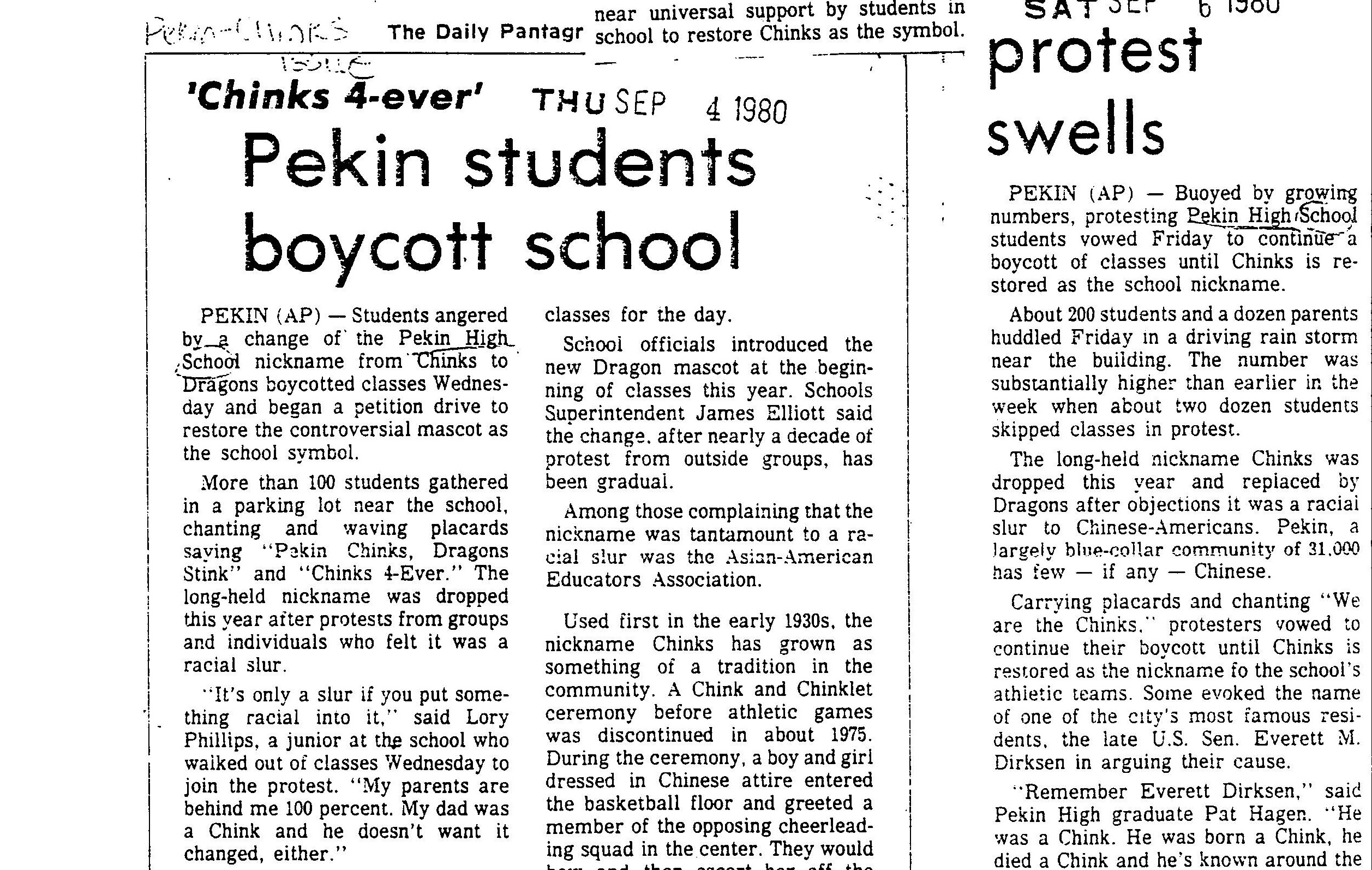
198009 Chinks 4-ever

Readers keep the thread alive:

You want to talk about offensive mascots?  My high school (Patrick Henry High School in Glade Spring, VA) has the Confederate soldier, i.e., The Rebels, as a mascot.  The Confederate flag is painted on the football stadium, and the marching band – of which I was a member – plays Dixie when the team scores.

Another sends the newspaper clippings seen above:

In 1980 Pekin (IL) High School changed its sports team mascot from “the Chinks” to “the Dragons.” Angry students protested, carrying signs that said “Chinks 4-ever” and the like. I especially like this quote: “My dad was a Chink and he doesn’t want it changed, either.”

Another shares a more amicable controversy at the local level:

My daughters attended, and I taught at, Arapahoe High School in Centennial Colorado – one of the first high schools in the nation to officially modify its mascot, with the assistance of the Arapaho tribe. The mascot was and still is the Warrior, fitting since the high school sits on ground once occupied by the Arapahos; their reservation is now in Wind River, WY. Ron Booth, principal at the time and part Indian, reached out to the Arapahos during mascot controversies in the Early 1990s. The result was a redesign of our mascot by an Arapaho artist to depict the warrior accurately; many educational and ceremonial visits by tribal members each spring to answer questions and relate tribal stories and lore; visits by AHS groups to the Wind River reservation and Denver Indian Center to donate goods, food, and share camaraderie, and the attendance at Arapahoe graduations by tribal leaders to deliver words of congratulation.

Our school is richer from the connections with the Arapahos, and I feel the tribe has gotten more respect and pride in return.

More discussion on our Facebook page.

In Which Mr Gallup Eats Some Crow Pie

Jeremy Stahl looks at the polling firm’s analysis of where it went wrong in the 2012 election:

It found that four areas most likely combined to result in the disparity between the polling firm’s final prediction of a 49-48 Romney popular vote win, and the actual result of a 51-47 Obama victory. Those four areas were as follows: how they weighted likely voters, underrepresentation of the East and West coasts in geographical controls, underrepresentation of nonwhite voters based on how Gallup determined ethnic backgrounds of survey respondents, and issues in how it contacted landlines that resulted in an “older and more Republican” survey sample. … At the time of the fiercest criticism, Gallup editor-in-chief Frank Newport said that there was “no evidence” that his company’s likely voter models were off. Now he’s saying they’ll do better next time.

Nate wins! Enten indicts the polling industry more generally, noting that “there are proven ways to poll that produce more consistently accurate portrayals of the election than doing a single live telephone interviews of a randomly selected population in a national poll”:

The average of polls done in the final week, excluding Gallup and Rasmussen, had Obama’s lead over Romney more than 2pt too low. I might be willing to look the other way, except the polling average in 2000 had George W Bush winning and had a margin error of again more than 2pt. The error in margin in 1996 was off by 3pt. The 1980 average saw an error of more than 5pt. The years in between 1980 and 1996 were not much better. In other words, the “high” error in national polling even when taking an average isn’t new; in fact, it seems to be rather consistent over the years. …

The state polling, meanwhile, did not show an analogous large bounce. It consistently had Obama leading in the states he needed to be leading in. Moreover, it showed Obama holding very similar positions to those he did prior to the first debate in the non-battleground states.

Yglesias, meanwhile, believes that the differences between Gallup’s numbers and the Obama campaign’s internal numbers polling “did exactly what it was supposed to do”:

[W]hat [the Obama campaign is] doing isn’t what Gallup is doing which—again—is trying to drum up media interest in Gallup polls. And compared to the Obama numbers, the Gallup numbers are really interesting. You could write lots of articles about those numbers, while the Obama numbers tend to suggest that you shouldn’t bother.

I’m not a huge fan of the “we should be gambling all the time about everything” school of thought, but it would be useful in this realm. If public polls were released by people who were placing large financial bets on the outcome of the campaign, then pollsters would work to purge their models of excessive volatility. But in the world that exists, the incentives are all wrong. “Incumbent President presiding over economic growth and falling unemployment will probably win and nobody’s paying attention to the campaign” is a terrible news story. It just happens to be true.

Nate Cohn thinks Gallup could prove more accurate next time:

The survey is extremely well-funded and has huge samples, especially over a multi-week period. They’ve brought in a highly regarded team of survey methodologists, and their commitment to transparency means that analysts should ultimately be able to confirm that their efforts have paid dividends. It just might be enough to restore confidence in America’s oldest polling firm.

The Inferior Medium

Tim Grierson compares the latest Owen Wilson-Vince Vaughn vehicle to “watching two aging fraternity brothers try to convince each other that they haven’t lost a step since college”:

If the movie was just the two guys hanging out, The Internship might have been enjoyable. But Vaughn has put them into a really creaky underdog tale that’s part Animal House, part Revenge of the Nerds, and a large part “Homer Goes to College”The Simpsons episode where Homer has to hang out with a bunch of smart, nerdy college kids and teaches them how to have some fun. That setup makes The Internship sound like a raucous comedy, but unlike Wedding Crashers, which was rated R, this PG-13 offering is actually pretty tame, no matter how many “shit”s the characters get away with saying. …

As for the Google setting and downsized-America topicality, the movie actually takes it seriously, hoping it’ll give the movie some emotional resonance. But according to The Internship, Billy and Nick are meant to represent all of us, the aging workers scared about an uncertain future in which we’ll be replaced by brainiac millennials who are too busy on their iPhones to, like, experience life, man, and get laid.

For A.A. Dowd, “it’s enough to make a lifelong Googler want to switch to Bing”:

Product placement is one thing; building a whole movie around the glorification of a multinational corporation is something else entirely.

Essentially a feature-length sponsored post, The Internship casts Vince Vaughn and Owen Wilson as middle-aged salesmen who find themselves competing against braniac college kids for a job at Google. As the film incessantly reminds viewers, the company—envisioned here as a professional paradise, where the food is free, diversity is key, and cars drive themselves—is regularly voted the greatest place to work in America. Characters go further, describing it as an “engine for change,” the “Garden of Eden,” and “the best amusement park you’ve ever been to, times a million.” If this excessively flattering farce is to be believed, Googliness is next to godliness.

Lydia DePillis has more on the corporate propaganda:

As the Los Angeles Times reported recently, Google charged neither location nor licensing fees for the privilege of shooting at its edenic headquarters, but did enjoy veto power over its contents. Accordingly, the script fully buys into the company mystique: Intern teams competing for full-time jobs are told they’ll be judged on their “Googliness,” which one character describes as “the intangible stuff that made a search engine into an engine for doing good.” And when Wilson’s love interest, a workaholic middle manager, says she puts in long hours because she thinks her job “makes peoples lives just a little bit better,” we’re clearly supposed to admire her.

The film’s advertorial nature hasn’t gone unnoticed. Early reviews have focused on the movie’s all-encompassing product placement, the Googleplex perks it highlights, and how it could be useful recruiting tool. (One critic even went so far as to suggest tickets to the movie, since it’s one long advertisement, should be given away for free.) It’s all true: In the world of The Internship, Google is basically paradise, the pinnacle of modernity and meaning in work. No wonder the company’s head of HR is so happy with it.

Previous Dish on the movie’s extreme product placement here.

Quote For The Day II

“In the absence of such a conversation, can we trust our elected leaders to value and protect the American idea as they act to secure the homeland? What are the effects on the American idea of Guantánamo, Abu Ghraib, Patriot Acts I and II, warrantless surveillance, Executive Order 13233, corporate contractors performing military functions, the Military Commissions Act, NSPD 51, etc., etc.? Assume for a moment that some of these measures really have helped make our persons and property safer—are they worth it? Where and when was the public debate on whether they’re worth it? Was there no such debate because we’re not capable of having or demanding one? Why not? Have we actually become so selfish and scared that we don’t even want to consider whether some things trump safety? What kind of future does that augur?” – David Foster Wallace, in 2007.

Reinventing Jazz

Until you’ve heard Sharon Clark put her spin on ’70s classics like “Rainy Days And Mondays” you haven’t really heard what the first jazz enthusiasts heard: familiar tunes made unfamiliar – and thereby more expressive and moving. The rave reviews – “an absolute triumph!” – are here. She’s back again this Sunday in New York City at 7 pm. Tix here.