Roger Ailes is pissed off at Jonathan Alter.
Month: June 2013
The FBI May Have Your Emails
The other shoe drops:
The National Security Agency has obtained direct access to the systems of Google, Facebook, Apple and other US internet giants, according to a top secret document obtained by the Guardian. The NSA access is part of a previously undisclosed program called PRISM, which allows them to collect material including search history, the content of emails, file transfers and live chats, the document says.
The program essentially provides [WaPo] the agency with a search bar into Americans’ lives:
To collect on a suspected spy or foreign terrorist means, at minimum, that everyone in the suspect’s inbox or outbox is swept in. Intelligence analysts are typically taught to chain through contacts two “hops” out from their target, which increases “incidental collection” exponentially. The same math explains the aphorism, from the John Guare play, that no one is more than “six degrees of separation” from Kevin Bacon.
The tech companies participating “include most of the dominant global players of Silicon Valley,” such as Apple, Microsoft, Yahoo, Google, YouTube, Facebook, and Skype. Ambers theorizes how this exchange works:
It is not clear how the NSA interfaces with the companies. It cannot use standard law enforcement transmission channels to do, since most use data protocols that are not compatible with that hardware. Several of the companies mentioned in the Post report deny granting access to the NSA, although it is possible that they are lying, or that the NSA’s arrangements with the company are kept so tightly compartmentalized that very few people know about it. Those who do probably have security clearances and are bound by law not to reveal the arrangement.
This arrangement allows the U.S. companies to “stay out of the intelligence business,” one of the officials said. That is, the government bears the responsibility for determining what’s relevant, and the company can plausibly deny that it subjected any particular customer to unlawful government surveillance. Previously, Congressional authors of the FAA said that such a “get out of jail free” card was insisted by corporations after a wave of lawsuits revealed the extent of their cooperation with the government.
Several of those tech companies immediately denied letting the government into their servers. Andrea Peterson explains what this might actually mean:
Comparing denials from tech companies, a clear pattern emerges: Apple denied ever hearing of the program and notes they “do not provide any government agency with direct access to our servers and any agency requesting customer data must get a court order;” Facebook claimed they “do not provide any government organisation with direct access to Facebook servers;” Google said it “does not have a ‘back door’ for the government to access private user data”; And Yahoo said they “do not provide the government with direct access to our servers, systems, or network.” Most also note that they only release user information as the law compels them to.
But the PRISM program’s reported access to data and the now repeatedly confirmed widespread access to phone records and other types of digital data appears to be almost exactly what the 2008 Protect America Act (PAA) allows Foreign Intelligence Surveillance Act (FISA) courts to compel tech companies to do — as many warned around the time of its passage. If tech companies are not providing direct access to their servers but are cooperating with the PRISM program, that leaves at least one other option: Companies are providing intelligence agencies with copies of their data.
Timothy B. Lee flashes back to when Congress passed the Protect America Act, on Sept. 11 2007:
Civil liberties groups warned that the PAA’s vague requirements and lack of oversight would give the government a green light to seek indiscriminate access to the private communications of Americans. They predicted that the government would claim that they needed unfettered access to domestic communications to be sure they had gotten all relevant information about suspected terrorists.
It now appears that this is exactly what the government did. Today’s report suggests that the moment the PAA was the law of the land, the NSA started using it to obtain unfettered access to the servers of the nation’s leading online services. To comply with the requirement that the government not target Americans, PRISM searches are reportedly “designed to produce at least 51 percent confidence in a target’s ‘foreignness’” — the lowest conceivable standard. PRISM training materials reportedly instruct users that if searches happen to turn up the private information of Americans, “it’s nothing to worry about.”
Tim Worstall defends the program:
[T]his sort of behaviour is not something that we should be shouting about government doing. It’s something that we should be shouting about government notdoing. The crucial point is here, from the DNI:
Section 702 is a provision of FISA that is designed to facilitate the acquisition of foreign intelligence information concerning non-U.S. persons located outside the United States. It cannot be used to intentionally target any U.S. citizen, any other U.S. person, or anyone located within the United States.
As I say that’s the important part of it all. The information, the data, may be in the US as a result of the global spread of the internet and the physical location of servers. But the information cannot be about either a US citizen or someone who is in the US. And, if we’re prepared to be honest about matters, we do actually want the government to be keeping an eye on foreigners in foreign lands. Which is what they’re doing.
Amy Davidson is unsatisfied with that explanation:
[T]his is all supposedly meant to stop terrorism by foreigners. When the N.S.A. looks through the private files of people who are one or two degrees of separation from the person who has caught its eye, though, it hasn’t just gone beyond that mission but has betrayed it. The Post article described analysts using “selectors” that are “designed to produce at least 51 percent confidence in a target’s ‘foreignness.’ ” If they turn out to have targeted “U.S. content”—beyond all the incidental information on Americans that’s swept up—they are supposed to submit it to yet another database, “but it’s nothing to worry about.” Actually, it is.
James R. Clapper, Director of National Intelligence, has released a terse statement on the leak:
Information collected under this program is among the most important and valuable foreign intelligence information we collect, and is used to protect our nation from a wide variety of threats. The unauthorized disclosure of information about this important and entirely legal program is reprehensible and risks important protections for the security of Americans.
Always Look Out For The Cook
Adam Johnson pens a fascinating profile of the man who fetched caviar, cognac and Big Macs for Kim Jong-il before becoming an intelligence asset for Japan:
The chef’s name, an alias, is Kenji Fujimoto, and for eleven years he was Kim Jong-il’s personal chef, court jester, and sidekick. He had seen the palaces, ridden the white stallions, smoked the Cuban cigars, and watched as, one by one, the people around him disappeared. …
When he finally escaped, Fujimoto became, according to a high-level cable released by WikiLeaks, the Japanese intelligence community’s single greatest asset on the Kim family, rulers of a nation about which stubbornly little is known. We don’t know how many people live there. (Best guess: around 23 million.) It’s uncertain how many people starved to death during the famine of the late ’90s. (Maybe 2 million.) Also mysterious is the number of citizens currently toiling their way toward death in labor camps, places people are sent without trial or sentence or appeal. (Perhaps 200,000.) We didn’t even know the age of the current leader, Kim Jong-un, until Kenji Fujimoto revealed his birth date. (January 8, 1983.)
Lil Kim was apparently a bit of a frat boy as well:
Kim Jong-il invited the singer with the bobbed hair to perform for Fujimoto. Her name was Om Jong-yo. … Soon they were singing a duet of “The Bride of Seto” on their wedding day, an event at which Kim Jong-il enforced heavy drinking, causing Fujimoto to black out. As a wedding prank, Kim Jong-il had the unconscious Fujimoto’s pubic hair shaved off.
Donated Cars Are A Bad Deal
Alex Mayyasi finds little reason for charities to be involved with used cars:
An IRS loophole has lead to a quirky situation where charities are in the business of acquiring and selling used cars. Charities can make some money from car donations and often outsource selling donated cars and other aspects of fundraising. By doing so, they can focus on their programming: running after school programs, sending care packages to soldiers overseas, or running awareness and outreach events for terminal illnesses.
But car donation drives, along with other forms of commercial fundraising like telemarketing and canvassing, seem to be an inefficient means of supporting charitable work. Less than half of the proceeds accrue to charities, with private companies retaining the rest, and fees eat up over half of the value of the donations. This not only means that people support charities less than they intend, it also cheats the US government of revenue.
Santa’s Little Geoengineers

A recent study from Scandinavia makes the case for recruiting Rudolph in the fight against climate change:
Turns out where we let reindeer dine [has] a big impact on the energy balance of the planet. That’s because reindeer (aka caribou) prune dark-colored Arctic vegetation, minimizing solar heat absorption. The study was done by Finnish researchers using satellite data to compare tundra in Norway, where reindeer aren’t allowed to graze in summer, with similar tundra in Finland, where they are. As you might expect, vegetation is shorter and sparser on the Finnish side. In contrast, the taller trees and shrubs of the ungrazed Norwegian side absorb more sunlight—which promotes an earlier snowmelt, increases solar absorption, and accelerates warming. …
[C]arefully managed, reindeer could be used to do what they do best: geoengineer the landscape. Selective summer grazing could be used to delay snowmelt, increase the surface albedo, and reduce ground heating. If wetlands and poorly growing forests could be brought back so that the forests were left sparse and the wetlands returned to a natural state, it would significantly cool the atmosphere,” says [study co-author Lauri] Oksanen.
(Photo: Reindeer (Rangifer tarandus) eating grass on the Svalbard islands in Norway. By DEA/C.SAPPA/De Agostini/Getty Images)
What’s The Solution To Insider Trading?
Surowiecki recommends giving more information to outsiders:
In a world where companies increasingly know about their business in real time, it makes no sense that public reporting mostly follows the old quarterly schedule. Companies sit on vital information until reporting day, at which point the market goes crazy. Because investors are kept in the dark, the value of inside information is artificially inflated.
“Insider trading is, by definition, based on information that is not known to investors,” Baruch Lev, a professor of accounting and finance at N.Y.U. and an expert on corporate disclosure, told me. “If you increase transparency, the gains for insider trading must go down.” Back in 2002, Harvey Pitt, who was then the head of the S.E.C., told Congress that companies should be providing investors with regular updates about their performance, rather than just making quarterly disclosures. More consistent, if not real-time, data about revenue, new orders, and major investments would help investors make more informed decisions and, into the bargain, would diminish the value of insider information. If companies tell us more, insider trading will be worth less.
Felix doubts this will happen:
[T]here are two reasons why most companies would never go down such a road. The first is just that they’re not technically capable of doing so. And the second is that most companies reflexively seek to keep control of their financial information. Reg FD has stopped them from picking and choosing who gets the information, but they can at least control what information they disclose, and when. Most of the time, they err on the side of disclosing less rather than more, since information is power and the company wants to keep power for itself rather than make it public.
Do Mascots Need Modernizing? Ctd
Many more opinions from the in-tray:
I appreciate your Cleveland readers’ comments (I’m an Ms girl myself but I like Cleveland!).
Sadly, the attached image was supposed to be the Indians’ commemorative cap for the 4th of July (oh the irony there). It has reportedly been pulled. The Atlanta Braves were going to ressurect another horrendous image onto its hats, but then denied that was the case.
I also appreciate this whole thread. I have family who are Native and part Native (Blackfeet), so it’s personal to me. I recommend The Absolutely True Diary of a Part-Time Indian by Sherman Alexie. It’s written for young adults and is a very engaging, easy read and gives a funny, heartbreaking and real look at life on the rez.

Another takes issue with the reader who invoked the Fighting Irish mascot:
Notre Dame itself is not just a Catholic institution, but very much an Irish Catholic institution. As such, its mascot is an expression of Irish identity by Irish Americans. The Washington Redskins is an institution originated, owned and operated by white dudes in a city where a long series of genocidal policies against Native Americans were planned and directed. So the situations are not analogous in any respect: not in the terms, not in the people, and not in the institutions.
Another pushes back on the second reader here:
To somehow equate the Cleveland Indians name to those of Negro league teams is to be grossly oblivious to the nature of those leagues. The Negro Leagues were segregated teams. The BlackBarons were called “Black” because they were black. By definition, they had to be, because black players were not allowed on white teams.
So this is entirely a different situation. The fact that there was this kind of color line is a shameful part of baseball history. But Negro League teams should be remembered and celebrated because of the great players who were excellent athletes that played hard. They were not ashamed of being black and wanted to show the world that black people could play ball just as well as whites. In this respect, your reader is correct about those names being marks of pride for the players.
This is not the same situation as the Redskins and Indians. The Cleveland Indians are not a team full of Indian players (The Sockalexis myth notwithstanding). When they took the name in 1915,
they were a team of white players, in a white league. They are named for a group of people who literally did not have rights at the time. This is an important distinction. Taking a team name that reflects pride in your group is vastly different than taking a name that caricaturizes a group with less power. To think that the name was not conceived from racism is to be ignorant of the world of 1915.

Another reader:
Before Atlanta hosted the Braves, for decades it was home to a white minor league team called the Crackers, and a Negro League team called the Black Crackers – seriously.
Another lightens the mood:
I always thought Penn’s Fighting Quakers were funny, in a stupid kind of way. Go Pacifists! Subdue them with Inner Light!
Another:
Sorry, I just had to respond to this reader’s comments you posted:
If I were living 50 years ago, I would of demand changing the nickname because of [racist Redskins owner George Preston] Marshall’s actions. Now, I think the Redskins reflect its true origin: pride, endearment and character from their football team.
This is just a bunch of happy horseshit.
In what way, precisely, do the Washington Redskins organization do anything to promote pride, endearment, and character among any Native American communities in the greater D.C. area, or nationally? I’m sure that the Redskins players and organization do a lot of charitable activities – all professional sports teams do as a way to engender good feelings among fans and because the players and management recognize how truly fortunate they are and want to give back to their communities. But do the Redskins do anything that is specifically targeted at Native American communities? Are they promoting education about Native American culture and history, working to preserve recordings of Native American languages as the last speakers of these languages grow old and die?
If they do, they’re remarkable for the lack of publicity such actions generate, because as far as I can tell there isn’t any.
Another:
Just wanted to add one more angle to the thread, which started in part with a quote from Doug Mataconis, who asked, “I have to wonder why this is something that Members of Congress need to be getting involved in, or why legislation is necessary to address something that is, in the end, a private business matter.”
Trademark is absolutely not a private business matter. Trademark is a system in which the government grants to people and business a set of rights in the usage of images and names. The underlying policy is both to protect consumers and to prevent unfair competition. Unlike say a contract agreed to by two parties, there is no private business conduct in trademark, the trademark holder gets rights that are granted by current legislation and the trademark office.
It seems the point of the proposed legislation is simply to deny the Redskins use the full force of the US Government to enforce its trademark. Currently, the Redskins can go to court, and in essence conscript the federal government into forcing people not to use their name or image, or pay them penalties for having done so. All the legislation would do is to say the government is not going to help them do that anymore. I understand that there may be reasons why the government shouldn’t pick and choose what symbols get Trademark protection, but that is a different argument than the standard “keep liberal government out of private business” trope that Mataconis puts forth.
More readers join the conversation on our Facebook page.
Speaking The Same Language
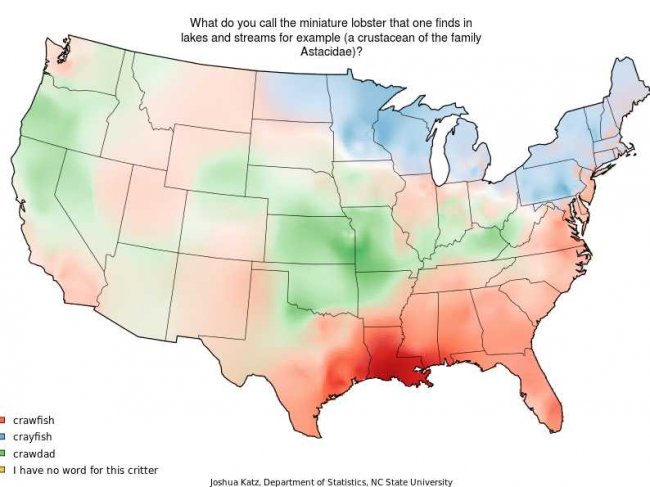
Business Insider featured Joshua Katz’s research about regional accents in the United States under the headline “22 Maps That Show How Americans Speak English Totally Differently From Each Other,” emphasizing the extraordinary divergences among speakers of American English. Sam Goldman calls this “misleading” and draws a different conclusion:
Far from showing “how Americans speak totally differently from each other”, the maps indicate a remarkable linguistic homogeneity. As far as I can tell, none of the differences that they record poses a serious challenge to understanding speakers from another region. Most regional and even international variations in English are humorous rather than obstacles to communication.
This fundamental consistency is among the strengths of English and the countries that speak it. Although each has a standard version used for official purposes, languages like Chinese, Arabic, Hindi, and even German are really families of dialects so distinct that they are not always mutually intelligible. That has important consequences, namely a much stronger sense of regional and ethnic identity. It may not be coincidental that societies in these language groups have been characterized by counterbalancing tendencies to balkanization and to strong central states that hold the various regions and peoples together by force.
Lifting Nature Up With Us
Gaia Vince suggests that as we enter the Anthropocene – the age that marks humanity’s geological influence – we will increasingly look to greener and more vertical architecture:
Cities will need to incorporate the natural world in new and innovative ways. Parks and green spaces will be multiplied from ground level upwards, attracting birds and wildlife to sky-gardens, tens of floors up.
In Singapore, for example, the Marina Bay Sands hotel features a skypark on the 56th floor, with trees, leisure facilities including a pool, and far-reaching views. It’s an example of how specific elements found in the natural world, such as a mountaintop view, a lake and palm trees, have been cherry picked and combined to provide an easy, entirely artificial landscape for the city.
Vertical farms are also being planted in Anthropocene cities, although the energy involved in irrigating and maintaining such farms makes them impractical for food production on a larger scale. However, growing food in the urban environment on regular multi-storey plots is likely to increase as hobby farmers, beekeepers and specialist growers take advantage of cleaner air, water and soils of Anthropocene cities, and vacant sites are used more effectively. In Berlin, rooftop fishfarms have been started, with the waste going to feed agricultural plots in the city. Creative growers are already converting industrial spaces, street corners and rooftops to micro-wildernesses or manicured into formal gardens. A disused raised railway in New York City has become a popular park, self-styled “guerilla gardeners” are planting flowers and trees in plots among the tarmac and traffic of London’s highways, and once-polluted industrial wastelands now chirp with birdsong, rivers swim with fish and populations of animals that have become rare in the countryside are thriving in urban niches.
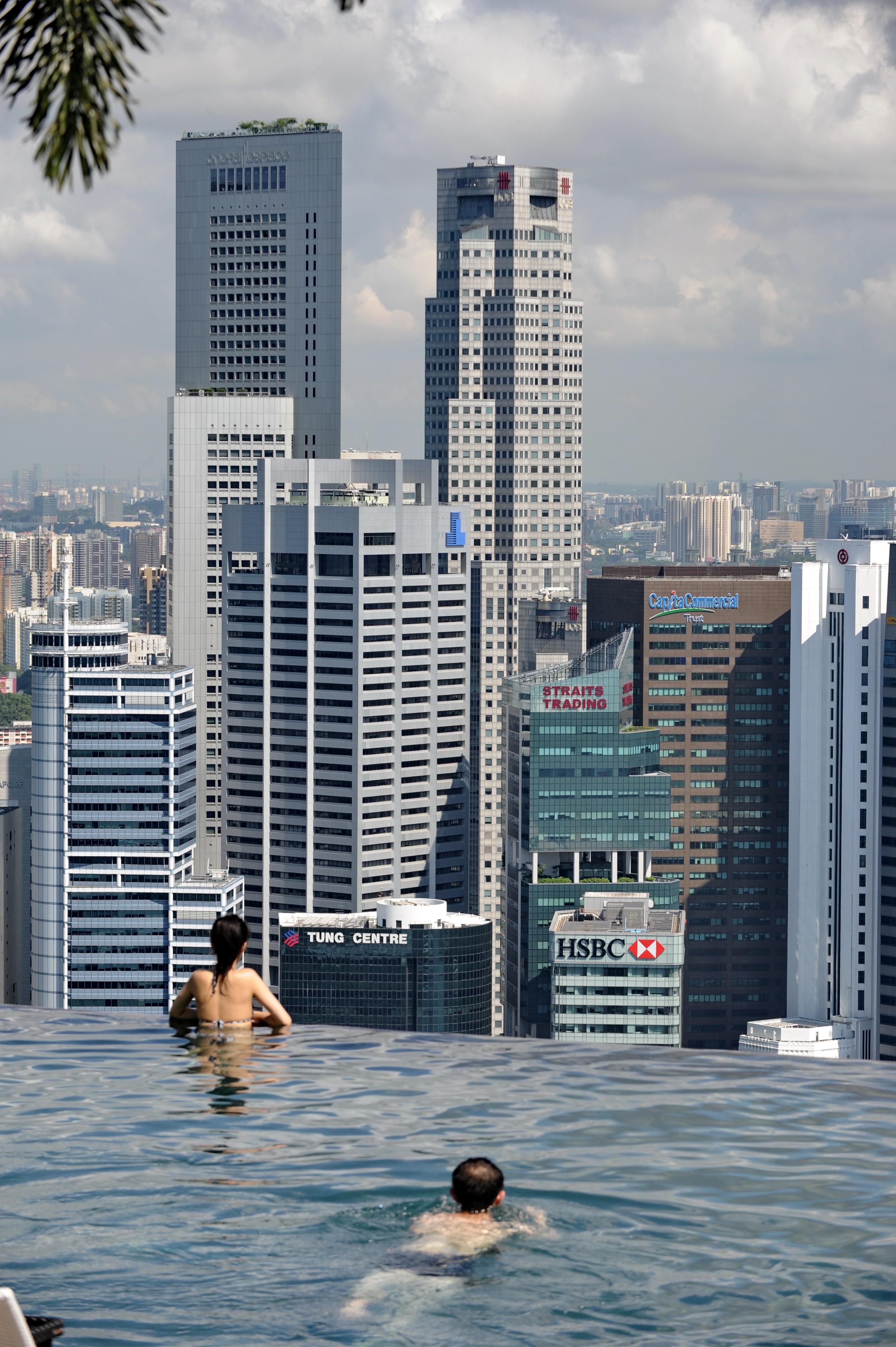
(Photo: Guests of the Marina Bay Sands hotel in Singapore look over the city-state’s financial district from a rooftop swimming pool on May 13, 2013. By Rosland Rahman/AFP/Getty Images)
Solar-Powered Coal
It should be available soon:
The world’s largest coal mining company – Coal India – is looking to innovative solution to reduce its own energy bills: it’s installing solar energy. The company, which is listed but government controlled, and which accounts for more than 80 per cent of coal production in India, is installing a 2MW plant at its Sampalbur coal plant in Odisha. It plans to install solar at its operations across the country, including at its mining research arm, the Central Mine Planning and Design Institut. …
[T]he most striking aspect of the decision is the company’s own recognition that fossil fuels are depleting, and that solar is approaching grid parity. “India has an abundance of sunshine and the trend of depletion of fossil fuels is compelling energy planners to examine the feasibility of using renewable sources of energy like solar, wind, and so on,” Coal India’s bid document said.
The move makes sense to Ryan Koronowski:
This is a remarkable statement from the largest coal company in the world. Coal India produces 90 percent of India’s coal, and not only is it turning to solar as an efficient business practice, it understands India cannot power itself by coal. In fact, a coal-based electricity system is not reliable: solar energy is. And solar may be the only hope for much of rural India to become electrified after decades of failed grid expansion plans. With so much potential solar capacity across the country … there is little wonder that even fossil fuel companies are looking to get in on the game.
 The Dish