Peak Faggot? Ctd

A reader quotes me:

“But ‘NoHomo’ is almost entirely an ugly, nasty prejudice.” I think you may be misunderstanding the colloquialism. “No homo” is a jokey addendum that means, “even though what I just said sounds gay, I’m not gay.” As in, “David Beckham is one handsome motherfucker, no homo.” I suppose it still communicates some level of level of prejudice if used without irony, since it implies that it’s important not to be mistaken for gay, but in context it’s usually not hateful. I don’t think I’ve ever heard it used to mean “there should be no homos.”

Many ironic and NSFW examples of “No Homo” can be heard above. Another reader:

I just felt it necessary to point out that the recent spike for “No Homo” in your graph is an anomaly. After Game 6 of the Eastern Conference Finals last Saturday, Pacers center Roy Hibbert made (what I thought was a clever and NOT rhetorically-charged) joke with “no homo” as the punch line.  This set off all sorts of discussion, cost him $75,000 (plus whatever future endorsements he loses) and likely spiked the Twitter traffic of “No Homo”.  You may recognize Mr. Hibbert from his brief time working for Tom Haverford’s Entertainment 720, and without getting further into the weeds than I already did on Reddit, his use of “No Homo” really was a well-crafted inversion of “that’s what she said”.

The Hibbert clip is here to see for yourself. In the same press conference he also called reporters “motherfuckers”, which was probably the main reason for the $75,000 fine. Update from a reader:

This is not true. The size of that fine was a direct result of his “no homo” line, and the league has been really vocal about this.  David Stern, the commissioner of the league, said, “While Roy has issued an apology, which is no doubt sincere, a fine is necessary to reinforce that such offensive comments will not be tolerated by the NBA.” He’s not referring to the word “motherfucker” here, and Hibbert’s apology was not in regards to the word “motherfucker.” For what it’s worth, Hibbert seems like a smart and intelligent dude, and his apology sounded sincere.

“A Menace That Is Called Twitter” Ctd

Brian Merchant shares some troubling news out of Turkey:

[Tuesday] night, police raided 38 homes where citizens who had tweeted messages sympathetic to the protests lived—16 were arrested.

Many of them are apparently teenagers. The local police apparently honed in on tweets they deemed to be propagandic, and traced them back to protesters’ IP addresses at home. Their purported crime? Using social media to “instigate public hatred and animosity.” In reality, that means tweeting out supportive words or encouraging fellow citizens to join upcoming demonstrations. …

This is the paranoid behavior of an autocratic regime; though it is unfortunately unsurprising, given the rampant police brutality that has wracked the nation over the last few days. It also demonstrates a terribly poor understanding of how social media works, as did Erdogan’s now-infamous ‘menace to society’ comment. The move is likely only to further incense protesters, generate more sympathy for them, and inspire the tech-savvy to block their IPs. Meanwhile, a social media post left by one of the protesters killed in action has helped transform him into a hero to the movement.

Previous Dish on Twitter and the Turkish protests here.

Senators For Life

Barro encourages greater turnover in Congress and looks for a “politically salable option”:

Frank Lautenberg missed most Senate votes this year because of ill health. Still, when Newark’s mayor, Cory Booker, announced his plan to run for Senate whether Lautenberg retired or not, some Democrats were aghast. Lautenberg aides told reporters that Booker was being “disrespectful,” and Lautenberg himself mused about spanking Booker like a disobedient child.

This is nuts.

Senate seats aren’t property, and Lautenberg wasn’t entitled to cling to his job even as he became too old and infirm to carry it out. We should have an expectation about Congress, as we do with other high-powered and demanding jobs, that people will retire when they are no longer up to the demands. …

[T]he best option is to change our norms about incumbency. Booker had this one right: being a good team player shouldn’t always mean waiting around for your party’s incumbents to retire. More politicians should be willing to make primary challenges, and state political parties should be more tolerant of them. And voters should recognize that “senator” is a job that benefits from turnover.

Claire Potter adds:

[P]erhaps the real question is not how old the Senate is, but how young it is not. If 37 senators are older than 65, only 12 senators are younger than 50. Demographically, the middle-aged, old and elderly are governing a nation entirely unlike the one they were formed by and educated in. Our most urgent policy questions – education, health care, immigration, communications technology, climate change, social security, long-term care for disabled veterans of Afghanistan and Iraq – are about what country the young will inherit.

Isn’t this why we could use some retirements in the Senate?

Recent Dish on the political age gap in Britain here.

Chart Of The Day

Opinion Immigration

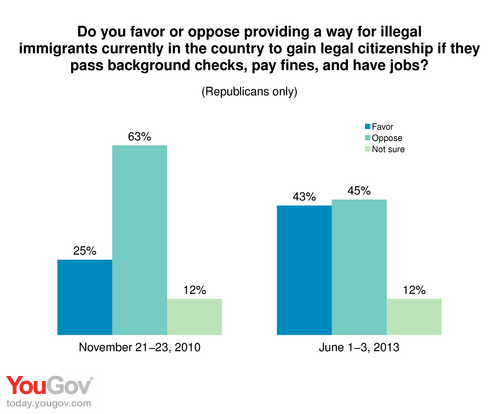
YouGov compares public opinion on immigration from 2010 and 2013:

[I]n 2010, Republicans overwhelmingly opposed opening up a pathway to citizenship; now, perhaps worried about their party’s weakness with Hispanic voters in recent elections, they divide evenly. Those in the West are among the most likely to say that immigration is a serious problem in their community (and 27% admit they know someone in this country illegally); they support this kind of path to citizenship 53% to 32%.

Know hope.

Can This Party Be Saved? Ctd

Pascal-Emmanuel Gobry summarizes the goals of reform conservatism:

Reform conservatives believe that the GOP should put forward serious and credible policies that directly address the issue of family formation and breakdown. It will be good for the economy, good for people, A Surabaya Zoo health worker checks theand is a prerequisite to shrinking government over the long term since voters will not acquiesce to shrinking public handouts if they do not feel that they have private safety nets available, first among which is the family. Furthermore, as Jonathan V Last has pointed out, it’s good politics since family formation is a key driver of voting for the GOP.

The reform conservative blueprint, then, goes something like this: Address family formation seriously -> win elections -> make it easier to start families and have kids -> more families and more kids -> a better economy, a healthier society, less demand for big government, more GOP voters -> win more elections -> shrink government, grow the economy and civil society -> win more elections -> rinse, lather, repeat.

The alternative scenario would go something like this: Don’t address middle income voters’ day-to-day concerns seriously, don’t make family formation more affordable -> concede the field to Democrats -> increase economic and social insecurity -> increase demand for government -> lose elections -> government grows bigger -> social pathologies get worse -> keep conceding the field -> increase demand for government -> etc. 2012 was Act I of that nightmare scenario.

I need to fess up. I endorsed Ross’ and Reihan’s book, but took longer than they did to let go of my libertarian instincts in the face of yawning social inequality. It’s only been since the impact of the Great Recession sank in that I have truly come to terms with the fact that, say, flat taxes are irrelevant right now to our major problems, or that publicly subsidized private health insurance is an important response to a middle class facing an epic (if much predicted) employment and economic crisis.

I do believe, with Reihan and Ross, that supporting family formation is vital – hence my support for marriage equality (and my bafflement at Ross’ ambivalence). But my preference is for government to stop doing things that actively harm family life, rather than using money transfers to shore it up against some resilient social trends that may actually be helping marriage become more moral over time. Hence my passionate support for welfare reform in the 1990s. But there’s a core agreement: the times demand a different response than that imprinted on so many of us under Reagan-Thatcher; and encouraging self-government is the best way to keep big government at bay. If the GOP were to accept the principles of Romneycare/Obamacare, for example, they could then help reform the architecture to control costs better, empower individual choices more, and win people like me back.

Bouie makes the rather obvious but no less potent point that conservative reformers have almost no actual, you know, power:

The Republican Party is broken, and fixing it is the only way to bring long-term sanity to our politics. Unfortunately, there’s no sign of change. Last week, writers on the left and the right engaged in a debate over the conservative “reform” movement, and who counted as a “reformer.” It was a fascinating conversation with one major takeaway: Regardless of who “counts” as a reform, the obvious fact is that they have little influence over the current direction of the GOP. They lack the power necessary to challenge Republican leadership, break the party’s “fever,” and begin to reestablish it as a mainstream institution.

There is, as yet, no Tony Blair of the American right, grabbing his party by the scruff of the neck and forcing it to adapt to a new reality. And there is the persistence of the fundamentalist psyche which regards any sort of pragmatic accommodation to new political and economic realities as psychologically destabilizing. Yes, I agree with Thomas Mann and Norman Ornstein that the current nihilist extremism of the current Republican Party is “the central problem in American life.” And yet I find the chances of getting reform from within close to impossible, given how far they’ve now gone over the edge. And this is a tragedy not just for America, but for the GOP itself.

The greatest failure of the GOP is not realizing that Obama is a president they could have worked with on policy grounds, and whose relationship with them could have actually defused some of the very traits that suburban voters and most generations under 40 still find so disturbing in the GOP base.

Here, for example, was a man whose family life would make him a cult hero if he were a Republican, but who has been demonized as an alien threat to America from the get-go. Here’s a Democrat who adopted Heritage Foundation ideas for healthcare exchanges. Here’s a Democrat who has actually cut Medicare. His stimulus was one-third tax cuts. Domestic energy production has soared under Obama, even as record numbers of illegal immigrants have been deported. There were and are so many ways in which the GOP could have used Obama for their own advantage – both strategically and culturally. But they refused to, opting instead for visceral, dumb, self-defeating short-term tactical political advantage. All tactics and emotion; no strategy and reason.

And even the reformers are constrained. Have Ross or Reihan ever said that although they’d prefer a different healthcare reform, Obamacare is better than nothing? If they did, they’d be Frummed out. Or take Yuval Levin, recently tackled by Chait:

Levin may arrive at conclusions that gratify the tea party, but he does not merely rant against big government. He presents his analysis as the considered result of careful study. He harnessed himself, at least rhetorically, to a series of falsifiable claims. They are being falsified, but the restraints of his ideology give him no room to do anything but obfuscate.

I’d qualify that as the restraints that partisanship imposes on him. But they rode this tiger for so long it’s hard to feel pity as they try both to get off and not be eaten at the same time. Previous thoughts on the subject here.
Obama’s Second Term – In Cartoon Form

My now ancient cartoon analogy of the relationship between the GOP and president Obama was the road-runner (el presidente) and Wile. E. Coyote (think Tea Party). Then the other night, as I was thinking about the challenges of the second term – specifically the legit and nutso scandal investigations by Ailes/Issa – another classic cartoon duo came to mind:

He even walks like the Pink Panther, when you think about it. Or rather glides. But I’ll probably stick to the meep and the meep.

Baseball’s War On Steroids

Major League Baseball recently announced the suspension of “about 20 players” for their connection to the performance-enhancing drug clinic Biogenesis. Update from a reader:

The MLB has not yet officially announced any suspensions, and the article you linked to references only leaked reports about potential upcoming suspensions. For a more in-depth discussion of the potential effect the suspensions may have on future labor relations you should check out this Grantland piece by Jonah Keri.

Pareene compares the MLB’s efforts to eliminate steroids to the war on drugs:

Years after BALCO, it looks as if just as many players are using. The league’s stricter enforcement has simply led to players getting more creative, and apparently relying on even less reliable sources. … Like the federal War on Drugs, enforcement is draconian and unequal (minor leaguers don’t get the protection and defense provided by the MLBPA). It is also occasionally incoherent: Marijuana use subjects players to suspensions and bans, though drunk driving doesn’t. There’s no concrete evidence that HGH does much for players beyond making them look really cut. At least Major League players have access, unlike your typical subject of the criminal justice system, to the best defense money can buy.

I’d say Alex is under-rating HGH, but his general point stands. Travis Waldron weighs in:

There exists … virtually no evidence that drug testing deters drug use.

Baseball doesn’t have records of drug use from before the testing era, so there isn’t any way to measure its efficacy. But the existence of tests and suspensions obviously hasn’t stopped Rodriguez, who admitted to steroid use in 2009, from associating with shady figures like Bosch, and it hasn’t stopped countless other players from using drugs either. Drug use is rampant in sports like cycling and the Olympics that have aggressive testing policies, and academic research has suggested that “testing alone is not a sufficient deterrent to eliminate drug use among college athletes.”

As for aggressive drug testing and busts of professionals serving as a deterrent for young athletes, Dr. Linn Goldberg testified in front of the House of Representatives in December that his two-year testing of high school athletes had no deterrent effect on their use of performance enhancing drugs. If drug testing young athletes doesn’t stop them from using drugs, should we really expect that drug testing professional athletes is going to stop young athletes from using drugs?