Obama’s Foreign Policy Shake-Up

The above comments will mean the usual brutal attacks on Power from the usual sources. But I have written similar things, and believe passionately that acquiescence to Israel’s continued settlement policy – designed to create a permanent Greater Israel – must be challenged by the United States. The constantly expanding occupation is against our values and against our interests. We should be using all our leverage to stop it, rather than funding it, as we continue to do. But Larison argues it’s the realists rather than the neocons who should be upset:

The one major issue that distinguished Rice and Power in the first term was their support for the Libyan war, and in spite of backing that misguided intervention both of them are being promoted. That tells current and future officials that there is no penalty in supporting unwise military action, and indicates that ambitious officials should push for more aggressive policies whether they are in the national interest or not. I don’t understand the selection of Power for the U.N. unless it is simply a reward to a long-time Obama loyalist. I suppose that the position has sometimes been filled in the past to make a political or ideological statement (see Bolton, John), and appointing Power to this post might be an exercise in placating liberal hawks disaffected with Obama’s recent foreign policy record. If so, I doubt it will work, since it will just make Obama’s liberal hawkish detractors more vocal in their demands that the U.S. intervene in Syria.

I suspect it won’t. Both Rice and Power have taken an anti-interventionist position on Syria, for the usual sane reasons (even if we could do something, what would that something possibly be? Arming branches of al Qaeda?). Besides, foreign policy under this president is made in the Oval Office. I’d say the reason behind these appointments is, as my shrink will often say, multi-determined. Rice and Power have extraordinary minds, moral clarity and the kind of self-discipline that Obama rewards. (Samantha’s campaign outburst against Hillary was, I like to think, the Irish in her temporarily escaping.)

I also think their gender matters. With Kerry replacing Clinton, the need for female prominence in foreign policy is all the more politically astute. While Erick Erickson is opining that women should naturally submit to their husbands as a matter of science, and the GOP wanders off into la-la land on abortion and contraception, Obama is shrewd to balance John Kerry at State with Rice and Power at the NSA and UN. (Full disclosure: I’ve known and admired Samantha ever since I turned her down for an internship at TNR way back when, but am not that close. And yes, that was a dumb mistake in retrospect.)

And if you were a president with a conscience but also a very cold, realist approach to foreign policy, wouldn’t you do exactly what he’s done? Find those most likely to argue for liberal intervention and bring them closer into the tent rather than risk them smoldering from a distance? They act as liberal buffers to an inherently conservative foreign policy (by which I mean the antithesis of neoconservative.)

Max Fisher sees the point:

[E]ven if Power and Rice did disagree with Obama on Syria, he’s already overruled more senior and experienced officials who wanted to upgrade U.S. involvement. He shot down a 2012 plan, backed by Defense Secretary Leon E. Panetta, Secretary of State Hillary Rodham Clinton, CIA chief David H. Petraeus and Gen. Martin E. Dempsey, chairman of the Joint Chiefs of Staff, to directly arm the Syrian rebels. Even if they wanted to, it’s not clear that Power and Rice would be better positioned to change U.S. policy.

Ali Gharib expects Power to be attacked, once again, over her comments about Israel (some of the most controversial seen above):

Will re-hashing these 2008 attacks squash Power’s nomination? Probably not. But will those segments of the pro-Israel right that attacked her in 2008 have at it again in 2013? Most definitely. And if the first salvos are any indication, they’ll use the exact same playbook they did five years ago. Like Chuck Hagel’s embattled nomination as Defense Secretary, Power will survive. But she’ll take some shots and come out hesitant to say ‘boo” about Israel.

Fisher puts Power’s old comments in context:

It appears that Kreisler asked Power how she, if she were a presidential adviser and human rights atrocities broke out in Israel-Palestine, would advise the president to “put a structure in place to monitor that situation [where] at least one party or another [may] be looking like they might be moving toward genocide.”

That last part is important: the hypothetical she’s addressing is about what to do if genocide appears imminent. He’s not asking Power, hey, do you think we should invade Israel to impose a two-state solution? Still, even remembering that she was being prompted with an extreme and unlikely worst-case hypothetical, Power’s answer was not ideal.

And James Gibney previews Power’s confirmation hearings:

Even if this doesn’t end up putting U.S. boots on the ground in Syria, Power’s confirmation hearings will showcase cognitive dissonance on both sides of the bench: Power as she bobs and weaves to avoid criticizing the administration’s relative inaction to stop the slaughter in Syria, and Republican Senators John McCain and Lindsey Graham as they hammer away at a nominee whose more robust views on intervention they doubtless have great sympathy for.

Samantha can take it. As long as she doesn’t get her Irish up.

I have to say on a personal note that I’m also moved by this Irish immigrant with such brilliance and passion representing the United States. In some ways, we actual immigrants, born abroad, represent a quintessentially and uniquely American experience: we chose this country because we love it and wanted to start our lives over. And it rewards us by treating us (if not in my case for a long time because of HIV) as if we belong here. That’s uniquely American.

(Thumbnail photo by Eric Bridiers, United States Mission Geneva)
What’s Up With Immigration?

The bill’s chances appear to have taken a turn for the worse. Chait assesses the situation:

Is the deal exactly what Rubio wanted? No. It wasn’t exactly what anybody wanted. But, again, that’s called “negotiation.” That’s why Democrats had to vote for utterly obnoxious provisions excluding gay couples. They didn’t like the things they voted for, but were under the impression that both sides were bound by the terms of the deal. Now Rubio is saying only they’re bound by it.

The question for Democrats is, at what point do they insist that a deal’s a deal? The dynamic here is that Republicans have a mainly political objective, and Democrats a mainly policy objective. The Republicans do want some changes to the law that would benefit businesses, but mainly they want to take immigration off the table as an issue in order to give themselves an opening to court Latino voters. Democrats are willing to take the issue off the table in order to get a substantive policy accomplishment.

He follows up here. My worry is that if this doesn’t get done by the fall, we’re entering primary season on the right and the lunatic choke-hold on pragmatic reform will tighten. Allahpundit analyzes Rubio’s recent demands for border-security guarantees:

If Rubio’s decided the bill’s current border-security provisions are untenable, it’s not because he’s been troubled by them all along and feels obliged to keep his initial promise. It’s because, despite his best efforts, the Gang of Eight simply won’t fly as-is among conservatives. He did his best to sell it and he couldn’t pull it off. Time for Plan B.

Drum is growing pessimistic:

“Those amendments” [that Rubio wants] are poison pills that would require 100 percent operational control of the border before any new green cards are issued, a standard that’s pretty obviously impossible to meet. The only reason to insist on them is to give Rubio a plausible exit strategy from his own bill.

Or so it seems. Maybe Rubio has something else in mind. But it’s sure starting to look like Rubio has figured out that his support for immigration reform is doing him more harm than good with the tea party folks he needs if he ever wants to become president. What’s more, he’s probably less confident than he used to be about the chances of getting the House to go along anyway, which makes it pointless for him to keep taking damage over the issue.

Ezra searches for a silver lining:

Letting Republicans break the bill into pieces makes it likelier that some of those pieces will pass. It also makes it easier for Republicans to vent their anger against certain parts of immigration reform — like the path to citizenship — without imperiling the whole bill. It makes it likelier that something, anything, passes the House.

Bernstein’s bottom line:

What Rubio’s apparent defection could mean is that the vote in the Senate will be a lot less overwhelming. But that only really matters to the extent that it puts pressure on the House. And what really matters in the House probably isn’t media pressure, but the basic calculation by mainstream conservatives about whether passing a bill is better than not passing a bill.

Whom Will Obamacare Burden?

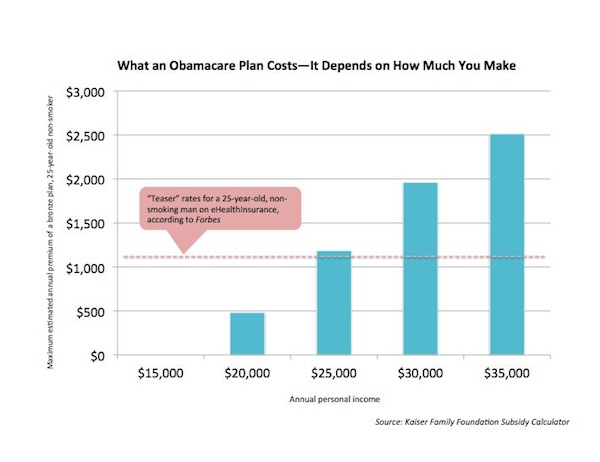
Subsidies Graph

Chait is unconvinced by the most recent ACA “victim” put forth by opponents of the law:

It is true — and nobody has ever denied this — that the hypothetical 25-year-old male will pay higher insurance premiums under Obamacare. Now, this 25-year-old male probably won’t pay higher premiums under Obamacare if he does smoke, or have any potentially worrisome medical history, or have family members with any potential medical history, or even if he’s a perfectly healthy non-smoker from a perfectly healthy family but has a low enough income to qualify for tax credits to cover his premium costs. And of course he’d be unaffected if he already gets insurance through his employer.

Will Wilkinson assesses the claim that the young and healthy will be forced into the insurance pool by the individual mandate, using a hypothetical 25-year-old freelancer named Nicole who makes $30K a year:

Over the next two years, as the penalty scales up, it’s pretty clear that Nicole would be smartest to pay the initially meagre fine and not sign up for insurance unless she comes down with something expensive. (No exclusions for pre-existing conditions!) But what about in 2016, when the non-compliance penalty is finally fully unfurled? That will be the greater of $695 per uninsured person, or 2.5% of household income over the filing threshold, which is not yet set, but this year was about $10,000 for individuals. So in Nicole’s case, that’s 2.5% of $20,000, which is only $500. So she’s on the hook for $695. For Nicole in 2016, then, the difference between going uninsured and getting a Bronze plan is $1,224, which is just a touch more than I recently paid for a cheap catastrophic plan. If America’s Nicoles are going without insurance due to cost, they’re not going to be induced to get it under Obamacare. If the programme is going to bring down the cost of an average policy by goading the likes of Nicole into the risk pool, it needs a bigger carrot, stick or both.

Sarah Kliff adds some important context:

Young Americans tend to have lower incomes than their older counterparts. That means they’re more likely to qualify for subsidies than their parents. In a new analysis released Wednesday, consulting firm Avalere Health estimates that “approximately two-thirds of young adults (30 and under) who are currently uninsured or enrolled in non-group coverage and who will not qualify for Medicaid—the population most likely to experience rate shock— have incomes between 133 and 400 percent of the federal poverty line (FPL), making them eligible for premium tax credits.”

To translate that out of health wonk speak: The federal government will help most young, uninsured people buy coverage under Obamacare. But, there’s also a significant contingent who won’t receive help–and those are the ones most likely to see their rates increase.

Cohn, who flags the above chart, goes into more detail:

A 25-year-old single man, making $35,000 a year, can expect to pay the full price of a bronze policy: About $2,511 a year in 2014. We can argue whether that constitutes true “shock,” given that it’s far less than employer policies cost. Still, it’s a lot more than the $1,104 premiums Roy found on eHealthInsurance. The same would be true for a 25-year-old non-smoker with even higher income. These are the young and healthy people who will end up paying more. That’s important and must be part of conversation.

But look what happens when we think about somebody making less money. If this young man’s annual income was $25,000, he’d pay just $1,184 a year. That’s basically the same as the eHealthInsurance bids, give or take a few six packs of beer. Dude! At $20,000 a year in earnings, the expected bronze premium comes all the way down to $481 a year. And at $15,000 a year, insurance is free. That’s right, the premium would be zero dollars. (If you’re interested, you can run the same calculations for silver policies, which are more generous, although the comparison to cheap eHealthInsurance plans becomes even more unfair to Obamacare. You can also run it for older people, or consider the possiblity of catastrophic-only coverage that Obamacare makes available to people younger than 30.)

Named After Your Parents’ Politics

Is everything now polarized? John Sides summarizes new research (pdf) on the baby names popular on the left and right:

[Eric] Oliver and colleagues argue that liberals, consciously or unconsciously, signal cultural tastes and erudition when picking their child’s name. In conversation with me, Oliver used himself as an example. He and his wife, a novelist, named their daughter Esme — a name gleaned from a story by the writer J.D. Salinger.

On the other hand, conservatives, by being more likely than liberals to pick popular or traditional names (like John, Richard, or Katherine), signal economic capital. That is, they are choosing names traditional to the dominant economic group — essentially, wealthy whites. Oliver noted to me that some immigrants also try to help their children assimilate and succeed by choosing names in this fashion. And, given research that shows that the ethnic connotations of a job applicant’s name can affect the possibility of getting an interview, choosing names this way may make economic sense.

Ask Josh Barro Anything: Caring About Inequality

Josh explains why conservatives need to pay attention to income equality:

Back in November, we looked at Josh’s insistence that the GOP consider some kinds of redistribution to help deal with inequality. Here are some of his additional suggestions from that post:

[Republicans] can take up the cause of cost control in health care and higher education, the effect of which would be to raise real incomes for the middle class. The rising cost of health benefits has been a key driver of middle-class wage stagnation. Unfortunately, many of the policies actually likely to control costs in these sectors are interventionist in a way that makes conservatives recoil.

Another possibility is greater high-skill immigration. Globalization has been disproportionately beneficial to high-skill workers in developed nations: they have seen the prices of products fall as manufacturing shifts to low-wage countries, but their own jobs are insulated from foreign competition. Letting in more foreign doctors and engineers should drive down wages in skilled professions and the cost of the services those professionals provide, raising real incomes for lower-income workers who already face wage competition from other countries. Reducing occupational licensing requirements would similarly raise real incomes.

Recent Dish on inequality here, here and here.

Josh Barro is currently the Politics Editor at Business Insider. He has previously written for Bloomberg View, and before that was a Senior Fellow at the Manhattan Institute. Previous Dish on Chait’s recent profile of Barro here and here. Our Ask Anything archive is here.

What IRS Scandal? Ctd

After learning that conservative groups make up two-thirds of the groups that had “received special scrutiny and been approved for tax-exempt status,” Kevin Drum is even less convinced by Republican attempts to play up the scandal:

This doesn’t tell us anything definitive about the entire set of groups that got special scrutiny. If the whole set is similar to the approved set, then about two-thirds were conservative and one-third liberal—most likely because of the boom in new tea party groups in 2010. But that’s just a guess. One thing isn’t a guess, however: Two-thirds of the groups who were approved for tax-exempt status were conservative. If the IRS was on a partisan witch hunt against conservative groups, that’s sure an odd way of showing it, isn’t it?

Garance Franke-Ruta lists some of the progressive organizations whose tax exempt status was checked by the IRS:

Non-conservative advocacy groups given special scrutiny by the IRS in or after 2010 included the Coffee Party USA, the alternative to the Tea Party movement that got a bunch of press in 2010, as well as such explicitly progressive groups as the Progressive Leadership Alliance of NevadaRebuild the Dream, founded by former Obama administration official Van Jones; and Progressives United Inc., which was founded by former Wisconsin senator Russ Feingold.

Also included in the special scrutiny were Progress Texas and Progress Missouri Inc.Tie the Knot, which sells bow ties to raise money to promote same-sex marriage; and ProgressNow, which describes itself as “a year-round never-ending progressive campaign.”

Peak Faggot?

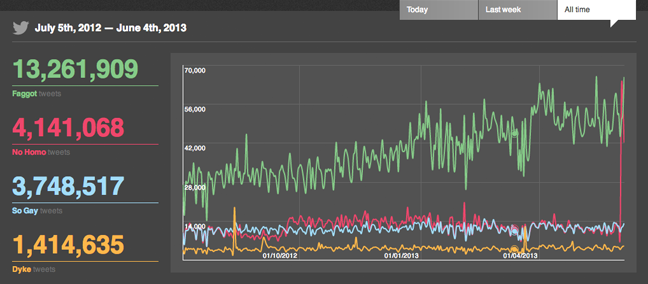
The word has been going gangbusters on Twitter lately:

alltimenohomo-grab

What’s interesting is to click on NoHomophobes.com to read the actual contemporaneous tweets that contain the phrases “so gay”, “dyke”, “NoHomo”, and “faggot.” I have to say that “so gay” does seem, from reading the tweets, to be close to meaningless in terms of active, pre-meditated homophobia. Yes, of course it is a negative term and is rooted in the premise that being homosexual is lame. But it has become so generic I’m not really outraged by it. In fact, I’m not that outraged at any of this. Twitter is full of expletives and hate-words. I wonder if the n-word and the word “bitch”, for example, are much more common.

“Faggot” is also somewhat ubiquitous, ranging from the classic hate term against gay men to a general term of abuse for straight women and straight men. But some of that abuse in context is jokey. So this post – which will be tweeted – will register as hate-speech, just as a joke between two friends in which “faggot” has been drained of any explicit homosexual meaning. But “NoHomo” is almost entirely an ugly, nasty prejudice.

I may not be personally outraged, but I’m in a very privileged position (only gay-bashed once in my life), and the general the trend is disturbing, especially when we have seen a spate of anti-gay street violence from the Castro to the West Village, a few blocks from where I now live.

It gets more disturbing still when you also have the spectacle of a Republican candidate for Lieutenant Governor in Virginia like EW Jackson. The state’s GOP has effectively affirmed the legitimacy of a man who has used not just tired cliches but what I think has to be called “eliminationist” rhetoric, as defined by Daniel Goldhagen. Take this:

“[T]he homosexual movement is a cancer attacking vital organs of faith, family & military – repositories of traditional values.”

Or this:

“The ‘homosexual religion’ is the most virulent anti-Christian bigotry & hatred I’ve ever seen.”

Now look at the actual definition of “eliminationist” rhetoric:

Eliminationism is the belief that one’s political opponents are “a cancer on the body politic that must be excised — either by separation from the public at large, through censorship or by outright extermination — in order to protect the purity of the nation.

I’m a free speech absolutist. But when we find hate terms surging on Twitter, eliminationist anti-gay rhetoric from major candidates, and a rise in attacks on gay men in neighborhoods associated with them, we should take notice. There is a range of tweeted sentiments here – from innocuous to unthinking (the NoHomophobes website has a smart slogan: “Homophobic language isn’t always meant to be hurtful, but how often do we use it without thinking?”). But when they are legitimized by rhetoric that seeks to speak of gays the way Afrikaners spoke of Africans, and extremist Sunnis speak of Shiites, we have a problem. I urge readers to check out the site and tell me what they hear and read, and what they make of it. It can get complex and I have two confirmation biases: I’m gay and am attached to a non-victimology temperament in identity politics.

But one thing I do know in this atmosphere: The GOP is dipping into some of the foulest waters here. I just hope they aren’t legitimizing a wave of hatred.

Can This Party Be Saved?

A Surabaya Zoo health worker checks the

Pareene reviews a report from the College Republicans on the perception of the party among key demographic groups:

[M]ost of these unfortunate impressions people have of the party are accurate reflections of the party’s positions. The report sidesteps most of this, calling for the party to sound more tolerant and open-minded. On same-sex marriage, the authors write, “the party ought to promote the diversity of thought within its ranks and make clear that we welcome healthy debate on the policy topic at hand.” We’ve been having “healthy debate” on the issue for some time now, and most Americans — including overwhelming majorities of young people — have come to the conclusion that the debate is basically over. Another always-fun topic in these reports is how they deal with the party’s recent nationwide reproductive rights tantrum. The College Republicans recommend just shutting up about it.

Amanda Marcotte, focusing on the contraception debate, points out that it’s more than a “problem of branding, misperception, or media bias”:

No one is forcing Republicans to attack contraception subsidies every chance they get. Republicans did not actually have to insist that your employer be able to prevent you from using your own insurance benefits on contraception, nor did they have to convene an all-male panel to discuss how important it was to give a woman’s boss a vote in her reproductive health care. It wasn’t required of the party that it run so many rape philosophers for office. Indeed, the problem for Republicans on the subject of reproductive rights is that young voters accurately understand its positions … The problem is that opponents aren’t distorting the attacks on contraception. The only way for Republicans to not be perceived as anti-contraception is to stop attacking contraception. Nothing else will work.

Drum blames the right-wing media:

It’s conservative media that controls the GOP’s fate. The Republican Party could almost certainly solve its problem if Fox News and the rest of the gang were on board. They could lighten up on the culture war stuff, thus increasing their appeal among young voters, while keeping the oldsters on board too. Right now, though, they can’t do it because the Rush/Drudge/Fox axis will go ballistic, turning the tea partiers into frothing maniacs over every perceived deviation from traditional morality. If they agreed among themselves to stop doing this, the frothing would subside and the party would have a whole lot more short-term maneuvering room to address their long-term problem.

(Photo: A Surabaya Zoo health worker checks the pulse of the sick 35-year-old elephant named Fitri, in East Java on July 26, 2011. STR/AFP/Getty Images)