Martin Bashir thinks the IRS is today’s equivalent of the n-word:
Month: June 2013
The FBI May Have Your Phone Records
[tweet https://twitter.com/cgreensit/statuses/342451643381587970 ]
The NSA has been collecting the telephone records of Verizon customers, regardless of any suspected wrongdoing, after obtaining a court order in April. The FISA Court gave the FBI a court order to monitor all national and international calls on an “ongoing, daily basis” for three months. Glenn Greenwald, Ewen MacAskill and Spencer Ackerman report:
The order directs Verizon to “continue production on an ongoing daily basis thereafter for the duration of this order”. It specifies that the records to be produced include “session identifying information”, such as “originating and terminating number”, the duration of each call, telephone calling card numbers, trunk identifiers, International Mobile Subscriber Identity (IMSI) number, and “comprehensive communication routing information”.
The court order appears to explain the numerous cryptic public warnings by two US senators, Ron Wyden and Mark Udall, about the scope of the Obama administration’s surveillance activities. For roughly two years, the two Democrats have been stridently advising the public that the US government is relying on “secret legal interpretations” to claim surveillance powers so broad that the American public would be “stunned” to learn of the kind of domestic spying being conducted. …
It is not known whether Verizon is the only cell-phone provider to be targeted with such an order, although previous reporting has suggested the NSA has collected cell records from all major mobile networks. It is also unclear from the leaked document whether the three-month order was a one-off, or the latest in a series of similar orders.
Timothy B. Lee adds:
“This confirms what we had long suspected,” says Cindy Cohn, an attorney at the Electronic Frontier Foundation (EFF), a civil liberties organization that has long accused the government of operating a secret dragnet surveillance program. “We’ve been suing over this since 2006.”
The order is based on Section 215 of the Patriot Act, which allows law enforcement to obtain a wide variety of “business records,” including calling records. EFF has long criticized Section 215, which sets a threshold for obtaining records much lower than the “probable cause” standard required to get a search warrant.
But Cohn argues that the kind of dragnet surveillance suggested by the Verizon order exceeds even the authority granted by the Patriot Act. “Section 215 is written as if they’re going after individual people based on individual investigations,” she says. In contrast, the order leaked to the Guardian affects “millions and millions of innocent people. There’s no way all of our calling records are relevant to a terrorism investigation.”
Marc Ambinder weighs in:
My own understanding is that the NSA routinely collects millions of domestic-to-domestic phone records. It does not do anything with them unless there is a need to search through them for lawful purposes. That is, an analyst at the NSA cannot legally simply perform random searches through the stored data. He or she needs to have a reason, usually some intelligence tip. That would allow him or her to segregate the part of the data that’s necessary to analyze, and proceed from there.
In a way, it makes sense for the NSA to collect all telephone records because it can’t know in advance what sections or slices it might need in the future. It does not follow that simply because the NSA collects data that it is legal for the NSA to use the data for foreign intelligence or counter-terrorism analysis.
Unfortunately, we don’t know precisely what the NSA can do because its rules are highly classified. This disclosure will hopefully force the government to clarify the rules it uses to actually analyze the data it collects.
Amen. But like Ambers, I’m neither shocked nor that outraged. Meta-data is not the content of our phone records. Gregory Ferenstein’s view:
The revelation dovetails similar exposes on massive government spying projects, including one project to combine federal datasets and look for patterns on anything which could be related to terrorism.
Late last year, I wrote about a few actual harms that citizens should be worried about from these types of big-data spying programs. Blackmailing citizens critical of the government seemed like a distant hypothetical, until we learned that the IRS was auditing Tea Party groups and journalists were being wiretapped. Nefarious actors inside the government like to abuse national security programs for political ends, and that should make us all (even more) suspect of government spying.
Ed Morrissey compares Obama’s data-mining to Bush’s:
Hypocrisy is an unfortunately ubiquitous condition in politics, but in the case of NSA seizing Verizon’s phone records, it’s particularly widespread. Some of the people expressing outrage for the Obama administration’s efforts at data mining had a different attitude toward it when Bush was in office. Conversely, we’ll see some people defending Obama who considered Bush evil incarnate for the same thing.
On that front, this kind of meta-data gathering hasn’t outraged me too much under either administration. This kind of technology is one of the US’ only competitive advantages against Jihadists. Yes, its abuses could be terrible. But so could the consequences of its absence. Maybe the record shows my passionate denunciation of this by Bush. I don’t remember it. If someone finds me in a double-standard here, let me know. Pareene zooms out:
While the fact that the NSA has the power to do this has been public for some time, we’ve never seen, until the Guardian obtained one, an actual Foreign Intelligence Surveillance Court warrant. They are very top secret. Someone will probably be prosecuted for leaking this one. That, in fact, is one of the primary issues civil libertarians, like the ACLU and the Electronic Frontier Foundation have been raising: If the way the administration interprets the law is secret, the law itself is effectively secret.
Where Coming Out Takes Real Courage
Joe My God passes along the trailer for Call Me Kuchu, opening in NYC on June 14th and LA the following week. A synopsis:
In an unmarked office at the end of a dirt track, veteran activist David Kato labors to repeal Uganda’s homophobic laws and liberate his fellow lesbian, gay, bisexual and transgender men and women, or “kuchus.” … But one year into filming Call Me Kuchu and just three weeks after a landmark legal victory, the unthinkable happens: David is brutally murdered in his home. His death sends shock waves around the world, and leaves the Bishop and Kampala’s kuchus traumatized and seeking answers for a way forward. With unprecedented access, Call Me Kuchu depicts the last year in the life of a courageous, quick-witted and steadfast man whose wisdom and achievements were not fully recognized until after his death, and whose memory has inspired a new generation of human rights advocates.
Elsewhere, Stephen Fry shares a shocking quote from his upcoming documentary Out There, which looks at the experience of being gay around the world:
I actually got a Ugandan minister to say on camera — he’s the Minister for Ethics and Integrity; it’s the only such ministry in the world — and I said to him, ‘Look, even if these… utterly false supports on which you base your homophobia were true, which they aren’t, there’s so much more to worry about in your country than the odd gay person going to bed with the other gay person. For example, you have almost an epidemic of child rape in this country, which is just frightening.’ And he said, ‘Ah, but it is the right kind of child rape.’ …
I said ‘That was on camera. Do you know that that was on camera?’ He said yes. I said, ‘Can you just explain what you mean? He said, ‘Well, it is men raping girls, which is natural.’
A Photographic Memory
Vaughan Bell passes along a spooky story about a Parkinson’s patient whose hallucinations persisted even in photographs:
Patient 1 was first evaluated at age 66, having been diagnosed with PD [Parkinson’s Disease] at age 58… She complained of daytime and night-time visual hallucinations for the past one year. Most of the time she did not have insight about them. She described seeing three children playing in her neighbour’s yard and a brunette woman sleeping under the covers in one of the beds in her house. She also saw images of different people sitting quietly in her living room. Most of her visual hallucinations subsided in open and brightly lit spaces but were, nevertheless, troublesome. In one instance, she saw a man covered in blood, holding a child and called 911.
Her husband, in an attempt to prove to her that these were hallucinations, took pictures of the neighbour’s yard and the bed in their house. Surprisingly, when shown these photos, the patient continued to identify the same children playing in the yard and the same brunette woman sleeping under the covers. This perception was present every time the patient looked at these photos. Within 6 months of stopping ropinirole and titrating quetiapine to 75 mg every night at bedtime the hallucinations were less severe and shorter in duration, but the patient continued to see them in the photos.
New York In Living Color
In 1939:
The Dish recently posted a color film of London from 1927. Update from a reader:
The video was more captivating than I thought it would be. I was surprised at how stylish the people seem, and how thin! Hardly any fat folks to be seen! Of course, many people were smoking, which might help stay thin. And the kids looked so healthy. They keep telling us we have an obesity problem in this country, but you don’t quite realize the extent until you look back.
Another points to an Atlanta version of 1939.
(Hat tip: Kottke)
Attack Of The Patent Trolls, Ctd
A reader writes:
I’m a patent attorney (and subscriber…) with over 20 years of experience. I’m not saying patent “trolls” are not an issue, but they are nowhere near the problem made out the graph you displayed and the president’s release yesterday. In 2011, Obama signed what was then called “patent reform,” a large piece of legislation that made many changes to the patent system. One of the changes, which was put in solely to address the alleged patent trolling problem, required that, in effect, you can only file suit against one accused infringer per case. So if you have a patent you believe covers, let’s say, a memory chip, and all the memory chip makers manufacture essentially the same chip (which, due to industry standards, is the case), you can no longer file a single case naming all the memory manufacturers. Instead, you are forced to file separate cases against each. So what used to be one case is now 5-10 cases.
Funny how that law took effect in 2011, which is when the data shows the increase in the number of cases. As my father used to say, figures are for liars, and liars figure.
I’m with Drum. The only way to fix the patent system is the fix the Patent Office. They are overworked, abused, and starved of resources. I bet most people don’t know that the Patent Office is self-funded (i.e., all the money it needs to operate comes from user fees). By statute, the Patent Office’s fees are set at a level so that it collects all the money it needs to operate – not more, not less. The PTO does this, and then Congress raids that money and takes some of it away for other uses. We cannot expect the Patent Office to do its job without the money it requires to properly operate.
The 2011 statute I mentioned was supposed to stop fee diversion, but the word I’m getting is that it has not stopped Congress from raiding the Patent Office’s coffers.
Getting Paraplegics Back On Their Feet
Helen Thomson tells the amazing story of Antonio Melillo, whose spinal cord was severed in a 2011 car crash:
Over in the corner of the lab, Thomas Hoellinger of the Free University of Brussels (ULB) in Belgium is wearing an EEG cap, which measures electrical activity at various points across his scalp. There are several ways he can use it to control the exoskeleton through thought alone – at the moment, the most promising involves wearing a pair of glasses with flickering diodes attached to each lens. … Measurements from this part of the brain can detect whether Hoellinger is concentrating on the left diode or the right. He shows me how concentrating on the left starts the exoskeleton walking, while concentrating on the right stops it. All this happens in under a second.
Melillo isn’t wearing the cap right now, because the team has hit a snag. When the exoskeleton moves, its motors induce electrical noise in the EEG signal, making the readings unreliable. So instead of mind control, Melillo is walking by moving his upper body. As he leans left, a pressure sensor just above his buttock registers the movement and moves the opposite leg of the exoskeleton. He repeats the process on the other side to begin walking. “It’s great, such an amazing sensation,” he says. “Not just walking but even being able to stand upright.”
In the future, researchers hope to be able to control the exoskeleton based on brain activity that “corresponds with the intention of walking” and allows the user to control their pace.
The Global One Percent
Despite its name, it is a less “exclusive” club than the US top 1 percent: the global top 1% consists of more than 60 million people, the US top 1% of only 3 million. Thus, among the global top percent, we find the richest 12 percent of Americans (more than 30 million people) and between 3 and 6 percent of the richest Britons, Japanese, Germans, and French. It is a “club” still overwhelmingly composed of the “old rich” world of western Europe, northern America and Japan. The richest 1% of the embattled Euro countries of Italy, Spain, Portugal and Greece are all part of the global top 1 percentile. However, the richest 1% of Brazilians, Russians and South Africans belong there, too.
Joshua Keating takes note:
As usual with Milanovic’s writing, the paper is a little all over the place but all of it is fascinting. He argues that we are living in a “non-Marxian” world in which a person’s material wellbeing is determined less by class than location. “Differently put, more than fifty percent of one’s income depends on the average income of the country where a person lives or was born,” he writes. So much for workers of the world unite.
Do Mascots Need Modernizing? Ctd
A reader writes:
As a long-suffering Cleveland Indians fan, I thought I would weigh in on this issue. I absolutely loath the “grinning Indian” that has been the team’s mascot for decades. In the club’s defense, it seems that they have been trying to limit its use despite what appears to be support for the image by fans. Today, the team uses either a script “I” or an uppercase “C” on its uniforms and caps. Eradicating the emblem altogether would be the right thing to do.
But what is not commonly known is that the team name actually came from a fan contest in the early 20th century to rename the Cleveland club. The name honors Louis Sockalexis, one of the first and only Native Americans to play major league ball. Is the term Indians anachronistic? Yes. But the name was not selected to disparage. I think that makes a difference.
Another:
As a Cleveland transplant who also happened to go to Florida State, I can’t stand the Indians logo (or name for that matter) and see it as something that holds back the city on par with Cuyahoga River burning. Not sure what a suitable replacement would be, but dropping Chief Wahoo (yeah, seriously) would be a big start. Maybe the team could just be “Cleveland” and continue to be referred to as “The Tribe” informally.
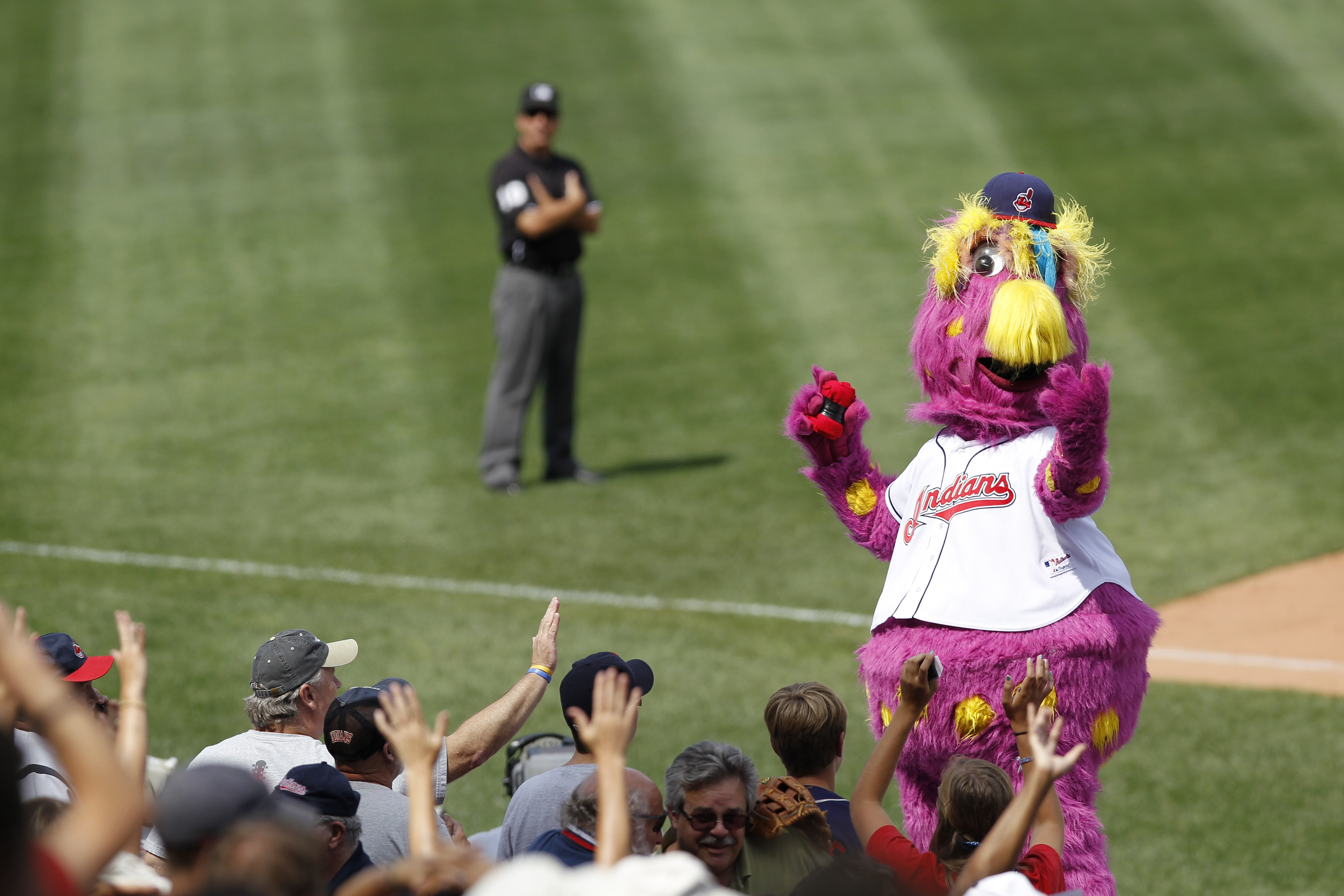
Here is a hint: when your physical mascot at the field has to look like [the photo seen above] because your real mascot is too offensive, you might want to change your mascot.
Another example is the Fighting Illini of the University of Illinois. They retired their Chief Illiniwek mascot in 2007 after the NCAA deemed it a “hostile or abusive” symbol. Originally, the entire name “Fighting Illini” was going to have to go, but it turned out that it predated Chief Illiniwek and referenced soldiers from Illinois that fought in WWI.
Should Congress be involved? I honestly don’t know, but it did start a discussion here on your blog, so some good has already come of it. The best pressure the government can do is to place the copyrights for the logos for the Chiefs, Indians, Braves, Redskins in the public domain. Once any guy with a screenprinting setup can use the logo to put on merchandise their would be some clear-cut economic incentives to finally change mascots.
Another:
I have been a Redskins fan all my life and when I first hear the word “Redskins” I immediately think about the NFL team. It was until my teenage years that some people use “Redskins” as a racial slur. For a long time, I was back-and-forth on this. But then I saw this Washington Post article about the origin of the term “Redskins.” It was created by … Native Americans. They used the term as pride and endearment. Whites used the term for endearment as well. Then in the mid 1800s, authors and writers started using “Redskins” to degrade the Native Americans.
For me, the question of whether “Redskins” is racist or not is tied to the person behind the team. George Preston Marshall, the original owner of the Redskins, moved the team from Boston to Washington to attract the Southern crowd. In the late ’50s, he changed one of the lines of “Hail to the Redskins” from “Fight for old D.C.” to “Fight for Old Dixie.” A year later, it went back to the original lyrics. Also at that time, the NFL pressured Marshall to get a player in color and the Redskins were the last team to integrate.
If I were living 50 years ago, I would of demand changing the nickname because of Marshall’s actions. Now, I think the Redskins reflect its true origin: pride, endearment and character from their football team. It started with the elder, late George Allen. Then the Redskins were really “The Redskins” when Joe Gibbs came in coach the team to three Super Bowl titles. Now with the ascension of Robert Griffin III, the Redskins are back to relevance in the NFL. It’s funny that when the Redskins are good, the critics propped up about the name and when they suck, they stay quiet and laugh at their futility.
Update from a reader:
Your reader repeats a commonly believed, but false legend. The Cleveland Indians were not, in fact, named in honor of Chief Sockalexis, or any actual Native American person. Rather, after the 1914 season, Cleveland’s American League team faced the prospect of playing without their star player, Nap Lajoie, for whom the press and public commonly called the team the Naps. The selection of the name Indians in 1915 was not the result of a “fan contest,” and it had nothing to do with Chief Sockalexis. Rather, it was pure corporate marketing, an attempt to steal some glory from the then-dominant Boston Braves of the National League. The Braves now play in Atlanta, after a stint in Milwaukee. And the Braves also gave their name to Boston’s football Braves, who adopted the nickname Redskins and moved to Washington in the 1930s.
As for the Braves? The team has long maintained, with some credibility, that the name originally referred to the patriot tax protesters of the Boston Tea Party, some of whom dressed as Indians for the event. Here’s the best linkable scholarly study of the Indians naming history.
(Photo: Cleveland Indians mascot Slider entertains the crowd during the game against the Seattle Mariners at Progressive Field on August 23, 2011 in Cleveland, Ohio. By Joe Robbins/Getty Images)
The National Weather Out-Of-Service
After the damage caused during last year’s hurricane season, Brian Merchant is gob-smacked that we’re not better prepared for the upcoming one:
This summer is going to be a stormy hurricane-filled hell—climatologists are predicting more extreme activity this season than the last, and remember Frankenstorm Sandy? So you’d think we’d be gearing up to brace for impact: Hiring on extra storm forecasters, investing in better satellites and modeling computers, all around getting more hands on deck.
Instead—and stop me if you’ve heard this one before—we’re doing the opposite. Fresh off the cusp of the biggest hurricane disaster to swamp the East Coast in decades, Congress is allowing budget cuts to hamper the nation’s most important storm-monitoring services.
Climate Progress provides the details:
The National Weather Service, already cash-strapped and under scrutiny for sub-par computer modeling, will be grappling with a hiring freeze and mandatory furloughs as it heads into a potentially daunting hurricane season. The NWS office in Tallahassee, which typically has 18 meteorologists on staff, is down to 14 due to the cuts. Though officials say they can maintain adequate staffing to provide critical services, such as forecasting at the National Hurricane Center in Miami and sending aircraft known as Hurricane Hunters into storms to measure speed and pressure, the staff and crews will be forced to take turns being furloughed. …
With resources and personnel already stretched thin, the prospect of multiple major storms becomes even more daunting. “The biggest concern would be if we have a very active hurricane season and we have back-to-back storms or we have multiple storms hitting the state, they would simply not have the manpower necessary to ensure they have the appropriate coverage in all their field offices to provide us with the most accurate and timely forecast,” said Bryan Koon, director of the Florida Division of Emergency Management.
 The Dish