The Best Of The Dish Today

frc-on-our-knees-gay-marriageThe Christianist right unveiled their new slogan for overturning the Supreme Court’s ruling on marriage equality which, as is their wont, appears to include a dude giving a blowjob. “On our knees” for America elevates it; “I’m in” puts it way over the top. Congrats to the obvious mole in the Family Research Council who has been at this for ever. Not since Tea-baggers …

A paraplegic surfed; a moderate, conservative Justice maneuvered; I recalled Bill Clinton’s record as the most substantively and legislatively anti-gay president in history; the Inspector General of the IRS was caught in a possibly perjurious comment which effectively exposed the IRS “scandal” as an invention by … Darrell Issa for Roger Ailes. And the Catholic Bishops, in a rare moment of moral leadership, called on the president to end the forced-feeding at GTMO . Where were they when prisoners were being, you know, tortured?

The most popular post of the day was my reaction to the SCOTUS ruling on marriage, “I Believe”; the second most popular was my call for the IRS IG to resign.

See you in the morning.

Thirteen Down, Ctd

13colonies

A reader writes:

As long as we are engaging in marriage equality numerology, it should be noted that 13 is exactly the number of states that would have been required to defeat the Federal Marriage Amendment.  The amendment, which would have banned same-sex marriages in all 50 states, was first referred to the House Judiciary Committee 10 years ago this week, when no states allowed the practice.

Should NBA Players Dodge The Draft?

Travis Waldron thinks so. He explains why the draft – held tonight – is more problematic for basketball than it is for football or baseball:

The NBA Draft traces its origins to 1947, when the Basketball Association of America formed, and it followed the worst-team-picks-first model the NFL had established more than a decade before. Now, though, it’s effect on limiting the bargaining power of athletes is perhaps even more pernicious than the other drafts, since a top draft pick in the NBA has much more potential to change the fortunes of an entire team than a top pick in football or baseball. A baseball player is just one of hundreds in his organization. A football player is one of 53 on a roster. A basketball player, though, is one of just 13 on each team in a sport where an individual can single-handedly change the complexion of an entire team. … A top draft pick in the NBA may not win a title on his own, but he can certainly put a team on the brink of a title far faster. That means he’s worth more money to teams that desire his services — and it means he loses more money in a draft system that prevents multiple teams from competing for those services.

Yglesias is on the same page:

[The draft] is a convenient way for veterans and owners to conspire together to depress the wages of young players, but in the name of “competitive balance” it also creates a constant open-ended bailout of mismanaged teams and prevents best practices from spreading. Teams like the San Antonio Spurs and Denver Nuggets, who manage to work their way into the playoffs year after year, are hobbled in their ability to retain fresh talent, while squads like the Orlando Magic and Cleveland Cavaliers, who plainly don’t know what they’re doing, engage in a goofy boom-and-bust cycle of occasionally picking up superstar talent on the cheap only to see the star fly the coop because management can’t get it together.

This is all rationalized through a baffling argument about the needs of small-market teams that completely ignores the fact that the teams that are most disadvantaged by the draft system are well-managed small-market teams, who are being systematically denied the fruits of effective talent evaluation.

Vietnam’s Imprisoned Bloggers

[youtube https://www.youtube.com/watch?v=Swobx5-OQFg&start=137]

Though the country is seen as a trailblazer for gay rights in Asia, its government is getting increasingly Orwellian:

In the last month or so, three bloggers have been arrested for criticizing the communist government, or—as Vietnamese authorities deftly put it—”abusing democratic freedoms” by posting their opinions online. While that charge might seem like a bit of a paradox, their prospects post-arrest aren’t looking great. On May the 16th, another blogger, Dinh Nguyen Kha, was sentenced to ten years in jail for “distributing anti-State propaganda” and “deliberately causing injuries.”  …

Alongside all that intimidation, there’s also the side issue of relentless propaganda to put up with as you go about your day. Whether you’re watching TV, surfing the internet, or simply walking down the street, Vietnam’s propaganda push is ubiquitous. In the capital city of Hanoi, the government rhetoric starts at around 6:45 AM, blasted out of loudspeakers once used to warn locals about impending American airstrikes. Today, messages range from the humdrum—”Don’t forget to pay your taxes,” for example—to the deification of the government and its leaders. It’s not quite 1984, but it’s not exactly normal, either—imagine being woken up every day with lectures on socialism and warnings of “social evils” rather than building work that seems designed specifically to fuck with you.

Previous Dish on Vietnam’s mixed record on human rights here and here. The above report from Al Jazeera was produced early this year.

Faces Of The Day

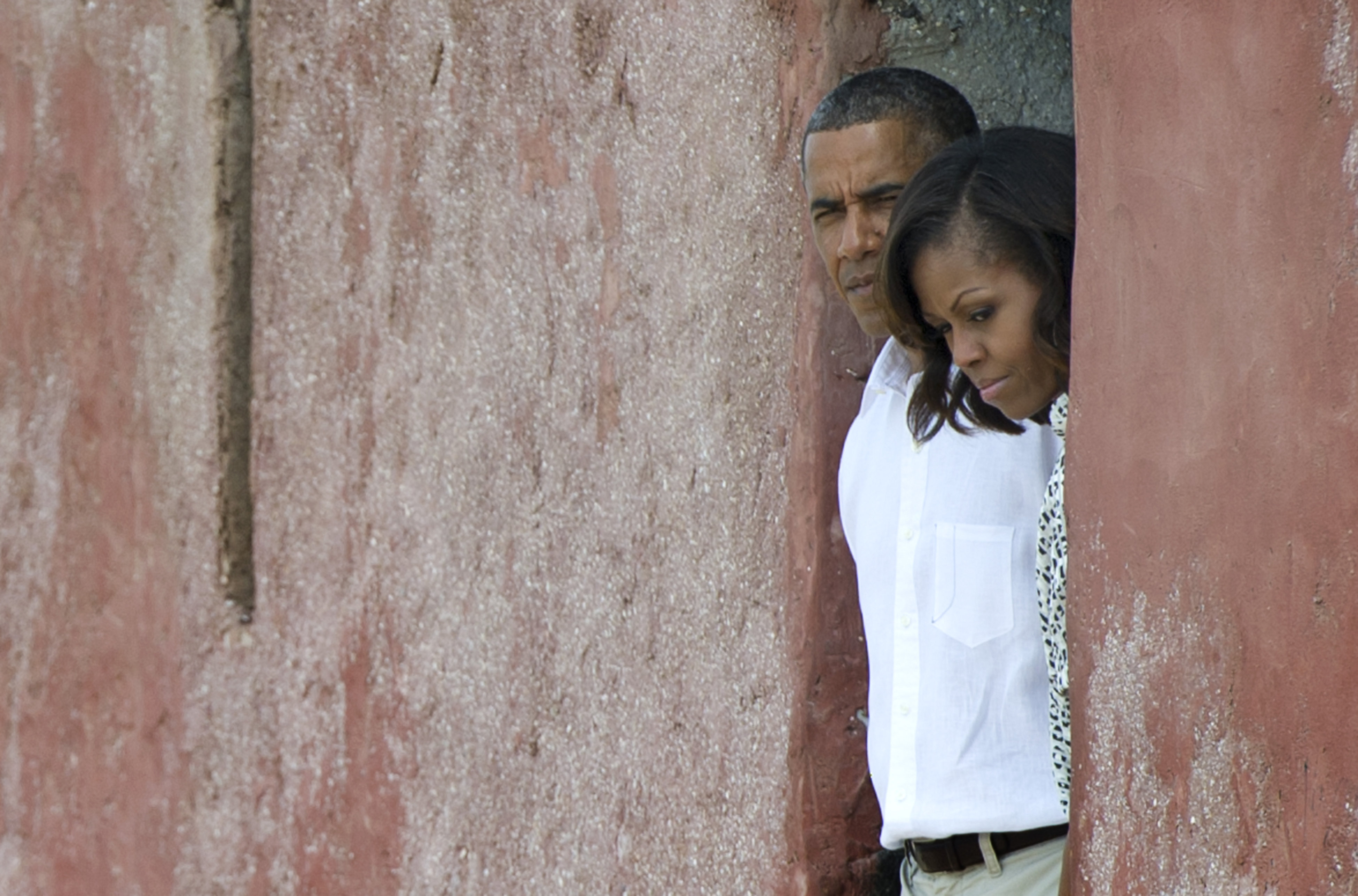
SENEGAL-US-DIPLOMACY

US President Barack Obama and his wife Michelle look out from the Door of No Return while touring the House of Slaves, or Maison des Esclaves, at Goree Island off the coast of Dakar on June 27, 2013. Obama and his family toured the museum at the site where Africans were held before going through the door and being shipped off the continent as slaves. By Jim Watson/AFP/Getty Images.

Combating Military Rape, Ctd

Amanda Marcotte hopes that the revelation that “the majority of sexual assault in the military is male-on-male crime” will help move the discussion forward:

Part of the reason for this is that women are still a small minority in the military, representing only about 15 percent of service members. But what this astonishing number demonstrates is the truth of what feminists have been saying about sexual assault all along: It is not caused by an overabundance of sexual desire, but is an act of violence perpetrated by people who want to hurt and humiliate the victim, using sex as a weapon. … [L]est you think this male-on-male crime is the result of the repeal of “don’t ask, don’t tell,” Dao shows otherwise. As one male victim told Dao, “The people who perpetrated these crimes on me identify as heterosexual males,” which is frequently true of male-on-male rape.

Robert Knowles and Rachel Vanlandingham believe the military instituting affirmative action for women would help fix the problem:

Until women occupy the highest ranks in sufficient numbers, the sexual assault epidemic will likely persist. Studies show that institutions with a critical mass of women in leadership roles have far fewer instances of sexual harassment. When recruitment, promotion, and retention strategies lead to greater gender equality in the upper ranks, it will, in General Dempsey’s words, cause people to “treat each other equally.” In fact, such changes can have a far greater impact than in the civilian sector. The military’s culture, for all its flaws, prizes discipline and cohesiveness, which gives the armed services the unique ability to change quickly when they decide to do so.

Now that the Pentagon has lifted its ban on women in combat positions, extensive gender-based affirmative action should follow. As combat positions are the top springboard for advancement, more women must fill these positions now and female officers must be promoted at a much greater rate. This does not mean imposing fixed quotas or disregarding standards and merit. But integration goals should be especially aggressive for these positions, and commanders should consider the previous exclusion of women when assigning and promoting candidates.

Taking The Heat

Chili Peppers, Sorrento

Mary Roach traveled to Nagaland in north-eastern India to witness a chili-eating competition that tests participants’ ability to withstand capsaicin, the main active ingredient in hot peppers:

The event itself is surprisingly low-key. The mood is one of stoic grimness. No one is screaming in pain. No one will be scarred by the heat. That’s not how capsaicin works. It only feels hot. The human tongue has pain receptors that respond to a certain intensity of temperature or acid. These nerve fibers send a signal to the brain, which it forwards to your conscious self in the form of a burning sensation. Capsaicin lowers the threshold at which this happens. It registers “hot” at room temperature. “It trips the alarm,” says Bruce Bryant, a senior researcher at the Monell Chemical Senses Center in Philadelphia. “It says, ‘Get this out of your mouth right now!’” The chili pepper tricks you into setting it free.

The whole affair is beginning to seem like an anticlimax when I look up from my notes to see [member of Parliament in Myanmar and contest participant] Pu Zozam headed my way. I have seen people stagger in movies, but never for real directly in my sightline. Zozam’s legs buckle as he tries to keep walking. He goes down onto one knee and collapses sideways onto the floor. He rolls onto his back, arms splayed and palms up. He’s making sounds that are hard to transcribe. Mostly vowels.

After a minute he rolls back onto his side and raises his head to retch. A doctor prepares a hypodermic of dicyclomine. The drug is more typically administered to people with irritable bowel syndrome, to relieve cramping. Cramps and regurgitation are body responses to gastrointestinal irritation. (This is why people throw up when they drink too much, too fast; alcohol is an irritant.) “The cramp is quite severe,” Catherine Burns, the contestant from Liverpool, told me later. She recalls sitting cross-legged with her fellow contestants afterward. Not good enough, her body informed her. “I suddenly just had to recline.”

(Photo by Will Clayton)

Kerry’s Climate Crusade

On the heels of his visit to India last weekend, John Kerry is pushing for an India-US partnership aimed at reducing emissions from the rapidly developing country:

[T]he beauty of today’s technology is that India can grow clean – an option the United States didn’t have during our time of economic transformation from an agrarian to an industrialized nation.

Andrew Revkin weighs the challenges for the secretary of state:

Kerry will likely face resistance in seeking lockstep commitments, of course, given that India’s prime challenge is bringing reliable electricity and affordable fuels by any means to its billion-plus citizens — some 400 million of whom were unaffected by last year’s blackouts because they have no access to electricity at all. …

In his New Delhi speech, Kerry spoke of India joining “China and the United States and other major economies in order to rapidly develop joint technology and pilot programs for low- or no-carbon strategies.” This is a sound idea, but could rub Indian officials the wrong way. More than a few times, Indian diplomats and officials have told me they bristle every time they see India lumped with China in discussions of obligations to eschew fossil fuels, given that India’s per-capita energy use is less than a third that of China. Still, Kerry is right that the prosperous, urban side of India, with a straining, highly inefficient electrical grid [pdf], traffic-choked streets and other sources of energy waste, can do plenty to cut emissions even as it boosts energy access.

John Upton has more on Kerry’s visit:

The Americans’ arrival in Delhi coincided with deadly floods in northern India that some Indian officials have linked to global warming. But though climate change poses urgent dangers in India, Kerry’s speech was not received warmly by all of the nation’s environmentalists. Some felt they were being lectured to by the secretary of state, a representative of a nation that is second only to China in total greenhouse gas emissions.

Kerry has long warned of the dangers of climate change, and it’s been one of his favorite topics to discuss abroad since he was sworn in as Obama’s top diplomat. “Everywhere I travel as secretary of state — in every meeting, here at home and across the more than 100,000 miles I’ve traveled since I raised my hand and took the oath to serve in this office — I raise the concern of climate change,” he wrote just last week in an opinion piece in Grist.

Your Thursday Cry

An Australian woman doesn’t let paraplegia keep her from surfing:

Update from a reader:

That duct-tape surfing video is heartwarming, and makes me think of an ex-pro surfer I grew up with, Jesse Billauer, who didn’t let quadriplegia keep him from surfing.

Also check out the first double-backflip in a wheelchair, featured on the Dish a while ago.