Chart Of The Day

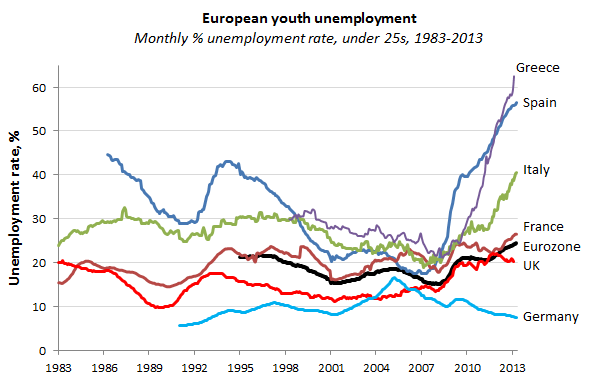
James Plunket passes along what he calls “the scariest chart in the world right now”:

European Youth Unemployment

Derek Thompson comments:

Youth unemployment is bad for all the obvious reasons, including the big loss to future productivity and earnings. But Europe’s youth unemployment is strange, because we’ve never seen a generation *this educated* also be this unemployed. Nearly 40 percent of Spain’s 20-and early-30-somethings are college educated. In Greece, it’s 30 percent. Europe’s crisis — clearly worsened by its austerity obsession — is an absurd waste of the most educated generation in the continent’s history.

Where The Childrens’ Books Aren’t

France, apparently. At least not good ones:

At their worst, French children’s stories are moralistic and heavy-handed, and even at their best, they are often old-fashioned. Many employ the passé simple, a tense too formal for speech, and the type is frequently very small. Engaging narrative tends to be sacrificed to the visual aspect, as though books were purely vehicles for illustrators. In short, French children’s books seem aimed more at adults than children.

Some reasons for the disparity:

“The aim of French books”, says Gilliane Quinn, a Paris-based Irish mother of bilingual children, “is often to get across a moral or an educational perspective. The stories don’t usually have a happy ending like English ones do. Chapters of ‘Les Malheurs de Sophie’, for example [Victorian tales of a little girl’s mischief, published 1858], always end horrifically, with the mother dying, the boat sinking, the horrible stepmother or the child being beaten as punishment for a prank. English or American stories wouldn’t leave their audience in such emotional despair, and yet ‘Les Malheurs’ are one of the big successes of French literature.” An American edition of “Babar”, incidentally, omits the opening scene, in which young Babar’s mother is gruesomely killed by poachers…

As for the lack of fun in the writing, could it be that French, with many words ending in a silent “e”, and a relatively small vocabulary (it is said to contain a fifth as many words as English), is less conducive to rhyme and puns and onomatopoeia?

How Do You Spell Glee In Urdu?

A Pakistani version of Glee, titled Taan – the Urdu word for “musical note” – is on the verge of becoming a reality:

The show revolves around the fictional Hayaat Haveli musical academy in Lahore. At its heart is a tension between a traditional music teacher and his younger rival, who trains budding pop stars, representing different faces of Pakistan. Among their pupils are the offspring of well-heeled bureaucrats and a talentless wannabe who dreams of becoming a Bollywood actress.

Some plotlines that differentiate it from its American counterpart:

One of the characters, Annie Masih is described as losing all her family in the 2009 attack on a Christian enclave in the town on Gojra, a real episode in which seven people were burned alive. Another storyline involves Fariduddin, a member of the Pakistan Taliban intent on blowing up the academy before he is eventually seduced by music.

Marya Hannun notes how the show plans on dealing with materials that might offend the country’s censors:

[A] love affair “between a Taliban extremist and a beautiful Christian girl” promises to give Rachel and Finn’s tortured romance a run for its money. And even more controversial is a planned storyline depicting a gay relationship.

The show’s creators have come up with creative ways to avoid angering authorities. Take the aforementioned plotline of two male lovers. “Let’s say in a certain scene, there are two boys talking to each other, they are not allowed to show their physical attachment to each other,” explains director Samar Raza, particularly since homosexuality is illegal in Pakistan. “So I bring a third character who says: ‘God designed Adam and Eve, not Adam and Steve.'” This third conservative character will theoretically enable Raza to discuss homosexuality while evading censorship.

Ahmadinejad’s Exit

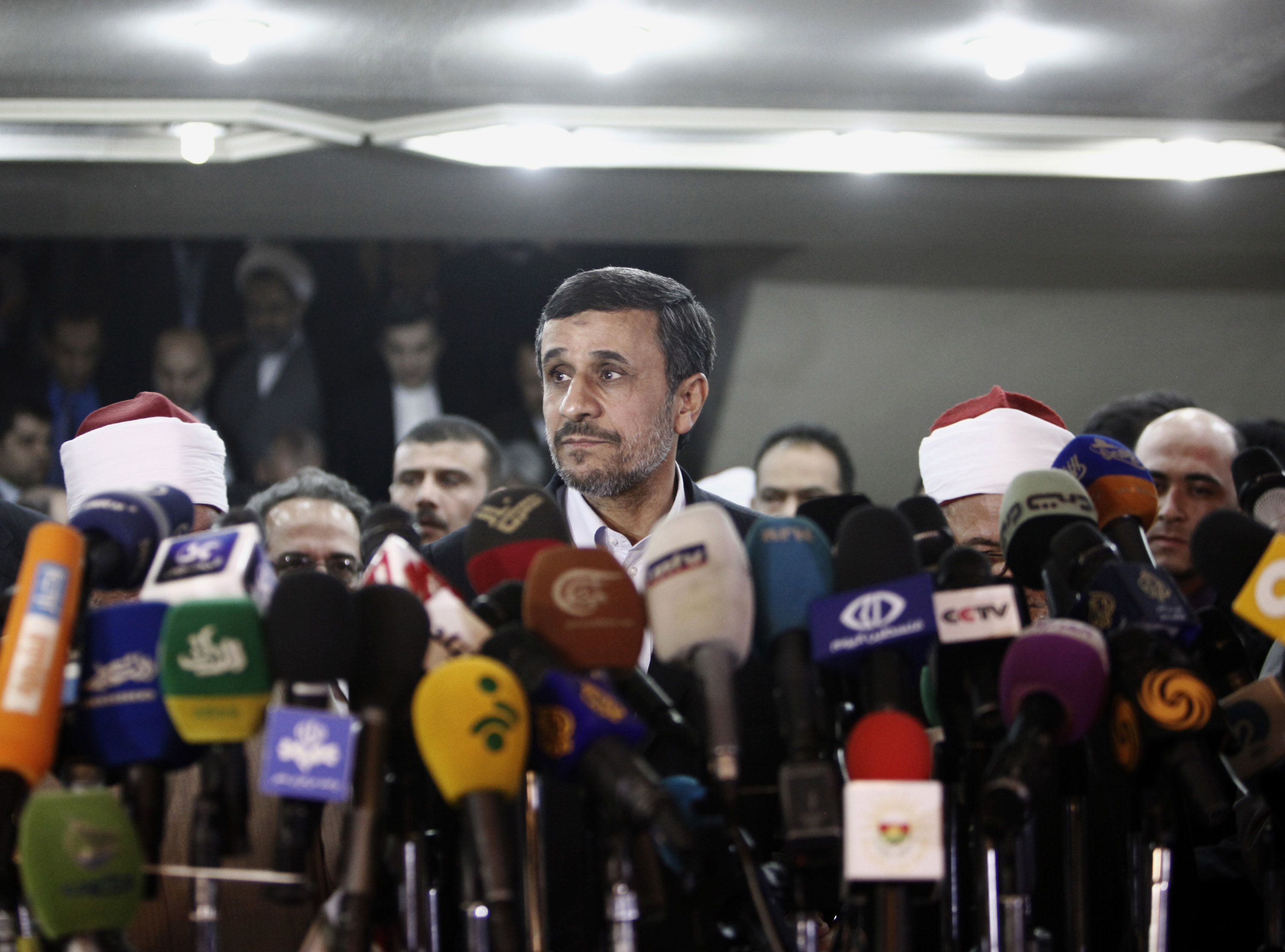
Mahmoud Ahmadinejad Arrives In Egypt On First State Visit In 30 Years

Cameron Abadi studies the outgoing president and his legacy in Iranian politics:

Ahmadinejad, canny populist that he is, soon began to privilege secular Iranian nationalism over fealty to Islam, and thumbed his nose at the Islamic establishment throughout his second term. He began calling explicitly for an “Iranian Islam,” a culture unembarrassed by Iran’s pre-Islamic grandeur. Rather than endorse the Islamic Republic’s traditional neglect of Nowruz—Iran’s traditional pre-Islamic New Year celebration, which was openly reviled by Ayatollah Khomeini—Ahmadinejad invited other heads of state to celebrate the occasion in Tehran. (Ayatollah Khamenei left town during the festivities.) He has offered repeated praise of Iran’s most celebrated pre-Islamic ruler, Cyrus the Great; suggested that men and women be allowed to attend soccer matches together; and openly attacked prominent clerics for their illicit accumulation of massive wealth. Meanwhile, Mashaei, his closest advisor, twice declared that Iran was not enemies with the Israeli people (forcing Khamenei to clarify that Iran and Israel are not “friends”).

All of this had an effect on the current elections:

Khamenei loyalists have labeled Mashaei a practitioner of “black magic” and attacked Ahmadinejad for “sinful” conduct (the latter for the crime of hugging Hugo Chavez’s mother at his funeral) and both Ahmadinejad and Mashaei have essentially been excommunicated from the political elite. The coming election seems certain to result in a president who has little inclination of challenging the primacy of the religious establishment. By the same measure, it seems unlikely to produce a president with any real connection to the Iranian people. Khamenei has even speculated that he might eventually abolish the presidency entirely. Having abandoned years ago any pretense to democracy, Iran’s regime may now be beginning to abandon any remaining claims to popular sovereignty.

(Photo: Iranian President Mahmoud Ahmadinejad speaks to the media during a press conference at the Al Ahzar headquarters on February 5, 2013, in Cairo, Egypt. President Ahmadinejad arrived in the Egyptian capital, becoming the first Iranian President to visit Egypt since the Iranian revolution in 1979. By Ed Giles/Getty Images)

How To Eco-Shop

Brendan I. Koerner answers a Wired reader’s question about whether it’s greener to purchase an item online or drive to a nearby mall:

Buying a product online involves a data transfer of about 1 to 2 MB, which means that your ecommerce experience uses around 0.002 kWh [kilowatt-hours of electricity]. If you translate that figure into carbon emissions, you’re doing as much planetary damage as driving less than 25 feet in an average car—a tiny fraction of the few miles you log on your journey to and from the mall.

True, any product bought online has to be delivered to your home. But since delivery vans serve scores of customers on each route, they’re much more efficient than private cars. Even if you string together a bunch of errands while at the mall, you’ll have a tough time closing the emissions gap per item between yourself and UPS.

But online shopping won’t magically save your children from an overheated, dystopian future. You are, after all, still accumulating manufactured goods that spewed forth from distant, coal-reliant factories. You know that iPhone 5 you just can’t live without? Seventy-six percent of its lifetime greenhouse-gas emissions stem from production, versus just 4 percent from transport. Which means that buying one is pretty much the same thing as pushing a polar bear off his ice floe.

The Best Of The Dish Today

My faves: Bill Maher defending cannabis legalization as the civil rights issue of our time (after marriage equality); a defense of the Millennial neologism “face-palm”; a declaration of love for the manual type-writer and for kids reading books in print; deadpan dogs’ inner monologues (see above); and the shared reign of the names Emma and Sophia for girls. I also asked why American soldiers had fought and died in Iraq to secure China’s oil supplies; and defended “Breaking Bad” as the equal of any novel.

The two most popular posts were Dan Savage and me talking sex, love and marriage; and the Emma and Sophia map.

See you in the morning.

Thatcher’s Real Gift: Relentlessness

Reviewing the first volume of Charles Moore’s authorized biography of Margaret Thatcher, David Runciman finds the character trait that enabled her rise to power:

The person on display here is not more intelligent than her rivals, or more principled. She chops and changes as much as they do. But she is a lot more relentless: if anything, she keeps chopping and changing long after they have gone home. She didn’t outsmart or outperform her enemies. She outstayed them.

How she wore her opponents down:

She liked to badger people, picking away at the same few threads until something started to give. Moore writes of her governing style: ‘She used every remark, every memo, every meeting as an opportunity to challenge existing habits, criticise any sign of ignorance, confusion or waste and preach incessantly the main aims of her administration.’ Unsurprisingly, this made her tiring to be around.

Orwell On Censorship

The Believer has posted his 1945 essay “The Freedom of The Press,” originally composed as the preface to Animal Farm, with footnotes by John Reed. An excerpt from Orwell with Reed’s comment:

Obviously it is not desirable that a government department should have any power of censorship (except security censorship, which no one objects to in war time). But the chief danger to freedom of thought and speech at this moment is not the direct interference of the MOI [Ministry of Information] or any official body. If publishers and editors exert themselves to keep certain topics out of print, it is not because they are frightened of prosecution but because they are frightened of public opinion. In this country intellectual cowardice is the worst enemy a writer or journalist has to face.

That people were willing to live in a state of denial—ignoring war, ignoring injustice, ignoring tremendous threats to themselves and even the planet—continually amazed Orwell, and he struggled with the cartography of complacency. In a letter to a friend, he wrote, “In the face of terrifying dangers and golden political opportunities, people just keep on keeping on, in a sort of twilight sleep in which they are conscious of nothing except the daily round of work, family life, darts at the pub, exercising the dog, mowing the lawn, bringing home the beer, etc.” In “Notes on Nationalism,” Orwell marveled at “the lunatic habit of identifying oneself with large power units.”

And therein lies the answer to our twenty-first century state of denial. Our identities are under siege: advertising, education, the arts. We are built up and destroyed by lifestyles and categories (of race, of class, of culture) that exist primarily to contain, delimit, divide and exploit the human experience. If there’s anything you think you need to buy to be who you are—whether it’s curtains from Ikea or a CD or a book or liposuction or take-your-pick—you don’t own yourself.

Recent Dish on Orwell here, here, here and here. Recent Bukowski on censorship here.
Kid-Friendly Chemo

Lauren Davis applauds a Brazilian hospital’s efforts to make chemotherapy less scary for kids:

[T]he cancer center is working with ad agency JWT, which also works with Warner Bros. The idea was to help children believe in the power of chemotherapy to make them ultimately better. They’re not just covering the chemo cases with superhero logos; they’re also giving pediatric cancer patients comic books in which the heroes experience something similar to cancer and must receive a similar treatment formulated by doctors. And in the comics, the cases for the treatment bags look just like the cases the kids get over their own chemo bags.

A children’s hospital in Pittsburgh employed a similar theme with its window washers earlier this year.