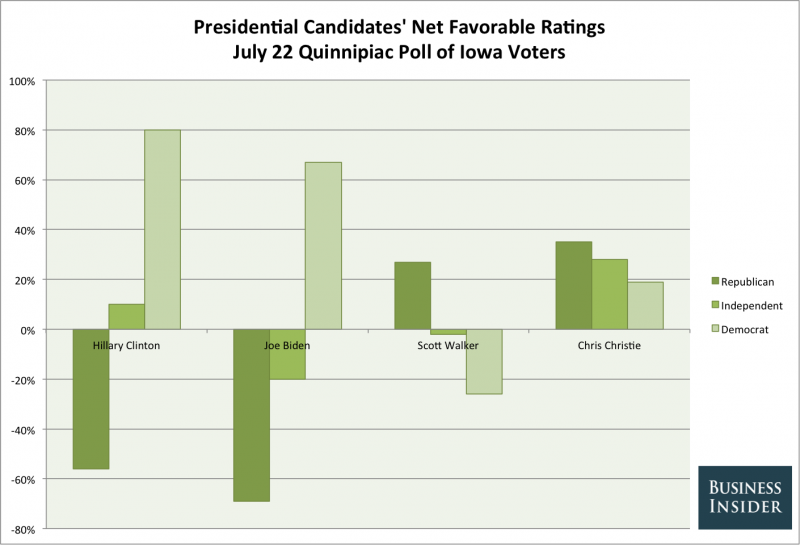
Barro feels that Chris Christie is the GOP’s best bet for 2016:
If you’re a political party whose problem is that your appeal is not broad enough, nominating the candidate with broad appeal should be a no-brainer.
Christie is sure to face conservative resistance over substantive policy issues (like his acceptance of the Medicaid expansion) and stylistic ones (like his literal embrace of President Obama last October). But his actions that have antagonized conservative base voters are the same ones that allow Christie to maintain a broad appeal.
And Christie seems to be sufficiently conservative for the Republicans who follow his governing actions most closely. Ninety-six percent of Republicans in New Jersey approve of the job he’s doing as Governor, according to a June Quinnipiac poll.
Yglesias doubts that Christie could run successfully as a moderate. He notes the last two GOP nominees could have touted their moderate credentials:
[C]ompared to their major rivals both Mitt Romney and John McCain were the moderates in the field. But while both Romney and McCain had some major moments of moderation in their records, they didn’t have any moderation in their platforms as presidential candidates. The deal struck by party leaders in both cases was basically we’ll overlook a record of heterodoxy in exchange for clear indications that you plan to govern in a totally orthodox manner. It would have been child’s play for Romney to draw a contrast between the pragmatic, ideologically flexible, “get things done” approach he took as Governor of Massachusetts and the uncompromising conservatism and obstructionism of the hideously unpopular Boehner/McConnell GOP but Romney chose not to draw that contrast because despite Romney’s personal record the Romney operation was founded on orthodoxy.
Meanwhile, Kornacki points out that, should he run, Christie would face a tough choice over whether to remain governor or not:
If the polls are right and Chris Christie wins a lopsided reelection victory this fall, it will put the New Jersey governor in position to seek the presidency in 2016. That’s the conventional wisdom, at least, and there’s plenty to be said for it. After all, by racking up a big margin in a deeply blue state, Christie would be making a powerful statement to Republicans across the country about his electability.
What’s not getting much attention is the flip-side: the severe consequences that winning a second term as governor could have for Christie’s ability to raise money for a national campaign – and the possibility that he might be compelled to resign his office during his second term if he’s going to seek the White House.
 The Dish