“[T]he criminals produced by medieval Islam seem to have been especially resourceful and ingenious,” writes Mike Dash of the loose association of rogues known as Banu Sasan:
Who were they, then, these criminals of Islam’s golden age? The majority, [historian Clifford] Bosworth says, seem to have been tricksters of one sort or another,
who used the Islamic religion as a cloak for their predatory ways, well aware that the purse-strings of the faithful could easily be loosed by the eloquence of the man who claims to be an ascetic or or mystic, or a worker of miracles and wonders, to be selling relics of the Muslim martyrs and holy men, or to have undergone a spectacular conversion from the purblindness of Christianity or Judaism to the clear light of the faith of Muhammad.
Amira Bennison identifies several adaptable rogues of this type, who could “tell Christian, Jewish or Muslim tales depending on their audience, often aided by
an assistant in the audience who would ‘oh’ and ‘ah’ at the right moments and collect contributions in return for a share of the profits,” and who thought nothing of singing the praises of both Ali and Abu Bakr—men whose memories were sacred to the Shia and the Sunni sects, respectively. Some members of this group would eventually adopt more legitimate professions—representatives of the Banu Sasan were among the first and greatest promoters of printing in the Islamic world—but for most, their way of life was something they took pride in. …
Ultimately, however, what strikes one most about the Banu Sasan is their remarkable inclusiveness. At one extreme lie the men of violence; another of Bosworth’s sources, ar-Raghib al-Isfahani, lists five separate categories of thug, from the housebreaker to out-and-out killers such as the sahib ba’j, the “disemboweler and ripper-open of bellies,” and the sahib radkh, the “crusher and pounder” who accompanies lone travelers on their journeys and then, when his victim has prostrated himself in prayer, “creeps up and hits him simultaneously over the head with two smooth stones.” At the other lie the poets, among them the mysterious Al-Ukbari—of whom we are told little more than that he was “the poet of rogues, their elegant exponent and the wittiest of them all.”
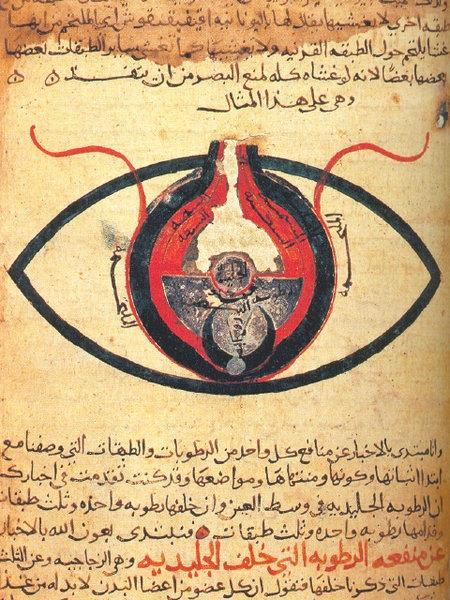
(Image: manuscript dated 1200CE, via Wikimedia Commons)
 The Dish
