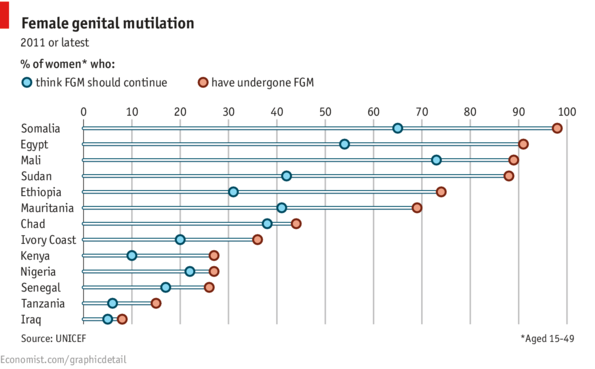
The Economist checks in on the barbaric practice that has affected 125 million girls and puts 30 million more at risk in the coming years:
[Female genital mutilation] has declined in more than half the countries UNICEF looked at, but most dramatically where it was already rarer. In the Central African Republic the share of women in the 15-49 age group who had been mutilated dropped from 43% in 1995 to 24% in 2010. In a few countries new data suggest the practice is all but eliminated. In the countries where it is most common, however, such as Egypt and Sudan, the prevalence has hardly changed. In Kenya it varies by ethnicity: FGM is now rare among the Kalenjin and Kikuyu tribes, and has almost disappeared among the Meru. Yet more than 95% of ethnic Somali and Kisii girls are still being cut.
Support for FGM, among both sexes but especially younger people, seems to be falling, even in countries where the practice is almost universal. Experience elsewhere suggests that this may herald an actual decline in coming years.
Here’s hoping.
 The Dish