The concept comes from Max Weber’s The Protestant Ethic and the Spirit of Capitalism, but the term “work ethic” appears nowhere in the text itself. Peter Womack dives in:
The ‘ethic’ Weber described is a complicated mixture of spiritual and practical imperatives, embracing ideas of self-government, the suppression of natural impulses, the search for marks of divine grace, and the purposive ordering of a person’s whole life. It is distinctively Protestant in the sense that it took the ascetic discipline of the monastic tradition and tried to rewrite it for life in the world. It was also, according to Weber, the victim of a historical irony: these particular virtues, promoted for religious reasons, were often conducive to making a great deal of money, and so bringing about conditions of luxury and leisure that threatened to undermine the virtues themselves. In other words, what Weber has to say about work is embedded in a story about how we became who we are.
Many historians have argued that it is not an entirely true story; but it is nevertheless an interesting one. Reducing it to the simple promulgation of a ‘work ethic’ destroys most of its interest, its power to provoke thought. The cliché works, as clichés often do, to make the idea at once more digestible and less alive.
In the process, several inconvenient signs of life drop away. One of them is the class content. As Weber tartly puts it, a ‘bourgeois businessman’, interpreting his bottom line as a mark of God’s blessing, ‘could follow his pecuniary interests as he would and feel that he was fulfilling a duty in doing so.’ Meanwhile, ‘The power of religious asceticism provided him in addition with sober, conscientious, and unusually industrious workmen’. That is, the shared beliefs of employer and employee caused both of them to act in the employer’s interests. ‘The work ethic’ is not the same for everyone: it depends where you are in a system of working relationships. Abstracting the phrase from the system loses that subtlety. A work ethic becomes the attribute of an individual. Some people have it, some people don’t, and all those who have it have the same thing. Society vanishes from the idea.
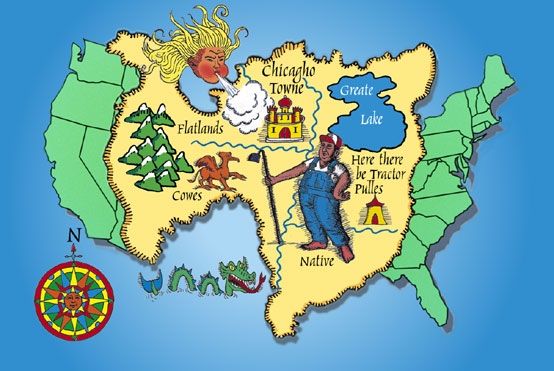
(Image from an Onion article about the Midwest. The popular Dish thread on the amorphous region is here.)
 The Dish