Press Charges Against Alec Baldwin

Screen Shot 2013-07-01 at 1.36.57 AM

A reader quotes me:

“It was one of the purest expressions of violent homophobia you can have.” No, it really wasn’t.  It was someone who was (rightfully) upset lashing out in a homophobic way.  That’s wholly different than someone beating a guy up for something like “looking like a fag”, for example, which is much more of a pure expression of violent homophobia.

“But you just fucking did – in your own words.” No, he didn’t. He didn’t “advocate violence against someone being gay”; he advocated violence against someone who happened to be gay. There’s obviously a difference there.

The fact that his gayness wasn’t the source of the vitriol makes this a different kind of offense.  It’s still offensive, to be sure, and probably reveals a bit how he really feels about gay people (or at least how callous he is about insults rooted in homosexuality), all his work with GLAAD notwithstanding. But it’s really not the same thing as attacking someone because of their sexual orientation.

The fact that he didn’t need to deploy homophobic threats proves just how meretricious they were. They were designed precisely to add homophobic insult to threatened injury. That must account for the vast majority of homophobic slurs: used not to begin with in some fracas but because they can be deployed subsequently to put another human being in his place. So Baldwin is cut off on the road; and he sees an HRC sticker on the bumper of the car and screams: “I’m gonna find you, you toxic little queen, and I’m gonna fuck … you … up. I’d put my foot up your fucking ass, but I’m sure you’d dig it too much.” And then proceeds to follow the dude and intimidate him. That isn’t homophobia? Except in this case, it’s worse. He knew the target was gay, and threatened to beat him up, and urged others – up to a million others who follow his tweets – to beat him up.

Why, I wonder, has Baldwin not been arrested? In my view, George Stark should press charges. Bigoted bullies like Baldwin need to know that their stardom (and their “liberal” past) does not excuse this. Kids are brutalized by this kind of language every day; they commit suicide because of this kind of language; others are killed by those who share Baldwin’s homophobic rage. And yet he still hasn’t apologized to the gay community for inciting gay-bashing.

The reason he escapes censure is because of liberal bias, which, when it defends homophobic violence, is particularly repellent. GLAAD is such a useless irrelevance you can overlook it. But check out Hilary Rosen, a prominent lesbian in Washington, all but giving Baldwin a pass:

What he said was disgusting. But I think he has a deeper reservoir of good will among folks because he’s been a progressive ally and fighter for progressive causes for years, and that’s the genuine side of him.

Fuck that. If he had used the n-word and threatened to lynch a black dude, would anyone doubt his career should be over? And yet gays and lesbians are defending him. How many African-Americans are coming to the defense of Paula Deen? Let’s rephrase his tweet in terms of, say, African Americans and see how it comes across:

I’m gonna find you, you toxic little spear-chucker, and I’m gonna fuck … you … up. I’d lynch your sorry-ass, but I’m sure you’d dig it too much.

Would Baldwin decide that this was merely “ill-advised”? Would African-American leaders vouch for his bona fides? These are the same craven liberals for whom Bill Clinton could sexually harass and assault any woman, and they’d look the other way. Another reader:

Not to defend Alec Baldwin, but there is a hysterical element to the uproar over these utterances that has lost all sense of perspective.

It is natural, when the Muse of Vituperation strikes, to use any available attributes of the person with whom one is irate as part of the denigration, whatever one’s feelings about the class of persons to which the object of the rant belongs. This may be viewed by others as homophobia, anti-Semitism, racial prejudice, or another kind of xenophobia, but it really proves nothing of the kind, unless you define those feelings so broadly as to convict almost everyone of them. At that point, the term “homophobia” becomes meaningless, mere inflammatory rhetoric, like calling Paula Deen a racist because she admitted in a court deposition that she used the “N-word” once or twice some decades back under provocation, bless her little pea-picking heart. Not to defend her, either – I can’t stand her, but that whole thing has become a witch-hunt, and now it looks like you’re trying to gin one up against Alec Baldwin.

Of course someone like Alec Baldwin is going to use terms like “toxic little queen” ranting at someone gay (or who he thinks if gay) with whom he’s so angry – he once famously called his own daughter a “pig”, for crying out loud. The insults are personal, not evidence of bias against a class of persons. Baldwin should have kept them private, instead of tweeting them. The way he used this language makes him an angry buffoon, but not a homophobe. I’d have probably called the guy a fucking little faggot, if I’d been in his shoes – but I wouldn’t have tweeted it.

For the record, I am openly gay, with a partner of 39 years. My dealings with individuals different from me are above reproach, but I wouldn’t want to be held to public scrutiny over what I’ve said about the @#$%! who cut me off in traffic talking on their fucking cell phones.

In other words: there are plenty of things we feel, but we don’t say them out loud, and we don’t tweet them. And we don’t tweet encouraging a mob to “straighten” another person out. Baldwin did all the above. Another:

I don’t think your comparison with Mel Gibson is entirely apt. Gibson had a history of anti-Semitic statements (some of them relating to his father, a notorious Holocaust denier) that preceded his drunken altercation with the “Jew” cop. Calling the cop a Jew was confirmation of what people already suspected of him. Baldwin, for all his history of mouthing off to people (including his own daughter), hasn’t had a history of making homophobic slurs (at least not to my knowledge). So this incident does not confirm what many people already suspect about him (other than that he has anger management issues).

Nevertheless, at least for me, the threats of violence are so specifically related to homosexual stereotypes, and so graphic, that I think I’m done with him. And I say that as someone who has been a fan for years. Not only that, I once met him on an airplane when he saved me from being hit by my suitcase falling out of the overhead bin. In addition to being quick to catch the suitcase, he was charming and humble. Or so it seemed.

The thing for him to do is acknowledge it and profusely apologize. Lots of liberal-thinking folks, especially baby boomers, find out that they’re still carrying around buried bits of racism, sexism or homophobia embedded during their childhoods. But he hasn’t apologized, which is troubling in and of itself. Okay, sure, he was mad because his wife was insulted. But he’s had time to cool down and come to his senses and see how ugly his tweets were.

How do we know if this man isn’t routinely given to this kind of homophobia? These things do not come out of nowhere. Another has the right idea:

You know, I never understand why celebrities (or most other people, it seems) in situations like this don’t just cop to it. What would be so awful about saying:

Yeah, that was homophobic of me” or “Yes, that was racist” or sexist or transphobic or whatever? “Yes, that was homophobic of me. I’ve done a lot of work supporting the gay and lesbian community over the years, and I’m proud of it, but the truth is, I’ve lived in a society where homophobia was the norm for a long time, and as you’ve seen, I’ve obviously internalized some of that. That’s not good. I’m sorry for what I said. I should never have said it, and I need to do some serious self-examination to ensure I don’t make such an awful mistake again. If there are people out there who have gone through a similar experience – both gay people and their straight allies – I hope you’ll please help me figure out what I can do to make the situation better. In the meantime, I hope the past work I’ve done supporting gay friends and strangers serves as evidence that I am not irredeemable and that my heart has often been in the right place. That does not excuse this incident or the words I used – I want to be clear about that. Again, I am sorry, and I ask for your help and support in becoming a less prejudiced person, and I aim to demonstrate over time that I’m worthy of your forgiveness.

I just don’t get the whole “Of course I’m not homophobic / racist / sexist / whatever” mindset. I suppose it’s just ego, and I know it infects even people who aren’t famous. But the truth is, we’re all at least one or two of those things to a degree. That’s why they’re such a problem – because they’re pervasive and affect us in ways we’re often not entirely conscious of. Maybe celebrities copping to it would just lead to a trend where people admit being prejudiced and then don’t change. But I’m guessing not. And I think the admission of it would serve as a reminder of how deeply these pernicious forces run in our culture (which would help us root them out) and of the fact that we’re all human and imperfect (which would take the steam out of overly p.c., sanctimonious finger-waggers).

In any case, something needs to change. As it stands, our cultural conversation is frequently much more about not getting caught (or doing damage control if you are caught) than it is about seriously addressing the thinking that leads to people like Alec Baldwin saying horrible things.

It would be good for Mr Baldwin to begin that conversation, starting with a full apology.

Sign Of The Weekend

From a baldly pandering reader in Chicago:

OLYMPUS DIGITAL CAMERA

Update from a reader:

The gentleman pictured in the Chicago pride parade appears to be Daniel Strandjord, who for many years (and possibly still today?) protested circumcision almost daily outside of the University of Chicago Hospitals. With a white beard and his trademark sandwichboard reading, “Foreskin is Not a Birth Defect,” it’s easy to dismiss him as a kook and he was regularly the object of jokes on campus. But an interview with him shows that he really knows his stuff, and I suspect many people have changed their minds after searching for more information after seeing him protest.

How We See Language

Neuroskeptic presents the case study of “Nissim,” a man who suffered a stroke that gave him a peculiar form of aphasia, or the a disturbance of the comprehension and formulation of language. He remained capable of abstract language but struggled to name “imageable” words:

Given a ball, he made gestures of throwing and catching it, but all he could say was: “Something accurate, swift, accurate… Something accurate that can serve him”. His appropriate gestures show that he understood what a ball is, but couldn’t find the words to express it – except abstract ones.

What might his case suggest about the connection between language and visualization?

[I]t makes you think: do we rely on visual imagery when it’s available? When we know what something looks like, does that visualization let us ‘get away with’ not knowing more abstract facts about it? Might seeing someone’s face make it harder to know or think about them in certain ways?

Your Vacation Begins With Planning

Professor Michael Norton, coauthor of Happy Money: The Science of Smarter Spending, explains how planning ahead can optimize your vacation in unexpected ways:

There’s a funny thing about vacations: we often experience one of the biggest increases in happiness in the weeks before the vacation begins. This seems odd—after all, the purpose of a vacation is to go away and be happy—but it speaks to the power of anticipation. Yes, it can be hard to wait for things (think of children in the days leading up to Christmas) but research shows that anticipation is a huge and often untapped source of happiness. Vacations are great, but looking forward to that sunny beach while trapped in an office cubicle can be nearly as exciting and interesting as the beach itself.

Given this, how do we maximize the happiness we get from our vacations? While we’re often tempted to put the trip on a credit card and pay it off months after the trip, we suggest a new strategy: pay now, and consume later. Imagine a vacation where you had to pay for every single bite of food you took, with a man standing next to you and making you fork over a dollar each bite. Not. Much. Fun. But when we pay for things up front, by the time they come around they actually feel free—because the pain of paying is so far in the past, we can truly enjoy the moment. And of course, paying up front also increases the likelihood that we will spend the time before the vacation daydreaming about it.

Literal Cartography

This embed is invalid


Stephan Hormes and Silke Peust created the above map, which translates the names of places to their literal meanings:

Most of the meanings are bland descriptions of the terrain or climate of the places they describe. Michigan, for example, is the “Land of the Big Lakes” (duh), and Mississippi is the “Land of the Great River.” Others carry baffling specificity, like Alabama’s “Land of the Thicket Clearers” or Missouri’s “Land of the People with Dugout Canoes.” Some are poetic, like Mexico’s “Navel of the Moon” and Houston’s “Heart’s Farm.” Others are more worldly: Cuba is the “Place to Find Gold,” and “Chicago” apparently means “Stink Onions.”

More here.

Steal This Blog

Kal Raustiala and Christopher Sprigman explain how the Chinese concept of shanzhai, which refers to low-cost knockoffs, may work to the advantage of Western companies:

[L]ike so much else in China, the meaning of shanzhai is undergoing a drastic change. As The Wall Street Journal recently noted, “Once a term used to suggest something cheap or inferior, shanzhai now suggests to many a certain Chinese cleverness and ingenuity.” Indeed, Beijing seems to believe that shanzhai is something to cultivate. In 2009, an official from China’s National Copyright Administration declared that “shanzhai shows the cultural creativity of the common people.” He added, “It fits a market need and people like it.” There is a certain convenience to this realization, of course: Chinese authorities hope that the relative freedom to copy might help ease or at least mask the yawning economic divide in China.

Felix Salmon agrees that “Chinese piracy, far from being symptomatic of a deep-seated inability to innovate, is actually an economically vital form of innovation”:

Raustiala and Sprigman use the example of Xiaomi, a phone company which has sold some 7 million phones, for a total of more than $1.6 billion, since its launch less than two years ago. Xiaomi copies a lot of Apple’s innovations, but it also generates many of its own, and it iterates much faster than Apple does. Much the same can be said for Weibo, which started by copying Twitter but which at this point is arguably more advanced than the original.

Or look at the Chinese YouTube, Youku, which is displacing television in large part because it has no copyright verification. As Chinese media companies evolve to take advantage of Youku, they will be much better placed to compete in the 21st Century than US companies which rely on copyright laws to keep consumers boxed in to increasingly-unnatural modes of consumption. If you’re playing litigious defense, that might help your current cashflows — but it’s not going to help you win a generation which will increasingly neither know nor care what “live TV” means.

Recent Dish on the imitative tendencies of the Chinese here.

Datamining For Laughs

Aziz Ansari is taking an analytics-based approach to his new stand-up material, asking show attendees to provide their name, gender, age, and relationship status before entering a ticket lottery. He explains on his website that, so far, his “writing process has been very interactive”:

One thing I found very interesting is how differently these conversations are among different groups of people. Single people between the age of 18-25 view these topics in a much different light than say single people over 30. Or married people over 40.

This gave me an idea. What if I could setup small shows to talk to very specific groups about these topics? What if I could do a show with half an audience of younger people and the other half is older married people? What if half the audience was single women over 30 and the other half was single men between 18-25?

Gabe Stein appreciates the experiment, but hopes it doesn’t come at the expense of creativity:

By knowing the approximate demographic makeup of his audience, Ansari can decide to tell specific jokes each night that he thinks will work for a particular audience. He can then gauge their feedback, and adjust his jokes accordingly to make sure audiences of all ages, genders and marital statuses respond positively to his shows. … [B]y using the web to collect data on his test audiences, Ansari is, however slowly and basically at first, starting to take comedy into the realm of data science by trying to understand who his audience is and what different segments of them like. If he succeeds, it’s only a matter of time before other acts and creative professions follow suit. Let’s just hope that the data doesn’t wash away the creativity entirely. That would be ironic, but not particularly funny.

Reviewing The Reviewers

Linda Holmes labels seven approaches to TV criticism, including:

The Craft model. In a lot of ways, this is the kind of criticism with which people are most familiar. It’s focused on the quality of work that goes into a show — how strong is the directing, writing, acting, lighting, scoring, and so forth. The higher-brow the show is, the more Craft writing there is; nobody spends a lot of time writing about the direction on NCIS or The Big Bang Theory, even if they like those shows.

And:

The Maker model. These are the pieces of writing that focus on the relationship between a show and its creator, in spite of the fact that lots of people’s work go into the final product. It’s kind of like auteur theory in film, although it tends to be a little more from-the-hip with television, and it doesn’t necessarily indicate that anyone is sophisticated enough to be considered an auteur. These are things like Emily Nussbaum’s marvelous New Yorker piece on Ryan Murphy, “Queer Eyes, Full Heart.” There are makers who attract much more Maker writing than others — Shonda Rhimes, oddly enough, attracts less of it than you might expect, given her massive impact on the ABC lineup, while Lena Dunham attracts outrageous tons of it, despite her relatively small audience. (Aaron Sorkin gets more of it the more he complains about it, which is sweet justice for someone, but I’m not sure who.)

One follower of the Maker model would be Brett Martin, whose forthcoming book Difficult Men profiles showrunners such as Matthew Weiner (Mad Men), Vince Gilligan (Breaking Bad), and David Chase (The Sopranos).  In a review of the book, Ken Tucker considers the quality of today’s TV criticism:

“An opportunity for editorializing and snarkiness”—that’s what has passed for TV criticism in many outlets. … [R]ecapping is ultimately a mug’s game—there is no way to maintain that kind of writing without becoming either burned out or a hack. And beyond the difficulties of sidestepping those occupational hazards, there remains the challenge of creating diverse aesthetic principles that rise above the Internet’s limited range of extracritical responses, which typically run the gamut from this-is-awesome! blog posts to fitfully edited twelve-thousand-word essays about this or that show’s elaborate “mythology.” Among those asking the proper artistic questions are Alyssa Rosenberg, blogging for ThinkProgress.com, Tom Carson at GQ.com, and Matt Zoller Seitz at New York magazine’s Vulture.

As Martin’s book argues, great TV must be interpreted and challenged by great TV criticism. Male egos may grow lush under the adoring gaze of online fanboys and fangirls. But as Martin’s vivid and idea-packed study makes plain, the best way to make sense of our culture’s difficult men, on- and offscreen, is to subject them to rigorous, if often admiring, scrutiny—in short, the sort of criticism that must now extend to television as much as it does to any other first-rate art.

Cent From My iPhone

E-mail Credibility

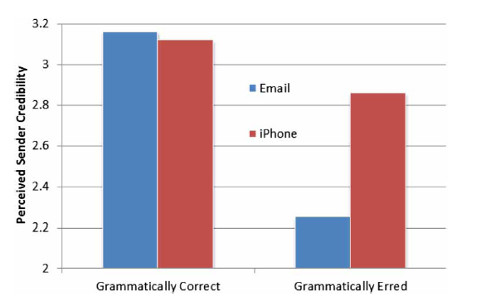
We are more forgiving of sloppy e-mails when we know they were sent from a smartphone:

When the message had correct spelling, grammar and punctuation, the sender was rated as being very credible — and there was little difference between whether the email seemed to have been composed on a computer or a phone. But when the message had errors in it, things changed: Students attributed higher credibility to the person who’d written the lousy message on a phone.

(Hat tip: J.K. Trotter)

Reserving Your Commute

Transportation researchers are exploring models that would compel drivers to reserve slots at coveted intersections:

So let’s say you want to drive through one of these points. As you approach, your car contacts the “intersection manager” and tries to make a reservation. The intersection manager crunches the data on all other cars on the road, decides whether it can fit you in, and tells you how much a place will cost. At this point, to reserve a space, you pay a small reservation fee. That’s to keep people from reserving spaces on roads all over town.

Once your road reservation is made, then you continue on course to arrive at the intersection within a certain time window — as with restaurants, there can be a bit of flexibility here, though not too much. As you cross into the intersection on the desired course, you pay the remainder of the reservation cost. Naturally, fees will be highest along the most desirable corridors, for the same reason it’s hard to get a table at Komi.

Now let’s say you can’t get your first-choice reservation.

You still have options to get into town. For starters, you can choose another route and make a reservation with that intersection manager. You can also simply show up at the intersection and hope the manager finds you a place; again, as at a restaurant, something might open up, but you could be waiting a while. You can also brush past the manager and continue on the road anyway, but you’d risk causing an accident or getting a ticket.

When the system is operating at its theoretical peak, the prices at various intersections create incentives for people to find alternate commute routes — or, of course, to take public transit. Those incentives, in turn, should decrease congestion. (On the flip side, if managers ask too much for space on the road, their route will go out of business.) Sure enough, when [researchers Matteo] Vasirani and [Sascha] Ossowski ran their idea through a model of Madrid traffic, they found that as intersections profits increased, general travel times across the city decreased.