You Think “Weiner” Is Bad? Ctd

integrityincongress

A reader can top Harry Baals:

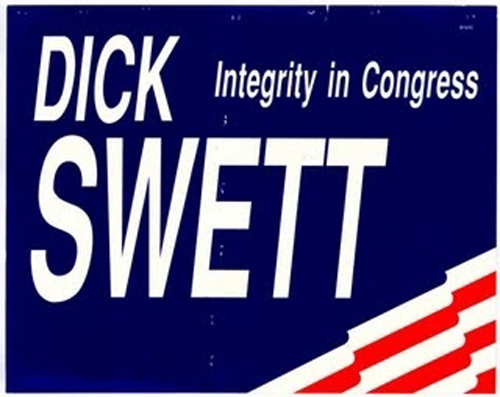
I know this is juvenile, but I can’t help it.  Here in New Hampshire, Dick Swett was a congressman for a few terms in the early 1990s. His campaign posters never failed to elicit a smile. Best of all, he was subjected to the Daily Show treatment when he stood up and asked President Obama a question at a town hall in Nashua in 2010.

Another:

I used to be a political consultant, and in the office we would keep track of great political “Dick” names. In the early 1990s, the president of the Cook County Board (the county that contains Chicago) was Dick Phelan. The last name was pronounced exactly the way it would to have your doctor write you an ED prescription.

Another:

When I did political fundraising in Michigan there was a big time lobbyist named Dick Weiner. Yes, just like Anthony.  That was a difficult call to make without laughing!

Another:

I was doing some personal research on Blower Bentleys yesterday and came across this video on the 1937 Grand Prix circuit:

I’m turning 52 tomorrow, maybe I’ll finally grow up.

Another:

I’ve always found the most unfortunate politician’s name to be Dick Mountjoy, a politician in the California State Assembly and Senate.  It didn’t help that I first encountered him while on a middle-school field trip to Sacramento.  I’d say his name was tailor-made for an adolescent’s sense of humor, but I can’t honestly say that I find his name any less hilarious now 15+ years on.

Another shifts genders:

Your reader who served with SFC Boner reminded me of a sailor off the USS Blue Ridge I met several times while I was deployed to Japan: a woman named Seaman Boob.

Imagine hearing that name get passed over the 1MC several times a day. Getting promoted didn’t help her much either; I believe she was an an interior communications electrician, so she became IC3 Boob, then IC2 Boob, and if she stayed in long enough, IC1 Boob …

Another:

Clearly the American military enjoys a significant advantage in terms of amusing names: the relative ethic diversity and the omnipresence of the nametape on the uniform make it impossible to ignore.  In my brief military career alone, I’ve had the pleasure of meeting Sergeant First Class Crazybear, Sergeant Sargent, and Major Horney.

Nothing, however, will outstrip a fond memory at the end of a deployment to Iraq at Ali Al Salem Airbase, Kuwait.  I was redeploying separately from my unit, and there were about 50 random sleep-deprived souls scattered about the waiting area, ready to head back home. In such situations, a relatively senior individual is designated to ride herd on the other passengers and ensure everyone is present through the time-tested Army roll call.  We all stood in yet another formation as a major read our names off in a loud, commanding voice:

“Garrity!”

“Here!”

“Gilchrist!”

“Here!”

The major paused.  A note of uncertainty crept into his voice.

“Glass … coke?”

And from the back, loud and triumphant:

“It’s pronounced Glasscock, sir!”

Another looks to the sports world:

Allow me to introduce you to Dick Pole, former Major League Baseball player and coach. And here are a few more from baseball, including Rusty Kuntz.

Another:

Let us not forget Randy Bush, who played outfield for the Twins in the 1980s.

Another:

This person isn’t a public official or a news reporter, but I still think the classic funny name of all time is a retired ob-gyn in Virginia named Harry Beaver.  Yes, he goes by Harry, not Harold.

And another:

Whenever I hear about people with funny/unfortunate names, I always think back to one of my college professors at UC Santa Cruz. Harry Beevers was one of the preeminent plant biologists of the 20th century. He was instrumental in discovering the glyoxylate cycle and the glyoxysome in plant cells. He was from the Northeast of England and spoke with a pronounced Durham / Geordie accent. He was a little intimidating in his classroom lectures but brilliant.

Another might just be pulling our leg:

In Junior High School (Greenfield Jr High, in El Cajon, CA) close to 30 years ago, my gym coaches were Harold Balls and John Hiscock. No joke. Of course the common refrain (amongst both students and staff) was, ” Where’s Hiscock and Balls?”, followed by much snickering.

I heard that after I left, Hiscock retired and was replaced by a coach named Longerbone. The whole thing was so preposterous that a local radio station once called the school on air to confirm that this wasn’t some kind of joke.

Another:

When I was in college I worked at a call center doing tech support for AT&T Wireless. One time I fielded a call from someone named Harry Johnson. My supervisor heard me laughing (while my microphone was muted, of course) and wandered over to check it out. When he saw the name Harry Johnson on my computer screen he started laughing too. Then, in one of the coolest but least responsible things a boss has ever done, he told the rest of our 15-person team to put their customers on hold and check out my screen.

One more:

My first GYN was named Dr. Stiff. Nice man, went to our church, had a good (and I should add, properly scientific) talk – along with his female partner in his practice – with all us high school girls about the sorts of things you need to see a GYN about, and made us feel very comfortable, and then I started going to him. I say this because I would not have chosen a GYN named Dr. Stiff out of the phone book – which might have been why he was trying to drum up business at church!

More readers are snickering over at our Facebook page. Update from a reader:

Now that you’ve expanded the review into the sport world, you have to acknowledge the legendary NASCAR racer, who died earlier this year: Dick Trickle. I once asked someone who worked in the sport, why he didn’t go by Richard or Rick? He said that Trickle started racing in Wisconsin on dirt tracks, where one of the other competitors was Richard Head, who did not go by Richard. I assume Trickle figured, by comparison …

And then there was the former head football coach at Glassboro State College in New Jersey in the ’80s: Richard Wackar. He did not go by Richard.

I assume you now realize this thread may never end?

Subscribers need to get their [tinypass_offer text=”$2/month”]’s worth.

Dolphins Have Names, Ctd

Linguist Geoffery Pullum calls the latest news item about dolphins’ communication skills “patently obvious twaddle”:

What the scientists did according to this new report was to capture the signature sound (the specific typical whistle noise) of each individual in a group of wild bottlenose dolphins and play the sounds back to the group. And what happened?

“The researchers found that individuals only responded to their own calls, by sounding their whistle back.”

Now, think about that. If you call out “Geoff Pullum!” in a crowded street, and I’m there within earshot, I’m likely to turn round and look at you. But what I am not likely to do is yell “Geoff Pullum!” back at you. The very description in the article of what happens when a dolphin hears their own signature whistle reveals that signature whistles do not function anything like names. It sounds analogous to a study of dog behavior finding that if you play Fido a recording of his own bark, he will bark.

Update from a reader:

Why does he assume dolphins and humans communicate the same way? What if repeating back his own name is simply an efficient way of saying “Yes, I’m here?”

When I first read the story, it seemed like dolphins use their names as message headers the same way pilots do. Whenever a pilot radios someone, she begins the conversation by saying who she’s calling and who she is, and then typically ends the conversation by repeating her own callsign:

Airplane N12345: Tower, November 12345.

Tower: Aircraft calling tower go ahead.

N12345: 345 holding short 22-left, ready to go.

Tower: November 12345, line up and wait runway 22-left, landing traffic one mile final on 18.

N12345: 345 [has received and understood your transmission]

So what’s so “obvious[ly] twaddle” about:

Dolphin 1: Dolphin 1 [calling anyone], just saw some tasty-looking tuna.

Dolphin 2, 30 miles away: Dolphin 2 [here, I have received and understood your song, and I’m coming too].

Dolphin 1: Dolphin 1 [understands you Dolphin 2 and will save some tuna for you].

Seems to me they’re pretty efficient communicators.

Goth Goes Global

946027_127306927465626_240420189_n

Young Kenyans are “less concerned with tribal loyalty than their parents” and “looking to forge a new, contemporary identities,” Rowan Emslie reports. One result: Nairobi now boasts a sizable goth community:

I meet [David Lith] at The Goth Shop, a clothing store and tattoo parlor housed in a mall in the affluent Westlands neighborhood of Nairobi. The very existence of this shop is noteworthy – it is fairly unusual to hear rock music in bars or shops in East Africa, much less experience anything related to goth culture. For some, old Dolly Parton and Jim Reeves cassettes in supermarkets remain the closest thing to even “rock culture” available in the mainstream. David is acting as my guide, taking me on a tour of the awkward little tattoo parlors, shops and bars that occasionally host the itinerant goth population of East Africa’s regional hub. …

[I]nterest in goth culture came about shortly after tattoos were popularized in the early 2000s through MTV and other Western music channels. Across the several parlors [I] visited, most had at least one goth-influenced artist on staff. Thanks to the launch of a rock-heavy radio station, XFM, and an increasingly popular metal DJ called Van Doom, the number of young Kenyans partaking in goth culture seems likely to expand in the near future.

A 2011 estimate put the Nairobi’s goth community at 300, but The Goth Shop has nearly 1,000 fans on Facebook and Oh My Goth Designs has more than 2,000. Check out more fantastic photos on the latter’s fan page.

A Rule Of Thumb Drives

Don’t plug in ones you find:

The thumb drive has long been a weak spot in the overall security landscape. As usual, the problem has a very human face: There is a raft of good policies in place to protect companies from losing data – or gaining viruses and assorted pieces of malware – from USB flash drives. Unfortunately, people are not paying attention. Even IT professionals are not eating their own cooking when it comes to USB security, according to CIO Insight:

In a recent study of 300 IT professionals—many of whom are security experts—conducted at the RSA Conference 2013, 78% admitted to having plugged in a USB flash drive that they’d found lying around. To make matters worse, much of the data discovered on those drives included viruses, rootkits and bot executables.

The story offers a bit of comic relief: The U.S. Department of Homeland Security ran a test in which staffers dropped flash drives in the parking lot of government and contractor buildings. Sixty percent of folks who picked them up simply plugged them into networked computers. That percentage jumped to 90 percent if the drive had an official logo.

(Hat tip: Geoffrey Ingersoll)

A Pit Stop On The Road To Democracy?

While addressing this week’s Iraqi prison break, Jon Lee Anderson zooms out:

Five hundred Al Qaeda terrorists back on the streets can do a lot of damage wherever they choose to go—to Iraq, Syria, Lebanon, or the fragile Jordan, where hundreds of thousands of Syrian refugees now live in camps along the border. Martin Kobler, the U.N. envoy to Iraq, warned this week that the likelihood of a regional conflagration was growing: “The problems in Iraq cannot be separated from the problems of the region. The battlefields are merging.”

Kobler is right. The Middle East is more of a powder keg, with more fuses, than it has been in years. Political violence is surging, with regional actors like Saudi Arabia and Iran lining up on opposing sides, and the United States and Russia arrayed behind them.

Sheri Berman considers all the recent tumult in the Middle East “not a bug in political development, but a feature”:

[T]he false starts and problems, the turmoil and the chaos and yes, sometimes even the violence, were an inherent and often necessary part of the process that ultimately abolished authoritarianism and paved the way for liberal democracy. …

What has happened time and again [throughout history] is that a country begins with a nondemocratic regime, proceeds through a phase (or several phases) of minimal or illiberal democratic experience, and eventually emerges with a consolidated liberal democracy. Almost all early democratic experiments around the world were illiberal or deeply problematic, and many ended badly. Only after many generations and attempts were most countries able to consolidate truly liberal democraciesthat is, to eradicate deeply ingrained nondemocratic behaviors and attitudes and develop new ways of thinking and acting that would enable liberal democracy to survive and flourish.

Jay Ulfelder pushes back on that argument:

As a grossly simplified description of the democratization trajectories followed by the United States and much of Western Europe, I think this works. As a road map that the rest of the world will eventually follow, however, I’m not so sure. In historical terms, the period during which the US and Europe could confidently be described as “consolidated liberal” democracies has been relatively brief, and some thoughtful observers argue that that era has already passed. What’s more, the geopolitical, economic, demographic, and environmental context in which political development is now occurring differs sharply from the context in which those earlier arcs unfurled, and the pace of change in that context seems to be accelerating still.

Don’t get me wrong, I’m still optimistic that global politics in the twenty-first century will continue to evolve in a more democratic direction. The tumult occurring in Egypt, Tunisia, Libya, Syria, Bahrain, Kuwait, and other corners of the Arab world is just the latest evidence that it’s getting harder and harder to sustain the kind of full-blown, paternalistic authoritarian rule that was the prevailing form of national politics around the globe throughout the twentieth century. I’m just not as certain as Berman seems to be about exactly what institutional forms that tumult will eventually produce.

Voter ID Laws Are A Bad Way To Steal An Election, Ctd

Douthat suggests the GOP rethink its voter ID push:

[P]recisely because the liberal outrage over voter ID laws is disproportionate — for understandable historical reasons and cynical political reasons alike — to their actual impact, it is quite possibly self-defeating for Republicans to keep pushing them.

In exchange for a marginal benefit to their candidates on election day, the G.O.P. is handing Democrats a powerful symbolic issue for mobilizing minority voters, and sending a message to African-Americans that their suspicions about conservatism are basically correct, and that rather than actually doing outreach to blacks the right would rather not have them vote at all. At best, the political benefit to the G.O.P. might outweigh the cost in non-presidential election cycles, for the House and for state offices, when minority turnout already tends to be depressed. But in that case, these kind of laws are just a way of consolidating the G.O.P.’s position as the new 1970s/1980s Democrats: A party that wields enough power in the states and Congress to postpone the kind of outreach it needs to be competitive at the presidential level. And as such, they’re another case of the G.O.P. playing a factional role in our politics, rather than trying to represent the nation as a whole.