
Another map from a reader:
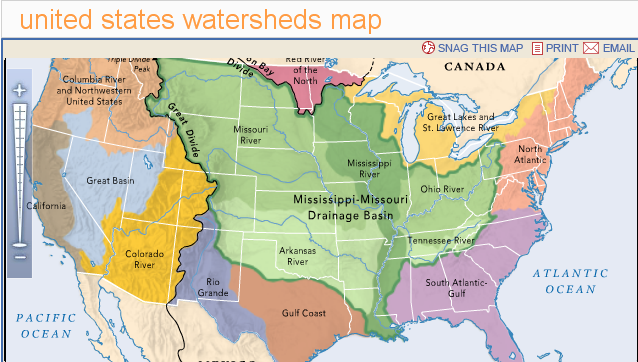
It explains how Pittsburgh and Topeka are both sometimes “Midwest”. I think another factor, in addition to geology, climate, rainfall, and highways, is rivers and watersheds. Areas that share a watershed are connected physically by a river and have similar geology seem to form contiguous units.
Another writes:
Such a cool thread. And, being the reader who (I think) got the whole “South vs Social Mobility” thread rolling, I feel a compulsion to weigh in on the Midwest one. I’m not Midwestern, but I find the cultural boundaries of the US to be endlessly fascinating, since they don’t really hew to state lines, even though everyone expects them to do so. In particular, your reader who pointed out the 100th Meridian dividing line is pretty dead on (though I might move the Midwest/West boundary myself over to the west by about 150 miles). Think of all the things in “Midwestern” states that are so reminiscent of the West: Mount Rushmore; Teddy Roosevelt’s Badlands and its roaming bison; Dodge City, Kansas. Those are all, in fact, on the other side of the 100th meridian.
Also, perhaps the reason that Texas has such a self-centered identity complex is because it has no other singular region in which to identify. El Paso is solidly in the West. Houston is solidly in the South. Dallas, though it considers itself nominally “Southwestern” (how?), is really both Southern and Great Plains at once. And who knows what the hell San Antonio is – not Southern, not Western, not Midwestern. Hence, my theory is that Texas pride is so overbearing because Texans need to find they have something in common.
Another:
As is often the case in such matters, too many of your commenters have fallen into the trap of trying to logically, geometrically locate the “mid” of the West, rather than follow the historical evolution of the vernacular.
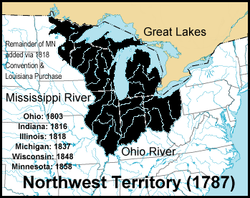
The tipoff is that nobody in the South thinks of themselves as Midwesterners, no matter where they lie, East to West. That’s because the historical precursor to the idea of the Midwest is the old Northwest Territory, which led to the settlement of the northwestern corner of the United States. At least, what used to be the northwestern corner of the United States, that is, the Great Lakes region (more or less).
The Louisiana Purchase blew up that claim to fame pretty much right as the Northwestern  Territory was formalized, but rather than die, the idea simply evolved. The people of the old northwest knew that, politically speaking and population-wise, they were still “West” even if the (largely fictional) western boundary of the nation had vaulted far beyond them. They lived in the more-or-less-west, the kind-of-west, the really-not-as-East-as-it-looks-on-your-map, or as it finally came to be known (with a shrug inserted in place of a hyphen) the Midwest.
Later, with the further addition of the Oregon Territory, the “westerners” of the Louisiana Purchase, similarly bereft of their edge status, likewise laid claim to living in the Midwest. They, as any Ohioan (living in the first Midwestern state) knows, are mere pretenders to the throne.
Another:
I have to dispute your reader who was “born and raised in the Midwest”, who continued: “I have one very simple rule: if it’s in the Eastern Standard Time Zone, it’s not Midwest.” Try telling that to the residents of Dayton, Ohio (where I was born), where everybody identifies their region as the Midwest. This is nothing new – when I was young (circa 1960), our local TV station produced a weekly music show called Midwestern Hayride.
In fact, as the border zone, Ohio turns out to be much more complex and interesting than it usually gets credit for. Here’s how you should understand the three largest cities in Ohio, geographically, culturally, and politically: Cleveland is an Eastern city (old, industrial, ethnic); Columbus is a Midwestern city (mostly flat, sprawling, surrounded by cornfields, service-oriented, much more homogeneous demographically); Cincinnati is a Southern city (geographically and politically more like Kentucky than most of the rest of Ohio).
Another passes along the Onion’s take on the subject:
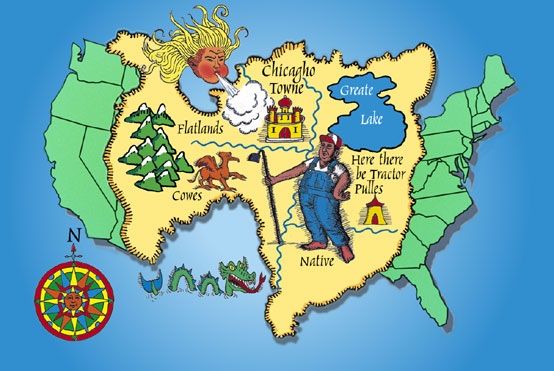
“The Midwestern Aborigines are ruddy, generally heavy-set folk, clad in plain, non-designer costumery,” Eldred said. “They tend to live in simple, one-story dwellings whose interiors are decorated with Hummels and ‘Bless This House’ needlepoint wall-hangings. And though coarse and unattractive, these simple people were rather friendly, offering us quaint native fare such as ‘hotdish’ and ‘casserole.’ … [T]heir mode of dress is largely restricted to sweatpants and sweatshirts, the women’s being adorned with hearts and teddy bears and the men’s with college-football insignias.



 The Dish