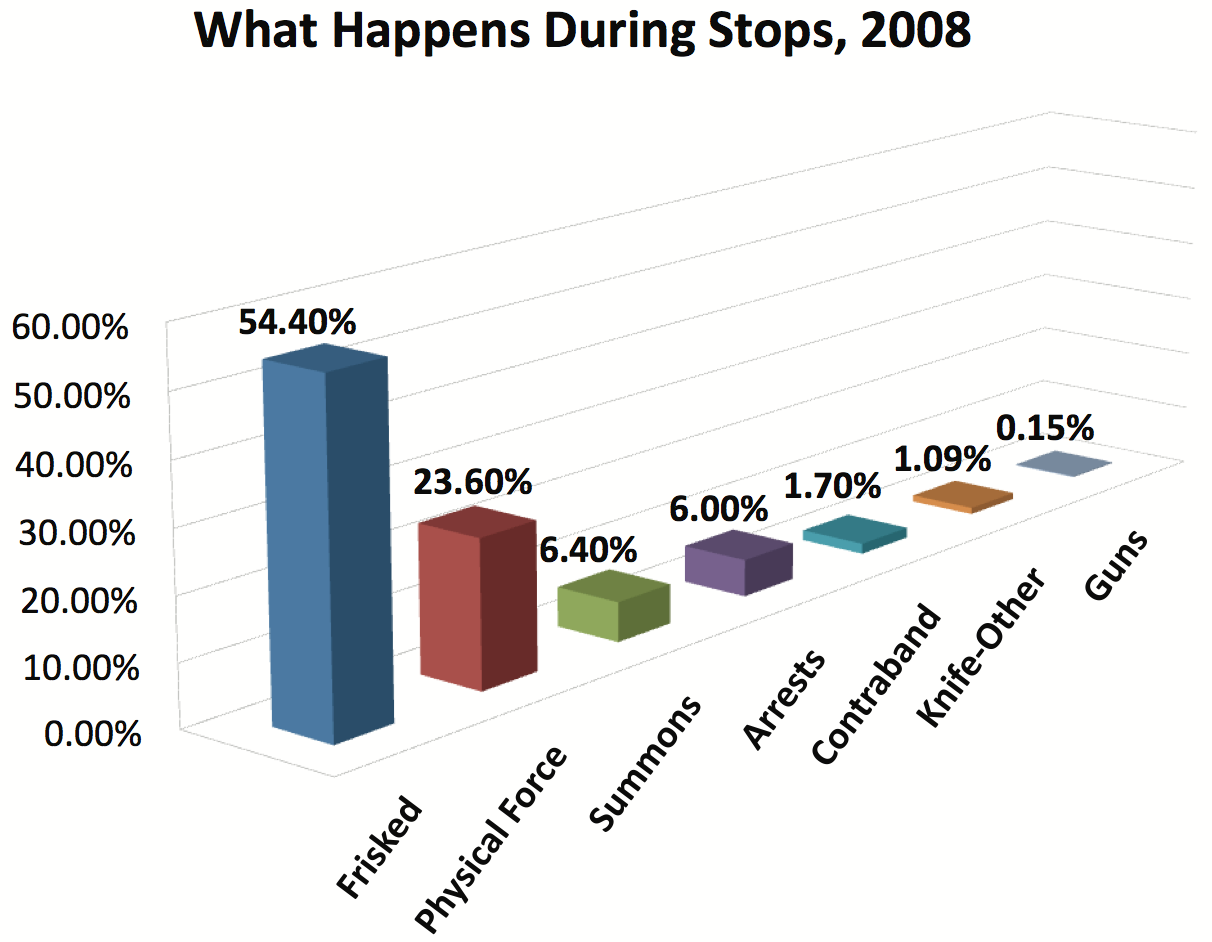
What Does Stop-And-Frisk Accomplish?

Stop And Frisk

TNC is unimpressed by its track record:

I am not totally opposed to policies in which individuals surrender some of their rights for the betterment of the whole. The entire State is premised on such a surrendering. But at every stop that surrendering should be questioned and interrogated, to see if it actually will produce the benefits which it claims. In the case of Stop and Frisk you have a policy bearing no evidence of decreasing violence, and bearing great evidence of increasing tension between the police and the community they claim to serve. It is a policy which regularly results in the usage of physical force, but rarely results in the actual recovery of guns.

Sullum adds that “debate about the effectiveness of New York’s stop-and-frisk program is interesting, but it should not be dispositive”:

For that matter, the demograpic profile of the people who are usually hassled by the cops, while it certainly should bother anyone who claims to be concerned about racial profiling or the 14th Amendment’s guarantee of equal protection, is not the most decisive argument against stop and frisk, which is the Fourth Amendment. As Mike Riggs noted yesterday, [NYPD Commissioner Ray] Kelly seems to think everyone detained by the cops must be guilty of something. “The notion anyone stopped has done absolutely nothing wrong is not really the case,” he said on MSNBC’s Morning Joe, because police “need reasonable suspicion to stop someone and question them.” Kelly not only confuses reasonable suspicion with guilt beyond a reasonable doubt; he assumes his cops really do have a sound legal basis for every stop they make and every pat-down they perform. That assumption is hard to credit, given that stops result in an arrest or summons only 12 percent of the time and pat-downs almost never discover guns. If the stop-and-frisk program is unconstitutional, as it appears to be, its putative effectiveness does not make it less so.

(Chart from a 2010 report (pdf) by the Center On Race, Crime And Justice)

Guess Which Buzzfeed Piece Is An Ad?

This one? Or this one? Or this one? Or this one? Or this one? Or this one? Or this one? There’s been an uptick lately in Pepsi stories, for some unfathomable reason. But before you look and find which one was formally paid for, ask yourself whether a copy-writer or a journalist wrote the following paragraph:

Pepsi announced second quarter earnings Wednesday that beat Wall Street expectations. The company, which also owns snack company Frito-Lay and beverage brands Tropicana, Mountain Dew and Gatorade, among others, reported revenue of $16.8 billion and net income of $2 billion, both increases over the prior year’s figures.

Pepsi is currently under attack from activist investor Nelson Peltz, who wants the company to separate its soft drink and snack business. Pepsi is against such a move. Below is a pretty sweet chart that highlights some key items from Pepsi’s earnings report.

Who wrote the following headline – a copy-writer or a “journalist”?

10 Reasons Why Beyoncé, Pink And Britney Spears’ Epic Pepsi Commercial Can Never Be Topped

Or does it really matter any more? It’s all entertaining! Previous Dish on “enhanced advertorial techniques” here.

Donald Duck vs Adolf Hitler

Nathan Jolly revisits WWII-era Disney, when the company was creating war propaganda for the US government. The above cartoon, Der Fuehrer’s Face, was released in 1943:

Donald is portrayed as a slightly resistant/drone-like Nazi, living in a town where everything — clouds, trees, telegraph poles — is swastika-shaped. Donald is dragged out of bed by, oh, just Himmler, Goebbels and Mussolini, who force him to read Mein Kampf, give him piss-weak war rations, then kick him to a factory, where his job seems to be to make artillery shells and salute pictures of Hitler. This repetitive regime results in a manic episode where Donald begins twisting his body into the shape of a swastika, before flipping out and tripping balls, his world now a spinning rush of singing shells, shrieking snakes, screeching smoke whistles and untold horror. As this is a cartoon, and also 1943, it turns out Heir Duck’s army flirtation was but a dream, with the cartoon ending with a tomato thrown at Hitler’s face – as per film and television laws in the ‘40s.

Oh, and Disney won an Academy Award for the piece.

Breaking: Man Gets Off Online, Ctd

A reader writes:

You really struck a chord with the operative term on this one: consent.  Compare this to the issues in my hometown of San Diego, where our mayor Bob Filner seems to be engaging in a pattern of very non-consensual sexual harassment.  I didn’t vote for the guy, but I supported him once he was in office.  Now most of his sane supporters and I want him gone.  I can’t blame them – it speaks to a serious level of disrespect for other people.

Weiner’s actions were totally consensual.  All other things being equal, I’d still vote for him if I was a New Yorker.  Being a 29-year-old Millennial, I’ve gotten plenty sick of watching political careers get consumed by some good old fashioned hanky panky.  Kennedy (and countless others) did that shit too; he just didn’t have a mechanism to accidentally get pics of his dick exposed to the masses.

Other readers are much more critical:

I agreed with you until I saw that press conference.  Watching his naked narcissism on display and his poor, shy, beautiful wife having to smile and say she supports him in his attempt to resurrect his career made me think he’s just another asshole.  He has a problem.  The fact that while losing his career he is still engaging in the same behavior means he can’t help himself. This “I’m a changed man” tour is nonsense.  How hard is it to not send pictures of your dick, really? Does his ego need to be stroked (lol) that badly?

The first time I felt bad for him, sad that his career had to end over something that was personal and fairly innocuous in the scheme of things. Now after witnessing that spectacle of selfishness and blind ambition, I think he’s a scumbag. His wife should run for mayor instead.

Another:

Huma Abedin stated, “Anthony has made some horrible mistakes both before he was in Congress and after.” So, she clearly was not okay with his second round of extramarital sexting.  This was clearly not consensual and within the bounds of their own private marriage agreement.  It obviously was another shock, another upset to Huma.  She looked sad.

This by no means makes Weiner a pervert or a predator.  But it sure makes him reckless and selfish.

Even after his humiliation in Congress, knowing full well that any further sexting is going to come back to bite him and further humiliate him and his wife and upset his plans for NYC mayor and her career plans, he does it again? What’s wrong with this guy? It’s not being prude or judgmental for New Yorkers to ask whether or not they want a person with such an obvious lack of self-control at the levers of power.

Another:

At first, your post made total sense to me, but I came to a full stop when I read this: “and in virtual space, no coercion is really possible”. With all the stories of online bullying and the possibility of blackmail, coercion is totally possible.

I meant physical coercion. Another reader:

I appreciate your general critique of America’s sometimes puritanical culture being at odds with reality.  But it’s worth pointing out that Career Services officers are constantly admonishing college students to make sure there’s nothing embarrassing about themselves on-line.  Karen Owen of Duke is only the most extreme example of rendering oneself unemployable in Corporate America via a Google search.  Given that this reality has been appreciated for many years now, Weiner has (yet again) shown astonishingly poor judgement.  He is seeking responsibility for managing a city of 8 million people, yet if he were a college student or regular working stiff, he wouldn’t be able to find even an entry level job.

One more:

I recently took my girlfriend of three weeks out on a relatively expensive date involving dinner, drinks and a show.  Up until that night, she had been picking up the tab for something each time we went out, but on that particular night, she looked me in the eye and said, “This pussy has value. If you want to get laid tonight, you’re going to pick up the tab for everything.”  I was a little taken back because I’ve dated a few strict feminists in the past who insist on splitting everything 50-50 and I much prefer that, but the “This pussy has value” attitude is pretty prevalent among both men and women, and so like most men, on that particular night I picked up the tab for everything and I got laid.

All that is to say, what did Eliot Spitzer really do wrong?  He paid for pussy, a common transaction between men and women that happens every single day in 80-90% of the relationships in America – married and unmarried, long term and brand-new.  As far as I can tell, he exhibited no serious personality defects or general sliminess.  In fact, I appreciate that he kept it purely a business transaction.

Compare this to Weiner, who apparently can’t control his own behavior, entangled his sexual targets in his political life, repeatedly lied to everyone and attempted to shield himself behind his wife while exposing her to public humiliation.  It is for good reason I think that many people are willing to give Spitzer another chance while they are through with Weiner.

The Speech Before The Battle

Josh Barro analyzes Obama’s economic speech from yesterday, the first in a series of speeches the president has planned on the subject:

It’s likely the White House’s real goal with these speeches is one they can’t say out loud: Defend status-quo policy, and the tepid recovery it is allowing, against any future crises that Republicans might manufacture.

Andrew Sprung sharpens that point:

If an extremist GOP, drunk with its budget war victories over Obama since 2011, rivets the entire nation by shutting down the government because Obama won’t agree to defund Obamacare, or threatens the nation with default because Obama won’t agree to ruinous new spending cuts on top of sequestration — then Obama’s sane, sober, repetitive, essentially centrist calls for long-term investment and commitment to the middle class should trigger a public opinion backlash against the GOP, just as Bill Clinton’s did when the Republicans shut down the government because the president wouldn’t agree to massive cuts to Medicaid and Medicare …  Obama has said that he won’t negotiate over the debt ceiling. He most definitely will not agree to spending bills that defund Obamacare implementation. Will events finally drive him to hold firm in some kind of full-scale showdown with intransigent Republicans?

That’s how I saw it. Obama shows his persistent attention to the economy, which has improved on his watch, while the GOP tends to their fanatical base and moves toward shutting down the entire government because they lost the last election and cannot bear to see the winner actually govern, even from the banal center. Beutler is on a similar page:

Whether this is the White House’s true intent or not, the speeches will have the effect of reminding the country, implicitly, that of all the things the government can do to improve the economy, a debt default threat is among the worst. Addressing the issue obliquely is actually key to preserving the fragile governing coalition he’s helped to build in the Senate, and to avoid the sense that he’s the one drawing battle lines. And If voters have the question of the country’s economic future in mind through the summer, it will make picking a debt limit fight all the more dangerous for the GOP, and certainly be preferable to blindsiding the country with a new round of brinksmanship that puts the fragile recovery on the line once again.

How Jon Cohn understood the purpose of the president’s speech:

Obama mentioned Republican obstructionism in his speech, not once but several times, and not in short bursts but for extended soliloquies. There’s a reason. Major fiscal fights loom—over how to pay for government services, and under what conditions to raise the nation’s borrowing limit. House Republicans are already warning of new attempts at brinkmanship—like threatening to shut down the government if Obama won’t agree to de-funding of his health care plan.

Wednesday’s speech was the beginning of an effort to remind the American people about the stakes in those fights, and who supports what. Obama’s not going to win over the conservative base of the Republican Party, obviously, but he’s having at least some success working with less extreme members, like Senators John McCain and Lindsey Graham. Not coincidentally, Obama chose his words carefully, criticizing a “a sizable group of Republican lawmakers” who have threatened not to raise the debt limit but also praising the “growing number of Republican Senators [who] are trying to get things done.”

Chait adds:

Obama’s ultimate goal is not merely to insulate himself from blame if and when House Republicans shut down the government or threaten to default on the debt, but to build a coalition with pragmatic Republicans to negotiate around Boehner’s back. It’s not totally hopeless: Mitch McConnell is fighting back a revolt among pragmatic Republicans, like John McCain, who want to compromise on the budget.

Suderman doubts that Obama can break the gridlock:

Obama’s insistence that he would do everything he could to break congressional gridlock only underscored how little there is he can do in response. “I will not allow gridlock, inaction or willful indifference to get in our way,” he said. “Whatever executive authority I have to help the middle class, I’ll use it. Where I can’t act on my own, I’ll pick up the phone and call CEOs, and philanthropists, and college presidents – anybody who can help – and enlist them in our efforts.” That’s right: The president is willing to pick up the phone and call philanthropists and college presidents, if that’s what it takes.

There isn’t, in other words, much he can do—or at least not much he can do that he also wants to do. And in Obama’s view, that seems to be the real problem.

And Drum wishes Obama’s speech had been bolder:

In what possible universe would bold new proposals break through the brick wall of modern Republican opposition to anything that’s not a tax cut for the rich? Obama could announce that John Galt has invented a free energy machine and just needs a small federal grant to commercialize it, and Republicans would oppose it. Obama could announce anything at all, and Republicans will reflexively oppose it.

The reason Obama should be bolder is not because it might “break through the resistance.” He should be bolder precisely because it wouldn’t make any difference. If you’re going to meet an adamantine wall no matter what you do, why not shoot for the stars? At least that way you’ve made it clear whose side you’re on.

AbFab Goes Royal

Had a coffee splutter this morning over this one:

William Sitwell, editorial director of John Brown Media, which publishes the Waitrose magazine, stands by the choice of Pippa. “Sales are soaring since she started writing for us,” he said recently, estimating that the circulation on the magazine has jumped from 1.5 million to 2.2 million. “She is a good cook and writer and works very hard,” he said, adding that she comes into the office once every month or two when they “bash out a few issues” and that “she has impressed the whole team here.”

My italics.

The Capitulation Of Samantha Power, Ctd

A reader writes:

I agree that it’s disappointing that Samantha Power censored herself in her nomination hearing and adopted the Washington line on some controversial subjects. But in criticizing the system that forces candidates to do so, you came down too hard on Power herself. Yes, it would be great if she took a stand and spoke her mind, but who would it serve if she jumped on her own sword? She might have put a dent in the system, but she might have just become a footnote in history, like Bork – used to caution future presidential appointees from speaking too candidly. Probably the latter.

You can’t look at Power’s career, or read Problem From Hell, and not come away thinking that she has a goal to use American power to serve humanitarian ends. Now that she is on the cusp of having a real, direct impact of US decision-making, should she speak the truth and likely claim only a moral victory, or hunker down, make some compromises and work to effect change from within? I sure can’t blame her for choosing the second option.

Another also sticks up for Power:

I would normally agree with you that watching confirmation hearings turn into Israel Day Parades is unsettling, and only confirms the worst stereotypes about Jewish control over Washington, etc. Hagel’s dance was particularly ridiculous, as Saturday Night Live (almost) pointed out.

However, it must be acknowledged that Power is up for UN Ambassador. While criticism of Israel is healthy and deserved, the UN takes this to new heights; no other country has been as lambasted and pilloried as Israel has. It is routinely called to task by a UN Human Rights Commission comprised of Cuba, Syria, Iran, etc. It is ridiculous and unfair, and only entrenches the Israeli right’s attitude of “they are all against us, screw em” that is a large part of the problem over there.

Whereas I didn’t care much for hearing Hagel swear allegiance to the Likud, it was nice to hear Power at least commit herself to defending Israel from the hypocrisy swamp that is the UN on this issue.

Ask Ken Mehlman Anything: What’s The Future For Marriage Equality?

A reader understandably asks:

I think your readers are a little bit more interested in what Ken was thinking while he was in the closet and shepherding anti-gay marriage laws in several states as head of the Republican Party. Why hasn’t he been asked this?

Because he felt that he had adequately addressed that question already, and our policy in the Ask Anythings is not to insist on an answer for any specific question. We give a huge amount of autonomy to the guests – and that was no different for Mehlman than for anyone else. Here are his previous confessions:

In an interview with Salon, the chairman of President Bush’s 2004 reelection campaign says he personally apologizes to people who “were harmed by the campaigns in which I was involved.” Ken Mehlman came out as gay in 2010. At the time, he expressed regret that he didn’t push back against the Bush campaign’s support for a federal anti-gay marriage amendment and anti-gay marriage initiatives on state ballots. “I can’t change the fact that I wasn’t in this place personally when I was in politics, and I genuinely regret that. It was very hard, personally,” he said.

Earlier this year, he said: “At a personal level, I wish I had spoken out against the effort,” Mehlman said. “As I’ve been involved in the fight for marriage equality, one of the things I’ve learned is how many people were harmed by the campaigns in which I was involved. I apologize to them and tell them I am sorry.”

I know exactly why these responses may not feel sufficient to many Dish readers.

But the Ask Anythings are not designed as classic persistent interviews by a lone interviewer. They’re constructed to give the speaker a chance to say whatever he or she feels – to shine or not, in the eyes of the readers. I am not in the room when the sessions are recorded, (with a few exceptions). The questions are voted on by readers. And what a guest chooses to talk about is often as revealing as what he or she chooses not to talk about. Our policy is to let them prove or hang themselves – and let you be the judge.

I also totally understand the sentiment that the man should still be raked over the coals for the 2004 campaign, especially in Ohio. But I have a firm and long policy in these cultural wars. Those seeking heretics will always lose to those seeking converts. And Mehlman is not just talking the talk on this; he has made a real difference in recent years in advancing the cause – which seems to me more important than settling old scores. Given that Mehlman has publicly apologized (unlike, say, Bill Clinton) to the gay victims of his past, I was not going to force another one in a format where we never do that anyway. It was my call to maintain these rules, but, of course, if Mehlman had wanted to apologize and explain again, I would not have stood in the way. He chose not to.

Because of these very limitations on Ask Anythings, we’ll be offering subscribers this fall a series of podcast conversations between me and a variety of other human beings where, trust me, I follow up questions relentlessly. They will not be traditional interviews, as on cable news or TV generally, just as the Ask Anything isn’t like anything on TV. They’ll be conversations – wide-ranging, spontaneous and with no topics off the table. They have no fixed time limit – and vary wildly in length and content.

We’re calling them “Andrew Asks Anything”. We have several in the bag and I’ll be taping more this fall. Stay tuned. But these will only be for subscribers. To become one, [tinypass_offer text=”click here”]. It’s as little as $2 a month, and, without ads, is our only source of income.

Ken’s previous answers are here. Our full Ask Anything archive is here.

You Think “Weiner” Is Bad?

A reader has that surname beat:

This is not an exact parallel to the Weiner case by any, uh, measure, but in the pre-Internet 1980s, Nashville once elected a mayoral candidate who, once he was in office, left his wife (she was his third) and before his divorce was final, became engaged to a cabaret singer named Traci Peel. For a few months, Nashvillians had a mayor who was married and engaged at the same time.

Ms. Peel promptly gave an interview to a local newspaper in which she confided that she and the mayor had just enjoyed “seven hours of passion.” Shortly afterward, the duo appeared on a national broadcast of the “Donohue” show, during which the mayor played harmonica as his fiancée belted out a version of the country staple “Rocky Top,” And then, in an interview, he blamed all of his troubles on the media sensationalizing his private life.

This amazing politician’s name? Boner. Bill Boner.

The man had more balls than the current Speaker of the House.