Out With The New, In With The Old

Andrea Palpant Dilley describes her foray into the world of trendy, contemporary church services:

When I came back to church after a faith crisis in my early 20s, the first one I attended regularly Buddy_christ was a place called Praxis. It was the kind of church where the young, hip pastor hoisted an infant into his arms and said with sincerity, “Dude, I baptize you in the name of the Father, Son and Holy Spirit.” The entire service had an air of informality. We sat in folding chairs, sang rock-anthem praise and took clergy-free, buffet-style communion. Once a month, the pastor would point to a table at the back of the open-rafter sanctuary and invite us to “serve ourselves” if we felt so compelled.

After two years there, she and her husband found they wanted more – “hymns and historicity, sacraments and old aesthetics” – so they started attending an Anglican church. What it taught her about the nature of religious worship:

We take communion from an ordained priest who holds a chalice of blood-red wine and lays a hand of blessing on our children. We sing the Lord’s Prayer and recite from the Book of Common Prayer — in which not once in 1,001 pages does the word “dude” ever appear.

In my 20s, liturgy seemed rote, but now in my 30s, it reminds me that I’m part of an institution much larger and older than myself. As the poet Czeslaw Milosz said, “The sacred exists and is stronger than all our rebellions.”

Both my doubt and my faith, and even my ongoing frustrations with the church itself, are part of a tradition that started before I was born and will continue after I die. I rest in the assurance that I have something to lean against, something to resist and, more importantly, something that resists me.

(Image of “Buddy Christ” via Wiki)

What Would John Locke Do? Ctd

Last weekend the Dish featured an essay from George Will on the place of religion in the American experiment, which included this passage:

Religion’s independence of politics has been part of its strength. There is a fascinating paradox at work in our nation’s history: America, the first and most relentlessly modern nation, is — to the consternation of social scientists — also the most religious modern nation. One important reason for this is that we have disentangled religion from public institutions.

Marc O. DeGirolami pounces:

One hears this kind of “fascinating paradox” claim frequently, but what’s much more fascinating is that one hears it from both conservative and progressive quarters. For conservatives it reinforces the myth of special American religious vigor that Americans like to tell themselves is a vital source of their collective civic health. For progressives it represents a distinctively American and putatively “pro-religion” argument for keeping religion as far away from politics as possible. American exceptionalism may be out of favor in elite circles, but this particular strain of it dies hard.

His broader contrarian critique of the way we think about church-state separation:

There is nothing inevitable (or “logical,” as George Will might put it) about religious strength that follows ineluctably from its complete separation from government. There is no iron law that says: the more we separate religion from government, the stronger religion must become.

Such a claim would run headlong into many counterexamples, contemporary and ancient. The ancient examples make the claim appear patently absurd. One wants to ask: “Do you actually mean to tell me that no society which has not observed strict separation between church and state has had a flourishing religious life? So there was no flourishing religious life in any of countless pre-modern societies that existed before Milton or Locke or Roger Williams or whoever got busy?” And to take only one modern case, religion and the state have been strictly separated for some time in laic France and in other extremely secular European countries, and the strength of religious life in those countries is by all accounts much weaker than it was in prior historical periods when there was greater proximity and interpenetration of church and state.

I suppose one might argue that religious weakness in a country like France is the result of the long, noxious association of church and state that preceded separation, and that we just need some more time before a newly flourishing religiosity emerges. That seems highly dubious. Church and state have been separated in France for over a century (since 1905). How much longer is it supposed to take for this delicate flower to bloom in the desert? In fact, it seems much more likely that strict separation of church and state has either contributed to the weakening of religious life in a country like France or (even more plausibly) that it has occurred at a time when religiosity was weakening for reasons of its own–reasons unrelated to, or at least independent of, strict separationism.

“Don’t Lord It Over Anyone”

Bert Thelen, a Jesuit priest who is almost 80 years old, recently renounced his vows, leaving the order and ordained ministry. In a remarkable letter to colleagues and friends, he explained his decision, citing a desire “to be my best self as a disciple of Jesus, to proclaim boldly His Gospel of Love, and to widen the horizons of my heart to embrace the One New World we are called to serve in partnership with each other and our Triune God”:

It is the Risen Christ Who beckons me now toward a more universal connection with the Cosmos, the infinitely large eco-system we are all part of, the abundance and vastness of what Jesus called “the Reign of God.”

Why does this “YES” to embrace the call of our cosmic inter-connectedness mean saying “NO” to ordained ministry? My answer is simple but true. All mystical traditions, as well as modern science, teach us that we humans cannot be fully ourselves without being in communion with all that exists. Lasting justice for Earth and all her inhabitants is only possible within this sacred communion of being. We need conversion – conversion from the prevailing consciousness that views reality in terms of separateness, dualism, and even hierarchy, to a new awareness of ourselves as inter-dependent partners , sharing in one Earth-Human community. In plainer words, we need to end the world view that structures reality into higher and lower, superior and inferior, dominant and subordinate, which puts God over Humanity, humans over the rest of the world, men over women, the ordained over the laity. As Jesus commanded so succinctly, “Don’t Lord it over anyone … serve one another in love.”

As an institution, the Church is not even close to that idea; its leadership works through domination, control, and punishment. So, following my call to serve this One World requires me to stop benefiting from the privilege, security, and prestige ordination has given me. I am doing this primarily out of the necessity and consequence of my new call, but, secondarily, as a protest against the social injustices and sinful exclusions perpetrated by a patriarchal church that refuses to consider ordination for women and marriage for same- sex couples. I have become convinced that the Catholic Church will never give up its clerical privilege until and unless we priests (and bishops) willingly step down from our pedestals.

Dreher predictably snarks:

In the United States, the Jesuit order has lost 70 percent of its membership since the Second Vatican Council. But be of good cheer, Catholics! Ceasing to believe the things Jesuits are supposed to believe, at least Bert Thelen finally left, instead of using the authority of his collar and his position to deceive and mislead others.

Paul Kowalewski, on the other hand, applauds the apostate:

In these few brief sentences, Bert Thelen wonderfully captures what is perhaps the greatest flaw of not only the the established church,  but the inherent weakness of any institution that is intrinsically hierarchical. We human beings are indeed “interdependent partners.” The entire creation “is” an “Earth-Human community.”  Any social system “designed” to place a chosen few in positions of power over others on lower rungs of the ladder is inherently flawed because that system is inconsistent with the flow and design of all creation.

When Jesus came among us, his life and teaching offered an alternative way of living in contrast to the prevailing culture of his day;  a culture that exalted the mighty, and oppressed the lowly.  Jesus leveled the playing field of life by exalting the humble and casting the mighty from their thrones – “Do not lord it over anyone…serve one another in love.” And he invited his disciples of every age to follow in his footsteps.

The Silence Of St. Thomas

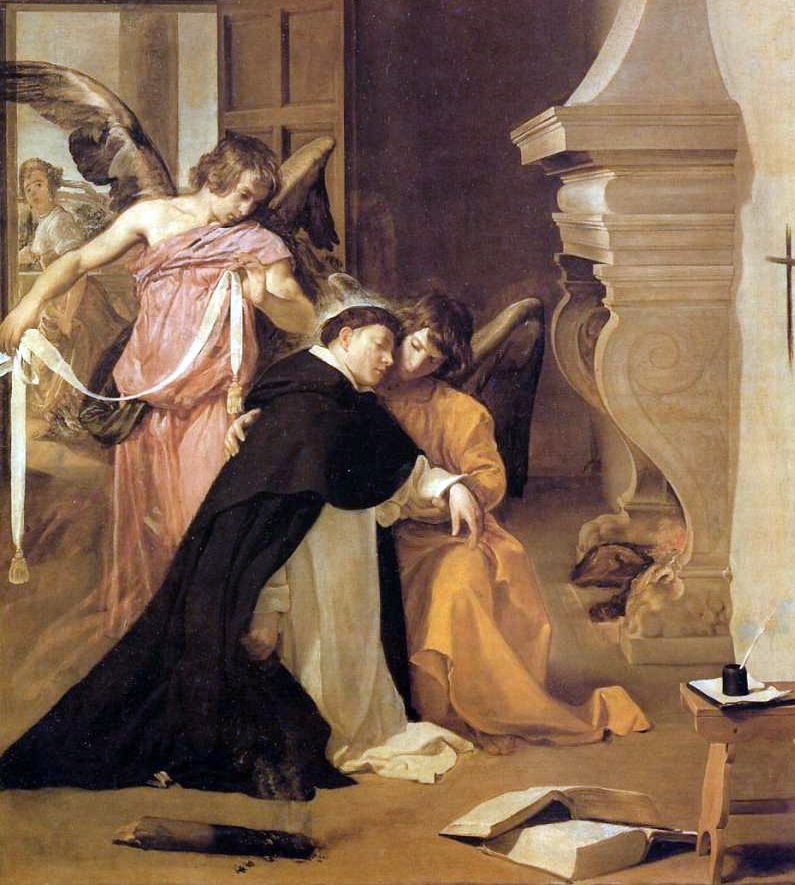
Saint_Thomas_Aquinas_Diego_Velázquez

Robert P. Imbelli recalls this storied detail from the life of Thomas Aquinas:

It is well-known that Thomas Aquinas ceased writing his Summa Theologiae before completing it. When asked why, a long tradition recounts that he told his secretary, Reginald of Piperno: “After what I have seen today I can write no more: for all that I have written is but straw.”

He pivots from the anecdote to cite this passage from Denys Turner’s new biography, Thomas Aquinas: a Portrait:

Theology matters only because – and when – there is more to life than theology, and when that “more” shows its presence within the theology that is done. So Thomas fails to finish, thereby exhibiting the presence of this “more” in the most dramatic way possible – by leaving space for it. His final sentence is not an empty and disappointing failure to finish. It is an apotheosis. By his silence Thomas does not stop teaching theology. He does not stop doing theology. On the contrary, by his silence he teaches something about doing theology that he could not have taught by any other means.

It brings to mind this description of the great medieval theologian’s final months from Josef Pieper’s classic book, The Silence of St. Thomas:

The last word of St. Thomas is not communication but silence. And it is not death which takes the pen out of his hand. His tongue is stilled by the super-abundance of life in the mystery of God. He is silent, not because he has nothing further to say; he is silent because he has been allowed a glimpse into the expressible depths of that mystery which is not reached by any human thought or speech…

The mind of the dying man found its voice once more, in an explanation of the Canticle of Canticles for the monks of Fossanova. The last teaching of St. Thomas concerns, therefore, that mystical book of nuptial love for God, of which the Fathers of the Church say: the meaning of its figurative speech is that God exceeds all our capabilities of possessing Him, that all our knowledge can only be the cause of new questions, and every finding only the start of a new search.

(Image: “Saint Thomas Aquinas” by Diego Velázquez, 1632, via Wikimedia Commons)

Quote For The Day

“Having completed a novel that is saturated with what Jung calls the God-experience, I find that I know less than ever about myself and my own beliefs. I have beliefs, of course, like everyone—but I don’t always believe in them. Faith comes and goes. God diffracts into a bewildering plenitude of elements—the environment, love, friends and family, career, profession, “fate,” biochemical harmony or disharmony, whether the sky is slate-gray or a bright mesmerizing blue. These elements then coalesce again into something seemingly unified. But it’s a human predilection, isn’t it?—our tendency to see, and to wish to see, what we’ve projected outward upon the universe from our own souls? I hope to continue to write about religious experience, but at the moment I feel quite drained, quite depleted. And as baffled as ever,” – Joyce Carol Oates

Dealing With Not-Knowing

Josh Jones uses the above short film to parse the poetry of Leonard Cohen, noticing his parallels with James Joyce and Jack Kerouac:

[Cohen’s] Beautiful Losers dense system of historical references does put one in mind of Ulysses, but the language, the syntax, the eagle flights into the holy and dives into the profane, remind me somewhat of another Buddhist poet of Canadian extraction, Jack Kerouac. Cohen even sounds a bit like Kerouac, in the short 1967 film, “Poen,” an experimental piece that sets four readings of a prose-poem from Beautiful Losers to a montage of starkly provocative images from black-and-white film and photography, Goya, and various surrealists. Made by Josef Reeve for the National Film Board, the short reels out four different recorded takes of Cohen reading the poem. At the end of each reading, he says, “cut,” and the film fades to black.

Taken from the novel’s context, the poem becomes a personal meditation on meditation, or perhaps on writing: “My mind seems to go out on a path, the width of a thread,” begins Cohen and unfolds an image of mental discovery like that described by Donald Barthelme, who once said “writing is a process of dealing with not-knowing…. At best there’s a slender intuition, not much greater than an itch.”

The Sexiest Veggie

dish_lettuce1

K. Annabelle Smith explains the historically erotic appeal of, um, lettuce?

[I]n Ancient Egypt around 2,000 B.C., lettuce was not a popular appetizer, it was an aphrodisiac, a phallic symbol that represented the celebrated food of the Egyptian god of fertility, Min. … The god, often pictured with an erect penis in wall paintings and reliefs was also known as the “great of love” as he is called in a text from Edfu Temple. The plant was believed to help the god “perform the sexual act untiringly.”

She describes the above image:

This relief, from the funerary temple of Ramses III at Medinet Habu, for example, depicts Min’s harvest festival. At the center is a statue of Min. Behind him, a procession of priests holds a small garden of lettuce. Min is also sometimes depicted wearing a long, red ribbon around his forehead that some say represents sexual energy.

“One of the reasons why [the Egyptians] associated the lettuce with Min was because it grows straight and tall—an obvious phallic symbol,” [Professor Salima] Ikram says. “But if you broke off a leaf it oozed a sort of white-ish, milky substance—basically it looked like semen.”

(Photo by Flickr user kairoinfo4u)

The Prudish Republic

Jillian Keenan explores Singapore’s repressed sexuality and spots increased signs of openness:

For decades, the tiny island nation nursed an international reputation of being serious, conservative, and–well, unsexy. In 2003, a survey found that Singaporeans had the least sex of people all the countries surveyed (granted, the study was sponsored by Durex, the condom company), and the more prudish aspects of Singapore’s criminal code, such as the legal bans on homosexuality, pornography, and oral sex (unless part of foreplay), haven’t helped dispel that stodgy reputation. It’s even technically illegal for Singaporeans to walk around naked in their own homes.

But times are changing.

With its military and economic stability relatively secured, Singapore’s sexual identity is blossoming in ways that are creative, compelling, and even risky. In the past year, Singaporean theater companies have staged sexually provocative productions such as Spring Awakening, a musical that describes homosexuality and masturbation, and Venus in Fur, a Tony-award nominated off-Broadway play about sexual masochism and domination. In April, Singapore’s first gay magazine debuted. And although homosexuality is still officially illegal, many Singaporean gay clubs are as popular and public as anything you’d find in Chelsea or the Castro.

More Dish on the progress of sexual mores in East Asia here and here.

Love And Death, Now And Forever

JW McCormack reviews the second book of Karl Ove Knausgård’s six-volume autobiographical novel, My Struggle:

If it is death, and the knowledge of death, that renders us undifferentiated and eventually indifferent, love is what sets us apart and individualizes—to a point, at least. Linda and Karl Ove’s early days trace often destructive highs and lows. Early on, he slashes his face with a broken glass after she briefly rejects him; in Stockholm, Linda threatens to leave over small matters while Karl Ove navigates his separation from his first wife. They behave, in other words, like children. And still, the world is a changed place that lives again with the intensity of childhood:

If someone had spoken to me then about a lack of meaning, I would have laughed out loud, for I was free and the world lay at my feet, open, packed with meaning, from the gleaming, futuristic trains that streaked across Slussen beneath my flat, to the sun coloring the church spires in Riddarholmen red in the nineteenth-century-style, sinisterly beautiful sunsets I witnessed every evening for all those months, from the aroma of freshly picked basil and the taste of ripe tomatoes to the sound of clacking heels on the cobbled slope down to the Hilton Hotel late one night when we sat on a bench holding hands and knowing that it would be us two now and forever …

Of course, love too can be a matter of pragmatic routines—it too is subject to the sublimating undertones of modern life. But the love that surrounds even the most debasing rituals of family life in Book Two (I’m thinking of a “Rhythm Time” class Karl Ove is obliged to participate in with his daughter) makes this volume more uplifting than the first, where the realities of death were the main concern. In love, Karl Ove is “cast back to the time when my feelings swung from wild elation to a wild fury … and the intensity was so great that sometimes life felt almost unlivable, and when nothing could give me any peace of mind except books with their different places, different times and different people, where I was no one and no one was me. That was when I was young and had no options.” Knausgård argues that we are most unalike as children and most similar when dead. In the middle, love restores the madness we are born with and gradually cured of.