A “Small Meaningless Rebellion”

http://youtu.be/o90VsOopAws

That’s how Nigel Godrich described his decision to pull his music off Spotify, the streaming music platform, tweeting, “The reason is that new artists get paid fuck all with this model.. It’s an equation that just doesn’t work.” Godrich’s Atoms for Peace collaborator, Radiohead frontman Thom Yorke, also removed his solo material from the service, adding, “Make no mistake new artists you discover on #Spotify will no[t] get paid. meanwhile shareholders will shortly being rolling in it. Simples.”  Spotify responded with a statement:

Right now we’re still in the early stages of a long-term project that’s already having a hugely positive effect on artists and new music. We’ve already paid US$500M to rightsholders so far and by the end of 2013 this number will reach US$1bn. Much of this money is being invested in nurturing new talent and producing great new music. We’re 100% committed to making Spotify the most artist-friendly music service possible…

Spencer Kornhaber characterizes the protest as “annoying, not that effective, and still important”:

Yorke and Godrich’s rejection of Spotify matters … for the simple reason that it screws with the service’s appeal.

I’m a big Spotify user, and I pay $9.99 a month for a premium subscription. (People can listen for free on their home computers as long as they’re willing to sit through ads). I like feeling as though all of recorded music is at my beckon, anytime and anywhere. Of course, all of recorded music isn’t actually at my beckon, and there are annoying gaps in Spotify’s catalog–like, uh, The Beatles. But weirdly, almost insidiously, you adapt. The awesome electronic artist Four Tet tweeted yesterday that he’s withheld his label’s music from the service for a long time. Which reminded me–I haven’t listened to Four Tet in a while… and that’s probably because most of his stuff isn’t on Spotify.

Radiohead’s manager Brian Message maintains his support for Spotify.  But Sam Duckworth sides with Yorke and Godrich:

4,685 Spotify plays of my last solo album equated to £19.22 (that’s 0.004p per album stream). The equivalent to me selling two albums at a show. I think it’s fair to say that at least two of those almost 5,000 listeners would have bought the album from me if they knew the financial disparity from streaming. At the same time, many record labels are reaping the rewards of online streaming, whether it be through potential share dividends when a company gets sold or the “money for old rope” practice of repackaging music.

Meanwhile, Benji Rogers, the co-founder of PledgeMusic, believes his direct-to-fan platform creates an equitable music economy:

The average pledger, based on the past six months, spends $57 per transaction on the site, and for that money they don’t just get the album and/or merchandise – they get exclusive, immediate video updates from the artist, as the record is being created. … [Rogers is] at pains to clarify that Pledge is not a crowdfunding platform, or a direct-to-consumer service. “Crowdfunding is ‘please give money, then I will do’,” he elaborates. “Direct-to-consumer is ‘I’ve done it, here’s five ways to buy it.’ We’re in the middle with ‘be a part of the making of it’ – it truly is direct-to-fan.”
The Truth In Fiction

In an interview for her debut collection of short stories, This Is ParadiseKristiana Kahakauwila explains why she tells a number of them from multiple perspectives:

In many ways fiction is more truthful than textbook history. Textbook history pretends to be objective, but it isn’t. Fiction admits to its subjective nature; moreover, it takes into account the emotional and psychological effect of an event. In many ways, only narrative can fairly engage both historical record and the humanity behind that record. The stories in this collection are ones that not only suit me personally—as someone fascinated with multiple versions and personal perspectives—but also ethically, as the stories bring to light viewpoints perhaps previously ignored or unknown.

The literary technique also connects to her distinctive background:

In Hawaiian, the word “hapa” loosely translates to “part” or “half.” I’m ethnically hapa—half Native Hawaiian and half Caucasian. Moreover, I grew up in California but spent holidays and summers on Maui with my paternal family, so I’m also geographically hapa. I wouldn’t have considered myself local until I moved to Honolulu. Now maybe I’m hapa-local.

I explain all this because my experience of Hawai’i has occurred in parts and on multiple levels: as a native and as a foreigner, as a local and as a visitor, as a Hawaiian and as a Caucasian.

My characters reflect this multiplicity of experience. “The Road to Hana” probably offers the most explicit discussion of this theme, but elsewhere characters such as Sarah in “Portrait of a Good Father” and Pili in “The Old Paniolo Way” struggle to find their place in Hawai’i. And I think they realize, as I have, that they don’t need to be restricted to one place, one relationship with the islands. They can occupy multiple spaces, have multiple relationships with their homes and their own histories. In one way or another, each of the characters is reflecting a part of me.

Books For All Ages

“Don’t be afraid to try YA” is Marisa Reichardt’s advice for adults curious about Young Adult literature:

Today’s YA novels don’t preach Afterschool Special-style morals to teenagers the way they did in the ‘80s. Books like My Name is Davy, I’m an Alcoholic, made me cringe more than feel like there was an author out there who understood what I was going through at 17. Today’s YA books also aren’t melodramatic like the Lurlene McDaniel books of the ‘90s. Fast forward twenty years later, and YA is legitimate literature where we can find beautiful lines like, “As he read, I fell in love the way you fall asleep: slowly and then all at once,” from John Green’s The Fault in Our Stars. The depth and beauty of words like these will surprise many adults who have written off YA as being nothing more than angsty books about teenagers.

Meanwhile, Kelly Jensen chastises adults who claim “that YA books were never as ‘bad’ in their day”:

Of course they were.

The difference is that back in their teen days, the context was different. They were teens themselves! The context was living, breathing, and experiencing the hard truths and sharp edges that come with navigating adolescence in the moment. The context was discovering that sometimes bad things happen to people or the realization that grown-ups are flawed creatures. That sometimes — more than sometimes — the world is a cruel and unforgiving place, no matter how much you play by the rules.

Teens don’t read books like [Laurie Halse] Anderson’s or [Patrick] Ness’s, [Judy] Blume’s or [Robert] Cormier’s, or any other books published as YA each year as how-to guides. They don’t read them as prescriptions for how to engage in violence or how to join gangs or how to be promiscuous (which only ever applies to teen girl characters anyway). They’re smart enough to know the whole story matters. That challenges and situations matter in context — their adolescence.

Face Of The Day

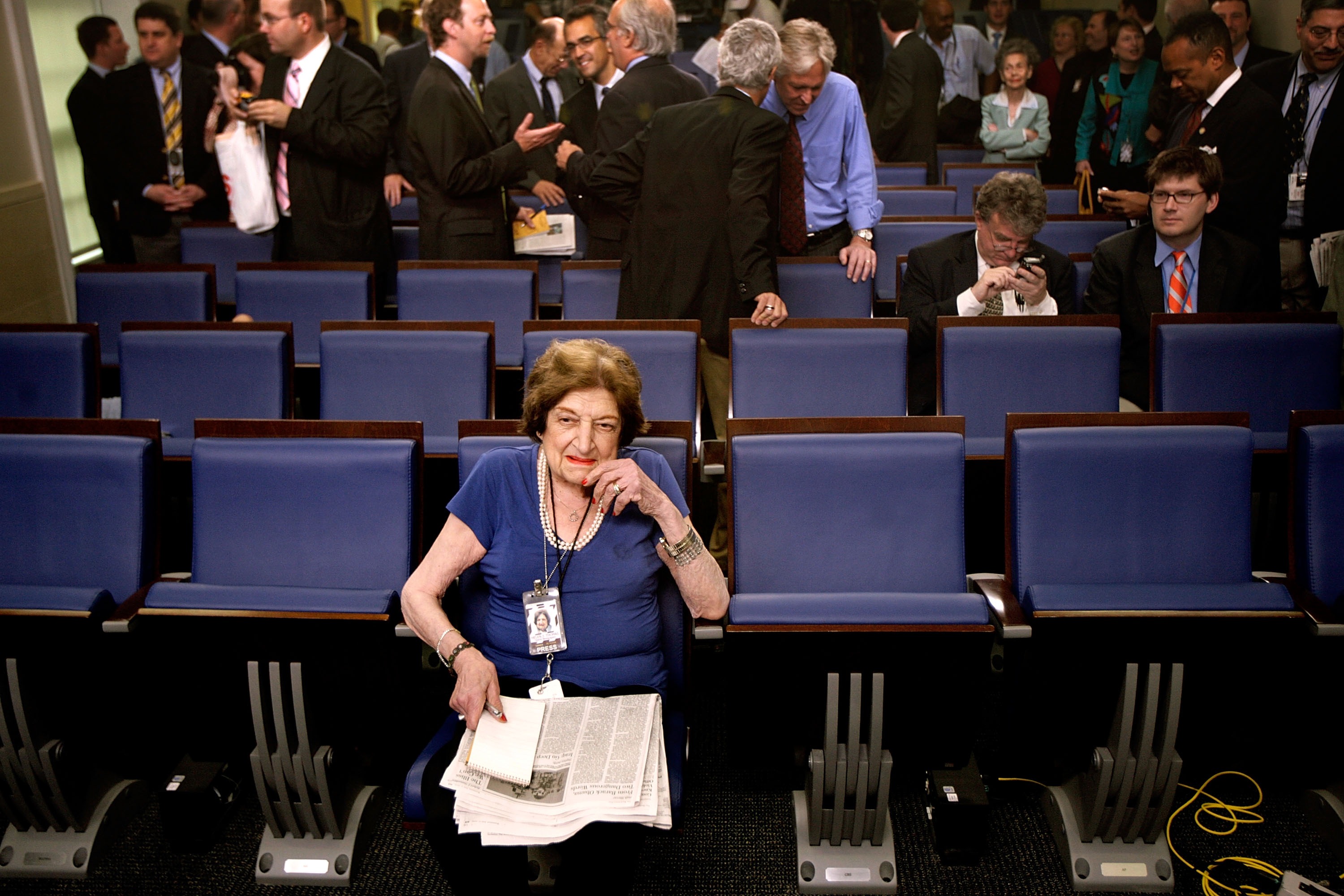
Journalists Return To White House Briefing Room

Long-time White House correspondent Helen Thomas takes up her seat on the front row of the remodeled James S. Brady Press Briefing Room in the West Wing of the White House on July 11, 2007 in Washington, DC. By Chip Somodevilla/Getty Images. She died today at the age of 92. Rest in peace.

Pieces Of Literature

Ted Gioia considers the rise of the fragmented, or “polyphonic,” novel:

[A] new type of fragmentation has come to the forefront in 21st century novels such as Jennifer Egan’s A Visit from the Goon Squad (2010), David Mitchell’s Cloud Atlas (2004), Roberto Bolaño’s 2666 (2004), Ian McEwan’s Atonement (2001), Geraldine Brooks’s The People of the Book (2008), Hari Kunzru’s Gods Without Men (2102), T.C. Boyle’s When the Killing’s Done (2011), David Foster Wallace’s The Pale King (2011), Zadie Smith’s NW (2102), Audrey Niffenegger’s The Time Traveler’s Wife (2003), and other recent works. Instead of relying on fragmentation as a means of disjunction and dissolution, as many experimental novelists had done in the past—Julio Cortázar, William Burroughs, J.G. Ballard, Gilbert Sorrentino, etc.—the new fragmented novel is holistic and coalescent. It resists disunity, even as it appears to embody it. …

The beauty of the new fragmented novel is that writers can have it both ways. These books pay deference to complexity, that deity of the lit critic, but they are also marked by an intense devotion to plot, pacing and other elements of traditional craft. Highbrow and lowbrow elements are pleasingly blurred. Experimentation proves that it is compatible with accessibility.

(Hat tip: Page-Turner)

The Indivisible Mind

dish_brainnebula

Richard Brody praises Thomas Nagel’s new book, Mind and Cosmos, for the value it places on human achievement:

Nagel’s thesis has … radical consequences for philosophy itself. His argument implies that consciousness—indeed, mental life, whether conscious or not—is not atomic but holistic: there is no such thing as a piece or an atom of experience, but, rather, a mind at a given moment is flooded with an incalculable number of perceptions, memories, ideas, judgments, and desires. Even enumerating them in the plural is a little silly, because it implies the ability to isolate them as singular events or things. Therefore, philosophy, in order to account for mental life, will need to turn aside from isolated experiments in logic and argumentation in favor of rough-edged, life-sized chunks—historical events and figures, works of art, artists themselves, cities, countries, languages, human dramas of all sorts, lived or imagined.

Which is to say that, though Nagel doesn’t write about art in “Mind and Cosmos,” the book’s widest implications involve art and how it helps us to understand the world. If Nagel is right, art itself would no longer be merely the scientist’s leisure-time fulfillment but would be (I think, correctly) recognized as a primary mode of coming to grips with the mental and moral essence of the universe. It would be a key source of the very definition of life. Aesthetics will be propelled to the forefront of philosophy as a crucial part of metaphysical biology, and so, the writing and practice of philosophy will come to look more like texts by Nietzsche, with their own built-in aesthetic and subjective components and emphases on historical and practical events. The very beauty of Nagel’s theory—its power to inspire imagination—counts in its favor.

Previous Dish on Nagel’s book here, here, and here.

(Photo by Flickr user ezhikoff)

Will Humanoid Robots Catch On?

Waldman doubts it:

Frankly, I’ve always been skeptical about the potential of humanoid robots. Sure, it helps us to relate to them if they look like us, but the human body has a lot of limitations. For instance, hands are great, but should a robot have only two? Why not four or six, or eleven? The more hands, the more things you can do with them. And legs are extremely useful, especially for navigating uneven environments where wheels won’t work well, like the rubble of a building that has fallen over, or the stairs in your house. But are two legs better than three or four?

Ted Chiang, in a piece we referenced recently, connects science fiction’s obsession with humanoid robots to slavery:

I think the reason for the convention was that it was a metaphor for slavery. That was the original promise and appeal of robots—that they would be slaves without the guilt. You can call them servants, but they are essentially slaves because they have no options and no real autonomy. I think that is the unexamined assumption of science fiction that depicts humanoid robots or human-like AI. These works are suggesting that it might be possible to have slavery without guilt.

The View From Your Window Contest

Screen Shot 2013-07-20 at 11.58.26 AM

You have until noon on Tuesday to guess it. City and/or state first, then country. Please put the location in the subject heading, along with any description within the email. If no one guesses the exact location, proximity counts.  Be sure to email entries to contest@andrewsullivan.com. Winner gets a free The View From Your Window book or two free gift subscriptions to the Dish. Have at it.

Kids These Days

Laurie Penny is impressed by “how much they have read, how creatively they think, and how curiously bullshit-resistant they are”:

Young people getting older is not, in itself, a fascinating new cultural trend. Nonetheless, the encroaching adulthood of people who grew up in a world where expanding technological access collided with the collapse of the neoliberal economic consensus is worth paying attention to. Because these kids are smart, cynical and resilient, and I don’t mind saying that they scare me a little.

Marc Bolan was wrong: the children of the revolution are depressingly easy to fool. The children of austerity, however, are not. They have grown up with the Internet, they are keyed in to the news and they understand, most importantly, that adults have no idea what they are doing.

My generation figured that one out a little bit too late, leaving us fired up with furious energy but not necessarily equipped to tackle the sudden lack of jobs, public services and education. Today’s teenagers have simply always known. They know that there’s a war on and they won’t be taken in by empty promises that hard work, good behavior and respect for one’s elders will lead to rewards by themselves.