A Poem For Saturday

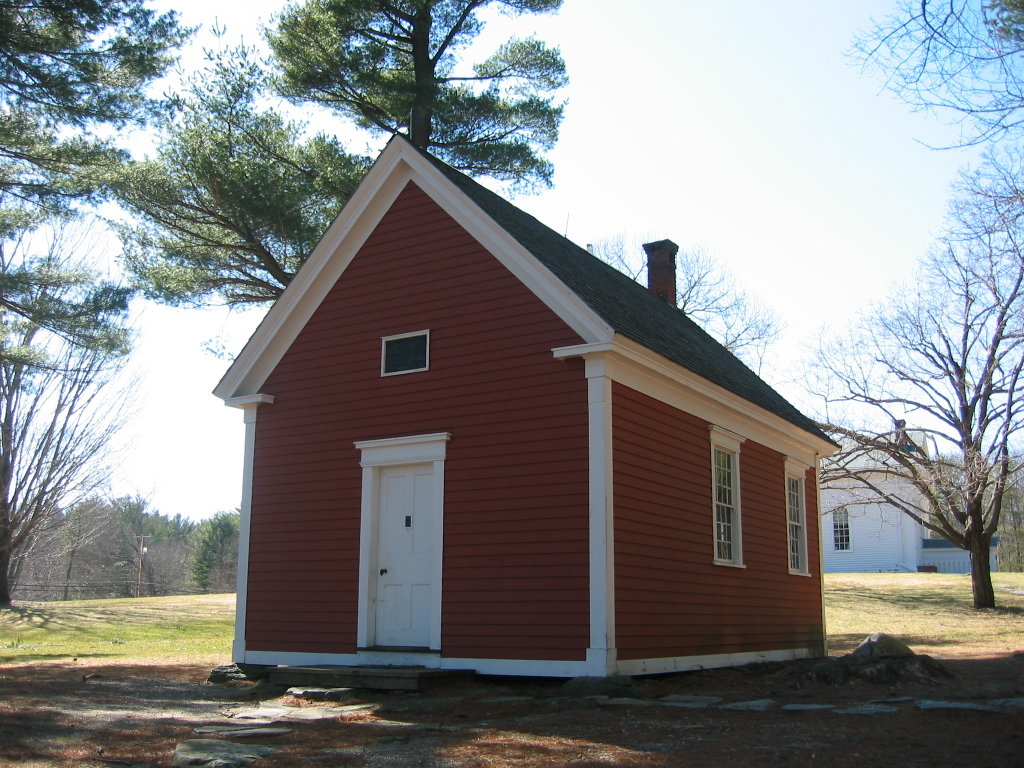
Redstone_School

“Mary’s Lamb” by Sarah Josepha Hale (1788-1879):

Mary had a little lamb,
Its fleece was white as snow,
And everywhere that Mary went
The lamb was sure to go;
He followed her to school one day—
That was against the rule,
It made the children laugh and play
To see a lamb at school.

And so the teacher turned him out,
But still he lingered near,
And waited patiently about,
Till Mary did appear.
And then he ran to her and laid
His head upon her arm,
As if he said, “I’m not afraid—
You’ll shield me from all harm.”

“What makes the lamb love Mary so?”
The little children cry;
“Oh, Mary loves the lamb, you know,”
The teacher did reply,
“And you each gentle animal
In confidence may bind,
And make it follow at your call,
If you are always kind.”

(Photo of the Redstone School, now in Sudbury, Massachusetts, believed to be the school mentioned in the poem, via Wikimedia Commons)

The Analog Type

Justin Peters explains why he writes out all of his posts by hand in a moleskin before putting them online:

Twenty years’ worth of sustained Internet use has left me with a head full of random trivia and a profound inability to concentrate. Every time I sit down in front of my computer to write a post, I end up browsing the IMDb page for the movie Cool Runnings or the career stats for underrated outfielder Ryan Spilborghs. I’m just as distractible when my computer isn’t connected to the Internet: I’ve wasted weeks of my life playing this stupid baseball simulation game that I downloaded years ago and can’t bring myself to delete.

When I’m working on a computer, it takes me three times as long as it should to write a post. When I’m putting pen to paper, though, there are no distractions. It’s just me and the ink, and I can’t tab over to something more immediately gratifying. Not only do I finish my posts faster, I’m more likely to just sit and think before I write a sentence or a paragraph—something I don’t always do while composing in Microsoft Word. (All of my dumbest posts were written directly to the computer. See if you can guess which ones! The answer “all of them” will receive only partial credit.)

Along the same lines, Will Self describes why he composes his novels on a manual typewriter instead of a laptop:

To get away from the internet and from the sub-sonic sound of a computer. I come in to my study every morning and I write first drafts on the manual and I don’t even turn the computer on until after lunch. I don’t like having the machine on in the room. I find it very weird and oppressive. The whole aesthetics of computers very much feeds into my OCD. They fill my head with obsessionalities and my actions become very repetitive. It seems quite inimical to the dreamy state out of which fiction comes which seems so much less causally repetitive than the way one works on computers.

I know other people aren’t like that and don’t have that problem but I sure as shit do. And the real sea change was of course broadband – the fact that you can be seriously trying to write something and you can click a few buttons and watch somebody being anally penetrated with a Lewis gun, it’s incredibly distracting isn’t it? Or you can buy some shit you really don’t need with a few key strokes. I mean, that’s not good, is it? It’s not helpful.

Choosing To Live

Robin Marantz Henig describes the complicated lives of Brooke Hopkins, who suffered injuries that left him dependent on life-sustaining technology, and his wife Peggy Battin, a lifelong advocate for the right to death:

The only consistent choice Brooke has made — and he’s made it again and again every time he gives informed consent for a feeding tube or a diaphragmatic pacer, every time he permits treatment of an infection or a bedsore — is the one to stay alive. This is the often-unspoken flip side of the death-with-dignity movement that Peggy has long been a part of. Proponents generally focus on only one branch of the decision tree: the moment of choosing death. There’s much talk of living wills, D.N.R. orders, suicide, withdrawal of life support, exit strategies. Brooke’s experience has forced Peggy to step back from that moment to an earlier one: the moment of confronting one’s own horrific circumstances and choosing, at least for now, to keep on living. But the reasons for that choice are complicated too. Brooke told me that he knows Peggy is a strong person who will recover from his death and move on. But he has also expressed a desire not to abandon her. And Peggy worries that sometimes Brooke is saying he wants to keep fighting and stay alive not because that’s what he wants, but because he thinks that’s what she wants him to want. And to further complicate things, it’s not even clear what Peggy really wants him to want. Her own desires seem to shift from day to day. One thing that doesn’t change, though: She is deeply afraid of misunderstanding Brooke’s wishes in a way that can’t be undone. The worst outcome, to her, would be to think that this time he really does want to die and then to feel as if she might have been wrong.

To Be Shy Is To Be Human

A self-described “shy introvert” offers his perspective on social life:

Shyness is something different [from introversion]: a longing for connection with other people dish_shywhich is foiled by fear and awkwardness. The danger in simply accepting it, as[Quiet author Susan] Cain urges us to do with introversion, is that shyness can easily turn into a self-fulfilling persona — the pose becomes part of you, like a mask that melds with your face. There is always something we cling to in an unhappy situation that stops us escaping from it. In my case, it is the belief that lots of voluble people do not really listen to each other, that they simply exchange words as though they were pinging them over a tennis net — conducting their social life entirely on its surface. A small, self-regarding part of me thinks there is something glib about easy articulacy and social skill.

My more sensible self realises this is nonsense, and that shyness (or, for that matter, non-shyness) has no inherent meaning.

There is nothing specific to shyness that makes you more likely to be a nice person, or a good listener, or a deep thinker. Shyness might have certain accidental compensations — being less susceptible to groupthink and more able to examine the habits and rituals of social life with a certain wry detachment, perhaps. Mostly it is just a pain and a burden.

Yet shyness remains a part of being human, and the world would be a more insipid, less creative place without it. As Cain argues, we live in a culture that values dialogue as an ultimate ideal, an end in itself, unburdening ourselves to each other in ever louder voices without necessarily communicating any better. Shyness reminds us that all human interaction is fraught with ambiguity, and that insecurity and self-doubt are natural, because we are all ultimately inaccessible to one another. The human brain is the most complex object we know, and the journey from one brain to another is surely the most difficult. Every attempt at communication is a leap into the dark, with no guarantee that we will be understood or even heard by anyone else.

(Image: Die Schüchterne, by Hermann von Kaulbach, via Wikimedia Commons)

The CIA Identifies America’s Greatest Threat

Dana Liebelson and Chris Mooney report that the CIA is funding National Academy of Sciences (NAS) research into geoengineering, which some say could mitigate climate change. But the CIA is keeping the research quiet – for domestic political reasons, it would seem:

The NAS website says that “the US intelligence community” is funding the project, and William Kearney, a spokesman for NAS, told Mother Jones that phrase refers to the CIA. Edward Price, a spokesman for the CIA, refused to confirm the agency’s role in the study, but said, “It’s natural that on a subject like climate change the Agency would work with scientists to better understand the phenomenon and its implications on national security.” The CIA reportedly closed its research center on climate change and national security last year, after GOP members of Congress argued that the CIA shouldn’t be looking at climate change.

Liebelson and Mooney note that the government’s interest in geoengineering dates back to the 1960s:

The first big use of weather modification as a military tactic came during the Vietnam War, when the Air Force engaged in a cloud seeding program to try to create rainfall and turn the Ho Chi Minh Trail into muck, and thereby gain tactical advantage. Between 1962 and 1983, other would-be weather engineers tried to change the behavior of hurricanes using silver iodide. That effort, dubbed Project Stormfury, was spearheaded by the Navy and the Commerce Department.

Kelsey D. Atherton points out that the military has good reason to worry about global warming:

Climate change, it turns out, is one of the major threats to national security, as specified in the 2013 “Worldwide Threat Assessment of the US Intelligence Community.” Climate change threatens food and water supplies, which in turn, could lead to all sorts of geopolitical conflicts. The intelligence community report singles out droughts in the “Nile, Tigris-Euphrates, Niger, Amazon, and Mekong river basins,” and notes that increased populations will put intense pressure on (already scarce) resources. This doesn’t speak to a direct, pressing security threat, but instead thousands of future problems.

The Best Of The Dish Today

Three questions: Is Marco Rubio now doomed in his party? Has Vladimir Putin over-reached? What would Honest Abe make of “Stand Your Ground” laws?

One quote on Snowden by a former president that didn’t make it into the US press. One memory: me as a twink in warehouse full of House music and black men. One reflection on the loneliness of life lived on social media.

The most popular post was on being gay and racial barriers; the second most popular was about the vicious homophobia of the GOP.

See you in the morning – and don’t forget NSFW Saturday nights. Thanks also for another strong revenue week. The subscribers-only model is working! You can get the full Dish experience by subscribing [tinypass_offer text=”here”].

“Modernizing Without Westernizing”

Patrick L. Smith reads events in Turkey, Iran, and Egypt as a sign that “modernization has to be separated from Westernization if it is going to occur constructively from here on out”:

Making the two equivalent is a 500-year-old habit among Westerners, begun when Vasco da Gama landed in India in 1498.

My candidate for the greatest distinction of our time is that people will be able to become modern while keeping their own cultures, traditions, histories, values and so on. Can we explain the fate of Egypt’s Mohamed Morsi in any other context? A year ago the secularized elite despised the army and all the gore and repression it stood for. These same people now embrace the army because it removed from office a properly elected president who happens to be Islamic. This week the Army gave them what they apparently wanted: a new cabinet of 34, with not one member of an Islamic party in it.

In the end, one does not worry much about the emerging nations. They have the force of history at their backs. Modernizing without Westernizing is what the concept of Islamic democracy is all about, for instance. It is a search for institutions that are built by, and reflect, the people who are going to live by them. “Inevitable” is not too strong a term for this process, hard and long and full of reversals as it will prove to be.

Chart Of The Day

Obamacare Costs

The above chart comes from an Assistant Secretary for Planning and Evaluation (ASPE) report (pdf) on Obamacare’s exchanges. The big finding:

In the eleven states for which data are available, the lowest cost silver plan in the individual market in 2014 is, on average, 18% less expensive than ASPE’s estimate of 2014 individual market premiums derived from CBO publications.

Sarah Kliff explains the chart:

What you’re looking at here shows what insurance plans will charge for coverage that will cover 70 percent of a typical subscriber’s health-care costs. These are averages of the second-lowest cost plans that provide this level of coverage (silver plans, as they’re known under the health-care law)

Jonathan Cohn considers why the premiums are coming in lower than expected:

The law’s critics and, by the way, quite a few insurance industry officials warned that premiums were going to exceed official expectations. The reason: Insurers couldn’t assume that young and healthy people would sign up for coverage. Without those customers, insurers would be left covering people who were predominantly older and sicker—and, as a result, more likely to run up big medical bills. In response, Obamacare’s defenders—or, more accurately, its believers—argued that the combination of subsidies and the individual mandate would be sufficient to entice enough young, healthy people. They also predicted that insurers, facing the prospect of losing customers to rivals, would opt to keep premiums relativley low.

For the moment, at least, the believers’ case looks pretty strong. A brand-new paper from the Robert Wood Johnson Foundation paper, prepared by Linda Blumberg and John Holahan the Urban Institute, may offer a clue why. The paper suggests that most people buying coverage on their own next year will be as healthy, if not healthier, than the typical person who today gets insurance though a job. Maybe the insurance industry’s own actuaries have, after looking carefully at the figures, come to the same conclusion.

Dustjacket Dating, Ctd

A reader writes:

I employed exactly this strategy when I decided, at age 26, that it was time to find a mate. My (Catholic) biological clock was ticking ever louder, and I figured with a few years of dating, I’d be able to be a mom by my early 30s.

Even though I don’t fish, I used a fishing analogy: the sort of fish I wanted would determine my bait and my pond. I wanted a man interested in the intellectual life, but also the physical one; I wanted a man who loved history; I wanted a man who loved women with brains and the means to use them. My chosen fishing pond was, fortunately enough, my work; I was a park ranger, and the many volunteers we got were fun and interesting people. Why look any further?

So I picked Barbara Tuchman’s The Guns of August, a highly readable history of the run-up to and early months of World War I – female, check; history/intellect, check. I carried it with me, and after heading to a bar after a sail with volunteers after work, he struck up a conversation about it. I baited my hook, tossed it in the water, and 18 years later I am still married to the first fish to come along. (I haven’t finished the book yet.)