Claire L. Evans, a musician frequently on the road, contemplates the meaning of travel:
Travel is inherently narcissistic. Even if we’re looking to be knocked off our axis, we’re still in the business of self-improvement. People want to go to faraway places and return changed. A lot rides on this expectation. We hunt for perspective, for miraculous connections, but when these moments happen, we don’t always recognise them — or we look in the wrong places.
There is a collection of jungle villages around Ubud on the Indonesian island of Bali, which is as remote and humid and disorienting as any foreign place. The landscape is clogged with temples spewing incense, and yet long lines of Western tourists snake out the doorway of the single mountain temple that featured in Elizabeth Gilbert’s book Eat, Pray, Love (2006). I
t’s easy to laugh at these people. It’s easy to say that they are missing the point, but are they? Maybe they’re just mainlining into the essence of what travel is always already about: pat revelations about the self. When we were in Bali, we went to a different temple, and our dirty tennis shoes looked ridiculous beneath the stiff embroidered sarongs we were commanded to wear. I felt nothing, except for self-consciousness and the impulse to snap a dozen pictures I haven’t looked at since.
The first stab at a medical diagnostic manual was made by a friend and exact contemporary of Linnaeus, with the rather daunting name of François Boissier de Sauvages de Lacroix, a physician and botanist in Montpelier. In 1763 Sauvages published his Nosology Methodica, explicitly stating in its title that it was modelled on the classification of plants. He had ten classes of illness, of which the eighth was madness. Each class was divided first into genera and then into species, producing 2400 kinds of malady.
There have been many systems for classifying mental illness since then, but all seem to me to be on the botanical model, and that has been their fatal flaw. …
Sauvages’s dream of classifying mental illness on the model of botany was just as misguided as the plan to classify the chemical elements on the model of botany. There is an amazingly deep organisation of the elements – the periodic table – but it is quite unlike the organisation of plants, which arises ultimately from descent. Linnaean tables of elements (there were plenty) did not represent nature.
The DSM is not a representation of the nature or reality of the varieties of mental illness, and this is a far more radical criticism of it than [National Institute of Mental Health Director Thomas] Insel’s claim that the book lacks ‘validity’. I am saying it is founded on a wrong appreciation of the nature of things. It remains a very useful book for other purposes. It is essential to have something like this for the bureaucratic needs of paying for treatment and assessing prevalence. But for those purposes the changes effected from DSM-IV to DSM-5 were not worth the prodigious labour, committee meetings, fierce and sometimes acrimonious debate involved. I have no idea how much the revision cost, but it is not that much help to clinicians, and the changes do not matter much to the bureaucracies. And trying to get it right, in revision after revision, perpetuates the long-standing idea that, in our present state of knowledge, the recognised varieties of mental illness should neatly sort themselves into tidy blocks, in the way that plants and animals do.
Grayson Schaffer finds that few Westerners appreciate just how dangerous it is to be a Sherpa:
According to the Himalayan Database, which keeps track of such things, 174 climbing Sherpas have died while working in the mountains in Nepal—15 in the past decade on Everest alone (see sidebar for a country-by-country comparison). During that time, at least as many Sherpas were disabled by rockfall, frostbite, and altitude-related illnesses like stroke and edema. A Sherpa working above Base Camp on Everest is nearly ten times more likely to die than a commercial fisherman—the profession the Centers for Disease Control and Prevention rates as the most dangerous nonmilitary job in the U.S.—and more than three and a half times as likely to perish than an infantryman during the first four years of the Iraq war. As a dice roll for someone paying to reach the summit, the dangers of climbing can perhaps be rationalized. But as a workplace safety statistic, 1.2 percent mortality is outrageous. There’s no other service industry in the world that so frequently kills and maims its workers for the benefit of paying clients.
(Photo: A Nepalese Sherpa collects garbage at an altitude of 26,200 feet during a May 2010 clean-up expedition at Mount Everest. A team of 20 Nepalese climbers collected 4,000 pounds of rubbish during the high-risk operation. By Namgyal Sherpa /AFP/Getty Images)
Doug Mack argues that guidebooks like Fodor’s and Frommer’s “are uniquely effective documents of a changing world—and, more to the point, they have been underappreciated actors in creating social change”:
They … stand out for shaping history, if not always intentionally, because of their authoritative reputation—they have long been the best insight into that which would be otherwise unknown. Most notoriously, the Nazis claimed to have used Baedeker’s guides in a 1942 series of air attacks on English cities, which would become known as the Baedeker Blitz. There’s some disagreement among historians as to whether the Nazis really did use the books, but this was Nazi propagandist Baron Gustav Braun von Sturm’s claim: that Baedeker had unwittingly identified the targets by highlighting Britain’s most beloved landmarks and towns, the places whose destruction would deal the biggest blows to the national spirit, including the cities of Bath and Norwich. More recently, shortly after American troops entered Iraq 10 years ago, Lonely Planet Iraq was pressed into duty for precisely the opposite goal, assisting officials who were prioritizing sites for protection.
Other guidebooks have specifically sought to right societal wrongs, like The Negro Motorist Green Books, a series published from 1936 to 1964, which guided African Americans traveling the U.S. in the era of Jim Crow. As civil-rights leader Julian Bond, whose parents used Green Books, told the New York Times in 2010, “It was a guidebook that told you not where the best places were to eat … but where there was any place.”
The ‘ethic’ Weber described is a complicated mixture of spiritual and practical imperatives, embracing ideas of self-government, the suppression of natural impulses, the search for marks of divine grace, and the purposive ordering of a person’s whole life. It is distinctively Protestant in the sense that it took the ascetic discipline of the monastic tradition and tried to rewrite it for life in the world. It was also, according to Weber, the victim of a historical irony: these particular virtues, promoted for religious reasons, were often conducive to making a great deal of money, and so bringing about conditions of luxury and leisure that threatened to undermine the virtues themselves. In other words, what Weber has to say about work is embedded in a story about how we became who we are.
Many historians have argued that it is not an entirely true story; but it is nevertheless an interesting one. Reducing it to the simple promulgation of a ‘work ethic’ destroys most of its interest, its power to provoke thought. The cliché works, as clichés often do, to make the idea at once more digestible and less alive.
In the process, several inconvenient signs of life drop away. One of them is the class content. As Weber tartly puts it, a ‘bourgeois businessman’, interpreting his bottom line as a mark of God’s blessing, ‘could follow his pecuniary interests as he would and feel that he was fulfilling a duty in doing so.’ Meanwhile, ‘The power of religious asceticism provided him in addition with sober, conscientious, and unusually industrious workmen’. That is, the shared beliefs of employer and employee caused both of them to act in the employer’s interests. ‘The work ethic’ is not the same for everyone: it depends where you are in a system of working relationships. Abstracting the phrase from the system loses that subtlety. A work ethic becomes the attribute of an individual. Some people have it, some people don’t, and all those who have it have the same thing. Society vanishes from the idea.
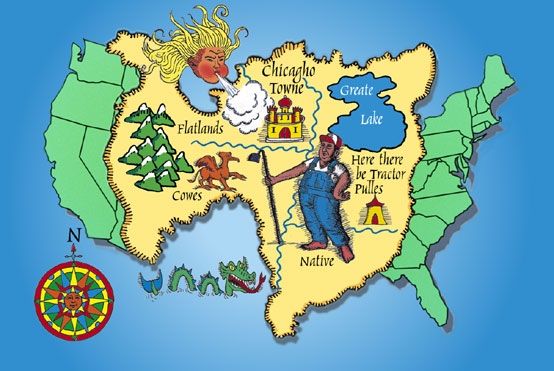
(Image from an Onion article about the Midwest. The popular Dish thread on the amorphous region is here.)
The founders of the Freedom Rights Project believe that the proliferation of human rights treaties obscures the public’s ability to understand the very rights being protected, thus reflecting poorly on an overstuffed bureaucracy:
The expanded and diluted notion of human rights allows illiberal states to change the focus from core freedoms to vague and conceptually unclear rights that place no concrete obligations on states. Enabled by such rhetoric, no human rights violation can stand scrutiny on its own merits. Instead, human rights violations are relativized — intellectually dismembered and discarded when it is politically expedient. In this world, cuts in development aid can be labeled human rights violations just like torture in North Korea.
Crucially, this unprincipled politics of human rights helps authoritarian states deflect criticism. In 2007, Cuba, which has one of the worst human rights records in the Western Hemisphere, succeeded in persuading a majority of HRC members to axe the specific mandate for monitoring its own human rights record. The praise authoritarian states shower on one another for supposedly upholding new, vague and abstract rights are therefore not just empty rhetoric but can produce real political gains.
Unfortunately, much of the human rights community has not only shied away from expressing qualms about rights proliferation, it has often led the process. But this approach has not helped advance the core freedoms that make the difference between liberal and non-liberal states: According to Freedom House, global respect for basic civil and political rights is in decline for the seventh consecutive year.
Of course, it is exactly those basic rights that non-free states want to neuter. When everything can be defined as a human right, the premium on violating such rights is cheap. To raise the stock and ensure the effectiveness of human rights, their defenders need to acknowledge that less is often more.
Are performing orcas enslaved? I suggest so. Are Tina Brown and Sally Quinn sexist? The argument is here. Who’s the most important author in America right now? Khaled Hosseini. How fragile is the faith of Fox News? As fragile as all fundamentalisms.
We learned that the current Israeli government would rather release cold-blooded murderers from prison than freeze a single building in a single settlement. And that if you really want a good orgy, head on over to Tehran, where the mullahs rule, and the next generation despairs.
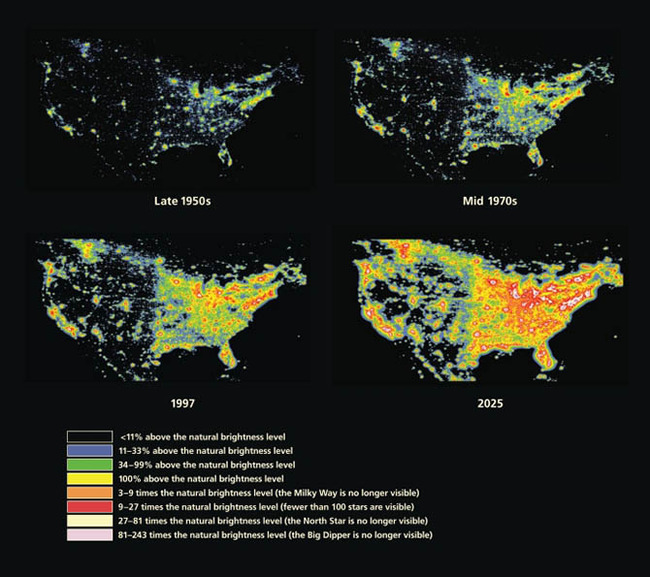
Ironically, what has happened now is that we have so much light that we can no longer see. We’re blinded — sometimes literally, by the brightness and glare of our security lighting — but also metaphorically, which is to say that when we light everything up, there is really no reason to look over and notice something, and say, “Wow, that’s a weird thing.”
When everything is so brightly lit, why should we look? It’s light, so it’s safe, so we switch off. And, while no one is looking, we’ve actually made life easier for the bad guys. Some studies even show that criminals actually prefer well-lit areas. I had several policemen and security consultants tell me that criminals are as afraid of the dark as we are. They don’t want to go in the dark. The light makes them feel safe, just as it does us.
(Image: Maps of artificial night sky brightness by P. Cinzano, F. Falchi, and C. D. Elvidge)
Patrick Howell O’Neill tells the tale of a Deep Web defector:
Before he gutted and nearly destroyed one of the most influential criminal markets on the Internet, a man using the nickname Boneless published a detailed guide on the art of disappearing. “I have some experience in this area,” he wrote, detailing how fugitives should best go about buying phony passports, dodging cops, and keeping their stories straight.
The guide was just one of many contributions Boneless made to HackBB, a popular destination on the Deep Web, a group of sites that sit hidden behind walls of encryption and anonymity. Back in 2012, the forum was a top destination for buying stolen credit cards, skimming ATMs, and hacking anything from personal computers to server hardware. And thanks to Tor’s anonymizing software, members were shielded from the ire of law enforcement around the globe. It was one of the safest and most popular places on the Deep Web to break the law.
Then one day in March, HackBB simply vanished, its databases destroyed. One user likened the events to burning a city–its library, market, bank, and entire community–to the ground. It wasn’t hard to guess who’d done it. A few days earlier, Boneless had disappeared–and with him, a serious chunk of the market’s sizable hoards of money.
The strangest twist seems to be the staying power of Boneless’ reputation as a stand-up guy–to a point. Even OptimusCrime still believes Boneless didn’t orchestrate the heist as much as “sold his powerful administrator account to the highest bidder.” They say the greatest trick a hacker ever pulled was convincing his peers he’d sell them out rather than hack ’em himself.
Like all of the greatest singers, Otis Redding was utterly unique. He lacked the technical virtuosity of his idol, Sam Cooke–another ’60s musician whose death came much too early–but made up for it with flawless taste and musical intellect. Despite his well-earned reputation for incendiary live performances–most famously on display in his performance at the Monterey Pop Festival [seen above], six months before his death–Redding was never the frenzied pyrotechnician of later “soul man” parodies. In fact, his greatest gift may have been his command of restraint and understatement.
The best singers are also masters of silence: The moments that Ray Charles doesn’t sing–when he’s just about to sing, just finished singing, or taking a breath (especially when he’s taking a breath)–can be as electrifying as any notes coming out of his mouth. Otis Redding understood and used this power as well as anyone. Critic Dave Marsh once wrote that Redding’s performance of “I’ve Been Loving You Too Long (To Stop Now)” sounds “as though each line is coming to him only the instant before he sings it, quavering notes as if in the grip of an undeniably exquisite passion that must be consummated–now!” a description that itself dwells in pauses, anticipation, the thrill of ensuing discovery.
“The Glory of Love” is not a very good song. … With its twin melodic lines—“That’s the story of, that’s the glory of love”—and its oppressively chipper tempo, it’s certainly catchy in a nursery rhyme sort of way, yet it’s supremely saccharine and just plain dopey. So why would someone like Otis Redding, at the height of his esteem, choose to cover this song out of the thousands in the American pop canon? It’s hard to imagine anyone save [songwriter Billy] Hill himself thinking it was worth the great singer’s time, even if they didn’t know how limited his time was.
But here’s the catch:
Otis Redding absolutely kills it. He transforms “The Glory of Love” into something moving and even sublime. As Steve Cropper’s guitar traces tears down your cheek, as Isaac Hayes and Al Jackson Jr.’s snare clicks out a tempo about twice as fast as the song demands, and as the horns offer sympathetic punctuation, Redding testifies mightily to the glory of love. It’s soul music, but the process of repetition, variation and elaboration is more akin to jazz. He teases out the song’s central ideas, however corny they may be, until they yield something meaningful, but as the song builds and builds, it never reaches a climax or epiphany. Rather than cut loose, the musicians hold back.
This is why Redding was such an immense figure in pop music in the 1960s and why his death was such a tragedy: He could plumb even the fluffiest pop song and locate a kernel of honest-to-God wisdom.


 The Dish