Communicating With Caveats

Jessica Love wonders if we will develop a system “to help us convey the particularities of our communication tools,” increasingly an imperative in an age when conversations take place across multiple devices:

Language is ripe with conventions, and though they can differ drastically from one situation or medium to the next, they are generally understood—or at the very least understood to be understood—by everyone involved. Thus, most of us take care to manage expectations when the unexpected arises. “Sorry, I’m losing my voice,” our waitress warns. (Don’t lowball your tip just because I don’t sound peppy.) “I’m taking a vacation from Facebook,” a friend cautions. (I won’t be “liking” everything you post.) “I will be out of the office through the end of the month,” a coworker auto-replies. (Unless you are really important, I’m not going to respond to your email until August.)

Increasingly, though, we must also manage expectations about the very devices we use to communicate. It is no longer obvious whether, say, an email was typed on a smart phone, a tablet, or a computer—or perhaps composed using a mobile dictation application, or something else altogether (something with a broken screen!). And yet, as they’ve always been, our messages are very much shaped by the method we use to communicate them.

An example:

Consider the “Sent from my iPhone” message that now accompanies so many emails. I actually welcome it as a caveat of sorts: I’m typing using the teeny keyboard on my phone, it says—my response may be abrupt and error-prone.  (And the caveat works!  Journalist Clive Thompson describes a 2012 study demonstrating that people who send emails with spelling and grammatical errors are deemed more credible when their sendoff is trailed by “Sent from my iPhone” than when it is not.)

Stories Of Permanent Flux

Science fiction writer Ted Chiang reflects on the genre:

I think science fiction is fundamentally a post-industrial revolution form of storytelling. Some literary critics have noted that the good-versus-evil story follows a pattern where the world starts out as a good place, evil intrudes, the heroes fight and eventually defeat evil, and the world goes back to being a good place. Those critics have said that this is fundamentally a conservative storyline because it’s about maintaining the status quo. This is a common story pattern in crime fiction, too—there’s some disruption to the order, but eventually order is restored.

Science fiction offers a different kind of story, a story where the world starts out as recognizable and familiar but is disrupted or changed by some new discovery or technology. At the end of the story, the world is changed permanently. The original condition is never restored. And so in this sense, this story pattern is progressive because its underlying message is not that you should maintain the status quo, but that change is inevitable. The consequences of this new discovery or technology—whether they’re positive or negative—are here to stay and we’ll have to deal with them.

(Video from L’uomo Meccanico [The Mechanical Man], 1921)

Face Of The Day

Seaweed Swamps Qingdao Coastline

A man tosses green algae to friends at a beach on July 18, 2013 in Qingdao, China. A large quantity of non-poisonous green seaweed, enteromorpha prolifera, hit the Qingdao coast in recent days. Since June 8, more than 50,000 tons of such seaweed has been removed from the city’s beaches. By ChinaFotoPress via Getty Images.

Schindler, Listed

The original scroll of Oskar Schindler is now sitting on eBay waiting for the highest bidder:

That’s right: Schindler’s list, The iconic document used by German industrialist Oskar Schindler to safeguard the lives of over 1,000 Jews during World War II, is being sold to the highest bidder on the same website you use to track down ultra rare Beanie Babies.

When There’s No One To Blame

In a dispatch from his hometown of West, Texas – site of a devastating fertilizer-factory explosion in April – Zac Crain says that the loyalties that sustained the town after the disaster extends even to the factory’s owners:

Everyone in town knows Wanda and Don Adair, who bought West Fertilizer Co. in 2004 when it was on the verge of closing. Don is a farmer, and Wanda used to be a substitute teacher and writes a column for the West News. Everyone in town knows the plant manager, Ted Uptmore Sr., too. The plant was only insured for $1 million, but that number is almost irrelevant. No one blames them for what happened. They don’t care that the plant had a decades-long history of compliance problems with various governmental oversight organizations. It was an accident. And no one knows exactly what caused it.

Investigators from the federal Bureau of Alcohol, Tobacco, Firearms and Explosives and the Texas State Fire Marshal’s Office have narrowed it down to a few things: an old golf cart parked in the seed building, shoddy wiring in the building itself, maybe even arson. It’s unlikely they will narrow it down further, given that all the potential evidence is scattered as far away as 2.5 miles, and the people on the scene are either dead or don’t remember anything after arriving at the plant. But even if they do, unless it points to Don Adair holding a gas can and matches, it won’t matter.

Previous coverage of the explosion here and here.

Immigration Reform’s “Main Political Fatality”

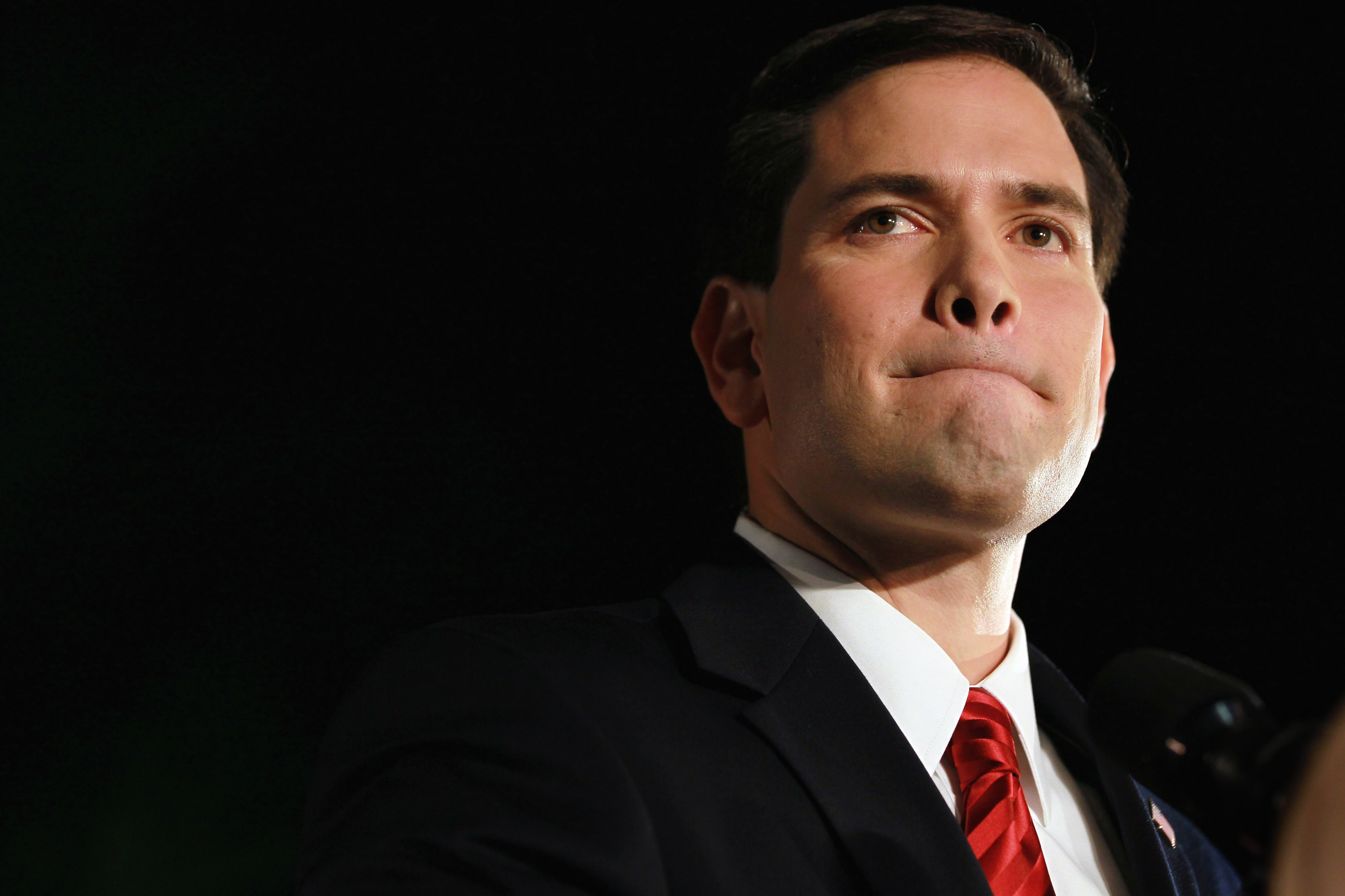
Senate Candidate Marco Rubio Attends Election Night Event

Josh Marshall declares it to be Marco Rubio:

[N]ow Rubio seems trapped, on the wrong side of his party’s base on a key issue – and one that looks unlikely even to deliver legislation that might have bipartisanship traction with middle-ground voters. It’s one thing to say ‘I bucked my party to bring change the country needs’, another to say ‘I bucked my party on change my country needs but it actually didn’t pan out. Sorry.’ And now he’s forced to become some sort of hyperactive conservative wild man – what he wasn’t supposed to be – in order to recoup ground on the right that likely can’t be salvaged.

In a later post, Josh adds:

The immigration reform debacle is forcing Rubio to lurch right in a way that makes him look like a guy who has no political core, no principles – just an opportunist. And as his record gets further scrutinized, reporters and voters will find a pretty similar story waiting to be unpacked in the pre-2010 era. It all fits together into a clear and comprehensible narrative about a politician on the make. I did a little poking around today and I get the sense there’s no shortage of Florida Republicans ready to tell this story.

Francis Wilkinson thinks that Rubio “made the rookie mistake of trying”:

While Rubio was working to accomplish something difficult — to improve the status quo — most of his likely rivals for the 2016 Republican presidential nomination offered no constructive proposals. And if immigration reform dies, the do-nothings will be the ones feted (and not only by Politico) for their political savvy.

Which is so fucking depressing.

(Photo by Joe Raedle/Getty Images)

Knowing Hope

Could John Kerry be getting somewhere in the Israel-Palestine talks? Hussein Ibish seems to think so:

Kerry has been commendably energetic in his efforts to restart talks. And it’s clearly paying off: The secretary of state seems to have received pledges from both sides not to take steps that could sabotage a revived peace process. He secured a commitment from the Palestinians not to pursue any further initiatives to join additional multilateral institutions, particularly the International Criminal Court, while Israel also appears to have given some private assurances that it will postpone scheduled settlement construction in highly strategic areas of the West Bank. Finally, the Arab League committee dealing with the issue clarified that the Arab Peace Initiative doesn’t rule out land swaps, and therefore is not the set-in-stone dictate many Israelis perceived it to be.

And today’s news is encouraging, especially if, like me, you always assume nothing will ever change.

Who Will Replace Jesse Jackson And Al Sharpton? Ctd

A reader complements McWhorter’s point:

It isn’t just that there is no one new to be the new Jackson and Sharpton; it’s that there isn’t a new community to lead. On the positive side, there isn’t a standard issue black community anymore. Maybe there never was, but there are now black children of privilege, black hipsters, blerds, etc. – all who identify with another group before they identify as black. The segregation in our society is more economic than it is racial. Poor, uneducated whites don’t really have it any easier than poor, uneducated blacks or Hispanics. There is nobody to come to the defense of the poor (no matter what the facts of any given situation are) in this country like Jackson and Sharpton did for African-Americans. The issues are more complex, and Jackson and Sharpton’s message has always been awfully simplistic. I don’t know if there CAN be a new one of them.

On the negative side, racism is a lot more sneaky then it used to be. Drug policy is perhaps the number one way the government is racist, and who stands up for that? The country as a whole just won’t open their eyes to that problem for myriad reasons.

The Egalitarianism Of Getting Laid, Ctd

A reader sends the above video, which is too perfect:

I just wanted to chime in on this post, since it reminded me of one of my favorite bits from The Chris Rock Show.

Another reader:

Oh. Em. Gee! Andrew, I think I was at the Clubhouse that same night in 1988! Being a young Arab student I probably got mistaken for a Latino but who really cared?! I was there to dance and enjoy myself. And while it was my first time in a mainly black nightclub, the atmosphere was sensual and erotic like nothing I had ever experienced. Good times.

Indeed.

Abraham Lincoln On “Stand Your Ground”

A word from the great president:

Abraham Lincoln discussed this romanticization of violence in 1838, in one of his earliest public speeches, “Address Before the Young Men’s Lyceum of Springfield, Illinois.” What, Lincoln asked, threatened the well-being of American democracy? Only one thing: vigilante violence, “the increasing disregard for law which pervades the country; the growing disposition to substitute the wild and furious passions in lieu of the sober judgment of Courts.” He detailed the epidemic of violence and then located its cause in the need for what we would now call identity politics. Constitutional institutions might be equitable, but they were not lacking in (and it’s striking that Lincoln used exactly this word) “authenticity”—the dry, rational legal system that the revolution had insured could never satisfy Americans’ need for an emotional connection with the past and with each other.

Lincoln’s own call, in response, was for an ever more radical rationalism: “Reason, cold calculating unimpassioned reason, must furnish all the materials for our future support and defense.”

As Adam Gopnik notes, Lincoln even cast the Civil War as the defense of the arid, legal principle that the Union was indissoluble – not a matter of honor or pride or culture. And that, of course, was his key difference with the dueling, honor-driven culture of the South (and Wild West). Adam Cohen also helpfully contrasts English and American self-defense laws:

Nearly 250 years ago, William Blackstone included in his classic Commentaries on the Laws of England a well-established rule: “[T]o excuse homicide by the plea of self defense, it must appear that the slayer had no other possible means of escaping from his assailant.” Sir Blackstone understood why people should be required to retreat before using deadly force: “the right to defend,” he warned, “may be mistaken as the right to kill.” …

[In contrast,] [i]n 1921, in Brown v. United States, the Supreme Court rejected the obligation to retreat. Justice Oliver Wendell Holmes, the author of the decision, later explained: “a man is not born to run away.”

Holmes, our most epigrammatic Supreme Court Justice, got at something profound about the “stand your ground” doctrine. It is not the product of elaborate empirical research or deep philosophical debate. It is, fundamentally, based on a notion of honor: that a man (and presumably a woman, though they seem to invoke it a lot less) should not be required to run away. That honor-based rationale is particularly American. Maybe because of our Wild West origins — the no-duty-to-retreat doctrine is sometimes called the “Texas rule” — or maybe because we are the world’s only superpower, we are a nation that is uncomfortable with retreat. We live in a culture in which avoiding conflict is considered cowardly, or, at best, humorous.