A Win For Russia’s Protestors

Navalny was released on bail today, while his appeal is pending:

Alexei Navalny’s lawyer called the decision to release him on bail, just a day after he was sentenced to five years in prison, as “unprecedented”. The judge in the northern city of Kirov ruled that keeping President Vladimir Putin’s opponent in custody would deprive him of his right to stand in mayoral elections in Moscow on September 8.

Tim Sampson looks ahead:

If Navalny is jailed during the campaign, there will likely be unrest similar to what was witnessed after his conviction. If he loses, many will question the legitimacy of the results. This is especially true, given the public scrutiny this ongoing trial has generated. And if Navalny somehow wins and assumes office, the continuing appeal means that the elected mayor of Moscow could find himself removed from office and jailed on dubious charges.

Benjamin Bidder notes that the Russian government has boosted Navalny’s profile:

Hardly any of Putin’s friends can be happy about seeing Navalny behind bars. “I never saw any potential in Navalny, but now he has some,” confessed Tina Kandelaki, a journalist and television host close to the Putin government. Behind such comments are the misgiving that, by trying to defeat their sharpest critic, those in power might really only be strengthening him.

Will Englund checks the timeline:

An appeal of a court decision in Russia typically takes about six weeks — which would bring Navalny right up to Moscow’s election day.

What Americans Think Of Abortion

Abortion Opinion

Leonardt examines public opinion:

[A]bortion is one [issue] in which selective readings of the polls can seem to prove opposite conclusions. After writing about abortion and public opinion in Sunday’s Times – arguing that the issue does not benefit Democrats as much as other high-profile subjects, like immigration, guns, taxes and same-sex marriage – I wanted to dig more deeply into the polls and their trend lines. For all the assertions that advocates make about public opinion, I think that a few consistent messages emerge.

The main one is that most Americans support abortion access with some significant restrictions.

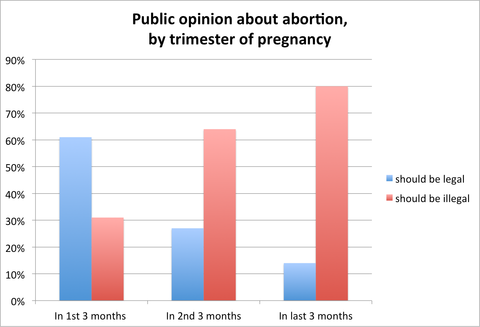
If you were going to craft a law based strictly on public opinion, it would permit abortion in the first trimester (first 12 weeks) of pregnancy and in cases involving rape, incest or threats to the mother’s health. The law, however, would substantially restrict abortion after the first trimester in many other cases.

Intriguingly, such a policy would be similar to the laws in several European countries, like France, where abortions are widely available in the first trimester and restricted afterward. It would also be consistent with much of Roe v Wade.

And it would almost certainly have become the law in most states has the Supreme Court not fucked it up. On the brighter side, Razib Khan notes that we are learning to detect fetal abnormalities earlier and earlier:

Whole genome sequencing of 2nd trimester fetuses is now possible, and it seems very likely that in the next few years they’ll move all the way to the 1st trimester. At that point the genetic analysis of 1st trimester fetuses will be routinized and be a simple consumption good. The ultimate question is what are we going to do with all that information? This is not hypothetical, speculative, or blue sky. It’s almost a reality.

Anything that might avoid the excruciating decisions faced by many Dish readers is a good thing. For the best thing I’ve ever read on late-term abortion, check out the Dish’s “It’s So Personal” series. You won’t think about this entirely in the same way again.

Peggy Noonan Loses It, Ctd

In a tiny glimpse of the distant planet she is now on, compare this sentence from her latest conspiracy-theory IRS column:

This is the moment things go forward or stall.

with this missive from something called reality:

The Internal Revenue Service’s inspector general said Thursday that he was expanding his investigation of I.R.S. treatment of political groups that applied for tax-exempt status to see if liberal groups were treated the same way as conservative ones. Under attack from Democrats over his earlier inquiries, the inspector general, Russell George, said there was new evidence to study in the controversy about the handling of tax-exempt applications from Tea Party and other groups. The new evidence suggests that the I.R.S. used not only conservative-sounding keywords to select certain applications for extra scrutiny, but also liberal-sounding words like “progressive.”

Yes it’s time to move forward – to expose what a huge non-scandal this always was.

Yes, Bibi Wants Us To Go To War For Him, Ctd

Contra the prime minister, John Judis parses a new report by former State officials who recommend we ratchet down the pressure on Iran:

Instead of increasing the threat of war, the authors suggest that the Obama administration imitate a series of steps that would persuade Iran that in exchange for pledging not to build a nuclear weapon (and agreeing to inspections to confirm the pledge is being carried out), the U.S. and the other negotiating partners would progressively lift sanctions and would also agree to Iran’s development of a peaceful nuclear program. They urge a meeting in the next months between Obama and Rouhani—perhaps during the fall United Nations session.

The authors point out that the United States stands much to gain from an improved relationship with Iran—not just in ending the threat of a nuclear arms race in the Middle East, but also in gaining Iran’s cooperation in neighboring Iraq and Afghanistan (where Iran initially worked closely with the United States against the Taliban and al Qaeda) and in Iraq and Syria, where a regional Sunni-Shia war looms on the horizon.

Is Rouhani someone “we can do business with” as Maggie once described Gorbachev? That would drive the neocons insane. Gary Sick thinks Bibi needs “a new set of talking points”:

Almost every year since the early 1990s, senior political figures, intelligence specialists and respected commentators have assured us that Iran would surely have a nuclear weapon in three to five years, sometimes less, unless Iran were forced to stop its mad dash for the bomb. It is not hard to understand the logic of this assertion. Israel itself managed to develop a nuclear weapons capability in absolute secrecy in only a few years. It was not alone. South Africa, India, even poor Pakistan with virtually no heavy industrial base, managed to develop nuclear weapons in secret within a decade or so of the decision to launch a determined program. By most accounts, Iran decided to restart its nuclear program — started under the shah and interrupted by the Iranian revolution — in the mid-1980s, nearly 30 years ago.

Detroit Goes Bankrupt: Reax

Population Decline

Yglesias provides an overview:

This is the largest city to ever file for bankruptcy, and obviously no large city goes bankrupt without a complicated array of problems. But the basic reason Detroit needs to do this is pretty simple. In 1950 there were 1.85 million people in Detroit. In 1970, it was 1.5 million. In 1990, it was a million flat. By 2010, it was down to 710,000. When your city is shrinking like that, you end up with a tax base that’s inadequate to maintain the fixed infrastructure or to pay off pension costs that were incurred in more prosperous times. Shedding legacy obligations is a necessary part of the fix. You can shed legacy obligations without filing for bankruptcy by just stiffing pensioners. But the scale of Detroit’s fiscal problems are so enormous that doing it entirely that way would be cruel and pointless—bondholders need to take a hit and this is the way to do it.

Plumer notes some of the city’s other problems:

— The official unemployment is now 18.6 percent, and fewer than half of the city’s residents over the age of 16 are working. Per capita income is an extremely low $15,261 a year, which means there’s not all that much tax revenue pouring in.

— Low tax revenue, in turn, means that city services are suffering. Detroit has the highest crime rate of any major city, and fewer than 10 percent of crimes get solved. The average response time for an emergency call is 58 minutes. Some 78,000 buildings are abandoned or blighted and there are an estimated 12,000 fires every year. About 40 percent of the city’s streetlights don’t work.

— High crime and blight are driving even more residents out of the city. It’s also driving down property values, which means many residents have stopped paying property taxes. The city collected about 68 percent of the property taxes owed in 2011. Both of those things put a further strain on Detroit’s finances.

Soltas zooms out:

Detroit’s dependence on cars … wasn’t exactly the problem. It was dependence itself. Cities should never go all in on any industry, cars or otherwise. It didn’t realize that until it was too late.

Rob Wile explains what happens next:

Assuming the case goes forward — some creditors may try to object to the filing — the court will now determine which entities — corporations, pension funds, employees and anyone else Detroit owes money to —  will actually see the money they were promised by the city.

According to the American Bankruptcy Institute Journal, Detroit technically gets to do all of the proposing for how that works out. It will submit a restructuring plan to the court, and if the plan doesn’t violate any sections of the federal bankruptcy code, it will be voted on by the creditors.

The creditors don’t get to propose their own plan, and the court can issue a “cram down” order to force objecting creditors to accept parts of the plan. But there will be negotiations going along the whole way where creditors will have their say.

John Cassidy expects this process to take time:

Having seen General Motors and Chrysler both emerge from bankruptcy leaner and with much less debt,  [Detroit’s mayor, Dave Bing,] and other officials are evidently hoping for a similar outcome for the city. But even assuming that the bankruptcy filing does survive a legal challenge, it’s far from clear how a case of this size, complexity, and political toxicity will work its way through the courts; the process could take years. Municipal bankruptcy cases are invariably complex. With Detroit’s debts standing at an estimated twenty billion dollars, this is by far the largest such case in U.S. history. And Detroit is still a city of more than seven hundred thousand people. Can an unelected official like [Kevyn Orr, Detroit’s emergency manager,] govern such a city for years on end with no democratic mandate? A mayoral election is due to take place later this year. So long as Orr is effectively running the show, its result won’t mean much.

Tim Fernholz offers three reasons why Detroit filed yesterday instead of in September or October as expected. One theory:

[Orr] feared lawsuits from pension funds seeking to stop the bankruptcy. In Chapter 9, the city’s promise to spend billions paying for retiree health care is likely to be shifted to the federal government, and the pension funds themselves are likely to take significant cuts. Their managers have been filing lawsuits seeking to prevent the city from entering bankruptcy, but the filing stays them all.

Lydia DePillis looks at who Detroit owes money:

Detroit is about $18 billion in debt, and will only be able to pay out a fraction of that in the short term. The two main groups of creditors arguing they’re entitled to that money are public employees and retirees, and bond holders. The investors are likely to make out better, since more of that debt is secured; the city will continue to pay water and sewer bondholders. Most of the pension debt has no similar backstop.

City residents will likely suffer a lack of anything other than the most rudimentary public services for a long time, but the impact is likely to be felt most keenly by those who lost a large chunk of the retirement they were counting on.

Barro wishes the public sector pension system was designed differently:

If a federal court approves Detroit’s bankruptcy plan, its retired workers will see their pension benefits cut drastically.

It shouldn’t be this way.

When a company goes bankrupt, most of its workers’ pension benefits are insured through the Pension Benefit Guaranty Corporation, a federal government entity established under the Employee Retirement Income Security Act of 1974.

Congress should extend ERISA or a similar set of rules to municipal and state governments. This would force governments to manage their pension systems in a safe way, and would protect workers from destitution in the event of a state or municipal insolvency like Detroit’s.

Sommer Matthews also considers the pensions:

Michigan’s constitution technically prohibits the accrued pension benefits of public employees from being reduced retroactively. But Detroit Emergency Manager Kevyn Orr has previously indicated that bankruptcy would mean pension cuts for both current and former city workers would be on the table. The city’s pension funds currently face an estimated shortfall of about $3.5 billion. For (hopefully obvious) political reasons, it’s unlikely that current retirees would see their checks disappear entirely, but smaller checks are a (frightening) possibility. Future retiree benefits would be the big area for cuts, though. Plenty of states and local governments have already slashed pensions even without going bankrupt.

The above map, on Detroit’s population loss, is from Nate Cohn, who rounded up various maps on Detroit’s decline.
The Egalitarianism Of Getting Laid

A reader writes:

This is kind of a tangent of the Richard Cohen and racial fear thread, but I had another thought about your ease with African-Americans back when your neighborhood in DC was still dangerous.  Do you think going to gay bars had anything to do with your comfort level?

I am not gay, but have been in a few gay bars with friends here in NYC.  One think that really struck me was how it was one of the only places where different classes mix – meaning upper-middle class/wealthy whites with poor blacks (and all of the other various combos).  I live in Washington Heights, and about the only bar where you see blacks, Latins, and newly-arrived whites mingle is at No Parking, the gay bar across the street.

Not being from here, I’ve been a bit surprised how much straight New Yorkers divide up by class and, de facto, race. I could see why there might be less understanding in our views of poor blacks and Latinos.

I’m sure being gay has a lot to do with it. There’s nothing like dating or fucking a person of another background, race or class to help you see the humanity in everyone. Alas, the gay bars in DC, while much less segregated than in other places, are still sadly divided. DC’s Pride is even divided into regular Pride and African-American Pride. But the gay commonality can dissolve many barriers if you’re open to it.

One of my most vivid early memories of nightlife in DC was a trip to the Clubhouse – now defunct – in a neighborhood that was deemed a little risky even for 1988. I went with a white club-kid friend of mine who kept raving about the music, which was similar to that played in The Warehouse in Chicago. It was one of the sources for early House music, and as we went in – around 2 am or so – it was packed with men of color, helium balloons and a big punch bowl. It was an informal event – in a warehouse space – but the music was so over-powering and amazing and unlike anything I had ever heard, I was captivated. I’d guess my friend and I were the only white dudes in the room (maybe we missed a couple in the mosh-pit of rhythm, and I was then a slip of a thing, a cute twinky English schoolboy. But within minutes I was part of the crowd, ignored by most, smiled at by a few, and completely immersed in that House sound that became the background to my coming out.

How do you get scared of generic young black men when you’ve danced with them all night long, or had so many fuckbuddies who needed a washcloth in the shower? In that sense, I’ve always felt that being gay was a real moral blessing. I could have been so much worse a human being if I’d been straight.