Meep-Meeped On Syria

I harrumphed and stamped my foot upon hearing that the Obama administration had agreed to some small arms sales to some Syrian rebels. I called the decision a “betrayal.” It seems more and more that it was instead just a canny sop to the allies until they came to their senses, which they seem to have finally done:

British newspaper reports on Monday said British military commanders had advised Mr. Cameron that there was no purpose to be served by sending small arms, since such modest arms supplies were unlikely to sway the outcome of the conflict, which is now in its third year. British officials declined to confirm the reports that Mr. Cameron had abandoned the idea of arming the rebels, saying that since no formal decision had been made to send weapons in the first place, it was not clear how he could be cast as retreating from it.

Of course, one reason to have a blog is to sound off loudly enough to send a message. So I don’t regret publicly going after Ben Rhodes et al. But I was empirically wrong to over-read what was a minimalist gesture in a longer game plan. And not for the first time.

Ask Michael Hanna Anything: Obama’s Record On Egypt

Michael thinks the Obama administration’s approach to Egypt is getting worse, not better:

The Economist wonders how much influence Obama actually has:

On a two-day visit to Cairo [this week], William Burns, America’s deputy secretary of state, met members of the military-backed interim cabinet, but Tamarod and the Salafists’ Nour party, which won the second largest number of seats at the last parliamentary election, declined to see him. The Brotherhood says it did not engage in discussions with him either.

It is not clear that Mr Burns would have had much to say to them, anyway. At the moment, America lacks a clear policy toward Egypt. Barack Obama has not publicly addressed the crisis, perhaps for fear of seeming meddlesome. Away from the cameras he is said to be trying quietly to influence events, but it is hard to see how he hopes to reconcile America’s democratic values with its immediate interests in Egypt, not least to ensure that Egypt’s treaty with Israel holds firm. Meanwhile, Mr Obama’s critics at home say his public reticence is due both to a lack of interest and to a confused analysis—a critique that dates back to his supposedly tardy and wobbly reaction to the Arab spring. A more likely explanation that unsettles Americans all the more is that the American president simply lacks the leverage to influence events in Egypt.

Michael Wahid Hanna is a Senior Fellow at The Century Foundation, where he works on issues of international security, international law, and US foreign policy in the broader Middle East and South Asia. He appears regularly on NPR, BBC, and al-Jazeera. Additionally, his Twitter feed is a must-read for anyone interested in Egyptian politics. Michael’s previous answers are here. Our full Ask Anything archive is here.

The Great Shorts Debate

As the raging heat wave rekindles the debate over whether it’s proper for men to wear shorts when not exercising or going to the beach, Ryan O’Hanlon looks to Professor Susan Kaiser, an expert in the psychology of clothing, for some historical perspective:

Within Western culture, the history of shorts becomes intertwined with those of breeches or 3735401277_04a529131a_zculottes (worn prior to the French Revolution in 1789), and thereby linked with issues of class as well as masculinity. Long trousers had been worn by the working classes, whereas aristocratic and bourgeois men wore breeches/knickers/culottes. This changed after the revolution, and long pants began to be worn by men of all classes in the 19th century.

Shorts per se were for little boys, who “evolved” into their manhood by switching from long white dresses (infants) to shorter white dresses (toddlers) to shorts (little boy) to breeches (middle childhood or so) to long trousers (probably teens). This progression—associated with the 19th and early 20th centuries—was associated not only with age grades but also with a kind of “flight from femininity” and toward manhood. (The implication, of course, is that femininity did not have the same trajectory; it was infantilized to a much greater extent.)

Alex Balk, who has written about shorts on at least 20 occasions over the past three years (including the classic “Iran Cracks Down On Men In Shorts, And Good For Them”) responded to O’Hanlon’s post with one entitled “Men Wear Pants Because That’s What Men Do.” On the other hand, native Floridian Hamilton Nolan insists that forgoing shorts “is nothing more than a declaration that you enjoy walking around with a serious case of sweat-soaked swampass for a large portion of the year.”

I’m for them if Jon Hamm joins in.

(Photo from Jasper Gregory)

“The Annihilation Of The Black Individual”

Ta-Nehisi explains Richard Cohen’s logic:

[W]e should take a moment to appreciate the import of Cohen’s words. They hold that neither I, nor my twelve year old son, nor any of my nephews, nor any of my male family members deserve to be judged as individuals by the state. Instead we must be seen as members of a class more inclined to criminality. It does not matter that the vast, vast majority of black men commit no violent crime at all. Cohen argues that that majority should unduly bear the burden of police invasion, because of a minority who happens to live among us.

Richard Cohen concedes that this is a violation, but it is one he believes black people, for the good of their country, must learn to live with. Effectively he is arguing for a kind racist public safety tax. The tax may, or may not, end with a frisking. More contact with the police, and people who want to be police, necessarily means more deadly tragedy. Thus Cohen is not simply calling for my son and I to bear the brunt of “violation,” he is calling for us to run a higher risk of death and serious injury at the hands of the state. Effectively he is calling for Sean Bell’s fianceé, Trayvon Martin’s parents, Amadou Diallo’s mother, Prince Jones’ daughter, the relatives of Kathryn Johnston to accept the death’s of their love ones as the price of doing business in America.

My response to Cohen here.

Chart Of The Week

A reader writes:

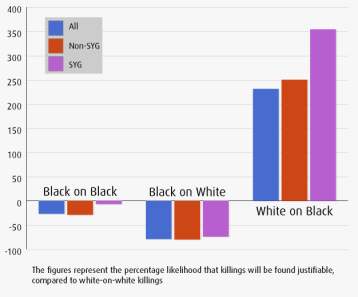
I’m surprised that you repeatedly posted that chart about the Stand Your Ground results compared to white-on-white incidents without attribution. It’s a great chart, and the difference so stark, that it begs for attribution.

We subsequently updated the posts with a link to the study – by John Roman of the Urban Institute’s Justice Policy Center, via PBS’s Frontline, which followed up with Roman to create the chart. Another reader picked up on Roman’s study:

I was amazed by the graph you’ve posted several times this week regarding percentages 11of justifiable homicides between the races.  It was troubling enough that I decided to track down the source of the study.  In doing so, I found out an even more amazing statistic.  The study looked at all 73,000 homicides between 2005-2009.  It then separated all of the homicides where one stranger killed another stranger, similar to what occurred in the Trayvon case.  Finally, the study separated those instances by race.  Of the 73,000 homicides in that time period, only 23 were one white person killing one black person.  23!  From the media coverage this weekend, I thought the number was probably in the thousands.  The small sample size makes the significant portion of the graphic you posted basically worthless.

I don’t think it makes the chart worthless. But it’s an important piece of perspective. Update from a reader:

The reader is fundamentally confused on the difference between a random sample survey and a census or direct reporting of observed data.  For a survey, you need to reach a certain number of responses/cases randomly selected from the total universe of potential respondents or cases to achieve statistical validity.  But if you’re reporting the actual, total data for a universe of observed people or phenomena, there’s no “sample size” involved – you’re reporting the facts.

Another critique:

Income is absent from this chart. Did it occur to you that perhaps the white people were wealthier and had better lawyers? Maybe the amount paid for lawyers correlates to the efficacy of those lawyers? (It stands to reason that lawyers that can charge more get their way more often; why would anyone pay more for them if that weren’t true?) In fact, nationally, white men earn 150% of what black men earn.

Another builds on that point:

Look at OJ – a rich black guy was able to kill two white people and get away with it, even with what looked like a very good case.  How? MONEY – he had a lot of it and bought the best lawyers he could to buy his freedom.  I suspect many of the white dudes in the chart that beat their case because of their ability to put up a vigorous defense, or at least threaten to do so. So the chart does show that SYG makes it easier to beat a murder charge, but it doesn’t show that whites (or Hispanics) are getting away with murder with a sly wink of a racist society.  I’d also like to see more detail from the chart as well, such as the location and situation of the relative incidents.  It’s possible that there are a lot of other factors involved.

The Tragedy Of Trayvon: Reader Odds And Ends

Some remaining thoughts on the Zimmerman-Martin saga:

Each man likely was scared of the other. Each man likely thought he was fighting for his life.  Martin, because a stranger was following him with a gun.  Zimmerman, because he did not know if Martin was armed. Their mutual panic spiraled first into a fight, and then into a life-and-death struggle fueled only by fear of the other’s intentions.

I’m a gun owner, but this is what scares me most about guns.  If two men are fighting, and one notices the other has a gun, won’t the one without the gun naturally fear for his life?  Won’t this fear lead him to escalate the situation by trying to grab the gun, or disable the other by slamming his head into the concrete?  Won’t the man with the gun, seeing the escalation, choose to use his gun rather than risk serious injury, or the other man taking the gun away and using it against him?  Won’t both men be acting in self-defense?

Another reader:

Imagine that Martin is also armed, legally possessing a handgun, on the night of his killing. Is there a point in his confrontation with Zimmerman where he is legally justified to shoot Zimmerman in self-defense? It seems to me that Stand Your Ground laws give an incentive to use lethal force in confrontations with even potential for physical violence … and also to shoot first.

Another:

I’d like to raise one more point in this conversation which keeps being overlooked both in this specific case and the gun discussion in general: Why does any conversation about self-defense tumblr_mpz9xoYIvJ1qz4e1ro1_1280focus on lethal gun use? Zimmerman could have used mace or pepper spray. He could’ve used a Taser. He could’ve used rubber bullets or a bean bag rifle. He could’ve shot Martin in the thigh or right shoulder.  And on and on.  But his chosen method of self defense was to shoot Martin in the area of the heart using bullets intended to inflict massive internal injuries.

Like you, I’m a small “c” conservative. To me, those are the “conservative” approaches to self-defense.  Shoot to kill first and ask questions later is the opposite. We apparently had a black woman in Jacksonville use a more conservative approach to self-defense by firing warning shots, and she is sentenced to prison for 20 years. What is the message being sent here?

Another:

I think it’s a bit dishonest to proclaim that Zimmerman confronted Trayvon without attempting to address the four-minute delay between the time Zimmerman told the dispatcher he lost sight of Trayvon and the start of the fight between the two.  Keep in mind, Trayvon was about two blocks from his house when Zimmerman lost sight of him, yet, almost four minutes later, a fight occurred closer to Zimmerman’s truck than to Trayvon’s house. This was one of the defense teams main arguments in trial, yet conveniently enough, it goes unmentioned by virtually every serious journalists and commentator.  And while this four-minute gap isn’t dispositive one way or another, it is pretty deceitful to leave it out of all analysis.

Glad to include it. Another:

Something I haven’t seen brought up in the Trayvon Martin case: In 2005 Zimmerman is arrested for “resisting officer with violence” and “battery of law enforcement officer.” But he wrote in his application to the Seminole County Sheriff’s Office Citizens Law Enforcement Academy that “the officer assaulted me first”.

Later that year, his fiance accuses him of domestic violence and takes out a restraining order on him. But he responded by taking out his own restraining order to protect himself against her. Finally we have this case, where Zimmerman claims that a kid who is running away suddenly, for no apparent reason, changes his mind and attacks Zimmerman.

The poor guy can’t catch a break! People keep attacking him, and then they (or the liberal media) claim that he attacked them!

In all seriousness, I think it would have been useful for the prosecution to present witnesses (the cop, the fiance) who could testify that Zimmerman was in the habit of assaulting people and then claiming that they assaulted him.

Another:

Did you know that George Zimmerman’s cousin accused him of molesting her beginning at at age 6, and it allegedly went on for several years? She said that her parents found out and confronted Zimmerman and that he admitted to the molestation. Why was this not admitted at trial, particularly since the defense was trying to admit things (and may actually have) from Trayvon Martin’s past?

One more:

I’ve been biting my tongue out of professional courtesy (I’m a prosecutor), but there is an issue here that isn’t getting enough attention: The prosecutors did a terrible job.

You noted that the juror conceded that one of the most important facts – that Martin was “suspicious” because he was walking in the rain – came from Zimmerman.  True, but he didn’t testify to that. Instead, the prosecutors inexplicably played a video of his self-serving explanation of that night.  They had no obligation to play that video, his explanation wasn’t subject to any cross-examine action, and he exonerated himself.  By playing it, they ensured he would never testify and thus be subjected to the cross-examination the prosecutor now says he was “praying” for.  It was obvious at the time this was a terrible decision.  This was their biggest blunder but there were many others; these folks were grossly incompetent.

Update from a reader regarding the molestation allegations:

Sometimes I forget that not everyone is a trial attorney like I am.  In all likelihood, the reason the prosecution did not attempt to enter this evidence is that it knew it was not admissible.  Evidence of prior bad acts in order to show character or conformity of behavior are almost never admissible.  The basis for this rule of evidence is that defendants are to be judged on what happened in this specific case, not what has the defendant done in the past.  The same logic kept out most of Trayvon’s past transgressions as well, if not all of them.

The same rationale applies to your reader’s suggestion that the evidence of Zimmerman’s prior claims of self defense should have been put into issue.  However, repeated self-defense claims and the self-defense claim in the Trayvon case could have caused this to be either “habit” evidence or permissible character evidence.  I don’t practice in Florida so cannot claim expertise of their rules of evidence.  But here the legal nuances are at least very interesting.  The sexual assault allegations would never be admitted.

Imagine if every trial became a list of horribles against the defendants?  We’d be persecuting people for their character, not prosecuting them for crimes.

Marriage Equality Comes To England And Wales

BRITAIN-GAY-MARRIAGE

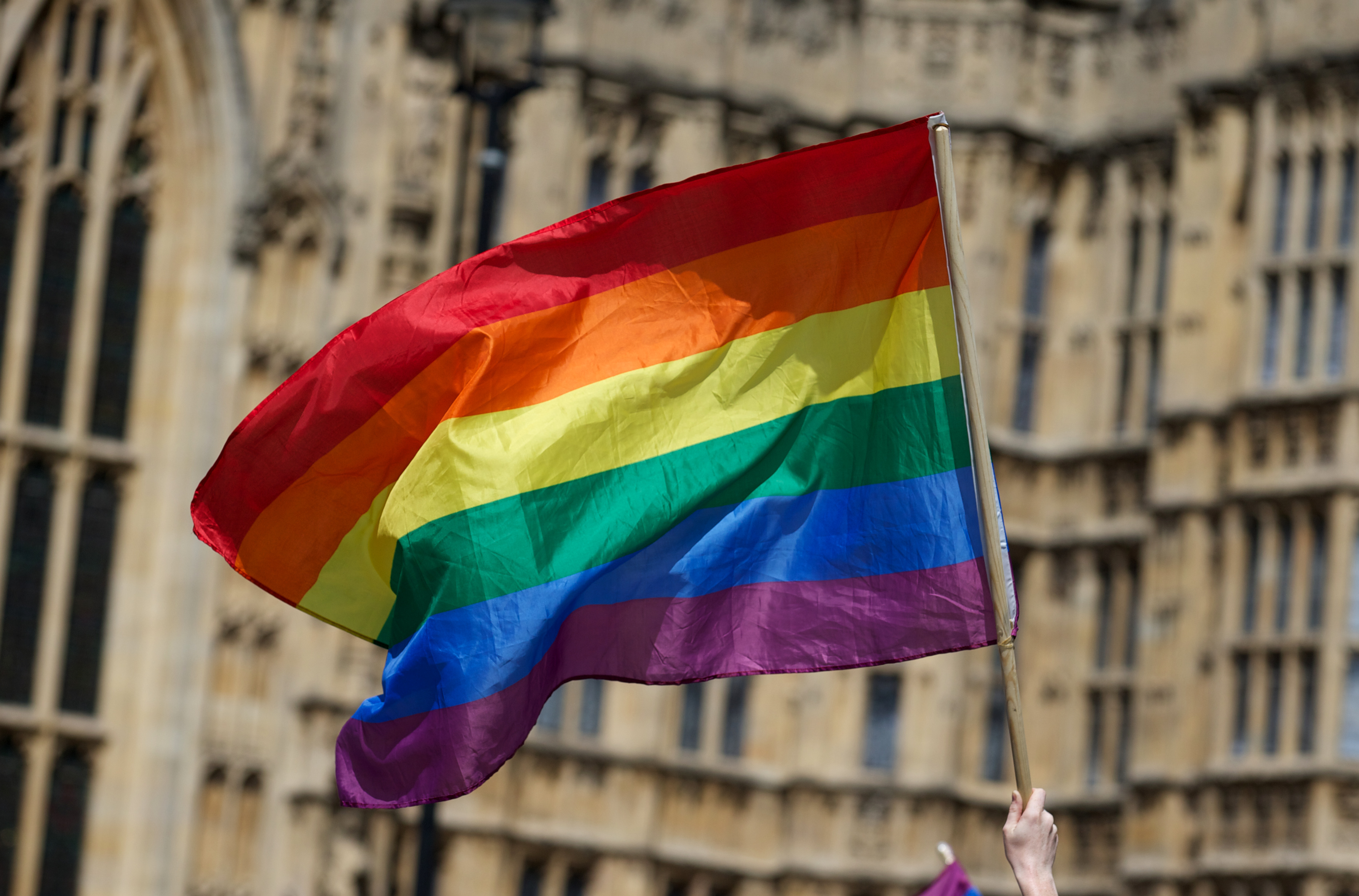
It’s official. And it’s hard to find a single story on it in the UK press. That’s how fast opposition fizzled. John Gallagher notes the Tory infighting on the issue:

The bill was backed by Tory Prime Minister David Cameron, who wanted to prove his party was progressive on social issues. However, Cameron paid a substantial political price for his backing. More than half of his party’s members in the House of Commons voted against the bill, including some of his own Cabinet ministers. That Tory rancor continued right down to the final debate.

But Cameron did what a conservative leader should – guided his right-flank back to the center, while allowing them to vent. It’s worth noting that almost all the leading Tory figures are for marriage equality – including London Mayor Boris Johnson and Foreign Secretary William Hague. The right on Britain supports universal healthcare, aggressive tacking of climate change and civil marriage for gay couples. If you wonder why I still call myself a conservative – as opposed to a Republican – think of me as an English conservative.

Caspar Aremi zooms out:

England and Wales join the fifteen countries (Argentina, Belgium, Brazil, Canada, Denmark, France, Iceland, Netherlands, New Zealand, Norway, Portugal, Spain, South Africa, Sweden and Uruguay), and several sub-national jurisdictions (parts of Mexico and the United States) who have passed legislation allowing same-sex couples to marry.

That’s 362 million more people who live in countries with marriage equality than was the case just a year ago. The total population now living in countries with marriage for all is 641 million. A year ago, it was 289 million.

(Photo: A gay campaigner waves the rainbow flag during a rally outside the Houses of Parliament as the Marriage (Same Sex Couples) Bill gets an unopposed third reading by the Lords in central London on July 15, 2013. By Andrew Cowie/AFP/Getty Images)

And The Greatest American Novel Is …

Tom Ferraro makes the case for Mario Puzo’s The Godfather, “the most read adult novel in history and the most influential single act of American creativity of the second half of the American century”:

The Godfather was written in 1969 and can be read as a dramatic response to a pivotal moment in American history.

Puzo substituted the Corleones’ tactical genius for our stumbling intervention in Vietnam; he traded the family’s homosocial discipline and female complicity for women’s liberation; and he offered the dream of successful immigrant solidarity in place of the misconstrued threat of civil rights and black power.

Yet like any profound myth narrative, The Godfather reads as well now as then. Its fantasy of perfect succession, the son accomplishing on behalf of the father what the father could not bear to do, is timeless. And Puzo’s ability to express love and irony simultaneously is masterful: the mafia is our greatest romance and our greatest fear, for it suspends our ethical judgments and binds us to its lust for power and vengeance. Of course, our immigrant entrepreneurs, violent of family if not of purpose, keep coming. Even Puzo’s out-sized vulgarities illuminate, if you can hear their sardonic wit.

After Puzo, none of America’s epic stories, Ahab’s or Gatsby’s, Hester Prynne’s or Invisible Man’s, reads exactly the same. And that is exactly the criterion of T.S. Eliot’s admission to the “great tradition.” The Godfather teaches us to experience doubly. To enjoy the specter of Sicilian otherness (an old-world counterculture, warm and sexy even in its violence) while suspecting the opposite, that the Corleones are the hidden first family of American capitalism. In Puzo’s omerta, the ferocious greed of the mafia is all our own.