Zimmerman and Martin with the races changed, from the Tumblr “While Seated” by Michael David Murphy.
The effect of race on acquittals in self-defense cases and with Stand Your Ground laws can be seen here. Update from a reader:
That FOTD just blew my mind. So powerful. Just sitting with it and being mindful of my own feelings and emotions, it’s amazing how deep-seated and unconscious some cultural and societal prejudices can be. Images like that bring them into consciousness though, which is the first step toward eradicating them. I’m emotionally shaken in a way I haven’t since this whole Zimmerman trial began, just imagining how different that hypothetical case would have played out. Could you imagine O’Reilly/Rush/Hannity’s rage in the unlikely event that an acquittal took place? Or their smug satisfaction when (far more likely) the black Zimmerman got the death penalty, and “justice” was done?
Which is unsurprising – except that obviously, he feels a little stymied by the choice just made by the Iranian people. (Neocons like their Iranians to be uncomplicated demons.) Ali Gharib unpacks Netanyahu’s latest push – once again made on national television – for the US to attack Iran:
Netanyahu’s remarks clearly took aim at what many advocates of forging a diplomatic deal—a deal, that is, to ease the nuclear crisis between Iran and the West and avert war—think is an opportunity in the election of Hassan Rowhani, a moderate Iranian cleric, to be president of Iran. After the CBS host’s third question, Netanyahu raised the Iranian election himself, for the purpose of dismissing Rowhani: “Now mind you, there’s a new president in Iran,” Netanyahu said. “He’s criticizing his predecessor for being a wolf in wolf’s clothing. His strategy is be a wolf in sheep’s clothing. Smile and build a bomb.” This will of course sound a little odd to anyone who’s looked at a few photos or videos of the lame-duck Iranian hard-line president Mahmoud Ahmadinejad, who smiled constantly.
But the “smile” line was just a catchphrase. Netayahu’s main point is the same one that’s been made before by Netanyahu himself and a virtual who’s who of American Iran hawks (helpfully catalogued by Marsha Cohen): that Rowhani shouldn’t even be given the chance to make good on campaign promises of accommodation with the West and transparency in Iran’s nuclear program.
Netanyahu knows that without the impunity of being the sole nuclear power in the Middle East, Israel’s capacity to wage conventional war at will in the region would be constrained. Adam Chandler notes the context:
The timing of the interview also seems noteworthy because Netanyahu is changing course on the diplomatic front, following the naming of senior adviser Ron Dermer as Michael Oren’s successor as the Israeli ambassador to the United States. On Oren’s way out, he has sought to emphasize that the United States and Israel have enjoyed a strong relationship, especially with regard to strategy on Iran’s nuclear program.
Everyone in the international community agrees that the new president of Iran will have to be given at least a year, and maybe more, to prove he is an earnest negotiator for Iran. You can’t just attack a presidential administration that only recently got into office and before taking the measure of it. The European powers and the countries of the global South would never accept it. … Netanyahu keeps threatening to attack Iran himself, if the US Pentagon won’t do it for him, but this bluff is transparent. Israel cannot plausibly conduct a successful military operation so far from its borders (Iran is a long way away).
You can almost hear Michelle Dean sigh with relief as she deems Orange Is the New Black “more than just a privileged-white-lady-goes-to-prison-story”:
[It’s] a tricky sell of a show, sitting as it does at an increasingly raucous intersection of pop culture and identity politics. The show follows Piper Chapman (Taylor Schilling) as she heads to jail for 15 months following a very bad decision in her early 20s. The privileged-white-girl-on-the-wrong-side-of-the-tracks plot can very quickly become a powder keg, as Lena Dunham so recently learned. Plus, comedy is an odd match for this setting; we usually expect more grit and gloom from prison, as in HBO’s Oz. But somehow, creator Jenji Kohan has whipped up a delightful show from that dicey premise.
Alan Sepinwall praises the series for zooming out from the main character:
Through Piper, we get to learn how the prison ecosystem works — the voluntary segregation by race, the legal and extra-legal aspects of the prison economy — but we also find out, through flashbacks and present-day dialogue, how the other inmates put themselves here and how incarceration has and hasn’t changed them from the person they were before they were given a jumpsuit and an ID number.
It’s with those stories — how a shy undocumented teenager from Jamaica grew into one of the prison’s most feared elders (Michelle Hurst), the difficult gender transition a fireman made to wind up as the resident hairstylist (Laverne Cox), the way certain lesbian inmates (like Natasha Lyonne‘s recovering addict) feel when their current lovers prepare to return to men on the outside — that Orange becomes particularly engrossing.
In fact, Emily Nussbaum suggests that white, well-educated Piper serves as a narrative “Trojan horse”:
Orange would likely not have been green-lighted if its central story had involved a poor black drug dealer. Even The Wire, one of the blackest TV crime dramas ever, had a white antihero as its lead. So did Oz, which shared a similar premise. (White person lands in penitentiary hell.) But Orange uses that premise as a lure to get us to listen to other voices.
Meanwhile, Matt Zoller-Seitz lauds the show for its “unusually complex and open-hearted” take on sexuality:
The heroine is bisexual, and at no point does the series suggest that she didn’t really love the woman who got her into this mess, or that she doesn’t really love her fiancé. There’s also a transgender character, Sophia Burset (played by African-American transsexual actress Laverne Cox), who enters the story with the eccentric definition of every other character and is never once presented as inherently comical or strange.
Nussbaum concurs:
[The women of Orange] form quasi-familial tribes and wounded triangles; it’s a matriarchal subculture that, as a Seven Sisters graduate, Piper had some preparation for. There are more lesbians here—butch and femme and of every ethnicity—than in any other series on television. Viewers ravenous for representation often graded the fun, flawed The L Word on a curve. Though Orange bears a resemblance to that show, it’s the more solid of the two, at least so far.
Last week, Nate Cohn suggested that Republicans “smooth out the many sharp edges of the GOP’s platform and message.” Some of his suggestions:
Keep supporting tax cuts and less regulation, but add an agenda and message aimed at the middle and working class. Remain pro-life, but don’t appear opposed to Planned Parenthood or contraceptives, and return to supporting exceptions in instances of rape or the health of the mother, as President Bush did. Stay committed to religion, but don’t reflexively doubt the science of evolution and global warming, or the promise of stem cell research or renewable energy. Oppose gun control, but why force yourself to oppose background checks? Oppose gay marriage if Republicans must, but could Republicans at least support civil unions? On all of these issues, the GOP need not compromise on its core policy objectives, but can’t afford to consistently stake out ground so far from the center.
But they won’t because moderation is anathema to them. They have become a doctrinal party in which doctrine is eternally true and cannot be changed – whether that is reflected by the view that tax cuts are the solution to every economic problem, that no accommodation to gays can be made at all, that climate change is a hoax, or that all abortion is cold-blooded murder, etc. Douthat pivots off these suggestions to argue against the Senate’s immigration bill:
Concessions on background checks would be at most a modest setback for the N.R.A., and it’s hard (at least for this pro-lifer) to see support for a rape-and-incest exception as devastating to the anti-abortion cause.
But, Ross. You aren’t, alas, the base. You’re capable of pragmatic adjustment, weighing the pros and cons, seeing the least worst option as a win. Have you ever heard that kind of argument on Fox News or Mark Levin or Rush Limbaugh? And do you really think the NRA – a lobby able to scupper modest changes in the wake of the murder of a score of school children – will decide that concessions for the sake of Republican victory is a sane strategy? What conceivable incentive do they have to do that when they get all they want anyway? Ross continues:
But from the vantage point of National Review or the Heritage Foundation or the Center for Immigration Studies (to cite a few places that take a restrictionist line on immigration), the Rubio-Schumer bill looks less like a modest setback, and more like a once-in-a-decade or even once-in-a-generation defeat.
What’s more, the fact that so many analysts, Cohn included, describe a vote for Rubio-Schumer as a vote to take the immigration issue “off the table” indicates that restrictionists are probably right to see it this way: Issues can go off the table because external circumstances changes (Cohn cites the example of the Cold War’s end), but when they are pushed off the table legislatively it’s usually a sign that one set of activists has basically won most of what they wanted, and their rivals have mostly lost.
Along the same lines, Ramesh recommends that the GOP pass a much more limited immigration bill:
The danger of a more sweeping amnesty is that it would encourage new illegal entrants by signaling that they will eventually be legalized, too. Congress should therefore hold off on that step while making sure that enforcement is up and running — and that the political forces that are supportive of amnesty have an incentive to make enforcement work rather than subvert it. Limited amnesty would be a good-faith gesture to show that the promise of future legalization isn’t merely words.
But Bernstein is unsure that scaled down immigration reform is possible:
Here’s the deal. Most Republicans, at the very least, want to pass something — so that they can deflect at least some of the blame for comprehensive reform failing, and at least to some extent because they really do support some legislation. But they can’t pass a comprehensive bill (at least not without relying on mostly Democratic votes), or even a mostly comprehensive bill. So the plan has been to pass a series of small bills that have wider support.
The problem? They may not have the votes for those, either.
Because they are not what Ross would like them to be. They’re fanatics, much more interested in the ideological posture of purity than the compromises of government. So they will block all compromise. They know not what else to do.
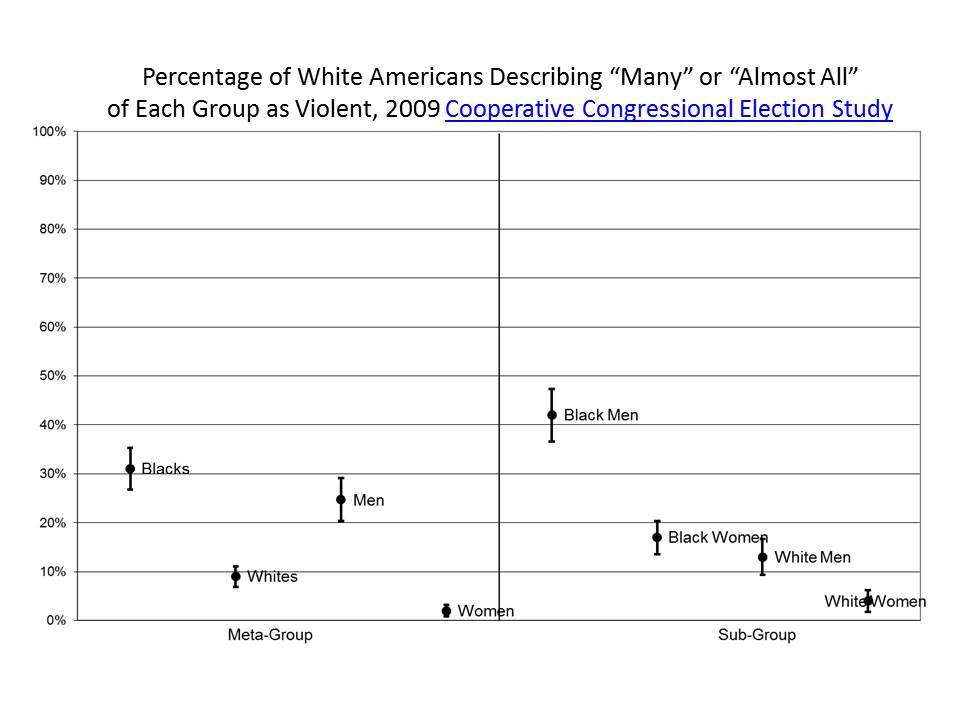
Ismail White and I have been conducting a number of studies on the uniqueness of attitudes toward black men. In a nationally representative sample of white Americans, we find that black men are indeed considered uniquely violent. While a traditional question about racial and gender stereotyping finds that whites perceive “blacks” as more violent than “whites” and “men” as more violent than “women,” a question that asks about combinations of these identities—black men, white women, etc.—shows how black men are uniquely stigmatized. More than 40 percent said that many or almost all black men were violent, but less than 20 percent said that of black women and white men. The figure [above] displays these results (with the bands indicating 95 percent confidence intervals).
If only the most sensitive part of the penis had some sort of natural, god-given sheath to provide some measure of protection against such occurrences…
“The man, which paramedics said the snake described as very small…” I can’t be the only one who misread it this one at first glance…
McCain has brokered a filibuster compromise. Chait calls it a “a total victory for the Democrats”:
[T]he threat of the nuclear option has once again succeeded. Republicans threatened to change the Senate’s rules in 2005 to stop Democrats from filibustering their judges, and it succeeded — Democrats agreed to let pretty much any judges through with a majority vote. Once again the majority party forced the minority into a total capitulation. There is a lesson here, and it’s not that the Senate is a wonderfully congenial place whose rules must not be touched.
It’s clear now that Reid will change the rules if he believes it necessary. But so too will McConnell.
If Republicans retake the Senate in 2014 and the presidency in 2016, there’s no way Majority Leader McConnell will permit Democrats to routinely filibuster or otherwise obstruct President Christie’s nominees. If they do, he’ll throw Reid’s words back in their face and make the change Reid threatened to make today.
The result is that the minority’s ability to filibuster executive-branch nominees was weakened, even if it wasn’t fully eliminated. The minority can use the filibuster against particularly objectionable nominees that the majority isn’t overly committed to confirming. But they do so with the express indulgence of the majority. If the minority uses it too often, or chooses a nominee the majority really wants to confirm, the privilege of filibustering nominees — and that’s what it is now, a privilege granted by the majority — will be taken away. No majority is going to take that nuke off the table.
How Alec MacGillis understands the actions of Republican senators:
What gives? Why weren’t Republicans more willing to let him go nuclear? Doing so would’ve allowed them to glory in the moral high ground and, once they won back the Senate as seems quite possible in the next few years, seek righteous revenge by breaking the filibuster for purposes far more consequential than confirming nominees to a few second-tier departments.
Others have already noted one reason for Republicans to pull back from this outcome: they could already undo plenty of the Obama legacy with a mere 51 votes—via the budget reconciliation process, which could, for one thing, dograve damage to Obamacare. But I would suggest another theory: that Republicans pulled back, in part, precisely because of the likelihood of how things would play out in the full post-filibuster revenge scenario.
As Megan Garber considers a new high-tech device for capturing smells – called the Madeleine, demonstrated above – she runs through many predecessors:
The tradition of scent-mapping goes back, it seems, to the 1790s, when the physician and pioneering hygienist Jean-Noël Hallé embarked on an odor-recording expedition of Paris. Hallé had a grand vision that was technologically limited: the equipment he used to document his six-mile expedition along the banks of the Seine started and stopped at his notebook and his nose.
Nearly two centuries later, however, in the 1970s, the Swiss fragrance chemist Roman Kaiser developed the odor-preservation technique he dubbed headspace capture:
a process meant to analyze and manufacturer the fragrances of the natural world. Kaiser used his technique to measure and then recreate the scents of a tropical rainforest; scientists and perfumers have since adapted the process to recreate scents of a more quotidian variety. In the 1980s, the scent scientist Braja Mookherjee, working for the fragrance firm IFF, invented a process that allowed technicians to extract fragrant molecules from living flowers, with the ultimate goal of recreating their smells. In the late 1990s, Japanese scientists began developing an “odor recorder” that promised to capture and replicate the world’s scents.
An interesting epistemological observation, to be sure, but jury-worthy?
Robert Weisberg teaches criminal law at Stanford Law School, and he immediately wonders what it meant when juror B37 asserted that “You never get all the information. How do you form an opinion if you don’t have all the information?” Weisberg sums up his lawyerly concerns in one sentence: “She thinks the world is one big reasonable doubt.”
Gail Brashers-Krug, a former federal prosecutor and law professor, is currently a criminal defense attorney in Iowa. She also jumped back when B37 said, ”You never get all the information.“ “That’s exactly what a defense attorney loves to hear,” says Brashers-Krug. “That’s reasonable doubt, right there. If I were a prosecutor, that would make me extremely nervous about her.” She adds that B37’s devotion to animals might raise flags for her as well. “The animal thing is weird. She doesn’t know how many animals she has, and she mentions her animals far, far more than her two daughters. She strikes me as eccentric and unpredictable. I never, ever want eccentric, unpredictable people on a jury.”
Apart from her use of newspapers, she seems like a total nutter to me. Alyssa reacts to the fact that B37 was, before thinking better of it, shopping around a book proposal:
[T]he larger issue is when B37 decided she had the material for a book on her hands, and how it might have affected her approach to the trial and her influence on other jurors. As literary world guru Ron Hogan wrote in a series of Tweets “If Zimmerman had been found guilty, Juror B37′s book plans would almost certainly lead his attorneys to ask the verdict be set aide … There is also the question of what Florida prosecutors could do to Juror B37 if she violated sequestration or was taking notes during trial … There is the possibility of juror misconduct, if she planned anything to do with her book during trial … I’d like to know EXACTLY when Juror B37 settled upon the narrative hook that the “system” & the “spirit” of justice came into conflict.”
That misconduct, if it existed, is shameful, but it can’t lead to a retrial of the case. Whatever motivations B37 consciously or unconsciously brought to deliberations and weighing of evidence have done the damage they were going to do, and there’s no way to rectify it.
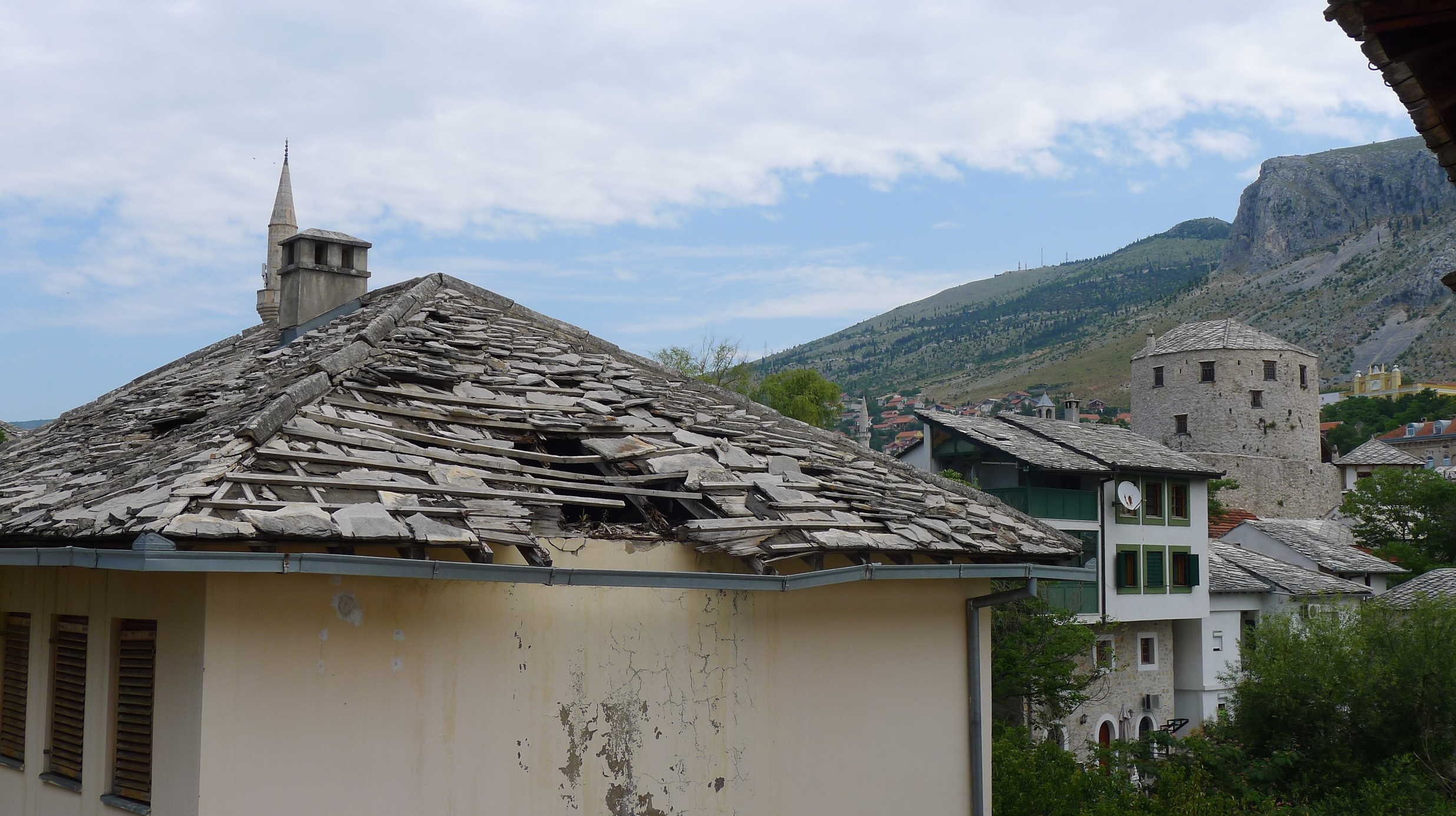
Well, the minaret, the decrepit buildings, and the vaguely Alpine feel of the vegetation and topography tell me it’s probably somewhere in the mountainous regions near the Black Sea. Since Tsarnaev was in court this week, and because I don’t have the the time or the obsessive nature to get more specific, I’ll pick Dagestan over Albania or any of the other possibles. I don’t see a free window book in my future, but maybe one day I’ll get to be one of the hilariously wrong entries at the beginning of the Tuesday post (or, dare I hope, one of the “getting closer” entries).
Another:
Minarets? Noticeably damaged structures that are nonetheless still standing? A steep hillside with a community on top of it? I’m going to guess that this is somewhere in southern Lebanon near the Israeli border, which would make that community with the high ground an Israeli kibbutz.
Another:
Long-time reader, first-time submission. In the spirit of the Type 4, two things pop out immediately: mountains and minarets. Then I spotted what looks like part of a church structure, so it’s got to be somewhere where Christianity and Islam overlap. I learned way more than I probably should know about minarets through Wikipedia and found a few that looked similar in Hungary, so I searched for cities in northern Hungary and Eger seemed to be a good fit. A quick Google Image tour of the city shows similar rooftops and a deceivingly similar yellow building as the VFYW.
Another:
Red roofs, European-style buildings, mountains, minarets … I’m going to guess it’s a view of the Mustafa Pasha Mosque in Skopje, Macedonia. The window looks to be somewhere to the Southwest. Beats me exactly where!
Another:
For this week’s view, I’m guessing Kruje, Albania, the site of Skanderbeg’s castle. Skanderbeg was a great military leader in the 15th century. He had an ingenious method of warning the country when the Ottoman Empire invaded: people would light a signal fire atop a mountain, and the sight of either the flames (night) or smoke (day) would warn those stationed atop other mountains to light fires in their turn, so that the news spread quickly throughout the country. Exactly like that scene in “Return of the King.” Kruje is a beautiful town well worth visiting. To be frank, on a quick search in Google images I couldn’t find that yellow building in the background, so it may be somewhere else in Albania. But I’m voting Kruje because it is fun to write the word “Skanderbeg.”
Another:
Oh man oh man! I know this one!
Maybe another reader will provide more accurate details-but what unexpected fun to know one of these. The building with the satellite dish in the middle of the picture is a wonderful tourist farm, Pr’ Betanci hosted by the friendly and helpful Marko, near the mind boggling (and UNESCO World Heritage Site) Skocjan Caves in the karst region of Slovenia. The tiny anachronistic town is called Betanja. The roofs are made of rocks to withstand the intense winds that arrive yearly. This picture seems to have been taken across the street from the tourist farm, probably at the edge of a huge drop-off which is a part of the cave system. Maybe someone’s house or apartment.
We stayed at this place a year ago May with our daughter, at the time a Peace Corp volunteer in Morocco and our son who joined us from San Francisco. We were looking for a country to meet up in that none of us had been to and that boasted great natural beauty. Slovenia did not disappoint! Amazing place. Fantastic food, wondrous hikes, gorgeous water.
Our reader follows up:
Oh man oh man, on second look I think I’m wrong. Oh well, it was super fun anyways.
Sounds too easy just to say it must be either Bosnia or Albania, since it could easily be a Turkish town abandoned because of an oncoming water project, but I have to plunk for Bosnia and wild-guess either Mostar or Srebrenica. Wonder how close I’ve come. Never been there meself.
Mostar it is:
My instant reaction this week was, “That looks like Albania.” Specifically, the town of Girokaster in the south of the country. I had a moment of doubt, but then I spotted the minarets and I was convinced. Wrong, but convinced. It took me a while to decide it wasn’t Girokaster, or any place else in Albania I was pretty sure it was somewhere in the Balkans though. After some thinking and different tries I settled on Mostar, Bosnia-Herzegovina.
I stopped in Mostar in June of 2000 as part of a long trip through Eastern Europe. I rode the bus up from Dubrovnik and spent the morning there before continuing on to Sarajevo. This was before the bridge had been rebuilt, and in fact very little damage had been repaired. I remember two things in particular. First how achingly beautiful everything was – the countryside really is some of the prettiest I’ve seen anywhere – and second realizing that the distinctive marks I saw everywhere in the pavement were caused by mortar strikes, which somehow brought the horror of the war home more than all of the devastated buildings and the bridge that wasn’t there any more. In Sarajevo a number the marks had been filled in with red resin and people referred to them as Sarajevo roses.
Another goes for the correct building in Mostar:
It is my perverse hope that I have exchanged a beautiful, sunny 80 degree day on the lake for a View From Your Window book. Something is wrong with me.
The buildings looked like Zagreb; I confirmed that the stone roofs were a Croatian sort of thing, but that didn’t make sense with the minarets. So, Herzegovina. Found white minarets and the citadel not in Sarajevo, but nearby in Mostar. At that point I was sure I found the right two white minarets, then the guard house/citadel/fortressy thing on the bridge. When I found a picture online that included the yellow building in the background, I got it.
So it’s always from a hotel, usually a small one. I got to the Motel Deny, which wasn’t quite it but left clues, so then I could search for nearby hotels. When I hit the Pansion Nur, I hit pay dirt with a picture that was virtually identical. The Pansion Nur website had other pictures that made the layout of the four room pension, and it’s relationship to nearby buildings, clear.
Now I have agonized about the exact window, having missed it before. The angle of that rough bothers me, how we can see the back corner of it. It doesn’t seem like that’s possible from the two bigger upstairs windows. The windows on the addition farther back appear to be too low. So that tiny kitchen window, on the far right of the main building, over the door? I think so. I’m calling it: far right window of the main building, over the door.
As always, I know I am now a member of a large club, as if I could get it, a lot of other people will, too. I have no history in Herzegovina. The closest I can come is I’m half Croatian and half Sullivan, so distantly related to a former-Yugoslavian VFYW, and I was off by a floor on the Rehobeth VFYW. And I had a flamboyantly wrong but printable wrong guess once. That’s all I’ve got.
P.S. Maybe it’s the Pansion Cardak next door. Which would be a bummer.
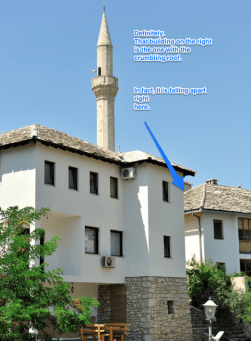
Bummer – the correct building is in fact Pansion Cardak:
This week’s VFYW was refreshing after a number of near-impossible weeks – not too easy, not too hard. My first reaction upon seeing the photo was that it was Albania. I received an invitation to the Peace Corps in Albania last week, and the mountains and minarets looked so similar to those I’d seen while researching my soon-to-be home. Alas, as my dad says, “Close, but no tomatoes.” I should have known better, too. The Tirana contest was the first one I played (and guessed correctly), and it’s doubtful that Albania would come around so soon.
While poking around different Albanian towns, I found a blog (I can’t find it again, arggh) in which a young woman had posted photos of her travels around Albania and this week’s town, Mostar, Bosnia and Herzegovina. The view is from a window at the Pansion Cardak Bed and Breakfast looking out over the town’s old bridge. The address is Jusovina br.3, Mostar 88000.
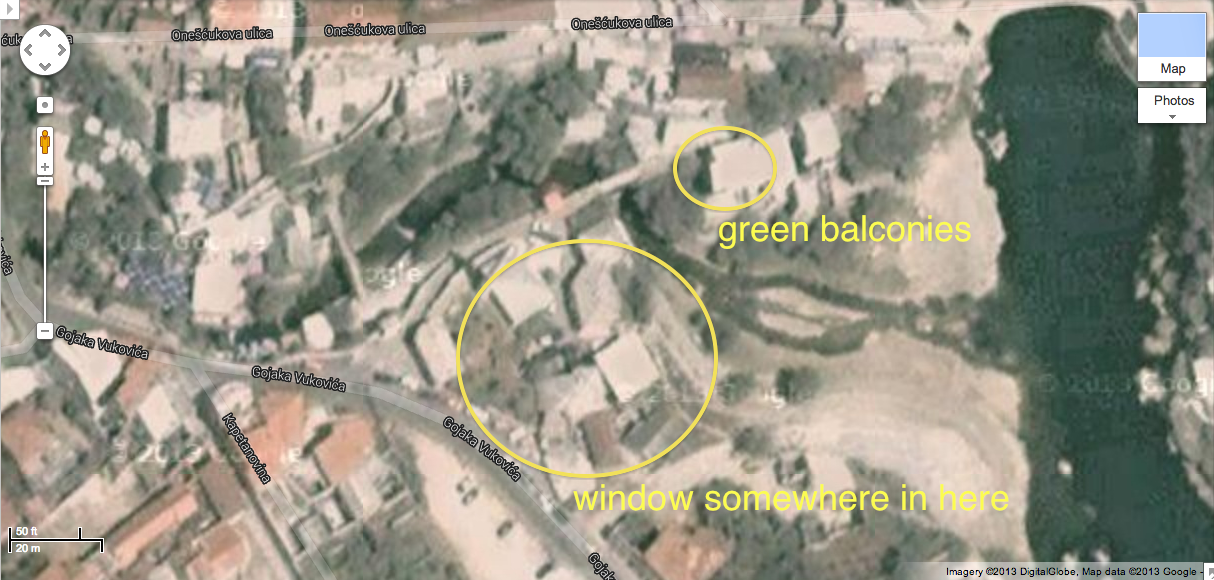
Another sends a satellite image:
Another:
This contest does a great service in expanding my knowledge of world geography and history. Thank you for giving us all a reason to be more curious and informed! I am quite certain the view is from the Old City area of Mostar, Bosnia and Herzegovina, looking northeast from the west bank of the Neretva River toward the tower of the Old Bridge, known as Stari Most. My best guess is that the view is taken from the second story of the Pansion Čardak guest house (map here), from this four-bed room, no doubt host to a few good pillow fights in the years since the city’s post-war reconstruction.
In my search, I learned a new word: palimpsest. There is a tension between the need to remember and the need to forget. Perhaps the tradition of diving off the bridge is a good way to honor both?
The 550-page nomination dossier to put the Old City of Mostar on the UNESCO World Heritage List, authored in 2005, is packed full of maps, images, and history readers may find of interest. The site made the list, with the Justification for Inscription crediting Mostar, “…as an exceptional and universal symbol of coexistence of communities from diverse cultural, ethnic and religious backgrounds – has been reinforced and strengthened, underlining the unlimited efforts of human solidarity for peace and powerful co-operation in the face of overwhelming catastrophes.” In the wake of present events, from Syria to Sanford, it is a timely reminder that coexistence is an idea, and more importantly an action, we all need to work desperately to reconstruct.
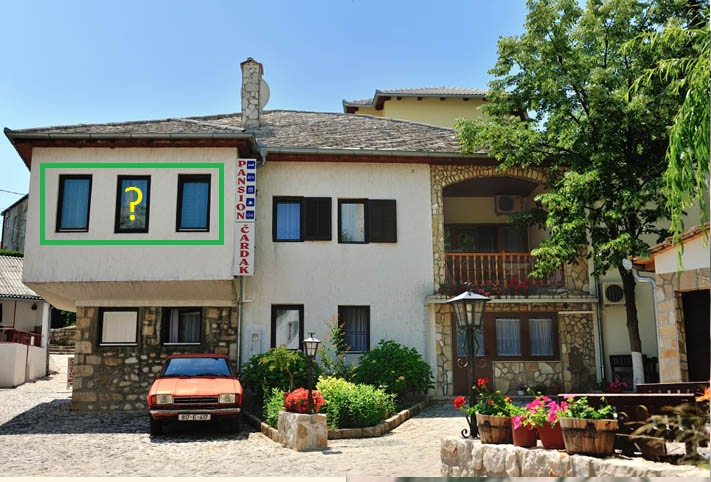
My window guess: I’m not quite sure which, but I’ll go with the middle of the three:
The submitter points to the correct window:
Thank you for selecting my picture for this week’s contest! For a little more background, the photo was taken from our room at Pansion Cardak, which I would highly recommend. Suzana, one half of the couple who own it, was as welcoming as can be. In this picture from their website, the window was the middle window on the upper floor – above the red car.
My girlfriend and I stopped over in Mostar after a few days in Sarajevo, on our way to Dubrovnik, Croatia. It was a great transition from the relatively un-touristed Sarajevo to the cruise-passenger crush of Dubrovnik, while retaining the fascinating multi-cultural character that we really enjoyed in Bosnia-Herzegovina.
Of course there’s the same troubled history that’s found everywhere in the Balkans – the most famous sight in Mostar is the Old Bridge, destroyed by besieging Bosnian Croat forces in 1993 but since reconstructed and reopened in 2004. The city is divided into a Bosniak (Muslim) eastern side and a Bosnian Croat (Catholic) western side, and our guide said that to this day there are locals who have not crossed the former front line since the siege.
That said, the photo (particularly the building in the foreground) doesn’t do justice to the town – it was a beautiful and friendly (and inexpensive!) place to visit, and an easy day trip from Dubrovnik for those traveling along the Adriatic coast.
Two readers guessed the correct window. The first one has participated in three contests:
I have been on these streets several times in the past decade with my students and this is just a hundred-meters or so from a square that in 2005 had a fascinating collection of political graffiti, ranging from the aggressively nationalist wolf of the Croatian Party of Rights (HSP).
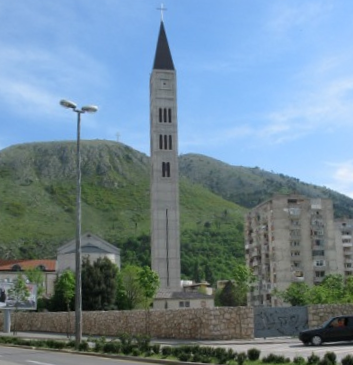
The Pansion Cardak is also only a few hundred meters from what may be the worst piece of religious architecture I have ever seen: the bell tower of Sts. Peter and Paul Church. It’s a variant on the region’s traditional bell towers, but done in prefab concrete and extended grotesquely out of proportion by an apparent desire to compete both with nearby minarets and with neighboring Croatia (it is allegedly 1 meter higher than the spire of Zagreb Cathedral). My first reaction was to see it as a middle-finger extended to Mostar’s muslim population, but up close, it has the painful look of a Viagra-overdose. (“If your artificial display of ethno-religious potency lasts longer than four hours, please consult a doctor or political scientist.”)
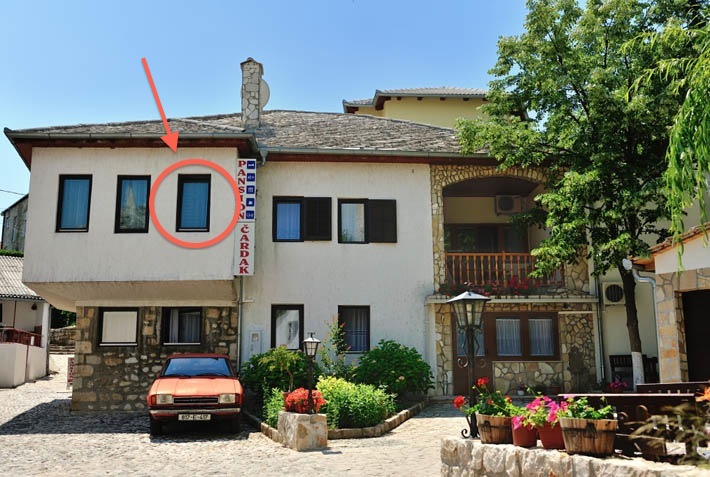
The second reader, however, has participated in eight contests, which serves as the tie-breaker this week:
This photo was taken from the second floor window of the Pansion Cardak Address looking northeast. You can see one of the towers of the famous Old Bridge (Stari Most) that was blown up during the Bosnia War and later rebuilt. I’ve attached a photo with the window of the pension circled that most likely was the photographer’s window:

 It is my perverse hope that I have exchanged a beautiful, sunny 80 degree day on the lake for a View From Your Window book. Something is wrong with me.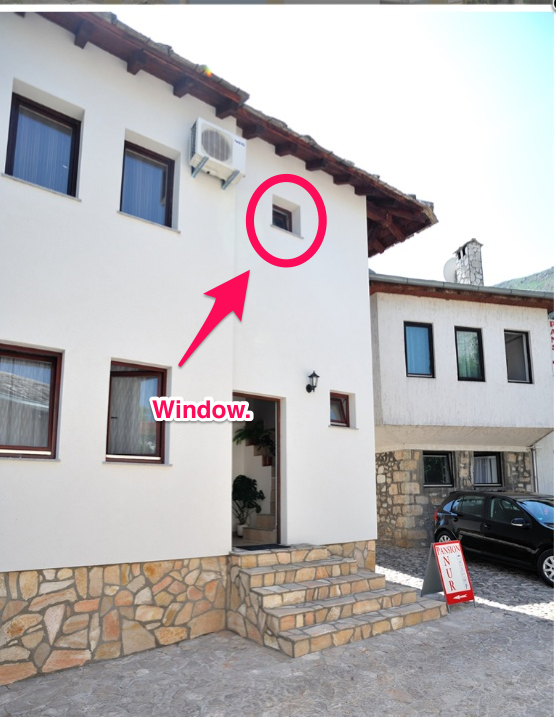
 The Dish