People sit during services honoring Trayvon Martin at Middle Collegiate Church in Manhattan on July 14, 2013 in New York City. George Zimmerman was acquitted of all charges in the shooting death of Martin July 13 and some congregants wore hoodies during the service to honor Martin. By Mario Tama/Getty Images.
That Reuters article wildly distorted what I said in that interview, and you’re now helping to spread it. My point was exactly the opposite: his lack of intent to harm the US is demonstrated by how responsible he’s been with the documents he had to take to prove what he was saying: documents which, had he not been responsible, would do serious harm to the US government (though not national security).
Molly Redden argues that Harry Reid’s filibuster reform proposal “is so modest that you could fairly construe it as a return to the status quo”:
It wouldn’t interfere with the minority’s ability to prevent a piece of legislation from coming to a vote, which members can do today without even staying on the Senate floor. And it doesn’t threaten the talking filibuster, of “Mr. Smith Goes to Washington” fame, which Senator Rand Paul used to such spectacular effect this spring. … [L]et’s not pretend that Reid’s choice to eliminate the filibuster in one narrow instance would organically, inevitably lead the Senate to eliminate the filibuster altogether. Those are separate choices in which the majority party will perceive separate stakes. As for whether the Senate could come to resemble their malfunctioning counterpart, it would be a false equivalence to make believe that that’s the rules’ fault.
When the Senate is filibustering executive branch nominees not because of their qualifications but because they don’t like what they would be legally authorized to do in office, I think a small rule change is vital. The GOP is becoming not an opposition party, but a wrecking ball, denying the ability of a duly elected president to nominate his own officials – and get them in place – within his own branch of government. Sarah Binder weighs in:
I think it’s important that Reid appears to be narrowly tailoring a rule change to apply only to executive branch nominees (and perhaps only after a nomination has been pending on the executive calendar for a set length of time). When asked by CQ’s intrepid Senate reporter, Niels Lesniewski, about what Reid would do when contested judicial nominations came to the floor in a couple of weeks, Reid refused to expand the scope of conflict to judges: “This is focused very concisely…This is not about judges…This is about presidential executive nominees.” Why was Reid so adamant about limiting the reach of a rule change to executive branch nominees? A narrowly tailored change might make his nuclear gambit look more like previous episodes of reform by ruling. It might also make it easier to secure the support of 51 Democrats.
Mark Kleiman wishes Reid would be more aggressive:
It’s understandable that some Senate Democrats want to solve the current crisis with as little damage as possible to their own power and that of their successors. That’s why Reid plans to move ahead with a rules change covering executive nominations only. But the Republican threat of retaliation – the one sort of Republican utterance that is invariably sincere – makes the proposed strategy of limited rules change incoherent. Since the Republicans will retaliate against a limited rules change with a comprehensive rules change, Democrats will never again get any benefit from being able to use the filibuster. So, in a rational world, having been forced to use the nuclear option to move the current batch of blocked confirmations they’d use it on everything at once. There’s no point in getting a little bit pregnant.
I’m completely with your perception of the Zimmerman trial as a real tragedy. But you made a mistake in your original post that I think requires a correction, or at least a clarification. In your original post you wrote:
I can see two things clearly: when there are no witnesses but the two individuals involved in a fight, and the victim is dead, and you live in a state that provides “stand your ground” immunity for self-defense, then proving a murder beyond a reasonable doubt is hard.
But there was one witness to the actual fight: Jonathan Good.
He testified that Martin was above Zimmerman, straddling him and beating him up before the shots were fired. Good’s testimony – as the only eyewitness – was extremely important. There were two narratives of the events in question: 1. That Martin was doing nothing when he was accosted by Zimmerman (and shot after a confrontation that Zimmerman initiated), or 2. That Martin attacked Zimmerman while Zimmerman was returning back to his car. Good’s testimony (apparently) supports the second narrative more than the first (at least that’s what most reporters thought at the time – we’ll have to wait on what the jurors say).
For what it’s worth, I think a manslaughter charge was justified and the jury’s interest in it (asking for additional instructions) proves just how clearly the state bungled this case. You haven’t dealt with that, but it’s important. If you don’t believe me, go back to the video of the two closings and compare them. Prosecutor Bernie de la Rionda yelled and shouted several times during his closing, and when Mark O’Mara opened the defense, the first thing he did was tell the jury he wasn’t going to shout and yell; he was going to change the tone of the discussion and be civil and respectful and appeal to reason. Even before he got into his argument, when I heard that, I knew he was going to win.
The Good testimony does indeed suggest that at some point in a scuffle, Martin was on top of Zimmerman. But another witness, Selma Mora, testified to the opposite. None had a very clear picture on a dark night. And Good did not witness the actual shooting. Good, moreover, denied Zimmerman’s claim that his head was being smashed against concrete (a critical point if you are claiming self-defense to the point of killing someone); and they all testified that after the fight, Zimmerman was bloodied but not by anything remotely life-threatening. I stand by my original post, although of course, the jury, as my reader notes, was examining every minute and I wasn’t. Good’s testimony might well have swayed them. And, again, I can easily see why they acquitted Zimmerman, given the reasonable doubt of such a confusing incident in the dark.
Up until now, Greenwald has been within bounds as a journalist. But Snowden’s [Saturday] message, delivered through Greenwald, is criminal extortion and not remotely anything like whistle-blowing or journalism:
“Snowden has enough information to cause more damage to the U.S. government in a minute alone than anyone else has ever had in the history of the United States,” Greenwald told the Argentinian newspaper La Nacion. Asked if he was afraid that Snowden might be killed, Greenwald said: “If something were to happen, those documents would be made public. This is your insurance policy.”
“The U.S. government should be on your knees every day praying that nothing happens to Snowden, because if something happens, all information will be revealed and that would be their worst nightmare,” Greenwald added.
Separate and apart from anything they’ve done up to know, this is despicable. I’d love to get your take on this. I fear the fame this episode has brought Greenwald has gotten to his head and he is now becoming just a criminal and a traitor.
The latest from Greenwald and Snowden is also unsettling:
“In order to take documents with him that proved that what he was saying was true he had to take ones that included very sensitive, detailed blueprints of how the NSA does what they do,” said Greenwald in an interview with the Associated Presspublished Sunday. Greenwald said Snowden had “literally thousands of documents,” which he called “basically the instruction manual for how the NSA is built.”
I can understand the reasons for exposing the security state’s innards if you want to render the entire program moot. I’m not sure I understand the motive for withholding that information as a form of blackmail or “life insurance policy”. This sentence from Greenwald is troubling to me as a journalist:
Snowden has enough information to cause more damage to the U.S. government in a minute alone than anyone else has ever had in the history of the United States.
If Snowden and Greenwald want to expose what they regard as illicit programs, why not just expose them? Bragging about their capacity to blackmail or terrify their own government seems, well, at best hyperbolic, and when the threat is made in a foreign newspaper, disturbing.
A new documentary film is in the works on the American way of mutilating infant boys – for profit and social conformity:
This embed is invalid
They just reached their Kickstarter target but could always use more funding to end this barbaric practice for both genders at their most vulnerable. Ten years ago, the British Medical Association put out the following statement:
“…it is now widely accepted, including by the BMA, that this surgical procedure has medical and psychological risks … the harm of denying a person the opportunity to choose not to be circumcised must also be taken into account, together with the damage that can be done to the individual’s relationship with his parents and the medical profession if he feels harmed by the procedure … The BMA does not believe that parental preference alone constitutes sufficient grounds for performing a surgical procedure on a child unable to express his own view … Doctors should ensure that any parents seeking circumcision for their son in the belief that it confers health benefits are fully informed of the lack of consensus amongst the profession over such benefits, and how great any potential benefits and harms are. The BMA considers that the evidence concerning health benefit from non-therapeutic circumcision is insufficient for this alone to be a justification for doing it.”
Previous Dish on this contentious subject – with plenty of dissents – here.
Responding to George Zimmerman being found not guilty, Joyner writes that “the prosecution handled a weak case poorly and that an acquittal should surprise no one”:
Now, of course, juries sometimes get it wrong. Many innocent men have been found guilty and many people who plainly did what they were accused of doing are acquitted. In this particular case, there’s no doubt, reasonable or otherwise, that George Zimmerman killed Trayvon Martin, a teenage boy who did not deserve to have his life ended. But that wasn’t what the jurors were being asked to decide. Rather, they were charged with deciding whether Zimmerman committed second degree murder as defined by Florida statute. And, as contemptible as George Zimmerman is and as outrageous as Trayvon Martin’s death is, it strikes me as pretty obvious that he did not, regardless of what one believes about what happened after the events we hear on tape end.
I think the jury basically got it right. The only real eyewitness to the death of Trayvon Martin was the man who killed him. At no point did I think that the state proved second degree murder. I also never thought they proved beyond a reasonable doubt that he acted recklessly. They had no ability to counter his basic narrative, because there were no other eye-witnesses.
But, in a later post, TNC puts the case in context:
The injustice inherent in the killing of Trayvon Martin by George Zimmerman was not authored by jury given a weak case. The jury’s performance may be the least disturbing aspect of this entire affair. The injustice was authored by a country which has taken as its policy, for lionshare of its history, to erect a pariah class. The killing of Trayvon Martin by George Zimmerman is not an error in programming. It is the correct result of forces we set in motion years ago and have done very little to arrest.
A glimpse at those forces:
Cord Jefferson likewise connects the shooting of Trayvon Martin to society’s racial prejudice:
It is a complicated thing to be young, black, and male in America. Not only are you well aware that many people are afraid of you—you can see them clutching their purses or stiffening in their subway seats when you sit across from them—you must also remain conscious of the fact that people expect you to be apologetic for their fear. It’s your job to be remorseful about the fact that your very nature makes them uncomfortable, like a pilot having to apologize to a fearful flyer for being in the sky.
Meanwhile, Jazz Shaw dismisses any idea that the trial was about race:
In the post-Zimmerman era, anyone who winds up in a conflict situation where there is a racial difference between the parties can now stand up and say that the villain was profiling the other party. It provides the convenient mental imagery to lump them in with rogue cops and the rest of the story. Don’t look for this to end any time soon. Profiling is the new substitute for discrimination, even if the perpetrator has nothing to do with law enforcement, and I’m betting it’s going to have a long run.
But I fail to see how profiling wasn’t obviously salient in this incident. Zimmerman convicted Martin of being a punk and a would-be burglar because he was black and wearing a hoodie in a complex where burglaries had recently taken place committed by young black men. Implicating an innocent person in that criminal group because he was a stranger, and looked like the criminals, is classic profiling. Charles P. Pierce groans:
[O]f course, this was not about race because nothing is ever about race.
The prosecutors even told us that it wasn’t about race. The defense won its case because this was not about race. The sharp guys and pundits will spend all weekend explaining how race was an element of the events that night, but that the case, ultimately, was not about race. And because this case was not about race, nothing out of our history counts, because our history, here in the land of the free, is not about race, either. Because our history is not about race, a few weeks ago, when the Supreme Court gutted the Voting Rights Act, what happened on the Edmund Pettus Bridge was not relevant. Because our history is not about race, last night, Emmett Till was not relevant, even though a few people inconveniently brought him up. But that was years ago, and the country has changed, and it is John Roberts’ Day Of Jubilee, and this trial was not about race because nothing is about race any more.
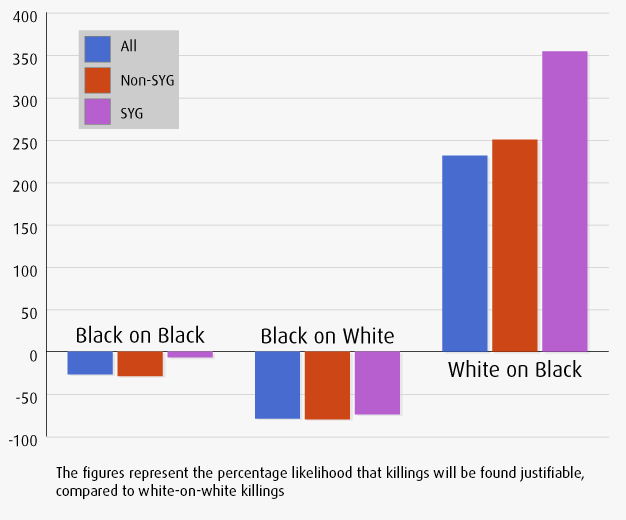
Along the same lines, Lisa Wade examines the racial effects of Stand Your Ground (SYG) laws:
[W]hite people who kill black people are far more likely to be found not-guilty even in states without SYG and black people who kill whites are less likely to be found not-guilty regardless of state law.
It’s simple: We are already biased in favor of the white defendant and against the black victim. Stand your ground laws give jurors more leeway to give defendants the benefit of the doubt. This increases even further the chances that a white-on-black homicide will be considered justifiable because jurors will likely give that benefit of the doubt to certain kinds of defendants and not others. Stand your ground may or may not be a good law in theory but, in practice, it increases racial bias in legal outcomes.
Carrying a deadly weapon in public should carry unique responsibilities. In most cases someone with a gun should not be able to escape culpability if he initiates a conflict with someone unarmed and the other party ends up getting shot and killed. Under the current law in many states, people threatened by armed people have few good options, because fighting back might create a license to kill. As the New Yorker‘s Amy Davidson puts it, “I still don’t understand what Trayvon was supposed to do.”
Unless the law is changed to deal with the large number of people carrying concealed guns, there will be more tragic and unnecessary deaths of innocent people like Trayvon Martin for which nobody is legally culpable.
Steven L. Taylor insists the legal system, however broken, was served:
In point of fact, the courts are supposed to produce an outcome that is commensurate with the laws as written. As such, if one finds an outcome to be “unjust” is it quite likely that the source of the injustice is not the criminal justice system, per se, but is, rather, the fault of legislators. Indeed, it is often the fault of the demands of the public (which are frequently contradictory*). Regardless, the application of the law in a certain circumstance often produces a legally correct (or, at least, a legally consistent and logical) outcome even if the outcome may not be considered “just” in an abstract sense. And, of course, the question of what is just, both in general and in the specific, is a normative one that is open to disagreement. Such disagreements, as is often the case with normative disputes, can be quite passionate.
My initial thoughts after hearing the verdict are here.
“Here’s the question no one asks: Was Trayvon Martin acting as a racial vigilante that night? Was he administering his own form of Street Justice in response to Zimmerman’s alleged racial profiling?” – Ace of Spades.
While the court did not release the racial and ethnic makeup of the jury, the panel appeared to reporters covering jury selection to be made up of five white women and a sixth who may be Hispanic.
I used quote marks around “white” for the reason my reader notes. Another:
For someone who “didn’t follow the trial that closely,” the truth of the Zimmerman case is surprisingly obvious to you. You state that Martin “was clearly racially profiled, followed and challenged,” and you call that a “fact”. You further state that “Zimmerman clearly made a decision that led directly to” Martin’s death. Those “facts” were disputed at trial, and a jury – who were especially chosen out of a pool of many for their impartiality, who weighed vastly more evidence and heard more testimony than you, and who spent 12 hours deliberating the case – concluded that those were doubtful claims, not facts.
We don’t know the details of the jury’s deliberations. But no-one disputed the fact that Zimmerman described Martin thus to the cops before he killed him:
Fucking punks. These assholes. They always get away.
And he was told by the cops to stop his stalking. He decided to ignore them. My reader continues:
You make other egregious errors about America’s system of justice. I’m sure many of your readers will point them out to you (such as the fact that a jury of one’s peers is a right of the defendant, not the victim). But if you feel the need to comment about “race in America” again, you first ought to examine your own heart. Why are you so quick to impute racism not only to Zimmerman, but also to a jury whose members are wholly unknown to you? Why are you so quick to assume, with so little knowledge, that systemic racism has so tainted the minds of Americans that our very system of justice is untrustworthy? Why did you feel it necessary to make a bombastic comparison between the manifest wrongs of nearly a century ago (lynchings) with a case where right and wrong is so painfully unclear?
I emphatically do not believe the jury’s verdict was racist; I think they almost certainly made the right call given the evidence and how they were instructed. It was Geraldo who said they were racist. As for the right of the defendant to a jury of his peers, technically my reader is right. But Martin was effectively put on trial as well; and an almost all-white six-person jury of women doesn’t seem to represent either Zimmerman’s or Martin’s peers.

 The Dish