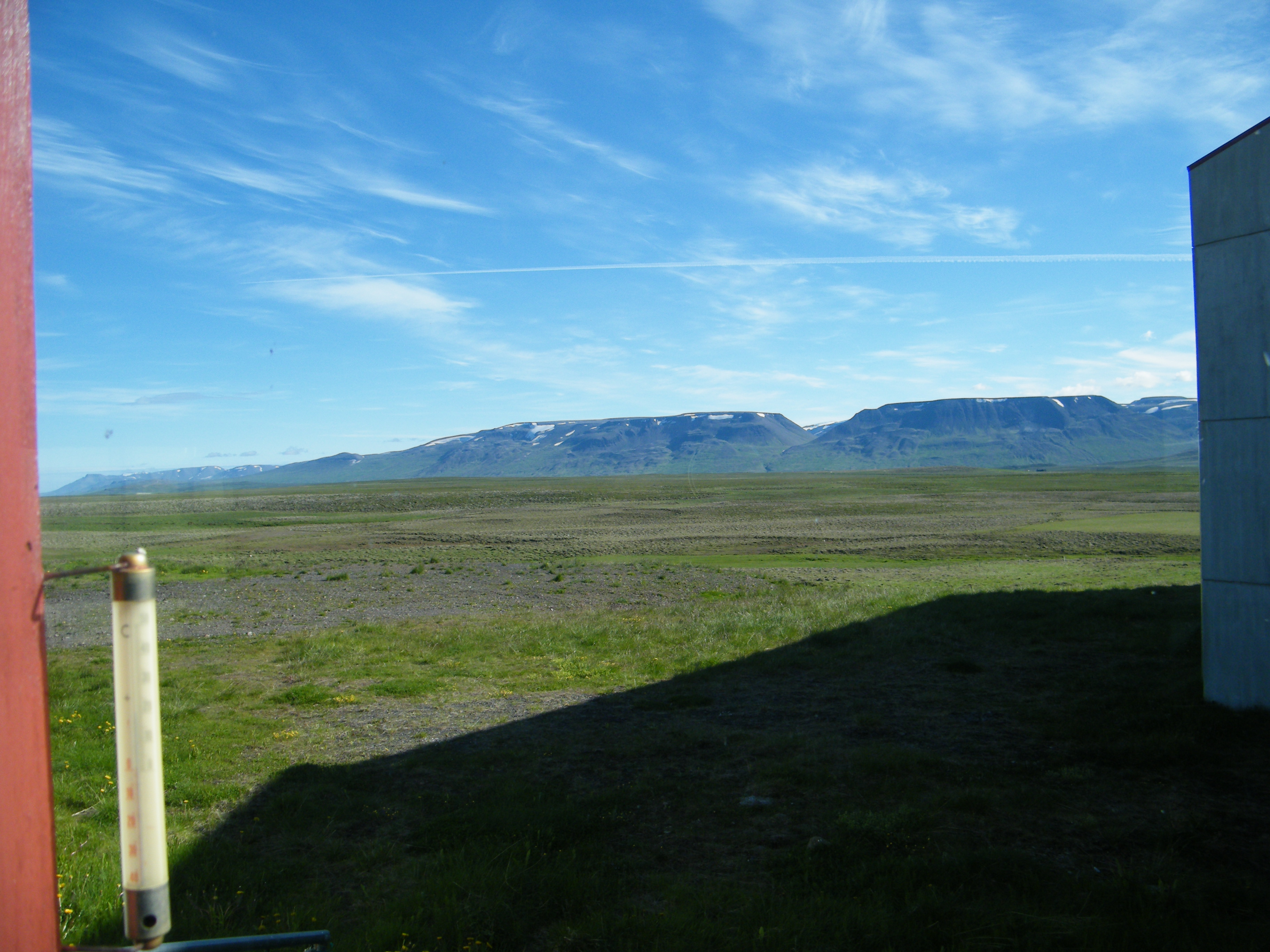
Húnavellir Skóli, Iceland, 8 am
Húnavellir Skóli, Iceland, 8 am
“I don’t think anyone’s really inclined to ‘share’. My thing about social networks is that it’s fundamentally insincere. I know from the record company perspective it’s part of the marketing process, and the fans can communicate with you… but it creates a fake intimacy, which in my opinion results in frustration and ultimately makes people angry. And I think that’s why, on Twitter, or indeed in the Guardian comments, everything turns into a row, and it’s because it’s presented as though they care what you think, but you realize they don’t, and then it turns nasty. It’s a sort of fake democracy. And we prefer to be not fake,” – Neil Tennant, pop genius.

A couple of points, one of which is a correction. The “Stand Your Ground” law in Florida was responsible for the delay in the trial, and, by some accounts, the difficulty in getting all the forensic evidence after so much time had passed. There’s little question that it was a law George Zimmerman was aware of. But it was not directly used by the defense in the actual trial, as I suggested, where the case became a classic one of self-defense in a very murky incident in the dark with no reliable witnesses. Josh Marshall has a good post on this nuance – but the Florida self-defense law is the same as in every state but Ohio. Eugene Volokh notes:
Who should bear the burden of proving or disproving self-defense in criminal cases, and by what quantum (preponderance of the evidence, clear and convincing evidence, or beyond a reasonable doubt), is an interesting question. But on this point, Florida law is precisely the same as in nearly all other states: In 49 of the 50 states, once the defense introduces any evidence of possible self-defense, the prosecution must disprove self-defense beyond a reasonable doubt.
This goes back as far as 1877:
“When a person, being without fault, is in a place where he has a right to be, is violently assaulted, he may, without retreating, repel by force, and if, in the reasonable exercise of his right of self defense, his assailant is killed, he is justiciable.”
The phrase “being without fault” seems problematic to me in this case. Once Zimmerman ignored the police warnings to leave Martin alone and let them handle it, it seems to me he was at fault. And that decision was the critical moment Martin’s life came under threat. With the Stand Your Ground law behind him, Zimmerman kept up his amateur policing. It’s the permissiveness of that law that can cause the emboldening of vigilantes. In the end, though, none of that mattered save Zimmerman’s contention that he had no way to retreat under alleged assault by Martin, and so was justified in killing an unarmed individual.
Still, it’s hard to read stories like this one without wondering how deeply this case may have shifted the sense of some whites that if they gun down kids in hoodies, they’ve got the law on their side. To wit:
In November, black youth Jordan Davis, a 17-year-old Jacksonville resident, was the only person murdered after Michael Dunn, 46, allegedly shot into the SUV Davis was inside several times after an argument about the volume of music playing … At the Gate Station, Rouer said Dunn told her that he hated “thug music.” Rouer then went inside the store to make purchases and heard several gunshots while she was still within the building.
Upon returning and seeing Dunn put his gun back into the glove compartment, Rouer asked why he had shot at the car playing music and Dunn claimed that he feared for his life and that “they threatened to kill me.” The couple drove back to their hotel, and claim they did not realize anyone had died until the story appeared on the news the next day.
What scares the shit out of me is the detail that the alleged murderer did not even blink as he got back in his car. His defense is that the black teens he shot at had a gun, even though no evidence has surfaced to prove that in any way, and that he shot in self-defense. But:
Without solid evidence from both sides and one surveillance video that only shows the story from the inside of the convenience store, this case has a long way to go.
What mindset allows you to shoot into a car full of teens because you hate “thug music”, and drive off as if nothing had happened? The mindset of Geraldo Rivera. I remain of the view that the best response to this case is to repeal these laws that empower vigilantes and all but encourage the murder of young black men – if you can find one alone, with few witnesses, and a semblance of a suspicion.
Steve Grand – star of the above music video, of unrequited gay love – is having a sensational month:
The 23-year-old singer-songwriter doesn’t have a label, manager, agent or publicist to back him, which makes amassing more than 1.2 million views in 10 days (he uploaded the video on July 2) an impressive feat. “This is all very grass-roots. All I did was upload the song on YouTube and share it on Facebook. It got around pretty quickly,” Grand said by phone from Chicago, apologizing for sounding tired due to lack of sleep after a whirlwind of press interviews.
While many people have dubbed Grand “the first openly gay country singer,” Zach Schonfeld isn’t so sure:
Grand’s story is indeed inspiring. Hailing from a Catholic family in the Midwest, the singer was sent to “straight therapy” for several years shortly after discovering his sexuality at 13. He self-financed his music video with $7,000, and according to a feature in the Chicago Sun-Times, his job experience “has run the gamut from modeling to supplying music for Catholic church events.” Only a week into Internet stardom, he has developed a flair for the dramatic. “I would die a happy man today,” he told the Sun-Times. “And it’s the first time in my entire life I can say that.”
But is rushing to call Grand the “first openly gay male country star” not a little, err, reductive, or even inaccurate? As is often the case with these sorts of bold media proclamations, the label brushes aside a bit of history in its eagerness. Most notably, it ignores Drake Jensen, a Canadian country singer who came out in February, 2012, and whose latest video, “Scars,” details the pain of being bullied as an LGBT teen. Of course, you could argue that Jensen isn’t exactly a star, and his video won’t likely have the same viral appeal; as Salon’s Daniel D’Addario notes, “his bearish physique isn’t winning him any fans among the BuzzFeed set.”
Grand himself questions the label:
“I actually didn’t set out to write a country song,” he said. “I’m not really concerned with labels, honestly. I was really surprised when I saw I was being labeled as a a ‘gay country star’ and people saying I was the first.” “There have been people that have done it before, and I certainly don’t want to take anything away from them. It’s not important to me whether I’m the first or not,” he continued. “I just wanted to create something really beautiful that resonated with people all over the world. The song has done all I could ask for.”
He got emotional on Good Morning America talking about how his family reacted to the music video. And coming out as a country singer hasn’t had a great track record so far:
In 2010, the industry was buzzing with the rumors that a gay singer was ready to come out. It ended up being Chely Wright, a country singer who had a #1 country hit in 1999 with “Single White Female.” Wright capitalized on her buzz to release new music and introduce herself to a new generation of fans via pride parades and gay media, and also released a documentary called Wish Me Away that showcased her career and struggles with being gay in country music.
However, by early 2011 she was singing a different tune. In an interview with the website Autostraddle, she was blunt and honest about the negative effects that coming out had on her career. “It didn’t help my career,” she said. “My record sales went directly in half. If it appears from the outside in that it’s helped my career, it could be because I haven’t talked about the negative.”
But Eric Sasson wonders whether Grand should even worry about such measures of success:
Steve Grand is already finding his audience among the thousands of viewers who have seen the video and have been touched by his story. So many artists are eschewing the traditional route of labels and releasing their own music, and finding an audience on their own—look no further than Macklemore to see how record labels may not matter as much as they used to. Grand’s audience may not end up being the traditional consumers of country music, but he is further proof that many artists would prefer to do things on their own terms than compromise who they are in order to win the hearts of executives and focus groups.
Lester Brathwaite has more for Grand fans:
Before baring his soul with “All-American Boy,” Grand bared a little more as Steve Chatham and the fast/furious moniker Finn Diesel, modeling underwear for DNA magazine, photographers Tom Cullis and Wander Aguiar, among others. But hey, girl’s gotta make that dough and that viral video didn’t pay for itself. Oh, and let’s not forget his previous musical incarnation as Steve Starchild, which gave us this cover of Lady Gaga’s “Marry the Night.” Sadly that video’s no longer available, but there’s also this other Gaga cover, “You and I“– we were never really into that song to begin with anyway.
Go here to watch him cover Lil’ Wayne’s “How to Love”.
Errol Morris sets the scene for the above trailer:
Josh Oppenheimer’s film The Act of Killing—for which I served, along with Werner Herzog, as an executive producer—is an examination of the Indonesian mass killings of 1965-66, in which between 500,000 and 1 million people died … [Oppenheimer] identified several of the killers from 1965 and convinced them to make a movie about the killings. But the film is even weirder than that. Oppenheimer convinced these killers to act in a movie about the making of a movie about the killings. There would be re-enactments of the murders by the actual perpetrators. There would be singing, and there would be dancing. A perverted hall of mirrors.
Morris poses a challenging question to Oppenheimer about a scene where the film’s central character, Anwar Congo, watches footage of himself re-enacting killings and subsequently pukes on a rooftop:
Morris: … The vomiting—whether the vomiting is one more performance for himself and for us, or if it is the result of something real. Can we ever know? … I’m left in the end with a question. I know that there is a past for people, but do they ever deal with it, or do they just try to reinvent it or just make it up out of whole cloth?
Oppenheimer: You’re raising a very, very scary thought. It’s so disturbing in some way that it would’ve been hard for me to maintain my relationship with Anwar, if this were an operating assumption. It could be right. If Anwar doesn’t have a past and also has these at the very most echoes, reverberations or stains from what he’s done that he doesn’t recognize, and if the final moment is maybe yet another moment of performance, if he then disappears into the night and we’re left in this shop of empty handbags, and there’s no connection to the past on that roof, then it’s almost too chilling for me to contemplate what the whole movie is really saying. It’s a disturbing thought.
After surveying a series of panicked stories about young people developing poor memory as a result of smartphones, Tom Stafford provides a reality check:
For a long time it was TV, before that it was compulsory schooling (“taking kids out of their natural environment”). When the newspaper became common people complained about the death of conversation. Plato even complained that writing augured the death of memory and understanding. The story also draws on the old left brain-right brain myth, which – despite being demonstrably wrong – will probably never die. Of course, it is possible that smartphones (or the internet, or TV, or newspapers, or writing) could damage our thinking abilities. But all the evidence suggest the opposite, with year by year and generation-by-generation rises found in IQ scores. One of the few revealing pieces of research in this area showed that people really are more forgetful of information they know can be easily retrieved, but actually better able to remember where to find that information again.
This isn’t dementia, but a completely normally process of relying on our environment to store information for us. You can see the moral panic driving these stories reflected in the use of that quote about teenagers not being able to remember phone numbers. So what! I can’t remember phone numbers any more – because I don’t need to. The only evidence for dementia in these stories is the lack of critical thought from the journalists reporting them.

A reader sends the above photo:
I usually can’t stomach stories about losing a pet, but I’ve been reading each one on this beautiful thread. Thanks.
Many more reflect on the need for selflessness when it comes to confronting our pets’ mortality:
Your love for them compels you to let them die with dignity in their own time and not on our time. When their bodies fail them, they are telling you in their own way to let go. I have learned this lesson the hard way when I kept my dog alive (with numerous surgeries and excessive medications) way longer than I should have. I have held two loving companions as they took their last breath. I cried for days on both occasions, but for different reasons. The first was due to guilt because I kept my canine companion around for selfish reasons such as that I couldn’t bear to live without them. The second time was due to the loss of my canine companion. The second loss has been much easier on me in the long run.
Another reader:
Our Sunny, a 16-year-old beagle, died in March. She was deaf, half-blind, crippled with arthritis … even maybe a little demented, since I don’t know if she really knew who my husband and I were anymore. But what told us that the time had come were her cries of pain. They weren’t whines or howls, just almost human cries. Our attending veterinarian and her husband were lovely and compassionate. We held our dog and told her how much we loved her and that she was going to be free of pain very soon. I wish I could say we would be free as well, but it is a better pain to grieve for a friend who’d given us so much rather than to endure the guilt of keeping her with us one more day because of our own selfishness.
I will be thinking of you, Andrew. You’ll know when it is time. God bless you.
Another:
I recently lost a dear pet, Tobias the Shetland Sheepdog. My wife and I loved him dearly, so we clung to him long after we should have made the rational choice. He suffered from arthritis and was mostly blind and deaf, to the point he wouldn’t go outside except in bright daylight. Still, he was the best little dog a human being could ask for. He had the most pettable ears. It’s very difficult to let go of a beloved pet. I just wanted you know you’re not alone.
Another:
I hope that both you and Dusty will be fortunate enough for her to pass away peacefully in her sleep. But if that is not to be, take comfort in the blessing of being able to ease her suffering. My beloved beagle developed lymphoma at the age of 14. I made the seemingly impossible decision to put him to sleep when he reached the point that the tumors in his neck were so large that he could no longer drink water. The alternative for him was an excruciating death from dehydration. He was so sick and weak that when the drugs were administered he simply relaxed and was gone. He died in my arms, surrounded by people who loved him. We should all be so lucky.
Months later, I came across the Villalobos Quality of Life Scale, which is used to help owners understand when euthanasia may be the right choice for their pet. I scored my dog and was surprised and almost relieved to see that, at my most generous, I could maybe give him a score of 15 in his final days. Euthanasia was the most compassionate and loving choice I could have made. It’s been two and a half years, and I still miss him every day.
More readers:
I just read your thread on putting down dogs. I went through this on April 30 of this year. Redding was my companion for 13 years. He was as handsome as he was sweet. He started to show his age a couple of years ago, around 11. So I had this two-year waiting period of wondering what you are going through with Dusty as he got slower and more fatty tumors popped up. He had been limping for a couple of weeks and the vet could not figure out what was wrong so we decided to keep an eye on it. One Saturday night he came into our bedroom just panting. It hurt him too much to sit or lay down so he just stood there. Panting. That was the sign that it was time to let him go. We got through Sunday and Monday I took him to the vet. For me it was a relief to see him pain free. My wife came with me to drive me home, but at that point she was more upset than I was. So I drove.
I was surprised that I felt what I was feeling. I was happy that my boy was no longer miserable and in pain, but kind of numb to the loss. I made arrangements with the vet to have him cremated. And over the next couple of weeks I would get sad when I walked in the house and looked at the couch, but did not see him there. I would tear up when people let me know what a good dog he was and that he is the reason they themselves got dogs. But it really hit me in the parking lot after I picked up his ashes. I had one of those good deep sobbing cries. It hits me now and again. I still find myself looking for him in his usual spots.
Anyway, just wanted to tell you my story (I believe I wrote in a while ago hoping you would cheer me up). It is hard and they do let you know, but in my case, there was also a great sense of relief and knowing that I made the right decision and did not hold on to him too long for selfish reasons in the hopes that he would miraculously get better. He loved and was loved in turn. He really was a good boy.
Another:
My family had to put down our lemon beagle, Bruce, a few years ago. He was 12, and it was clearly time; he didn’t have a major sickness, but was extremely frail and completely stopped eating and we didn’t want him to suffer. I couldn’t be there because I was living abroad, but my parents and sister took him to the vet, where they put him to sleep in the courtyard of their small office park, near a fountain. He was a so cute (huge ears that made him look like a puppy well into old age), and the rare dog that actually liked the vet. A few of the assistants even came out to be with him and cried because they loved him too. My sister held his head in her lap as he drifted off.
When it comes time for Dusty, I really, really encourage you to not let her suffer because it’s too hard for you to let her go. I’ve seen this happen way too often and it’s so painful to watch. When the spark has gone out in her eye, you’ll know. Don’t let yourself be blinded by your love and need for her.
Another:
I know you’re getting a ton of emails on this topic, but I have noticed differences in how people respond to their pets’ end of life issues. I’ll preface this with a recent medical scare we had with our 14 lb, Type 2 diabetic Siamese cat. We love him so much that we placated his constant meowing at his food bowl by feeding him too much! Hence we, in a sense, gave him Type 2 diabetes. Diet and two insulin shots a day for two years. Then something very scary happened.
Last week, my wife fed him breakfast and gave him his morning insulin shot. About 10 minutes later, he lost control of his bowels and vomited (poo, pee, and vomit almost simultaneously … an unholy trinity if there ever was one). He then collapsed on the floor. I rushed him to our vet (after giving him some corn syrup) to find out he was in insulin shock and had gone blind.
My wife cried almost the whole day. Our cat might die, and he was clearly suffering (luckily he recovered and is now in diabetes remission). If the vet told us that he couldn’t be saved, I would have put him down immediately. My wife? Not so much.
It seems many people become wrapped up in their own grief to the detriment of the suffering animal. We keep our animals alive for us not for them. It’s a bit of a paradox. We’re willing to have our animals suffer because we don’t want them to die. We love these family members, but our own feelings of loss lead us to hurt the things we love. I found myself telling my wife that we needed to think of the cat and not about our feelings. I admit that not every case is clear cut, that there’s a waiting game that can happen while treatment occurs. However, some cases are clear, yet many people wait … and wait … until they’re ready for their animal to die, which seems backwards and selfish to me.
Must we control every aspect of our animals’ lives, including making them live too long?
Another reader:
I delayed putting down the first dog my husband and I shared, a black Lab he had before he met me. He couldn’t bring himself to make the decision and I could not bring myself to push him to do it, even when I knew it was the right thing. I will never let my own selfish feelings get in the way like that again. I will never be able to look one of my companions in the eye again and essentially say, “You must suffer because I don’t have the guts to do what is right”.
One more:
I have had the pleasure (if pleasure is ultimately a positive outcome) of being present at the planned final moments of five of our pets, and the agony of two that were unplanned, but should not have been unexpected. One week after 9/11, I awoke to find our black labrador mix Calvin floating lifeless in our swimming pool, no doubt because his poor eyesight and shaky legs doomed him when all he probably wanted was a drink of cool water. He’d been struggling for a while, but we could not bear the thought of putting him down.
About a year before, our beagle Lester (who bore a striking resemblance to Dusty) had a growth on his liver, but we decided to try surgery, even though he was already 13 years old and had other health issues. Whether by fate or the incompetence of the veterinarian, he bled out on the operating table and that is our last memory of him.
In both cases, our own selfishness prolonged their lives beyond what was fair and reasonable. We have learned our lesson, and all our beloved pets since have been showered with love and affection on their final day; we like to think that is what they took with them to their end. You can expect to have reservations when the time comes, but trust your own instincts. Simply imagine how you would want other humans to treat you if you were in a similar situation, and the decision will be clear.
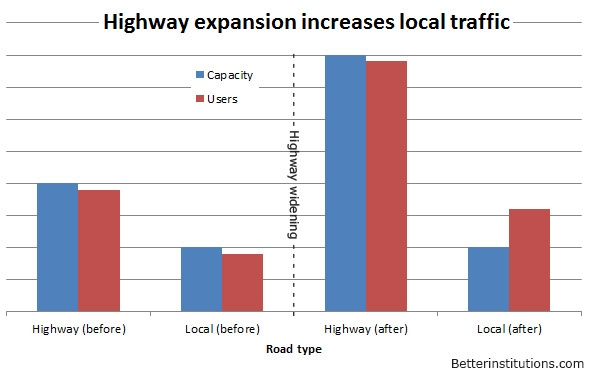
Shane Phillips, who created the above chart, thinks so:
[I]magine this scenario: you live 20 miles outside the city and want to get downtown, so you take the freeway there. The highway part of your trip used to take 30 minutes, but thanks to the new lanes it now only takes you 20 minutes. The last mile of your trip has slowed since there’s a bit more local traffic, but it only increases from three minutes to five. All told, your trip time has decreased from 33 minutes to 25–great!
Now imagine you live in the city, five miles from the city center. It used to take your bus 20 minutes to get downtown, but unfortunately as a city resident you don’t reap many benefits from the additional highway capacity. Instead, your trip is entirely on local roads, so all those extra cars coming into the city only slow you down. The trip that used to take you twenty minutes now takes thirty. The suburban visitor/commuter saved about ten minutes, and the city resident lost about ten, and all it cost was a few hundred millions dollars in construction and millions more in demolished buildings and businesses that are no longer producing revenue for the city. Money well spent, right?
(Hat tip: Angie Schmitt)

Caleb Scharf defends science writers who use metaphors against those who oppose “anything that smacks of anthropomorphism”:
Black holes are not, they complain, allowed to be ‘monsterized.’ Galaxies can’t experience painful disruption, planetary systems can’t be spoken of as disheveled entities or family members. Well, okay, but since prehistory humans have sought to relate to the world around themselves by finding anthropomorphic connections. Is it scientific? No, not particularly, but what are we to do, just shrug and separate ourselves from the entire natural world–them and us?
As a working scientist I actually don’t have any problem with the notion of making mental labels for natural phenomena that include some degree of personality. I like my black holes fearsome and my interstellar gas thin and frail. It may well be that in doing so one reinforces a certain blinkering, but we’re not all Mr. Spock, we need structures, we need something to hang on to–as long as we remember to let go occasionally.
More Dish on the use of metaphor in science here.
(Comic: xkcd)
Apparently not like this:
A pilot explains:
I prefer the term “auto flight system” instead of “autopilot” because we’re actually talking about a collection of subsystems that help control various aspects of a flight: heading, altitude, course, speed, engine power, etc. Different components are used at different times, and can be used together or separately, depending. There is a thing called the autopilot, which frees you from having your hands physically on the controls. There’s also something called the autothrottle, which controls engine thrust. I say “controls,” but it’s doing so in response to what’s needed and input by the crew.
He’s not happy about what most people associate with term:
One of the most stubborn myths in all of aviation is this notion that pilots just sit there while the plane flies itself from City A to City B. It’s infuriating to know that people believe this, because it’s utterly false. Airplanes do not fly themselves. The crew flies the airplane through the automation. A plane cannot fly itself any more than an operating room, with all of its advanced technical equipment, is able to perform an organ transplant by itself. The equipment makes things easier, but the operation itself is controlled by humans.

 The Dish