Face Of The Day

dish_hairlesscat1

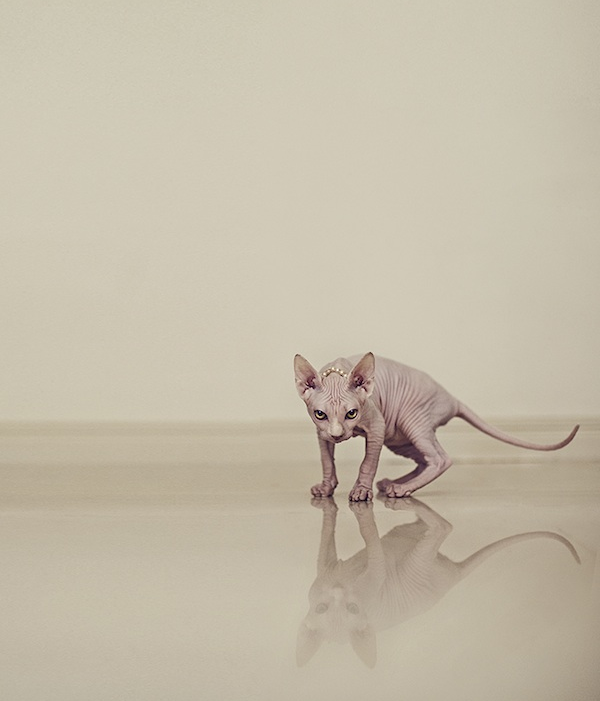
Serenah Hodson photographs Sphynx cats:

When asked why she decided to create a whole series about them, she told us this, “Sphynx cats have always fascinated me, there’s something mysterious almost mythological about their appearance. It’s like they come from another planet. I wanted to photograph them because they are so bizarre-looking, I wanted to show people their beauty.

“I honestly believe that if you look at any animal long enough and close enough you’ll find them beautiful, eventually. Man-made things can be incredibly ugly, but Mother Nature knows what she’s doing.

“I think some people are just turned off by their nakedness, but I love that they’ve got nothing to hide. And they really do have the most amazing personalities, they’re very outgoing and ‘dog-like’ which makes them wonderful to photograph.”

(Photo: Serenah Hodson)

Reading In Reverse

Brad Leithauser devises a readers’ experiment: how do poems stand up when we read their concluding lines first? In the case of Robert Frost’s “Hyla Brook,” this technique yields epiphany:

Does he fully deserve his last line: “We love the things we love for what they are”? Suddenly, having this time read the poem backward, its full beauty broke over my head. The poem is not necessarily about a brook—lovingly evoked though its brook-ness is. It could just as well be the one-eyed cat we adopt because no one else will take it in. Or the incompetent oil painting we embrace because a great-uncle painted it. (See Elizabeth Bishop’s “Large Bad Picture.”) Or your dead grandfather’s sweater, which you hold onto even though it is: 1) ugly, 2) unfashionable, 3) pilled and worn, 4) ill-fitting.

Frost might not have appreciated the backwards approach, however:

There’s an irony in reading Frost backward, given how strongly he recoiled at working backward. He once noted, “I never started a poem yet whose end I knew. Writing a poem is discovering.” He viewed the issue in characteristically ethical terms. To write a poem whose ending you were already aware of seemed to him a form of cheating. I’ve never been able to share Frost’s views on this. If a poet determines that a poem should begin at point A and conclude at point D, say, the mystery of how to get there—how to pass felicitously through points B and C—strikes me as an artistic task both genuine and enlivening. There are fertile mysteries of transition, no less than of termination.

The Inner Lives Of Animals, Ctd

“Do elephants have souls?” asks Caitrin Nicol, who describes how the beasts demonstrate an unusual appreciation for mortality:

For man, his sense of self, sense of history, and sense of the intemporal, however inchoate, are gestured at with his remembrance of those who have passed on. But here he is joined by the elephants, the only other known creatures that — whatever it may mean to them — purposively commemorate their dead, in a way [Coming of Age with Elephants author] Joyce Poole calls “eerie and deeply moving”: “It is their silence that is most unsettling. The only sound is the slow blowing of air out of their trunks as they investigate their dead companion. It’s as if even the birds have stopped singing.” Using their trunks and sensitive hind feet, the ones they use for waking up their babies, “they touch the body ever so gently, circling, hovering above, touching again, as if by doing so they are obtaining information that we, with our more limited senses, can never understand. Their movements are in slow motion, and then, in silence, they may cover the dead with leaves and branches.”

After burying the body in brush and dirt, family members may stay silently with it for over a day; or if a body is found unattended by elephants not related to it, they may pause and stand by for some time. They do this with any dead elephant, recently deceased or long departed with only the skeleton remaining. “It is probably the single strangest thing about them,” [Elephant Memories author] Cynthia Moss writes:

Even bare, bleached old elephant bones will stop a group if they have not seen them before. It is so predictable that filmmakers have been able to get shots of elephants inspecting skeletons by bringing the bones from one place and putting them in a new spot near an elephant pathway or a water hole. Inevitably the living elephants will feel and move the bones around, sometimes picking them up and carrying them away for quite some distance before dropping them. It is a haunting and touching sight and I have no idea why they do it.

Elephants even react to carved ivory, long divorced from the original remains and altered and handled extensively. Poole writes of a woman who came to visit Tsavo National Park wearing ivory bracelets: as an elephant approached, the park warden cautioned her to hide them behind her back; but when the elephant arrived, she reached around behind the woman and contemplatively perused the bracelets with her trunk. Poole then had a friend stage a repeat performance later, and the same thing happened.

Recent Dish on animal consciousness here and here.

From Rag To Comedy Riches

New-names-for-armed-services-e1373373069927

George Meyer’s late-’80s humor magazine Army Man had a staff that went on to fill the ranks of The SimpsonsSNL, and The New Yorker.  James Folta scans old copies of “America’s Only Magazine” and marvels that it isn’t more well-known:

[W]hat makes Army Man‘s humor so relatable is that many of the pieces are pointedly critical and, like much great humor, evidently reflect the writers’ frustrations. The jokes land with more honesty and truth as a result. … It’s the density of the jokes that makes them more than just a quick laugh. They are able to pull in large ideas, universal gripes, and pain. This universality and relatability is what would make the Simpsons one of the greatest shows of all time. …

In the age of Twitter, it can be tempting to compare Army Man‘s short, punchy humor to tweets. But unlike Twitter, Army Man has no chaff. This is the power of an editor with a strong vision. Meyer chose the funniest of funny. Careful attention is given to each joke but also to the unity of the absurdist, off-kilter voice. With Twitter and democratic or algorithmic organization, the steading hand of an editor is lost. Meyer’s editorial guidance makes Army Man more than what it would appear to be.

The magazine’s success would be its ultimate downfall.

One of Army Man‘s biggest fans was producer Sam Simon. When Simon needed to quickly pull together a writing staff for the first season of The Simpsons, he opened a copy of dish_AMpetpeeveAmerica’s Only Magazine and hired George Meyer, Jon Vitti, and John Swartzwelder. Later, most of the masthead of Army Man would end up writing for The Simpsons. Which was great for The Simpsons, but it doomed the magazine. Meyer didn’t want to sacrifice the quality of either by trying to juggle his attention. So after just three issues, the magazine stopped.
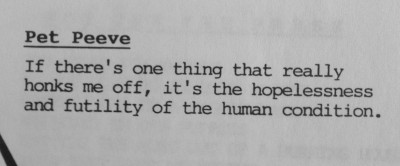
Army Man‘s ranks also included Jack Handey, Andy Borowitz, and Bob Odenkirk.
The View From Your Window Contest

Screen Shot 2013-07-12 at 2.57.52 PM

You have until noon on Tuesday to guess it. City and/or state first, then country. Please put the location in the subject heading, along with any description within the email. If no one guesses the exact location, proximity counts.  Be sure to email entries to contest@andrewsullivan.com. Winner gets a free The View From Your Window book or two free gift subscriptions to the Dish. Have at it.

Sex And The Civil War

Angela Serratore revisits a curious chapter in America’s sexual history. In 1862, Nashville’s population of sex workers had risen more than sevenfold over the past two years, and gonorrhea and syphilis were on the rise among Union soldiers. After unsuccessfully trying to expel the prostitutes from the city, George Spalding, provost marshal of Nashville, legalized the profession:

Resigning himself to the fact that soldier-line-upprostitutes would ply their trade and soldiers would engage them, he reasoned that the women might as well sell sex safely, and so out of sheer desperation, Spalding and the Union Army created in Nashville’s the country’s first system of legalized prostitution.
Spalding’s proposal was simple: Each prostitute would register herself, obtaining for $5 a license entitling her to work as she pleased. A doctor approved by the Army would be charged with examining prostitutes each week, a service for which each woman would pay a 50 cent fee. Women found to have venereal diseases would be sent to a hospital established (in the home of the former Catholic bishop) for the treatment of such ailments, paid for in part by the weekly fees. Engaging in prostitution without a license, or failing to appear for scheduled examinations, would result in arrest and a jail term of 30 days.

The prospect of participating in the sex trade without fear of arrest or prosecution was instantly attractive to most of Nashville’s prostitutes, and by early 1864 some 352 women were on record as being licensed, and another hundred had been successfully treated for syphilis and other conditions hazardous to their industry. In the summer of 1864, one doctor at the hospital remarked on a “marked improvement” in the licensed prostitutes’ physical and mental health, noting that at the beginning of the initiative the women had been characterized by use of crude language and little care for personal hygiene, but were soon virtual models of “cleanliness and propriety.”

(Image: Case Western Reserve University’s Dittrick Medical History Center)

A Poem For Saturday

Old Tombstone

Wendell Berry, prolific and versatile poet, essayist, and fiction writer, and a dedicated activist, has lived for decades as a writer and small scale farmer on seventy-five acres in Henry County, Kentucky where his ancestors settled in the early 19th century.

Berry has written novels set there, including Hannah Coulter (2004) and A Place on Earth (1967). Along with his many books of poems – among them, Given: New Poems (2005) and The Selected Poems of Wendell Berry (1998) – he is the author, as well, of many collections of essays, including The Art of the Commonplace: Agrarian Essays of Wendell Berry (2002) and What Are People For? (1990). His many books of stories include That Distant Land: The Collected Stories of Wendell Berry (2002).

In 2010, he was awarded a National Humanities Medal. Today and in the days ahead, we will post several characteristically beautiful poems of his, beginning with “The Meadow”:

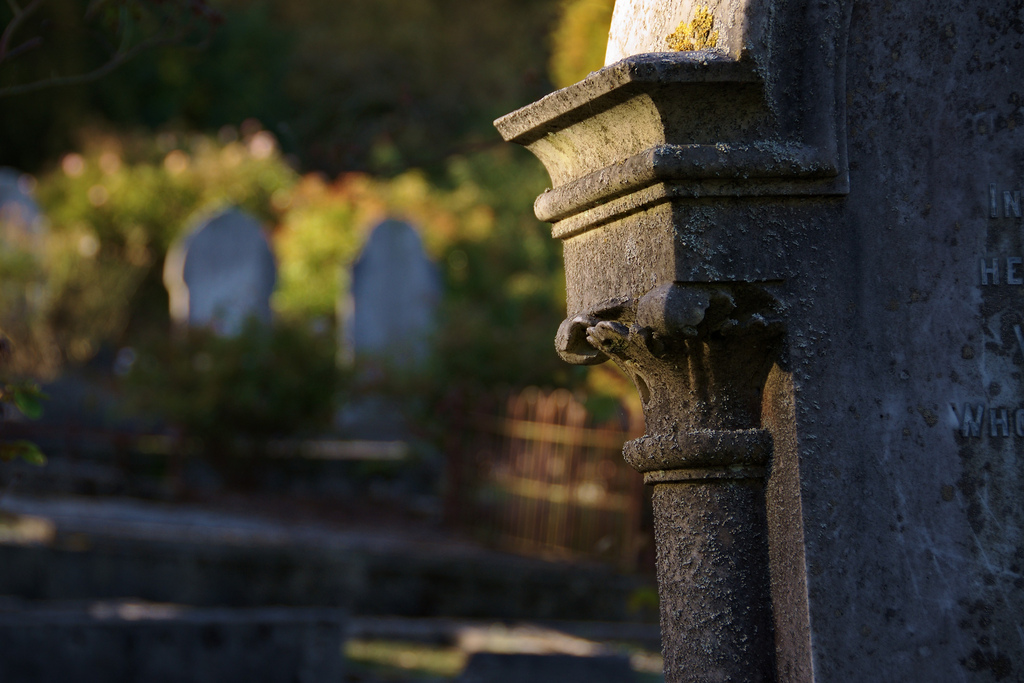
In the town’s graveyard the oldest plot now frees itself
of sorrow, the myrtle of the graves grown wild. The last
who knew the faces who had these names are dead.
and now the names fade, dumb on the stones, wild
as shadows in the grass, clear to the rabbit and the wren.
Ungrieved, the town’s ancestry fits the earth. They become
a meadow, their alien marble grown native as maple.

(From Collected Poems, 1957-1982 © 1984 by Wendell Berry. Reprinted with kind permission of North Point Press. Photo by Tomas Sobek.)

Creative Voices

A Radiolab podcast reviews the career of neurologist and author Oliver Sacks, who turned 80 this week. In an interview with Suzanne Koven of The Rumpus, Sacks discusses his new book Hallucinations and the connection between hallucinations and creativity:

Rumpus: You describe the hallucinations Henry James had on his death bed—vivid scenes of the Napoleonic Wars—and novelist Amy Tan’s hallucinations when she had Lyme disease. Do you think that creative people have more interesting hallucinations? Or do you think they simply describe their hallucinations in a more interesting way?

Sacks: Well that’s a very nice, contrasting pair. Amy called them “a detritus of a dream,” or something like that and had not much interest, whereas Henry James thought it was some subjacent fantasy which he’d had all his life and finally sort of took over. At one time I did read a book called The Voices of Poetry, where the thesis was very much that a “voice” is not just a metaphoric reference to the muse.

Rumpus: Have you had that experience in writing? Of hearing a voice?

Sacks: No. Yes. Although I wouldn’t call it … I’m not sure what to call it. I have it less now, but with my first book, with Migraine, there were many, many problems, including a sort of mad, internal threat in which I said to myself, in September of ’68, You have ten days to write it and if you’re not finished by ten days, you’ll commit suicide. This sounds even madder than it was. You have to know some of the background. Anyhow, under my own threat or joke, I first started writing and within hours the feeling of terror was replaced by a feeling of joy in the writing and, in particular, a feeling that I was taking the book down to dictation. It came to me absolutely fluidly by a sort of inner voice. I was excited. I didn’t want to go to bed. I slept for two or three hours a night and no more. Perhaps I was hypomanic. I’m not sure what word to use.

So that was very much like hearing a voice. I can’t say it was anyone’s voice in particular. But my verbal auditory imagery is as vivid as my visual imagery is poor. My musical imagery is somewhere in between.

“What If Superheroes Were Psychotic?”

That’s the question Amber Frost thinks is posed by the short film above:

In this beautiful, unsettling short film, “The Flying Man,” a powerful Übermensch actually takes it upon himself to be judge, jury, and executioner. Unlike the usual underdog superheroes of comics, where the audience is meant to casually rationalize their operation outside the rule of law, we are left completely chilled as he drops people from dizzying heights to their terrifying deaths with a sadistic resolve. He is in no way the protagonist, or even an anti-hero: he’s a terrorist.

A Stroll Through Literature

Matt Seidel emphasizes the metaphorical power of describing how literary characters walk. One example:

“The Shadow Over Innsmouth” betrays a pathological fear of “biological degeneration” that manifests itself in the narrator’s loathing of the Innsmouth natives, those “blasphemous fish-frogs of the nameless design” who hop irregularly through abandoned streets.

The tale is partly about an abiding embarrassment over the clumsiness of our ancestors as they crawled forth from the ocean and were literally fish out of water. Aristophanic gymnasts these Innsmouth creatures are not. Fish-like though they may be, their motion at times seems “positively simian.” Particularly noteworthy is their “alien-rhythmed footfalls,” the “dog-like sub-humanness of their crouching gait,” as they surge “inhumanly through the spectral moonlight in a grotesque, malignant saraband of fantastic nightmare.” The narrator feels a growing and uncanny connection to the natives, and thus in a nice touch, he manages to escape partly by imitating their shambling hop. The walk, though feigned, nonetheless reveals a certain truth about his origins. By the end of the tale, and after some timely physiological changes, the narrator becomes a Prufrock with gills who can more than merely fantasize about cavorting with underwater sirens.