A reader sent it in from an exhibition at the Katonah Museum of Art in New York, as part of a quilt-like structure of artefacts from the AIDS era. Eww:
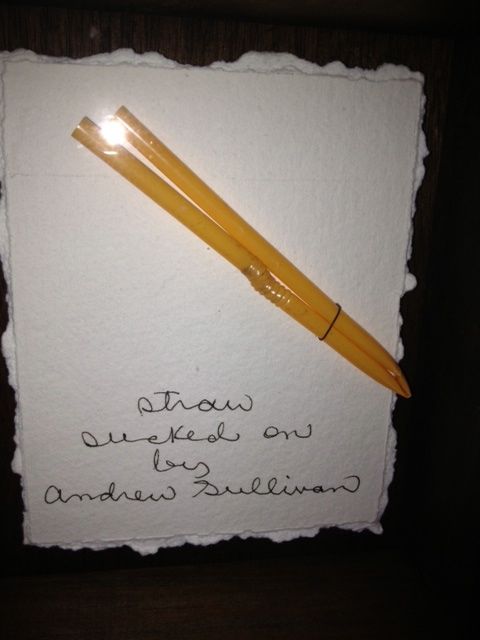
The full exhibit:

A reader sent it in from an exhibition at the Katonah Museum of Art in New York, as part of a quilt-like structure of artefacts from the AIDS era. Eww:
The full exhibit:
Yesterday, in a post titled “Kill The Bill,” Lowry and Kristol came out against immigration reform. Lowry defends his position in the above video. There’s nothing new in what he is saying. It amounts to the same arguments as the past (enforcement won’t happen, even after a bill that ladles resources into that under an administration that has deported illegal immigrants at record rates) and the same Kristol view of politics as the past: total warfare at all times against anything that might get signed by president Obama.
I have to say I am unsurprised by this. Lowry basically said (above) he’d be happy for next-to-no legislation to ever pass the Congress, regardless of the underlying problems. Notice too that for Lowry, the actual plight of the undocumented workers and their families is completely absent. And this is what, to my mind, rightly affects Latino voters. Lowry and Kristol cannot see past intellectual categories and Village pyromania to empathize whatsoever with close to half the country. They think the problem was this:
During the debate over immigration in 2006–07, Republican rhetoric at times had a flavor that communicated a hostility to immigrants as such.
They don’t even hear themselves, do they? As for the Latino vote, how’s this for communication of hostility?
At the presidential level in 2016, it would be better if Republicans won more Hispanic voters than they have in the past—but it’s most important that the party perform better among working-class and younger voters concerned about economic opportunity and upward mobility.
Whites First! How Douthat sees the Lowry-Kristol op-ed:
The core of the Lowry-Kristol thesis isn’t that the G.O.P. should necessarily resign itself to a Romney-esque performance among Hispanics in 2016 and beyond; it’s that a conservative party with an appealing, populist-inflected economic agenda will ultimately probably win more white votes and more Hispanic votes (and, for that matter, black votes and Asian votes) than a conservative party whose idea of rebranding is just a headlong rush to put President Obama’s signature on an immigration bill.
Notice that the motives include nothing of any substantive policy concern and are entirely about differences over partisan interest. And if Ross believes the current GOP is going to adopt any of the populist economic policies that could be attractive to working class white voters, he’s looking at a different party than I am. Repealing universal healthcare will reassure economically insecure whites? Gutting Medicare will do the same? Who is proposing anything but steep austerity and yet lower taxes in the GOP?
First Read wonders whether Republicans in favor of immigration reform have any cards left up their sleeves:
Given the growing conservative opposition to immigration reform, here’s a question worth asking: Can pro-reform Republicans strike back?
Today from his presidential library in Dallas, TX, George W. Bush will be delivering a speech on immigration. But is this going to help convince conservatives or make them even more resistant? Remember, the modern conservative movement hasn’t been too friendly to Bush’s policies or presidential agenda. The GOP-leaning American Action Network is up with a $100,000-plus national TV ad campaign, urging Republicans to support the Senate’s immigration reform bill. But is $100,000-plus enough? And GOP immigration supporters have released a poll showing that Republican primary voters want to fix the immigration system and prefer an imperfect solution to no solution. But is releasing a poll going to do the trick? Right now, the Republicans who want immigration reform to pass have been VERY QUIET lately. Does that change?
Dickinson considers the risks of killing immigration reform for Republicans:
Waiting for 2015 … means Republicans will have to live with the collapse of immigration reform for the next year or so. Perhaps voters will applaud that Republicans didn’t rush a bill that was bad policy. But given Congress’ approval ratings and willing Republicans ready to point fingers, it’s also just as possible that the independent voter might conclude that the GOP cannot apply reason to the problems of the day to find a workable solution.
How could any voter not see that?

Puebla, Mexico, 10 am
Rick Hertzberg has a must-read. These indeed are the remaining, big, unanswered questions:
Has the N.S.A. program actually worked to uncover and thwart terrorist plots? If so, are there or could there have been alternate means that could have worked about as well or better at less cost—less cost in money and resources, less cost to civic trust and confidence? In what concrete ways does the program invade people’s privacy? Exactly how, if at all, does the program increase the government’s power to do bad things to good people? And how much does it add to the powers the government already has via information-gathering and police-like agencies such as the I.R.S., the F.B.I., and the Homeland Security apparatus? Is the marginal increase in government power that the N.S.A. program represents justified by the marginal increase in safety that it provides, if it does provide such an increase?
That’s a helpful via media between the defensive crouch of Washington and the hyperbole of Snowden – toward a rational testing of the policy’s costs and benefits. Yes, we pay a president to make that kind of call for us – but presidents are inclined to back the system, if only to protect their own political posteriors in an age of sporadic Jihadist terrorism. An independent review would be useful – unless the NSA did to it what Brennan and his former war criminal buddies are doing to the Senate Intelligence Committee Report on torture.
In our first video from Michael, he offers his thoughts on the troubling rise of polarization in Egypt, and whether civil strife could follow:
Some see no civil war any time soon. Laura Dean:
First, the Egyptian army is powerful, and though it might provoke here or deliberately refuse to act there, it nevertheless would not allow a full-blown civil war. This would defeat the military’s central objective of cementing its own authority. And it is not clear that the Brotherhood would be willing to call on its supporters to take up arms or could marshall enough support to take on a force as powerful and apparently united as the Egyptian Army. Egypt is unlikely to become another Algeria, where the army removed the Islamists from power before they had been allowed to try their hand at governing, resulting in civil war. In this case, by contrast, the army has widespread support in part because many people think that the Brotherhood sealed its own fate through a year of bumbling and incompetent governance.
Furthermore, while there are clear efforts to marginalize the Brotherhood, the army and interim government have gone to great lengths to include and accommodate the Salafi Nour Party, indicating that there is still room for Islamists to participate in politics. The Nour Party may absorb former Brotherhood members and others who might otherwise defect from the political process entirely. Finally, Egypt already had an armed Islamist insurgency in the 1990s. And it didn’t work.
Nour Youssef looks at how Egyptians of various political stripes are responding to recent events:
The word polarization fails to describe what is happening now. Public opinion is more of an aggregation of wishes for the defeat, suffering and death of certain members of the public, who are no longer considered members altogether, by other members of the public, whom they no longer consider members of the public.
Case in point, the sentence “We need to cleanse Egypt of (insert group of people you disagree with)” is one I hear everywhere. The refusal to accept that the country will not run out of islamists or secularists for many years, if ever, and that neither party can be effectively shunned from society, is making conversations simply exhausting.
Michael Wahid Hanna is a Senior Fellow at The Century Foundation, where he works on issues of international security, international law, and U.S. foreign policy in the broader Middle East and South Asia. He has published widely on U.S. foreign policy in newspapers and journals, including articles in the New York Times, the Los Angeles Times, the Boston Globe, Christian Science Monitor, the New Republic, and World Policy Journal, among other publications, and is a frequent contributor to Foreign Policy. He appears regularly on NPR, BBC, and al-Jazeera. His Twitter feed is also a must read for anyone interested in Egyptian politics. Our full coverage of the current events in Egypt is here. Our Ask Anything archive is here.
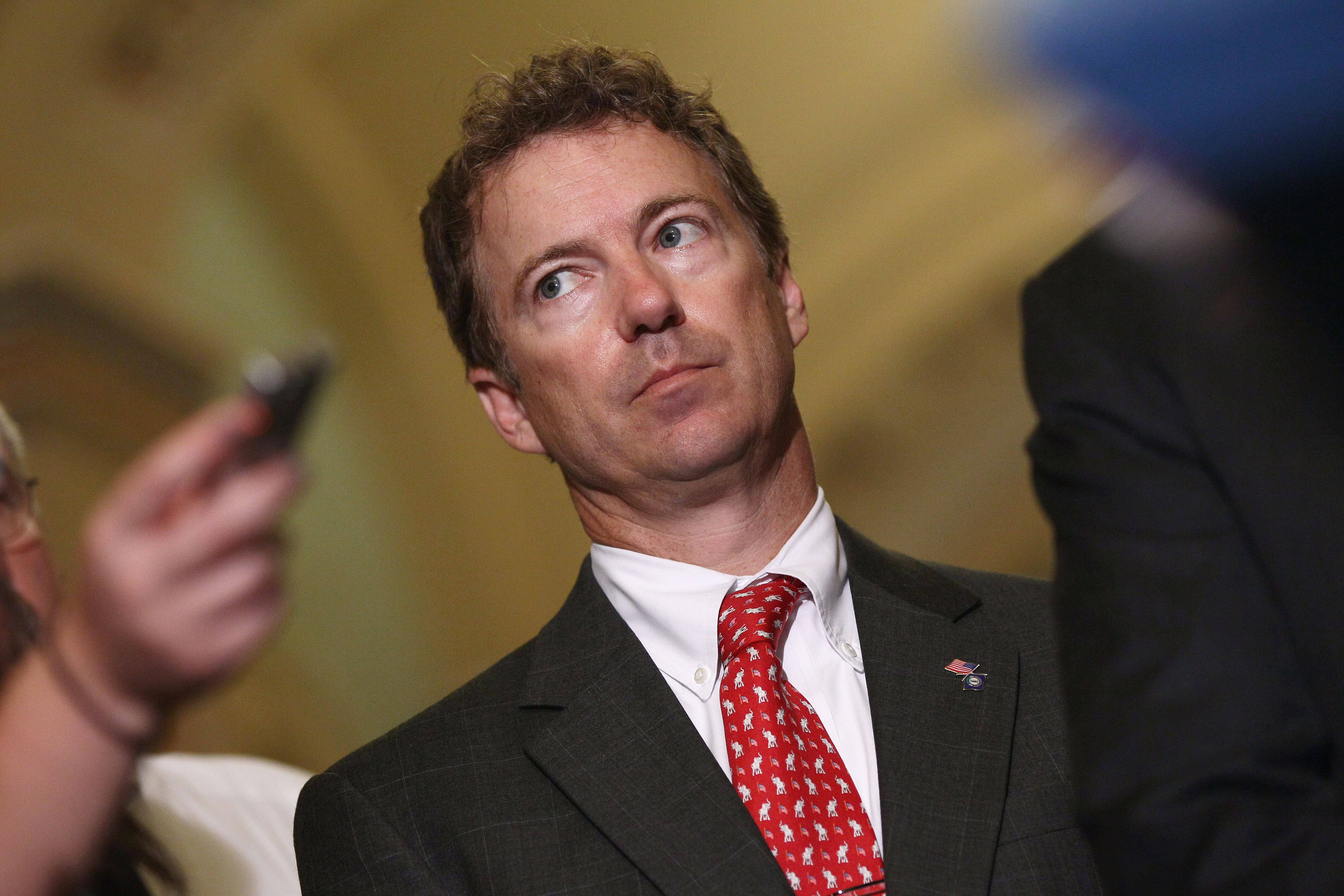
Yesterday, Alana Goodman performed a classic Washington take-down – of Jack Hunter, a Rand Paul staffer:
From 1999 to 2012, Hunter was a South Carolina radio shock jock known as the “Southern Avenger.” He has weighed in on issues such as racial pride and Hispanic immigration, and stated his support for the assassination of President Abraham Lincoln. During public appearances, Hunter often wore a mask on which was printed a Confederate flag. Prior to his radio career, while in his 20s, Hunter was a chairman in the League of the South, which “advocates the secession and subsequent independence of the Southern States from this forced union and the formation of a Southern republic.”
Are you shocked that such a profile – even when cherry-picked for drama – could be found on the libertarian right? Me neither. Weigel explains Rand Paul’s perspective:
[L]ike many conservatives, he finds the charge of “racism” to be terribly watered down by overuse. Why do white supremacists or Southern avengers like him so much? Well, they’re misled—lucky enough, they’ve found Paul-style libertarianism, and they will discover that color-blind politics is a far better use of their time. This probably sounds crazy to Paulite outsiders, but it doesn’t to them. They don’t think the left, or neoconservatives, are in any position to tell them about racism.
Well, yes … but. Chait gets it:
Now, obviously, you can like Ron and Rand Paul without being the slightest bit racist. Very, very few Rand Paul fans are glad Abraham Lincoln was shot. At the same time, the logic of southern white supremacy and the logic of libertarianism run along very similar lines. They both express themselves in terms of opposition to federal power and support for states’ rights.
Segregation was in large part a policy of government, not the free market. But it took intrusive federal power to destroy segregation. Barry Goldwater expressed his opposition to the 1964 Civil Rights Act in classically race-neutral, anti-big-government terms. The deep connection between the Pauls and the neo-Confederate movement doesn’t discredit their ideas, but it’s also not just an indiscretion. It’s a reflection of the fact that white supremacy is a much more important historical constituency for anti-government ideas than libertarians like to admit.
In this country, that last point is indisputable, it seems to me. It’s both a function of history and an accident of history. But it seems to me that when someone has a body of written work you can easily examine, why not read what he actually says rather than infer views from his more colorful past? Daniel McCarthy cites the most inflammatory nugget that Goodman found – that “during public appearances, Hunter often wore a mask on which was printed a Confederate flag.” Not quite as it sounds:
Free Beacon’s attack on Hunter involves cherry-picking quotes, many over a decade old, and referencing his career as the “Southern Avenger,” a pro-wrestling persona, complete with luchador mask, that Hunter adopted as an on-air radio personality and as a columnist for the Charleston City Paper.
Did a left-leaning alternative newspaper think they were employing a hate-fueled neo-Confederate? Not hardly: Hunter’s columns were provocative and conservative, but anyone who reads them, while finding plenty to disagree with—he’s an independent thinker—will not find hate. Naivete, yes, and a certain obtuseness about minorities that’s long been characteristic of the right. Over the five years that I’ve known him, however, Jack has re-examined his thinking and confronted questions of fairness that the right has too often avoided. He’s done this while remaining devoted to the canons of Russell Kirk’s conservatism.
Want proof? Read The American Conservative‘s Jack Hunter archive. Read this piece, in which Jack, who supports same-sex marriage, respectfully disagrees with its comparison to the Civil Rights struggle, whose magnitude and sacrifices exceed anything else in the past century. As ever with a good columnist, not everyone is going to agree with the argument, but the respect and good-faith that characterize it will be obvious.
Jason Kuznicki, on the other hand, washes his hands of Paul:
The association here seems a good deal stronger, if anything, than the one between the elder Paul and his neo-Confederate associates … I do not have to tolerate this stuff, and I won’t. Rand Paul has always insisted that he was a conservative, not a libertarian, and I’d sometimes tried to say, “Well, yeah, but he kind of really is a libertarian. Sort of.” From now on, the conservatives can have him, and they will hear no objections from me. Take him, he’s yours.
(Photo by Win McNamee/Getty Images)
Yes, we really do have a new Pope.

A reader writes:
Such a gloomy post! I think there is still reason to be optimistic. The rhetoric of the new Pope suggests religious institutions are not yet completely closed to change. That young evangelicals tend to be less socially conservative is a hopeful situation. It is difficult to see how conflicted countries in the Mideast will build a bridge between fundamentalism and modernity while at the same time transitioning from dictatorships to self government, but the American ills could be corrected with some firm, consistent pushback from rational Republicans to a fundamentalist base. A GOP that sounded more like David Brooks and less like Rush Limbaugh could win. The party is not too far gone to recognize that fact and adjust. A political solution is not yet out of the question, but it can only come from the right.
It would help if the rest of us, not just urban liberals but moderates too, could avoid sounded bigoted when discussing Christianist fundamentalists, but where to begin? When someone is willfully ignorant or cherry-picking history to support their belief system almost any challenge, no matter how carefully worded, can be labeled and dismissed as arrogant or bigoted.
I didn’t mean for the post to be gloomy; just realistic. Any successful resolution will take a generation or two. But we should not underestimate the forces out there. In the US, after being trounced in the last election, the GOP is actually veering even further right in their nihilism and sabotage. There is no figure in that party able to control the forces daily goosed by Ailes et al. It looks as if the fever hasn’t broken but intensified: they are waging war now on every front – from new anti-abortion laws across the country to sabotaging the president’s universal healthcare law, to preventing any functioning executive branch, and to go down screaming on immigration reform. Their bet now is the same bet as 2010: total opposition by all nonviolent means on all fronts, using the midterm elections, where their base turns out more reliably, to ratchet up the effect. It is not getting better. Another reader:
Thinking about your post, I’m struck by how important of a Pope Fransisco Uno may be. Consider his words from a recent Mass:
If we, each doing our own part, if we do good to others, if we meet there, doing good, and we go slowly, gently, little by little, we will make that culture of encounter: we need that so much. We must meet one another doing good. ‘But I don’t believe, Father, I am an atheist!’ But do good: we will meet one another there.
That’s such a humbly-but-radically different kind of confrontation than I (a blue atheist but also a student of religions) had ever expected from a Pope. Fransisco so far has spoken with a unique and important voice. I hope it doesn’t fall on deaf ears of the blue or the red.
Another:
I really enjoyed your essay for the way it distilled the principal conflict of our time into a fight over the adaption to modernity. We are all Weberians now. I think Hitchens said it most succinctly in concluding Hitch-22 (I’m paraphrasing without the book handy):
It’s quite a task to combat the absolutists and the relativists at the same time: to maintain that there is no totalitarian solution while also insisting that, yes, we on our side also have unalterable convictions and are willing to fight for them.
What I think Hitch meant is that skepticism is the essence of democracy, and that though we must insist upon the abandonment of absolutist pretensions (religious or secular), we must ourselves be unwavering in our commitment to forever question our values and interests.
Between belief and unbelief there is doubt. How we get there, I don’t know.
(Photo: Donna George of Houston, TX, stands and prays during the non-denominational prayer and fasting event, entitled ‘The Response’ at Reliant Stadium August 6, 2011 in Houston, Texas. Thousands attended the event organized by Gov. Rick Perry in order to pray for God to help save ‘a nation in crisis’ referring to America. By Brandon Thibodeaux/Getty Images.)
That’s the lesson Will Wilkinson draws from sequestration:
Of course, the sequester was ill-timed, and has probably hampered America’s economic recovery. That shouldn’t stop us from drawing some general lessons from the experience, though. Meat cleavers work, and they aren’t in practice so indiscriminate as they may seem to be. They focus attention, clarify priorities, and lead to the swift discovery of previously unimagined economies. That the effect of the sequester has been relatively benign so far strikes me as a data-point in favour of relatively inflexible fiscal rules, such as debt-ceilings and balanced-budget amendments, capable of somewhat offsetting the diffuse-cost/concentrated-benefit dynamic that otherwise drives democracies toward imbalance and ruin.
Matt Steinglass counters:
Democracies are driven toward imbalance and ruin? Which democracies does he have in mind?
Democracies are the wealthiest countries on the planet; as a rule, they have better credit ratings than other forms of government. Perhaps democracies do have a tendency to use taxpayer money to reward interested groups, but they seem to do so less than other forms of government, or else to have other built-in advantages that counterbalance this problem, such as stable property regimes, the rule of law, and confidence in the ability to levy taxes to pay back debt, due to the consent of the governed. In some particular democracies, excessive generosity with taxpayer money may be more of a problem than in others, and may retard economic growth; one thinks of high government debt levels in Italy. But Italy’s problems arguably have less to do with government debt than with rigid business patterns, corruption and cronyistic regulations, not to mention low birth rates; and democratic governance has in fact succeeded in getting Italy’s budget back to primary surplus (unwisely so, in the midst of Europe’s recession). In any case, this doesn’t seem to be a problem that afflicts America, which is among the world’s richest nations and has very good growth rates for a developed country.
Paige Brown digs up examples of real-life zombies in nature:
The changes that “zombie” parasites induce in their hosts range from small shifts in the percentage of time the host spends performing certain activities to the display of spectacularly abnormal behaviors, like in the zombie ant. Changes in the host caused by infection by the “zombie” are beneficial to the parasite because they lead to better transmission, or reproduction, success of the parasite. … Another parasitic protozoan, Toxoplasma gondii, infects rodents, cats and even humans. The parasite can only reproduce in the intestines of felines, so cats are the preferred host. This zombie parasite manipulates the behavior of rats, making them rather reckless and attracted to the smell of cat urine (gross!), thus increasing the rodents’ chances of being preyed upon by cats. Some studies have even suggested that T. gondii may slightly change behavior of infected humans, potentially playing a role in schizophrenic disorders.
Previous Dish on zombie fungus here.
 The Dish