Obsessive-compulsive disorder affects 2.2 million American adults. Matt B. reflects on a childhood experience of debilitating indecision over a souvenir T-shirt:
[M]y fixations had grown to the point where Mom offered to drive me back to the restaurant so I could exchange my shirt for the pink one. I had turned her down once or twice before, but things had gotten pretty tumultuous in my head, and I relented. Fine, I thought. Let’s just get this over with. Maybe then I’ll be able to go down to the beach and enjoy things.
When we got to the restaurant, though, my doubts multiplied. I could feel a tension building, a fizzy pressure in my head. I weighed the pros and cons of each shirt: the gray one was more traditionally cool, but the pink was bolder, full of a weird, preppy swagger. Gray wouldn’t turn any heads, but maybe I didn’t want heads turning – maybe I just wanted to get in under the radar. Pink was edgier, but it ran some real risks.
Mom tried to talk me through the decision, telling me to ask myself which one I liked better. She angled her head forward in determination, smacking her hands as if wiping them clean: “Just go with it.”
I knew, at some level, that she was right, that thinking about things this way was tormenting me to no good end. But I couldn’t decide. I didn’t know which one was better. As soon as I leaned in one direction, I felt terrified that I might be missing out on everything the other shirt had to offer. After ten minutes of indecision, I burst into tears.
Mom stayed with me, but I suspect she was more unsettled than she let on. I’m not sure there had ever been an instance like this one, in which my indecision and ambivalence rose to such acutely painful heights. I felt silly sitting there, aware of how privileged and prissy my concerns would look to most people. Here I was, a young boy on a nice beach vacation with his family, with a totally unnecessary T-shirt already in his possession, thrashing about because he thought there might be a slightly nicer one out there.
I was also aware of what I was missing. Everyone else was at the beach, playing or reading or crashing around in the surf. The beach itself was only a small road and a short sand dune away. I didn’t want to be here, but I didn’t know how not to be.
Michael McCarthy notes Pope Francis’ ride of choice is a $16,000 Ford compact:
The Pope advised new priests and nuns to travel in more “humble” vehicles rather than driving fast, late model cars. To prove his point, Pope Francis is driving a low-priced Focus around Vatican City, according to news reports.
Scott Monty, Ford’s global head of social media, said via e-mail that the former cardinal Jorge Mario Bergoglio of Argentina appears to be using a “second-generation” Focus instead of a new model.
For Pope Francis, it’s yet another contrast with predecessor Pope Benedict XVI, who had a custom-made electric vehicle donated by Renault and a BMW X5 given to him as a gift by the German auto maker.
Gary Stibel, chief executive officer the New England Consulting Group, sees synergies:
“This is a smart car for a smarter Pope,” said Mr. Stibel. “It’s a simple, real car for a real humble Pope. Clearly Ford does benefit from this because he’s chosen their car.”
“It hurts me when I see a priest or a nun with the latest model car; you can’t do this,” he said. “A car is necessary to do a lot of work, but please, choose a more humble one. If you like the fancy one, just think about how many children are dying of hunger in the world.”
Brian Kellett, a paramedic who in “most cases [is] completely against force-feeding,” nevertheless deems the Mos Def video “propaganda”:
I have placed more NG tubes than I can remember and I have never seen a reaction as strong as that shown in the first video. It certainly isn’t very pleasant to have a NG tube inserted as it tickles the back of the throat that makes you want to gag (or swallow), but it is not this apparent torture that is being shown. An NG tube is inserted in hospitals for a number of reasons, sometimes for surgery, sometimes because a patient cannot swallow. In the first video Yasiin Bey [aka Mos Def] isn’t given water to drink during the procedure, but in many of my patient’s I also couldn’t give them anything to drink to ease the passing of the tube as these patients would have no gag reflex and so giving them water could result in them inhaling rather than swallowing the water. Inhaling water can have side effects that include death.
Yasiin Bey is also shown to be resisting, while the person in the [above] video is complying with instructions. Many of the patients that I passed an NG tube into had some form of confusion, either due to a stroke, due to dementia or due to a multitude of other causes . In some cases I would be passing a tube into the stomach of someone against their will because they had tried to commit suicide and were under a Mental Health Section.
Even in these cases I never saw a reaction as strong as that of Yasiin Bey.
A reader has a very different take:
I have a rare condition called Multiple System Atrophy, which involves a number of progressive diseases/conditions. But of all of the painful things I’ve endured, feeding tubes take the prize.
I first encountered NG tubes in 2002, when after a bout of pancreatitis I found my stomach completely without function. After about a week, the decision was made to insert a nasal tube. I can never forget that experience. Two nurses came to insert the tube. They explained what the process would be, telling me it would be mildly uncomfortable. Undersale of the century. They tried inserting it in the right nostril first. Whether I already had a deviated septum or they caused it with poor technique, they couldn’t get the tube to pass. It turns out they also forgot to apply the numbing agent, meaning I felt every bit of the pressure and pain of the first attempt.
They moved to the left nostril. This time, they remembered the xylocaine or lidocaine, but it really made no difference. It was mildly uncomfortable in the way that the New York Yankees are a recreational baseball team. I have never felt such pain – not even in proctological or urological procedures. Well, maybe it is similar to the urological ones. I felt as if I was drowning as the burning hot sensation passed from my nasal cavity to my throat. I began dry heaving, with the most intense gagging sensation I’d ever felt. The hose didn’t move easily, and the nurses were literally pushing against the resistance with jabbing movements.
Once it was in, it felt like there was a knife in my throat. For days, I was gargling liquid lidocaine to dull the stabbing sensation. The pain was constant and would keep me awake. As my tube was more permanent than the ones being used at Gitmo, I had more issues than are relevant to the discussion. But suffice it to say, there were more issues caused by the tube than I care to remember, and they ultimately had to move me to a surgical feeding tube because of the issues with the NG.
I am in a place right now where I am wasting away. My stomach has no peristaltic function. Two years ago, I weighed 215 pounds. Today, I tip the scales at 125. A 5’10” man in his late thirties, I have the build of a prepubescent boy. My biceps are now smaller than my wrists used to be. But I cannot bring myself to being fed by a tube again, either temporary or permanent. I love my family, and want to spend as much time with them as I’m given, but my wife and I agree that when I was living with a tube, I was not really living; I just wasn’t dead.
I have extremely mixed feelings when it comes to Guantanamo Bay and the hunger strikes. On one hand, Congress has made it almost impossible for the Administration to return those prisoners who are cleared, as the requirement of absolute certainty that those released won’t engage in terrorist acts is not something that can ever be 100% fulfilled. And letting prisoners die would be an absolute disaster, both politically and on a human level. But I also know that forcing a plastic tube up the noses and down the throats of human beings is torturous, if not outright torture. Every politician and military leader who has caused or supports this situation should be forced to endure just one session of restraint and insertion. Until then, it will be seen as just another process issue by the game players in Washington, who are more interested in scoring political points than ending the very real humanitarian crisis that we have created in Cuba.
Update from a reader:
I’ve had a naso-gastric tube inserted twice, each time as part of the treatment for a bowel obstruction. I can confirm what others have said: it ranks up there with the worst things I’ve ever experienced. That said, my reaction was nothing like Yasiin Bey, in no small part because the thing I was being treated for was a bowel obstruction (and its subsequent complication, pancreatitis), which is also on the list of the worst things I’ve ever experienced, and which I was willing to endure almost anything to alleviate, up until the tube went in and the gag reflexes and pain from the plastic tube chafing against my nasal passage and throat started. Yasiin Bey seemed to exhibit none of the gag reflexes and dry heaving that I experienced every time, which really made me wonder if the tube was really being fully inserted. The only time I’ve ever seen an NG tube inserted was when it was going into my own nose, so I really can’t say if my experience was typical or not. I can say two things for sure: first, I think Yasiin got off easy. Second, the “paramedic” who claims the tube “tickles the back of the throat” is correct in the same way, to quote one of your earlier correspondents, that the Yankees are a recreational baseball team.
Fortunately, one of my NG tube insertions was in California, where we don’t have strong strictures against pain killers. Dilauded, a wonderfully potent opiate, made me unable to concentrate on anything for even sixty seconds, but also numbed the pain in my nasal passage, throat, and stomach, where the end of the tube was constantly poking into my stomach wall, enough that I could manage to sleep at night. The other time I had an NG tube inserted was in Arizona, where they felt that miniscule amounts of morphine were more than adequate to kill pain. They weren’t. The pain was constant, twenty-four hours a day, and was only tolerable if I didn’t move. Sleep was nearly impossible: moving my head in any way pulled on that tube, increasing the pain and scratching more tissue off my already raw throat.
Yasiin also missed out on the best part of the entire experience. His tube was in for only a few minutes before being removed. There is nothing – absolutely nothing – like having a tube in for days before it’s pulled out. Even though every nurse that extracted my tubes pulled them out slowly and carefully, extraction is also painful, as the tube rubs for its entire length against the now raw surface of your throat and nasal passages. When the tube finally rounds the last turn and pulls free, the sudden feeling of relief is indescribable.
Research suggests we that we trust the contents of secret documents more than the unclassified stuff:
Specifically, “(a) people weigh secret information more heavily than public information when making decisions, (b) people perceive the same information as being of higher quality when it is portrayed as secret rather than public, and (c) people evaluate others’ decisions more favorable when those decisions are based on secret information rather than on public information.”
The authors [of the study] suggest this effect was very much in evidence following the original Wikileaks disclosures, when people who are normally skeptical about the judgments of U.S. officials were suddenly taking as gospel documents written privately by those very same officials. As Dan Drezner wrote at the time, there was a “natural inclination to think that any Wikileaks document will endow it with the totemic value of Absolute Truth. “If it was secret, then it must be true,” goes this logic.” In fact, it’s quite possible for diplomats or military commanders to be as wrong in private as they are in public.
It’s also not hard to imagine the kind of incentive structure that this bias creates. If classified information and secret recommendations are judged to be more credible, there’s going to be a natural tendency for the officials crafting and passing along this information to keep as much of it secret as possible.
Claude S. Fischer reflects on the Americanization of recent immigrants:
Take the case of Mexican-Americans, an intriguing instance of Americanization, given their especially large numbers and their easy travel back-and-forth to the “old country.” These immigrants are, as the title of historian George Sanchez’s 1995 book states, Becoming Mexican American. That is, they are defining and building a distinctly new identity. Through organizations, political mobilization, and ideological construction (for example, building up the legend of Atzlán), activists are constructing what it means to be both Mexican and American. And they are doing it in American ways, with voluntary associations and mobilized by modern American ideology extolling ethnic consciousness. The latest wave of immigrants have entered a culture that values, at least ceremonially, ethnic pride, probably as a result of the 1960s Black Pride movement. (“Black is Beautiful” was soon followed by “Kiss Me I’m Polish.”)
One advantage of studying contemporary over historical immigration that we have more tools for the study. Some survey research casts light on how Hispanic or Latino consciousness has developed. For example, a recent study compared the answers of Hispanics who took a survey in English to those who took it in Spanish. The English speakers expressed more “Hispanic Consciousness” than did the Spanish-speakers. They were more likely to say that it was very important for Hispanics to “maintain their distinct cultures,” less likely to say that it was very important for Hispanics to “blend into the larger American society,” and more likely to be critical of how the U.S. media portrayed Hispanics.
That is, the more integrated into American society, the more they emphasized their ethnicity. Another study not only found that, as might be expected, more educated and later-generation Latinos were likelier to vote in elections, but also that they were likelier to engage in specifically Latino-oriented activism.
Lisa Rosenbaum considers how doctors and patients approach medical decisions, examining the influence of the “affect heuristic,” which is defined as “the role that emotions play in our perceptions of benefit and risk”:
When affect guides our decisions, we are far more sensitive to possibility than to probability. In one experiment, some subjects were asked how much they were willing to pay to avoid a potential loss of twenty dollars; others were asked how much they would pay to avoid a potential electric shock. The people asked about the shock paid about the same amount of money, regardless of whether the probability of receiving it was one per cent or ninety-nine per cent. The responses of people asked about the monetary loss, however, tracked more closely to the associated probabilities. The mere possibility of risk, no matter how small, drives our behavior.
How might this tendency play out in medicine? Take, for instance, the increasing rate of women with breast cancer pursuing prophylactic double mastectomy—most famously, Angelina Jolie. For most women with breast cancer, the risk of later developing breast cancer in the other breast is low, meaning the risks of mastectomy outweigh the benefits. Indeed, a recent survey of women who had undergone prophylactic mastectomy found that some seventy per cent would derive little survival benefit. Nevertheless, ninety per cent of those women reported that they were “very worried” about breast-cancer recurrence. In other words, in the setting of fear, the possibility of recurrence, rather than its actual probability, fuels decisions that, over all, likely cause more harm than good.
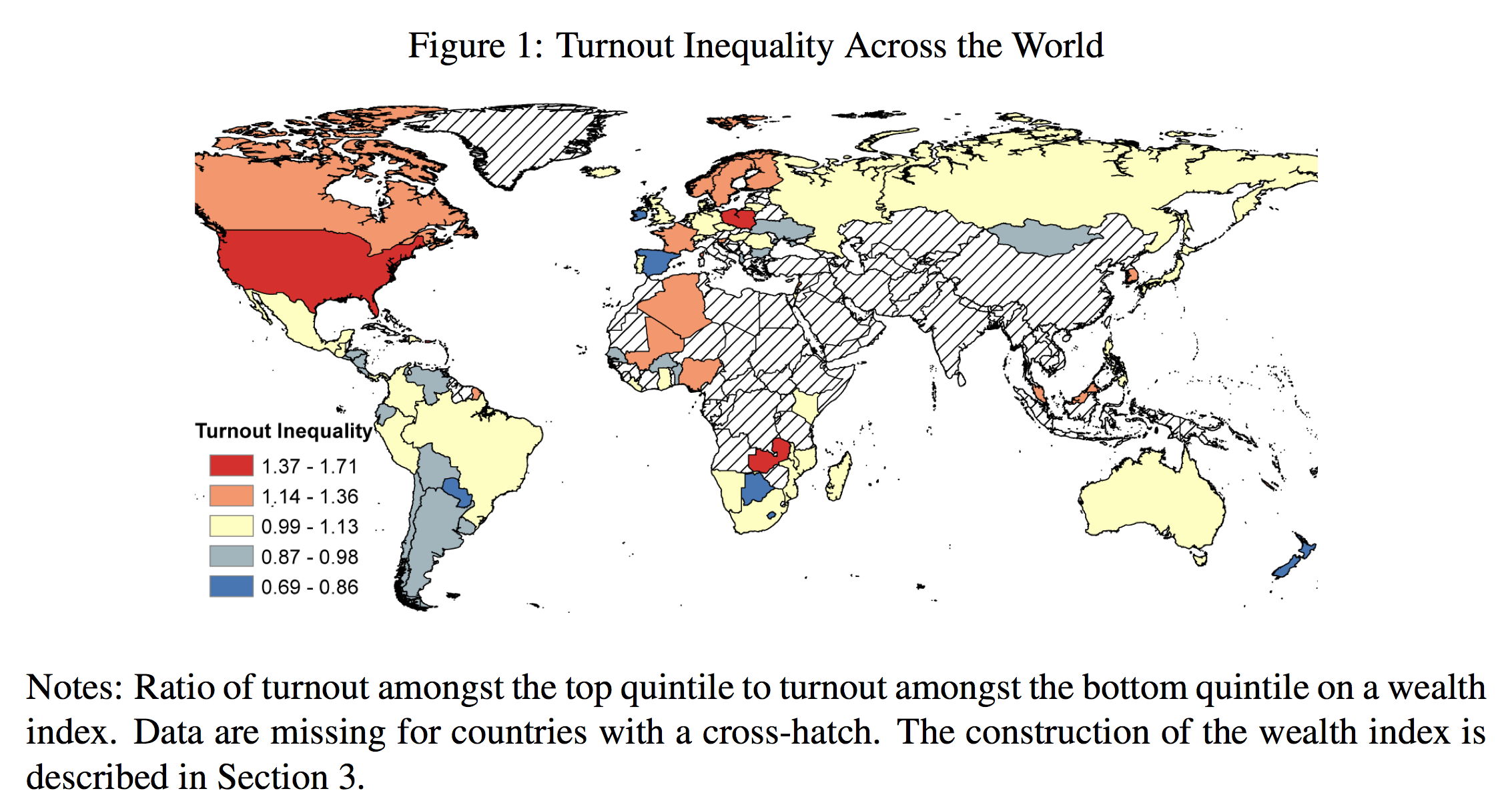
The above map is from a paper by Kimuli Kasara and Pavithra Suryanarayan (pdf), “When do the Rich Vote Less than the Poor and Why? Explaining Turnout Inequality across the World.” The abstract:
The conventional wisdom that the poor are less likely than the rich to vote is based upon research on voting behavior in advanced industrialized countries. However, in many places the relationship between turnout and socioeconomic status is reversed. We argue that the potential tax exposure of the rich explains the positive relationship between income and voting in some places and not others. Where the potential tax exposure of the rich is high, they have more of an incentive to participate in politics. Therefore, where states have the capacity to tax the rich, politicians use fiscal policy to gain support. Using survey data from a wide range of developed and developing countries, we demonstrate that the rich turn out to vote at higher rates than the poor where the state has the bureaucratic capacity to tax the rich and where the political preferences of the rich and poor diverge.
Joshua Tucker points out “the role of the US – and, interestingly, Poland and Zambia – as outliers in terms of having over-representation of the well-off citizens among voters.”
A Financial Timesarticle spotlights Amazon’s shipping warehouse in the former coal-mining town of Rugeley, England. John Brownlee follows up:
The issue at Rugeley is not that workers are ungrateful for the jobs Amazon has given them, or even that they find these jobs unpleasant. Most of Rugeley’s workers come from mining families, a stock not exactly known for its weak-livered dandyism. It doesn’t matter that these jobs are hard. It’s that they have no future. … The jobs in the Rugeley fulfillment center are almost always temporary positions handed out by agencies on zero-hour contracts. Nothing is guaranteed, and a fulfillment associate’s job can completely disappear between one day and the next. As such, the local economy is not recovering as locals hoped. Amazon is not investing in the town’s people; instead, it’s mechanizing them.
Brownlee talks to Ben Roberts, whose photo series Amazon Unpacked documents Rugeley’s “vast” and “shockingly quiet” shipping center:
“The workers at Rugeley are effectively human robots,” Roberts says. “And the only reason Amazon doesn’t actually replace them with robots is they’ve yet to find a machine that can handle so many different sized packages.” … “When you buy something from an independent retailer, you might pay more than Amazon, but that extra bit is an investment,” Roberts explains. “When you pay it, you’re investing in the quality of not only your own life but the life of the community around you.”
The same panicked grasping by local governments at jobs, no matter how temporary or poorly paid, that led to the placement of the warehouse in Rugeley is how Amazon managed to place packing plants in other locations as well. Amazon (a company that receives more money from the UK government than it pays in taxes, remember) currently has other UK “fulfillment centers” in Hemel Hempsted, Hertfordshire; Swansea, Wales; Doncaster, South Yorkshire and Peterborough, Cambridgeshire, former mining towns all. At what point will those communities be forced to ask what, in fact, Amazon is giving back to them, if anything?
If you thought Rod Dreher was a bit of a Puritan, you’re not entirely right:
“The hunger for strangeness” — that’s a great phrase, isn’t it? It is interesting to observe how often the impulse to suppress it arises in human culture, always at the hands of a moralistic idea in power, an idea that distrusts sensuality as nothing more than a temptation away from the Truth. Let me clarify that I believe sensuality can be a temptation away from Truth … but it also can be an avenue towards Truth. In Orthodox Christian worship, the incense, the icons, the vestments, the singing — it’s all meant to reveal God to us, and to prepare our hearts to receive Him. The reason for feasting and fasting in traditional Christianity is to learn to rejoice in the gifts of God — of bread, of wine, of meat and fruit — while also learning not to be overcome by our pleasure in these created things.
 The Dish