Quote For The Day

“When I first learned about waterboarding, when I became deputy attorney general, my reaction as a citizen and a leader was: this is torture. It’s still what I think,” – James Comey, nominee to head up the FBI, this morning.

So why not prosecute its perpetrators for war crimes? And what about all the other torture techniques approved by George W Bush?

How Barbaric Is Force-Feeding? Ctd

Readers voice skepticism over this disturbing video:

I feel churlish for pointing this out, since I, too, want to see the forcefeeding of Gitmo detainees stopped, but since this undercuts the strength of the argument, it’s worth point out that Mos Def is an actor. Moreover, he’s a very good actor, having been nominated both for an Emmy and a Golden Globe for a powerful performance in this movie.  Which means that he (unlike Hitchens) may not have been the best person to do this. I fear there are going to be no shortage of neo-cons who will say he was exaggerating very convincingly (though you could always challenge one of the doubters by telling them to try it for themselves).

Another:

Call me cynical, but isn’t it strange that Yasiin is literally begging the people doing the procedure to stop? The whole project is voluntary, right? Why wouldn’t they stop when he first asked them to? I’d wager it’s because they knew that having Mos beg for a bit would better persuade the viewer of the horrors of forced feeding. I don’t mind that so much as a cause marketing idea, except that it presents an inaccurate picture.

Undergoing NTF in and of itself, one time, is not actually such a debilitating or psychologically damaging thing. In fact, it’s pretty commonly done in hospitals and at home, even for children, who presumably have a lower tolerance for pain than a grown adult. I agree that subjecting Guantanamo prisoners to this twice a day, against their will, constitutes torture, but I think it’s patently obvious that Yasiin was doing a bit of acting here. Which is a shame, because it cheapens what is otherwise a correct and important message.

Another speaks from experience:

This past January, I began tube-feeding – or “force feeding” – my son, who is just under two years old.

He had become dangerously underweight due to a medical condition, and could not take food by mouth, so this was the safest way to feed him. The tube, called an NG tube, is not dissimilar to the one in the Mos Def video.  It’s just smaller – more appropriate for a child.  To insert it, I hold his head still (I have to use a strong grip) while my husband measures an appropriate length of tube out, and then pushes it through his nostril and into his stomach  My son struggles, cries, and yells, and we have to swaddle him to keep him from using his arms to block us.  He’s usually gagging as it goes down his throat.  Sometimes he vomits while we’re placing the tube, and we have to stop and wait 5-10 minutes before beginning the process again.

The first time we did it was the worst.  He screamed, and, really did look like he was being tortured.  We’ve had to do it 8-10 times since then, and it’s gotten easier. Nowadays, he no longer looks frightened, but is clearly deeply uncomfortable during the insertion. Once it’s in, he’s fine.  Food is pumped into his stomach 2-3 times a day; he’s usually watching television or peacefully sleeping when he’s being fed.  No discomfort whatsoever.

My son is one of many.  Hundreds of children are either born or later develop conditions that make tube-feeding a necessity for some amount of time.  I learned about them at this website.

Like you, I find the situation at Gitmo an abomination.  And I loathe how this practice refuses these men the right to their own bodies (and I agree with Steve Chapman).   Still, every time you or someone else writes that force-feeding is “barbaric” or “grotesquely inhumane” (and especially when they compare it to water-boarding) I cringe, as I’m sure many other parents of NG tube-fed children do.

Another notes:

For what it’s worth, efforts have been made to categorize the pain associated with common medical procedures.  Insertion of a nasogastric (NG) tube is considered among the most painful of common procedures, according to surveys of patients.  This procedure ranks ABOVE reduction (re-alignment) of a fractured bone.  To do this to people against their will, repeatedly, is beyond inhumane.  One of the lessons I take from these studies is that I owe my patients a bit of IV opiate painkiller (fentanyl, morphine) before proceeding to place the tube; I doubt the prisoners at Gitmo are accorded such compassion.

Will We Cut Egypt’s Aid? Ctd

Supporters Of Ousted President And Opponents Continue To Wage Street Battles

Larison shakes his head:

If the U.S. isn’t willing to suspend aid to a foreign military after it carries out what everyone can recognize as a coup against a properly elected government, it won’t be willing to suspend it later when the coup leaders fail to hold early elections or for any other reason. I think everyone debating this in the U.S. knows perfectly well that this is so. Perhaps it is time to acknowledge that all this talk of U.S. leverage is just a pretense that the U.S. has the ability to influence events in Egypt when it no longer does.

Goldblog makes the case for keeping that cash flowing:

In Pakistan, we saw what can happen when American military aid is cut off. After Pakistan went nuclear, the U.S. retaliated by punishing its army. Most notably, the U.S. stopped bringing members of the Pakistani officer corps to America for training. The result: a Pakistani officer corps that doesn’t know, or like, the U.S. And, of course, our boycott of Pakistan’s military didn’t actually end the country’s nuclear program. Cutting off the Egyptian military would only free it to behave more brutally toward its internal foes than it does now.

I’m with George Washington:

The nation which indulges towards another a habitual hatred or a habitual fondness is in some degree a slave. It is a slave to its animosity or to its affection, either of which is sufficient to lead it astray from its duty and its interest … The peace often, sometimes perhaps the liberty, of nations, has been the victim.

End aid to Egypt and Israel. The first doesn’t deserve it; the second doesn’t need it. And the long taxpayer-funded bribery to keep the two countries from conflict has inevitably led to what Washington warned so presciently against. Because of this “unbreakable” bond, we have supported violent dictators in Egypt and a brutal, grinding occupation in Palestine. And the Arab world blames us for both. They are not wrong.

Turning the US into a slave of the expansionist Jewish state and of the Egyptian military needs to end. It has hurt all three of its participants … and may even force the US into an insane attack on Iran’s nuclear program. This is a golden opportunity to cut our ties. We should take it – and would, if the Congress were not also a victim of this departure from America’s “duty and its interest”.

Recent Dish on the subject here.

(Photo: A man displays a poster picturing the crossed face of U.S. President Barack Obama as tens of thousands of people attend a rally in Tahrir Square against ousted Egyptian President Mohamed Morsi on July 7, 2013 in Cairo, Egypt. By Carsten Koall/Getty.)

The Last Lesson We Learn From Our Pets, Ctd

Redding(2)-3-29-13

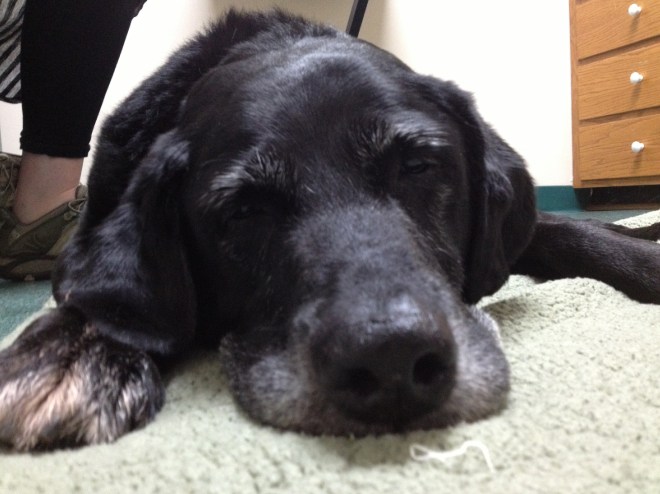
A reader sends the above photo:

I don’t know you from Adam, but I do subscribe to your blog.  My wife and I just put our dog down yesterday. I attached a picture of him sedated. The vet tech gave him a shot and he went from panting in pain to this peaceful rest.  They gave us 10 or 20 minutes alone with him and then came in and administered the overdose of anesthesia.  We petted him while he passed on.

I often look to your blog to try and find comfort when things happen in the world.  I guess now I am looking for something on a personal level.  Thanks for listening.

Another reader:

I just read your post about Dusty and twice you used the phrase “put down” (the first time without quotes). For the love of God and all that’s holy – I’m an atheist – can we please start a movement to change that horrible phrase? Put down? That’s something you do to a phone or a bottle or a piece of luggage. It’s absolutely NOT what you do with a companion who’s been there through thick and thin; who’s been loved and loved in return. I very recently had to let go of my big Endymion, a gorgeous, amazing, friendly and loving cat of many years and I cry whilst writing this. I most certainly did not “put him down.” I let him go. Let go > put down.

Good luck with Dusty, you have my love and support.

Another:

I’m sure mine will be one hundreds of notes you get on this topic.  It’s one I have been thinking about for many 1044795_10201205134237952_1267167286_nmonths now.  My dog, my very first dog, was diagnosed with incurable cancer last October.  With treatment, we were told he would like have a year.  And so treatment it was. It’s been nine months, and I have fought through an extended grieving process.  Beyond the medical treatments, the dog has suffered longbouts of anxiety that we have struggled to manage.  I have often found myself thinking that if it is this much of a struggle with the dog, what will happen when my now 60-year-old parents start to wind down their lives?  My dog, through his illness and eventual death, is teaching me how to plug ahead, and to love, cherish and find grace in a friend whose time is limited.

At the moment, things have normalized.  And we are loving the hell out of our buddy while we can.  His personality is back for the most part, as you can see in the included photo.

Another was better able to cope with the death of her 92-year-old grandmother after the loss of her pets:

In the last four years, we have had to put three pets to sleep.

Our first was our 12-year-old lab, Max, who suffered from severe hip dysplasia and then got cancer.  We opted not to do chemo because he was already feeble.  We tried some natural remedies that I do believe gave us a few more good months with him.  When we made the decision to put him down, he had stopped eating and could not pick himself up to walk outside.

Our cat got a cancer diagnosis about two years after Max was put down.  He was almost 19 years old and the cancer was in his nasal passage, which caused him to not be able to breathe very well.  We tried some medications to reduce the size of the tumor, but ultimately we had to put him down about a month after diagnosis, when his reduced oxygen intake made him disoriented and very weak.  His kidneys also started failing.

Our second lab, Cooper, who was our first “child” together (Max having come into our marriage from my husband and kitty from me) got a cancer diagnosis about a year after Max was put down, which resulted in us having to amputate one of his hind legs.  He rebounded from that almost immediately and enjoyed life as a tripod until last fall.  I had noticed that it was taking him some extra time to pull himself up to standing position and that he seemed to lose his balance more often.  He was 11, so I did not give it to much thought.  We had not noticed any new tumors in our check-ups.  Cooper always acted like a puppy and was so happy to be around us.  His behavior did not change as he got older; he was always a happy dog and, for some reason, chose me as his favorite person.  I liked to call him my 85-pound lapdog.

When he stopped eating for a few days, I immediately took him to the vet.  It was cancer again, but this time a different, more aggressive form than what led to the earlier amputation.  Hemangiosarcoma.   Cooper had tumors on most of his major organs.  These types of tumors were filled with blood vessels in danger of rupturing at any moment and causing massive internal bleeding.  In fact, it appeared that some of the tumors may have already ruptured, as his abdomen was partially filled with blood (which is why he would not eat). During the time these tumors were growing and spreading, he never act like he was in pain, he just appeared weaker than normal.  I would have to help him into our bed at night (where he normally slept) because he could no longer make the jump.  He needed a little assistance walking up steps.  He never stopped being the most loving dog, furiously wagging his tail anytime one of us was around.

When the vet confirmed the nature of the cancer and the risks of massive internal bleeding if one of the larger tumors ruptured, we made the decision that very day to put Cooper down.  While it had been difficult with Max and the kitty, because they both had seemed so physically and mentally ready to go, the grief in making the choice to end their suffering was somewhat manageable.  With Cooper, his overall personality remained fairly unchanged.  He was still so happy and loving at the time of his last diagnosis.  The staff at the vet hospital even remarked on what a happy tail-wagger he was.  That made it a much more difficult decision because I wanted to take him home and spend more time with him.

Knowing that the tumors on his organs could rupture at any moment and cause him to have a terrible, painful death, however, helped us make our decision.  We could not allow that to happen when we had a chance to ease him into wherever he would next be going.  We brought our kids to the hospital and we spent a good hour just hanging out with Cooper in a room by ourselves and saying our goodbyes.  When it was time, my husband took my kids out, and I laid down next to Cooper and held him and talked to him while the injections were made and for some time thereafter.

I miss him so much, and even though deep down I know we made the right decision for Cooper, I wonder if he could have comfortably lived a few more months.  On the other hand, I also wonder and fear that he had been in pain much longer than we ever knew, and his sweet, loving disposition just masked his pain and discomfort.

All of this is to say that the lives and deaths of Max, kitty, and Cooper have helped me get through other things in my life.  After we had put down Max and kitty, my grandmother was diagnosed with pancreatic cancer at age 92.  She was at home with hospice care for several months.  I think having gone through the passing of Max and kitty helped me through the passing of my grandmother.  I had not previously lost any human member of my family that I was especially close to.  My grandmother’s passing in some ways helped me through Cooper’s death (she died about three months before he did), and his passing likewise helped me with accepting my grandmother’s death.

I wish the best for you and Dusty and just wanted to relay that, based on my experience with the four (or three)-legged loved ones in our lives, it is true that you will know when it is the right time to let them go.

The real reason I wanted to write to you, though, was to share a picture with you.  During our last moments with Cooper, my husband took a picture of the kids and me with him.  I was so torn up after putting him down that it took me two weeks to even look at the picture:
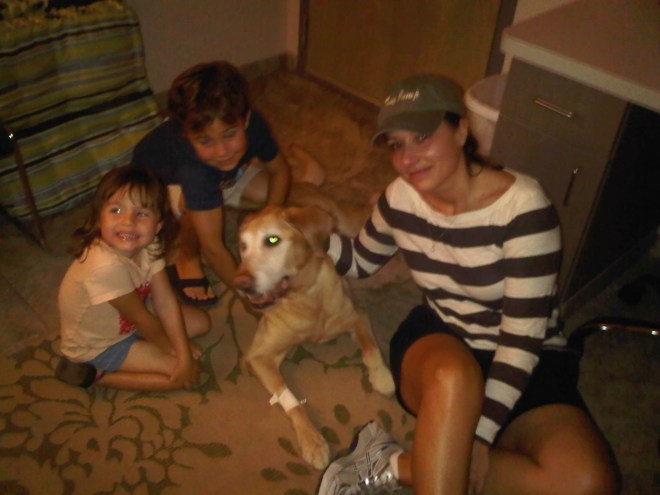
cooper2012

While the photo is a bit fuzzy, I hope you can see the extra-special twinkle in Cooper’s eye.  This was his last gift to me and so typical of who he was.

Previous reader stories here.

Buzzfeed’s New Low

Yesterday, Buzzfeed published “The Story of Egypt’s Revolution in ‘Jurassic Park’ Gifs.” L.V. Anderson feels that “there is something wrong with treating a political crisis as though it occupies the same moral realm as kittens and frosted tips”:

“The Story of Egypt’s Revolution in ‘Jurassic Park’ Gifs.” The democratic yearnings of an oppressed people reduced to 20-year-old catchphrases. A bloody, tumultuous, ongoing political conflict filtered through moving screen shots from one of Spielberg’s most popcorn-ready blockbusters. The deaths of hundreds of Egyptians—including more than 40 allegedly peaceful protestors who were shot just yesterday—metaphorically reenacted via computer-generated dinosaur maulings.

Oy.

Clearly, Anderson doesn’t understand the sheer brilliance of the business model.

Globalized Indifference, Ctd

2007 study in The Quarterly Journal of Economics found that 40,000 people must die in a drought to receive the same amount of US news coverage as a single person who dies in a volcano-related incident. Similarly, a disaster is 5 percent less likely to make American news and 6 percent less likely to receive relief if it occurs during the Olympic Games. Beth McMurtrie highlights new research on how causes break into the public eye:

[N]ongovernmental organizations, government agencies, and others who work in human rights and development—what [political scientist R. Charli] Carpenter refers to as global issue networks—are performing a deliberate calculus when they decide where to spend their energies. What matters isn’t necessarily the urgency of the cause, but whether they think they can sell it to the public and muster the resources to run an effective campaign.

Carpenter used surveys and focus groups to ask leaders of advocacy groups about the factors that come into play in deciding whether to turn problems into causes.

Responses were blunt: There needs to be a victim and a perpetrator. Some issues are “too complex” to advocate for. And if no clear solution is in sight, the problem is that much harder to rally around. “People need to be able to feel like they can make a difference,” said one participant.

Understanding Inhumanity

A trauma studies scholar who interviewed members of the Chukiren, a group of war criminals, describes the difficulties of his work:

I recently wrote a piece for CNN about a Syrian rebel who carved out a man’s heart and began to eat it. The editor had asked me to explain what could make a man do such a thing. I tried to explain, and many people were outraged by what I wrote. In one way or another, they were all saying: You think when you try to understand why men do evil things, you are going to learn something that might help prevent atrocities in the future. But really you are just excusing the perpetrators, justifying unjustifiable actions. The only thing you need to understand about evil is how to punish it.

Many of the Chukiren have died since I last spoke with them. The others are failing rapidly. I’m not sure I ever really came to understand them. But that is not because what they did is beyond understanding, not because evil is some kind of mystery. In some ways, it is all quite simple. If I had been a 19-year-old when my country entered into a genocidal war, I would have done the same thing everybody else did. That’s true for most of us. Making monsters is a straightforward process, and ­nation-states are expert at it.

Why the war criminals did what they did—in the end, that is not what I find hard to understand. What I find hard to understand is what must it be like to be the person who did those things. When we imagine getting perpetrators into our hands, the first thing we think about is punishment, what we as a society are going to do to them. But I think the real and final punishment is having to be the person you are.

Blame It On Obamacare

Sarah Kliff answers the questions posed by the anti-Obamacare ad seen above. Waldman sees the ad as evidence that, over the next couple years, Obamacare will be blamed for any and all healthcare problems:

The ad mentions not being able to choose your doctor, which would be bad. If you chose an insurance plan in an exchange established by Obamacare, that plan will probably have a network of doctors from which you have to choose if you want your care paid for, and if your doctor isn’t on it, then you’ve been prevented from choosing your own doctor.

Of course, that isn’t because of Obamacare, it’s because of the way insurance works in America; it’s how it worked before Obamacare, and it’s how it’ll work after Obamacare. But it’s a lot simpler to say, “Now that we’re under Obamacare, I didn’t get to choose my doctor!” And did you know that under Obamacare, medications could come with dangerous side effects? Or that under Obamacare, kids who get shots will cry? Not only that, under Obamacare, you could get cancer and die—even if your doctor wanted to save you. In fact, under Obamacare, we’re all going to die one day. Thanks for all the misery, pain, and death, Obama.

What’s The Endgame In Egypt?

Shadi Hamid is unsure:

I think there are two options. First is the Algeria or eradication scenario, in which the military and old-regime elements simply try to destroy the Muslim Brotherhood. That’s the repression option. Then you have the referendum option. I don’t know how you would do it, exactly. The military has dug in so deep to its position, and it’s already calling the Muslim Brotherhood terrorists, so I don’t know if this is realistic. But typically what you’d do is have some vote where both sides agree to abide by the will of the people.

At least in the near term, though, I think we could just be in a continuation of this low-level civil conflict, this war of attrition between the two sides. A stalemate with violence, if you will. The short-term outlook is very dark now.

Larison expects more violence:

It is likely that incidents such as these will keep happening, because the Brotherhood has a great deal to gain from continued clashes with the military. These will result in excesses and abuses that can be used to discredit the coup leaders in Egypt and internationally, and over time the coup government will lose the popular support that has been invoked so many times as its justification.