Truckers are the latest group of blue-collar workers threatened with obsolescence (WSJ):
Some 5.7 million Americans are licensed as professional drivers, steering the country’s vast fleets of delivery vans, UPS trucks and tractor-trailers. Over the next two decades, the driving will slowly be taken on by the machines themselves. Drones. Robots. Autonomous trucks. It’s already happening in a barren stretch in Australia, where Caterpillar Inc. will have 45 self-directed, 240-ton mining trucks maneuvering at an iron-ore mine.
Most of the hubbub around autonomous technology has focused on passenger vehicles, notably Google’s promotional wonder, the Google Car. Ford Motor Co. Chairman Bill Ford Jr. says self-driving cars will hit roads by 2025. But commercial uses are where the real money and action lie: rewiring a massive part of the U.S. economy while removing tens of billions in costs from a commercial fleet that today numbers 253 million trucks.
A fleet of “smart trucks” can reduce staffing needs at a typical iron mine by 30 to 40 percent, according to a recent study from the University of Queensland. Lots of previous Dish on self-driving vehicles here.
In classic fashion, the Clintons let it be known through various toadies and surrogates that they wanted Anthony Weiner to pull out of the race. Friends also vented that comparisons between Huma Abedin and Hillary Rodham were completely outrageous. It was too easy a volley back over the net, but I did it for Hitch. Just when you’ve forgotten what self-loving narcissists the Clintons are, they come back to remind you.
Pope Francis gave a press conference after a triumphant visit to Rio and changed the entire atmosphere in the Vatican toward gay people. K-Lo stuck to the Ratzinger script, but that’s finito. A majority of Americans now favor marriage equality in all fifty states, according to Gallup, but the GOP won’t budge an inch. The global hegemonists in the GOP took aim at Rand Paul. Well, they would, wouldn’t they?
“Pope Francis made clear that being gay is not an impediment for ordination. For him, the issue is not orientation but whether a person is a good priest. Even if a priest fails in celibacy, one can “then convert, and the Lord both forgives and forgets. We don’t have the right to refuse to forget.” The pope made it clear that there is no room for homophobia either in the church or society. But if I had said what he said 24 hours before Francis, I would have been reported to the archbishop,” – Father Thomas Reese, National Catholic Reporter.
“I never thought I’d live to see the day when a Pope would tell me that he doesn’t judge me for being gay, but has a problem with me driving a Lexus,” – a gay priest friend of a gay priest friend.
I’ve just watched the actual video of Pope Francis’ airplane press conference, and it’s even more remarkable than the quotes we gleaned earlier from reporters like John Allen. What’s so striking to me is not what he said, but how he said it: the gentleness, the humor, the transparency. I find myself with tears in my eyes as I watch him. I’ve lived a long time to hear a Pope speak like that – with gentleness and openness, reasserting established dogma with sudden, sweeping exceptions that aren’t quite exceptions – except they sure sound like them.
In the written text, I was disappointed, for example, by his absurd statement that Pope John Paul II had definitively shut down the question of women priests. Firstly, no Pope has the authority to shut down a debate like that, especially one that is purely managerial and pragmatic, and not a matter of doctrine. The statement is so absurd part of me wondered whether Francis wasn’t deploying a little irony … and then I listened to him actually speak the words. And it was far sweeter than irony.
He asserts orthodoxy and then swerves dramatically to one side, his voice lilting and becoming more intense, as if to say, “Yes, I know this is what the Church teaches, and I am not challenging that. But look at the wider picture. Remember that in the Church, the honor accorded to Jesus’ mother is higher than that of any of the apostles, and that women, simply by virtue of being women, are above priests in importance to the Body of Christ.” That’s both a repetition of orthodoxy and yet also a whole-sale re-imagination of it.
Think of this Pope’s refusal to revisit the issue of women in the priesthood and then note that he washed the feet of a woman in Holy Week – the first time any Pope had washed the feet of a woman, let alone, as was the case, a Muslim woman in juvenile detention. Remember also the remarks of one of the most powerful religious figures on earth about atheists:
The Lord has redeemed all of us, all of us, with the Blood of Christ: all of us, not just Catholics. Everyone! ‘Father, the atheists?’ Even the atheists. Everyone! … ‘But I don’t believe, Father, I am an atheist!’ But do good: we will meet one another there.
And this is surely part of the point. What Francis is telling us, it seems to me, is that we should stop squabbling about these esoteric doctrines – while he assents to orthodoxy almost reflexively – and simply do good to others, which is the only thing that really matters. Stop obsessing in your mind and act in the world: help someone, love someone, forgive someone, meet someone.
One of the most telling things about Jesus is that he did not elucidate a theology. It had to be inferred by Paul. Jesus merely told stories of great charm and mystery. But he also clearly transformed the lives of those he encountered by the way in which he lived and died. It was that that convinced so many that this human being wasn’t just any other human being, that the divine had somehow transformed him, and he could transform others. I heard in the voice of Francis today the voice of Jesus confronted with the woman about to be stoned for adultery. No, he does not condone adultery. But the entire dynamic of the story is about something else: it’s about how Jesus defused an impending, brutal execution by bobbing and weaving and drawing in the sand and then speaking intimately with the woman herself with what can only be called revolutionary empathy.
“They are our brothers.” That’s the tone of Jesus. That is, for the Papacy, revolutionary empathy.
Perhaps this is a better way of seeing the difference between Francis and what came before him.
It is impossible to think of Jesus seeing the marginalized of his time, like lepers or Samaritans, and teaching them that they are “somehow distorted, off center, and … not within the direction of creation” because of something they simply are and cannot change. Jesus – as represented by the Gospels – clearly sees that kind of rigid, callous thinking as the mark of Pharisees, the sign of a religion that has forgotten love in its obsession with law, and therefore cannot be connected with the Father of all Creation which is Love. Francis, mind you, does not rebuke Benedict XVI; he pours out affection for him. But everything he is saying and doing is an obvious, implicit rejection of what came before.
What Francis is doing is not suddenly changing orthodoxy; he is instead pointing us in another direction entirely. He is following Saint Francis’ injunction: “Preach the Gospel everywhere; if necessary with words.” He is a walking instantiation of the way Jesus asked us to live: with affection and openness, charity and forgiveness; and a reluctance to seize on issues of theology instead of simply living a life of faith, which is above all a life of action in the service of others:
We all have a duty to do good. And this commandment for everyone to do good, I think, is a beautiful path towards peace. If we, each doing our own part, if we do good to others, if we meet there, doing good, and we go slowly, gently, little by little, we will make that culture of encounter: we need that so much.
Following the second murder of an Tunisian opposition figure in six months, Fadil Aliriza spotlights mounting tension in the original “Arab Spring” nation:
In the background of Tunisia’s political scene, there is a steady hum of anger and frustration. Any big event risks tapping into that well of anger. Tunisians are angry that there has been little progress since the revolution. The economy has not improved and has, in some sectors, weakened. Unemployment refuses to decrease. Corruption is still integral to every facet of Tunisian life. Government and municipal services remain inaccessible and unresponsive to most of the population. Police brutality continues. Stark economic inequalities between people of different economic classes, and between developed coastal regions and underdeveloped interior regions, persist. Political divisions tend to fall along sharp ideological lines, and, despite Tunisia’s woes, assembly members take regular breaks from their task of drafting the constitution.
In this tinderbox, the second political assassination in six months has acted like a spark, and people are looking for someone to blame.
Meanwhile, Juan Cole surveys the chaos in Libya, where “over the weekend, all hell broke loose”:
The assassination of a militant secularist nationalist in Benghazi just after the assassination of of a militant leftist secularist in Tunis raised the question of whether the extremist Libyan and Tunisian devotees of political Islam coorinated the attacks so as to foment turmoil that might form a path whereby they could take over the country.
It seems obvious that the Libyan government needs to swallow its pride and get outside help in accelerating the training of new security forces. What were probably extremist fundamentalist terror cells bombed the courthouse in Benghazi, in front of which crowds gathered on Feb. 17, 2011, to kick off the revolution, was bombed and partially destroyed. Another bomb was set off Sunday evening in Benghazi, as well. …
And no, these problems of transition would not justify having kept the totalitarian and murderous dictatorship of Muammar Gaddafi in place. In fact, many of the extremist fundamentalists were provoked to a life of violence by his oppression. I have a bad feeling about this.
Previous Dish on the recent upheavals in the Arab world here.
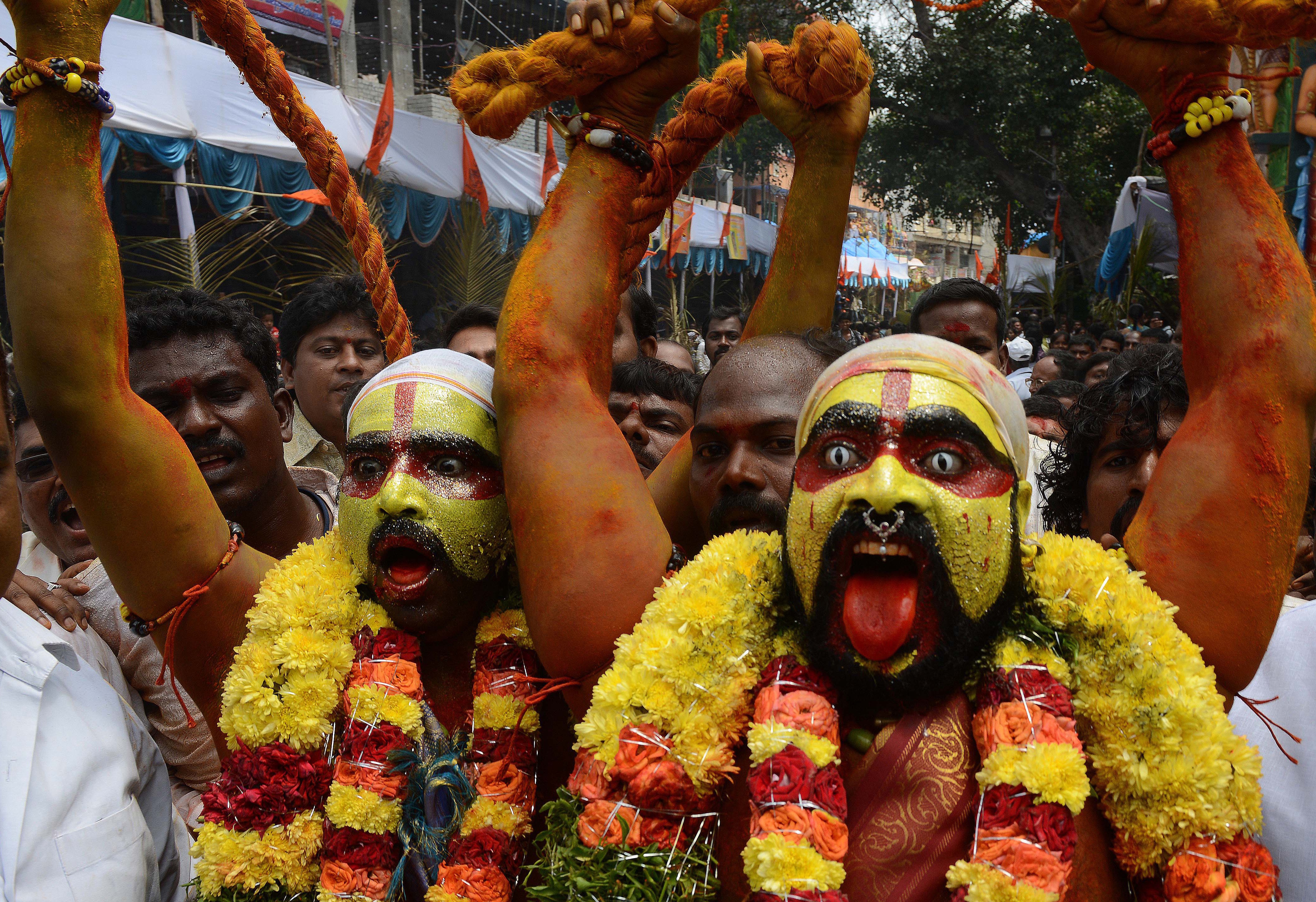
Indian Hindu devotees representing Potharaju, brother of the goddess Mahankali, dance in the streets during the Bonalu festival at the Sri Ujjaini Mahakali Temple in Secunderabad, the twin city of Hyderabad, on July 29, 2013. The Goddess Kali is honoured mostly by women during Bonalu festival by offerings of food and dancing. By Noah Seelam/AFP/Getty Images.
Noam Scheiber responds to critics of his piece on the decline of corporate law firms:
Big Law boosters point to the fact that revenue at the country’s 100 biggest firms grew by 3.4 percent last year—a reasonable increase, if hardly the 8-12 percent increases of the early-to-mid-2000s. But when you unpack the number a bit, it looks even less impressive. It turns out that the bump was driven primarily by a huge fourth quarter after three middling ones. And that big fourth quarter was, in turn, the result of some idiosyncratic factors—like a rush by corporations to complete transactions before the dreaded fiscal cliff took effect on January 1, and law firms aggressively seeking payment before the end of the year (for similar reasons).
Meanwhile, other data show the problems for the legal profession continuing. Of the law students who graduated in 2008, 75 percent of found a legal job within nine months, according to the National Association for Law Placement (NALP). For those who graduated in 2012, the number had fallen to 64 percent, a record low. Of course, Big Law firms typically hire associates well in advance, so these numbers partly reflect the hiring environment that existed a year or more earlier. And, in fairness, NALP reports that hiring at big firms did recover a bit for the class of 2012 after a terrible 2011, even if it was still well below the 2009 level. Still, the fact that the market for lawyers was historically weak more than three years after the recession is pretty alarming. NALP refers ominously to a “new normal” in law-firm hiring.
Update from a reader:
Here’s the main problem with Scheiber’s thesis: Where the heck is all the business going to go when 90% of big law firms collapse?
I’ve been a big law associate for a number of years, and I think I would have noticed if 9 out of 10 of my colleagues had been wandering the halls with nothing to do. So, when the firm-pocalypse comes and wipes out 180 big firms, how are the remaining 20 (which will likely be the busiest 20) absorb all of the abandoned legal work without massive expansion? Even if they could expand like that, with only 20 law firms, how could you ever find one that wasn’t already representing your adversary or negotiating counter-party?
And it’s not like thousands of little firms will spring up to replace all the fallen giants. Small-firms are just not capable or cost efficient enough at handling the kinds of matters that the big boys do. You can’t run a giant, months-long document review out of a five-person law firm unless you aren’t doing anything else, and if you aren’t doing anything else, how does your firm survive when the case suddenly settles and you haven’t booked anything else because your whole firm was working on that one case which could have lasted months?
While civilian defense employees can change their gender and keep their jobs, military personnel cannot. Tom Vanden Brook tells the story of one Army sergeant who decided to transition from female to male after returning from Iraq in 2011:
As a reservist, the sergeant has a civilian job and goes to work dressed as a man. For Army drills on weekends, the woman must emerge. “It’s kind of a double life,” the sergeant says. “In my civilian life everyone just knows he, just him. I go in with my facial hair, and I’m just a guy. When I put the uniform on, I shave. The feminine voice comes out if I can. Whatever I can muster that’s feminine. That’s when the sergeant who’s supposed to be female comes out.”
The sergeant says FTM servicemembers rely on each other for support:
“Female to male, we have a band of brothers,” the sergeant says. “There’s at least 300 of us connected. We talk quite often to each other. We serve as battle buddies in a battle that nobody knows we’re fighting.”
(Video: A news segment on Kristin Beck, the former Navy SEAL formerly known as Chris Beck. Previous Dish on Beck here.)
Amid reports that the Egyptian military will be reinstating Mubarak-era security measures, Ahmed Feteha highlights concerns (WSJ) that General Sisi will become the country’s next dictator:
In the weeks since Mr. Morsi was removed from office, Gen. Sisi has been the country’s most popular figure. State-run media regularly compare “the field marshall of the people” to larger-than-life Egyptian leaders like Anwar Sadat and even Ahmose, the pharaoh who expelled the Hyksos invaders from the country 3,500 years ago.
Even after Saturday’s bloodshed, the media largely echoed the official line blaming the Muslim Brotherhood, not Gen. Sisi’s rallying cry against the Islamist group. But in throwing over Mr. Morsi, Gen. Sisi is largely responsible for alienating Islamists, who account for at least a quarter of the population. On Friday, as pro-army crowds gathered, the government added fuel to the fire by filing criminal charges against Mr. Morsi for collaborating with the Hamas militant group during the 2011 Egyptian revolution.
Gen. Sisi has promised that he has no desire to rule. But many find it hard to believe that he will head back to the barracks after seizing the heights of Egyptian political life. And with hundreds of thousands of supporters chanting Gen. Sisi’s name in Tahrir Square, the little-known general is increasingly looking like Egypt’s king rather than its kingmaker.
[Sisi] has begun to adopt a special tone of intimacy, that of the leader in deep discussion with his people, which suggest he sees himself in the line of descent from Nasser. …
The Egyptian army’s overweening sense of entitlement is an aspect of the country’s political pathology. An army that has seen no combat for a generation and faces no serious challenge from external enemies nevertheless absorbs massive resources, enjoys marked privileges, and arrogates to itself special political rights. Egypt should be reducing the influence of its military, not reinforcing it. But, in the immediate future, the decisions of the army, and what are probably now its rather nervous civilian allies, are critical. They must release Brotherhood leaders, find a formula for the rehabilitation of Morsi and a framework for talks that the Brotherhood can accept. Otherwise there will soon be more blood on Cairo’s pavements.
But John Beck sees signs that the military’s recent authoritarianism will soon erode popular support for Sisi:
“I think, it’s clear that the issue is the role of the military in politics. Sisi is very much at the forefront in the process of undermining the democratic process,” says Maha Azzam, an associate fellow on the Middle East and North Africa program with the Royal Institute of International Affairs. “I think as each day passes… it’s becoming less credible to stand by what is becoming clearly both a coup and a military takeover and a return of the old regime,” she added. “There’s no grey. You either stand with the military takeover… or you stand against the coup.”
More and more Egyptians may be falling into the latter camp. The Salafist Nour Party — a former ally of the Muslim Brotherhood which then supported the military’s ouster of Morsi — said in a statement on Wednesday that the call for protest “foreshadows civil war.” Other, more secular groups who welcomed Morsi’s ouster also saw Sisi’s announcement as a move designed to provoke violence and create an excuse to impose curfews and increase the military’s hold on power. “We are stuck in the middle between military and fundamental authoritarianism,” says Bassam Maher, an activist and NGO worker.
He added, that while many “revolutionary” activists are becoming increasingly suspicious of Sisi’s motives, they have been reluctant to stand against the military directly because they do not wish to be thought of as aligned with the Muslim Brotherhood or other Islamist groups, which they also oppose. Many activists describe themselves as paralyzed and conflicted about opposing the army’s recent moves.
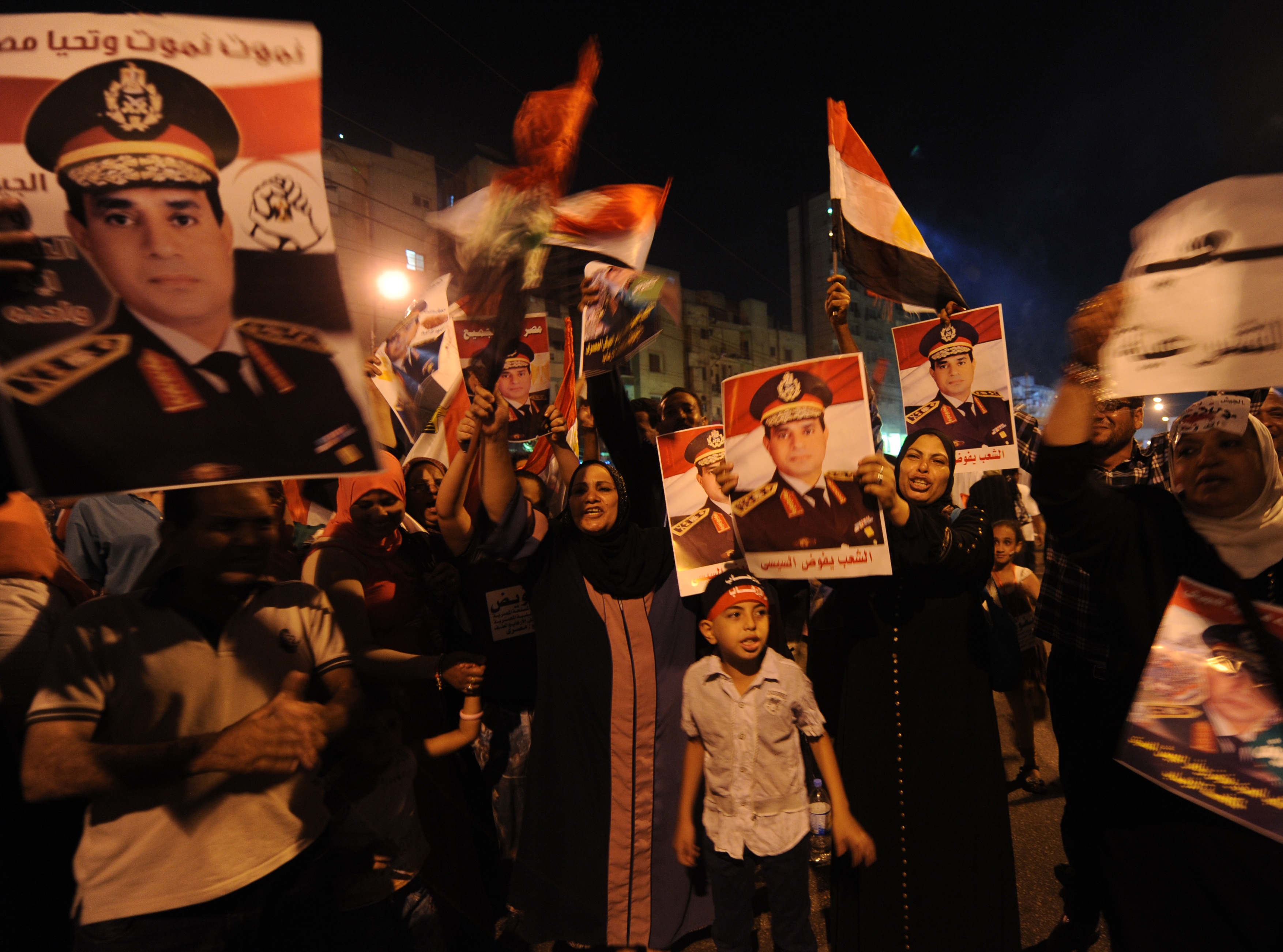
(Photo: Opponents to deposed Egyptian president Mohamed Morsi hold portraits of Egyptian army chief General Abdel Fattah al-Sisi as they demonstrate at Itihadiya main street in Cairo on July 26, 2013. Hundreds of thousands of anti-Morsi protesters gathered in Cairo’s Tahrir Square and around the Itihadiya presidential palace in response to Sisi’s call for Egyptians to show their support for a security clampdown on ‘terrorism’. By Fayez Nureldine/AFP/Getty Images)


 The Dish