The Last Lesson We Learn From Our Pets, Ctd

IMG_4965

This post struck a chord with a lot of readers. Here are a few of many we are planning to post:

I feel your pain.  We have had to put four dogs to sleep and one cat (age 18.5). This is not counting my parents’ pets. When we put our last dog, sweet golden retriever Zella, to sleep (very unexpectedly), I did as I always do and stayed with her through the whole procedure.  My husband couldn’t bear to be there, and so he said good-bye and left to wait outside.

This, however, made Zella a bit agitated – “Why is Papa leaving?” She was not feeling well (she had hemangiosarcoma, which is basically a blood-fed tumor, in her case larger than a softball and pressing on her liver), but she perked up when the vet came in because he had been working with hamsters and his hands and shirt smelled so awesome. So she was wagging her tail and smiling when we invited her to sit on the floor, which she did not want to do.  So I sat on a bench in the room and she hopped up next to me and sat/leaned against me. As the serum was injected, Zella just leaned on me more and more and ended up with her head in my lap. It was really a very peaceful and sweet way to die.

The vet told me afterwards that he wished every pet owner would stay with their pet at the end, because when they leave the room, the pet gets agitated and it’s harder for the staff to keep them still, making the whole process so much more stressful for the pet.  He also said that the women always stay, but only about half of men do, which I thought was interesting.

I’ve attached a picture of sweet Zella on the day before we took her in.  She was SUCH a great dog! I am very sorry about Dusty’s health.  It is so, so hard to say goodbye to a wonderful dog.  I will be thinking of you when that day comes.

Another reader:

The decisions you have to make on behalf of your companion animals just rip you apart.  We recently faced that image002problem with our beagle, Buddy. By age 14 he had lost almost all of his teeth (we never could get him to floss), he had been blind for two years and almost completely deaf, yet he seemed to get some enjoyment out of life.  He still loved to eat, of course; he could still consume a milk bone with no teeth. And he could usually make it out the doggy door to the back yard when he needed too.  Most of all, he seemed to get very happy when we would lie down next to him and pet him.

But sadly, about a month ago, things got suddenly worse.  He refused to eat his kibble (he would still eat treats) and his back legs were giving out, so he could not stand up reliably.  He could no longer make it through the doggy door; we had to carry him outside and back in.  He barely recognized us and he slept 99% of the time.  When he would stand up, he seemed to be in pain.  After conferring with the vet, we decided it was time.  However, he had been my best friend for so long … it took me a couple of days to agree.  But we finally put him in the car for his last ride.

He always hated going to the vet.  Nasty things seemed to happen there.  This time he knew where he was, and tried to struggle before going in the vet’s door; then he sort of gave up.  They got us into a room in short order, and we spent some quiet time with him.  The doctor came in and asked us if we wanted to stay while she gave him the shots.  There was never any question; we had him since he was eight weeks old, so we were going to be there at the end.

By this time he was just lying on the table anyway, seemingly passed out.  When she gave him the final shots, it seemed to make very little difference; his shallow breathing just stopped entirely.  I took one last look at him and just lost it, bawling all the way home.

When we got our house, our other beagle, Cloe, gave us a quizzical look seemingly asking, “Where is he?”  That night, she kept getting up and wandering around the house, then letting out a short high-pitched yelp, and looking at us questioningly.  She knew he was missing.

The next day, she seemed to adapt and life went on.  So we gave her a lot of love, and we adapted too, but we always remember Buddy.  I cannot find the actual quote, but I am sure that Arthur C. Clarke once wrote something like the following: “One of greatest tragedies of human life is the all too short lives of our animal best friends.”  So Andrew, prepare yourself.
Ask Michael Hanna Anything (About Egypt)

This embed is invalid

[Re-posted with new questions suggested by readers]

Michael Wahid Hanna will join us to answer your questions related to the ousting of Morsi and the Muslim Brotherhood, the ensuing violence, and what’s next for Egyptians. Hanna’s Twitter feed continues to be a must-read for anyone following the events in Egypt. From his bio:

Michael Wahid Hanna is a senior fellow at The Century Foundation. He works on issues of international security, international law, and U.S. foreign policy in the broader Middle East and South Asia. He recently served as a co-director of The Century Foundation’s International Task Force on Afghanistan, co-chaired by Thomas Pickering and Lakhdar Brahimi. He has published widely on U.S. foreign policy in newspapers and journals, including articles in the New York Times, the Los Angeles Times, theBoston Globe,  Christian Science Monitor, the New Republic, and World Policy Journal, among other publications, and is a frequent contributor to Foreign Policy. He appears regularly on NPR, BBC, and al-Jazeera.

To submit a question for Hanna, simply enter it into the Urtak survey after answering all of the existing questions (ignore the “YES or NO question” aspect and simply enter any open-ended question). To vote, click “Yes” if you have a strong interest in seeing him answer the question or “No” if you don’t particularly care.

The Coup Watched ‘Round The Arab World, Ctd

Adam Shatz runs down how news of Morsi’s ousting is going down across the Middle East:

Qatar, which invested heavily in the Brothers, has lost a major ally. (The Saudis, who supported the more extreme Salafis against the Brothers, played their hand much better: the Salafis sided with the army and are likely to have a say in the transition.) Hamas, which reshuffled its regional alliances when its parent organisation came to power in Egypt, leaving its offices in Damascus for Doha, must be weighing its options. Bashar Assad is already gloating. Morsi was a passionate champion of the Syrian insurgency; only two weeks before his overthrow, he infuriated Assad (and, more fatefully, Egypt’s secular-minded generals) by appearing at a rally where one cleric after another called for jihad against the regime in Damascus. In an interview with the official Thawra newspaper, Assad said: ‘The summary of what is happening in Egypt is the fall of what is called political Islam.’ That autopsy might have come as news to his Islamist allies in Tehran and in Hizbullah, without whom he could not have defeated the rebels in Qusayr. Still, the Sunni trend in Islamism has suffered a serious blow in Cairo, and its effects are likely to be far-reaching.

Madawi Al-Rasheed zooms in on Saudi Arabia in particular, whose rulers always saw the Brotherhood as a rival brand of Islamism:

The failure of the Muslim Brotherhood to hold on to power for a year is now celebrated in the official Saudi press. So-called liberal journalists congratulate the Egyptian people on getting rid of the so-called religious dictatorship while forgetting their own plight under a regime that was equally if not more oppressive. In contrast, Saudi Islamists spread the rumor that Saudi Arabia, together with the United Arab Emirates, was behind Morsi’s fall. While there may be some truth to this, such rumors undermine the Egyptian crowds that assembled to press for his downfall. If the outcome so far pleases the Saudi regime, it should not obscure the fact that Egypt remains diverse, volatile and may not unquestionably succumb to the rule of Islamists or other governments eager to patronize them. The Egyptian crowds got rid of their Islamists and will not become clients of the Saudi regime. They have staged two revolutions so far and will continue to do so until they reach a post-revolutionary equilibrium in which all are politically represented.

William McCants gauges the Salafi reaction:

[N]o Salafi is likely more pleased with the turn of events in Egypt than Ayman al-Zawahiri, the leader of al Qaeda. For decades, Zawahiri has argued that the Muslim Brotherhood’s engagement in party politics does nothing more than strengthen the hands of its adversaries and ratify an un-Islamic system of rule. Since the beginning of the Arab Spring, he has continued to make his argument that the West and its local proxies will never allow an Islamist government to actually rule. He doubtless views the coup last week as a final vindication of his argument.

More Dish on the regional reaction Egypt’s coup here.

How Barbaric Is Force-Feeding? Ctd

You be the judge. Yasiin Bey (aka Mos Def) demonstrates the force-feeding procedure used on Gitmo hunger strikers:

Conor watched the video (I actually found it too painful after a while):

[W]hile I don’t know whether or not forced feeding crosses the line of torture, the exercise reminded me of the late Christopher Hitchens volunteering to be waterboarded.

The Obama Administration is force-feeding numerous Gitmo prisoners twice daily as a response to a hunger strike they launched to protest being held indefinitely without charges or trial.

The standard procedures used include “strapping detainees to a chair, forcing a tube down their throats, feeding them large quantities of liquid nutrients and water, and leaving them in the chair for as long as two hours to keep them from purging the food,” The Washington Post has reported. Detainees say the procedures are abusive, verge on torture, and have “caused them to urinate and defecate on themselves and that the insertion and removal of the feeding tube was painful.”

It’s definitely grotesquely inhumane. Seizing control of a human being’s internal body and organs, painfully forcing instruments inside his sinuses and stomach twice daily to keep him under the total control of the authorities is horrifying enough. But when you consider that, unlike Mos Def, these prisoners, many innocent or falsely charged, have no way to challenge their indefinite detention, and are stuck in an endless purgatory of nothingness, the barbarism is obvious. As is the sadism and “globalized indifference” of the American public and their craven Congress. Steve Chapman wants the force-feedings to stop:

It would be unpleasant for the administration to accept the possibility that these detainees will die by starvation. But it might also force the American public and its elected representatives to wake up to the needless, open-ended suffering that is being inflicted on innocent people. It might induce other nations to accept freed inmates.

It might do none of these things. Then maybe the hunger strikers will conclude they are better off dead. If that choice reflects badly on us, it should.

Amen. Life-long confinement without even due process of any meaningful sort, is so alien to democratic principles and Western jurisprudence, it remains a rebuke to everything America claims to stand for.

Earlier Dish on force-feeding here.

Now We Should Add FA To LGBT? Ctd

Readers push back against the notion that Fat Acceptance (FA) be treated like an oppressed group:

I take issue with Anna Mollow comparing fatness to sexual orientation: “Body size is determined primarily by genetics”. This statement is missing half of the equation.  Genetics plus caloric intake determine body size; the two halves necessarily go together.  Compare that to sexual orientation: you can be gay and celibate but you’re still gay.  If you’re genetically predisposed to fatness but your calorie intake is low (because of food availability, quality, poverty, or whatever), you won’t be fat.

Fat attraction is different.  That sounds more like another sexual interest along the great spectrum of human sexuality.

Another reader:

I’m sorry, but give me a freaking break. Do we need a separate acceptance movement for short people?

Or people with ugly noses? With bacne? What about an acceptance movement for unintelligent people with lousy personalities?  I mean, why should I have to try and not be a stupid asshole towards people; shouldn’t the onus be on them to accept me for the stupid asshole I am?  After all, it’s not like I can control my stupid genes or asshole-ish upbringing!

Look, nobody’s perfect.  Some of those imperfections can be fixed, mitigated or papered-over.  But sometimes, we just gotta do the best we can with the hand that the good lord dealt us, and hope to meet people who either don’t mind the imperfection or to whom it’s not an imperfection, but a bonus. Demanding that everyone ignore your particular imperfections or be branded some kind of bigot is both unrealistic and a bit self-centered.

And I say this as a fat person whose family is full of fat people.  No “thin privilege” here.

Another:

“Body size is determined primarily by genetics.” Anyone who wants to convince us of that needs to explain why our genetic pool has changed so drastically in the past half century to produce the dramatic rise in obesity within the US. Fat-shaming is not cool and may well be counter productive. But if one is going to make extraordinary scientific claims about genetics, one needs to produce extraordinary evidence to back them up.

Another:

If obesity was primarily a genetic disease, you’d see it all over the world, not just in large numbers in the United States. In most other countries in the world, people simply don’t get as fat as they do here. And more interestingly, immigrants from those same countries to the US become obese at the same rates as Americans. Unless people have conditions like hypothyroidism or the rare Prader-Willi syndrome (most obese people don’t), making a comparison between gay people and fat people is irresponsible and unfair to both.

The Massacre In Cairo, Ctd

EGYPT-POLITICS-UNREST

Omar Ashour fears that the country is on the brink of civil war:

The shadow of Algeria in 1992 looms. There, the full-blown civil war did not start right after the coup in January, but in September 1992; nine months later. If al-Seesi and his junta behave like Khaled Nezzar in Algeria or Francisco Franco in Spain, we are likely to see an escalation in armed confrontations between the junta and the president’s loyalists. This can have disastrous regional and international consequences. Egypt’s population is three times that of Algeria in the 1990s and more than four times that of Syria. Unstable Libya and Sudan are on the borders and so is Palestinian Gaza and Israel. All sides in Egypt have their international and regional allies and patrons and they will be asking them for help.

Walter Russell Mead adds:

Few potential tourists and investors these days are picking up their newspapers and thinking that Egypt is looking like a safe destination once more. The uglier the military government looks, and the more blood it has on its hands, the harder it will be for Western governments to shovel billions more aid dollars into the Egyptian money pit.

The calendar is also bad; Ramadan has come. The mosques will be packed and emotions will be high. This is the time of year when religion looms largest in the life of the average Egyptian, and it is the time of year when the imams have their biggest audiences. From the Brotherhood’s point of view, the military could have done it no greater favor than creating 42 new martyrs at the start of the holiest month in the year.

And David Kenner notes that the “violence is already threatening to break apart the alliance between some political forces and the military”:

The Salafist Nour Party, which was already feuding with other opposition forces over the selection of the next prime minister, has withdrawn from any negotiations on government formation, while a spokesman said that “[i]t is as if the former regime is back fully fleshed.” Secular leader Mohamed ElBaradei, meanwhile, called for an independent investigation into the events.

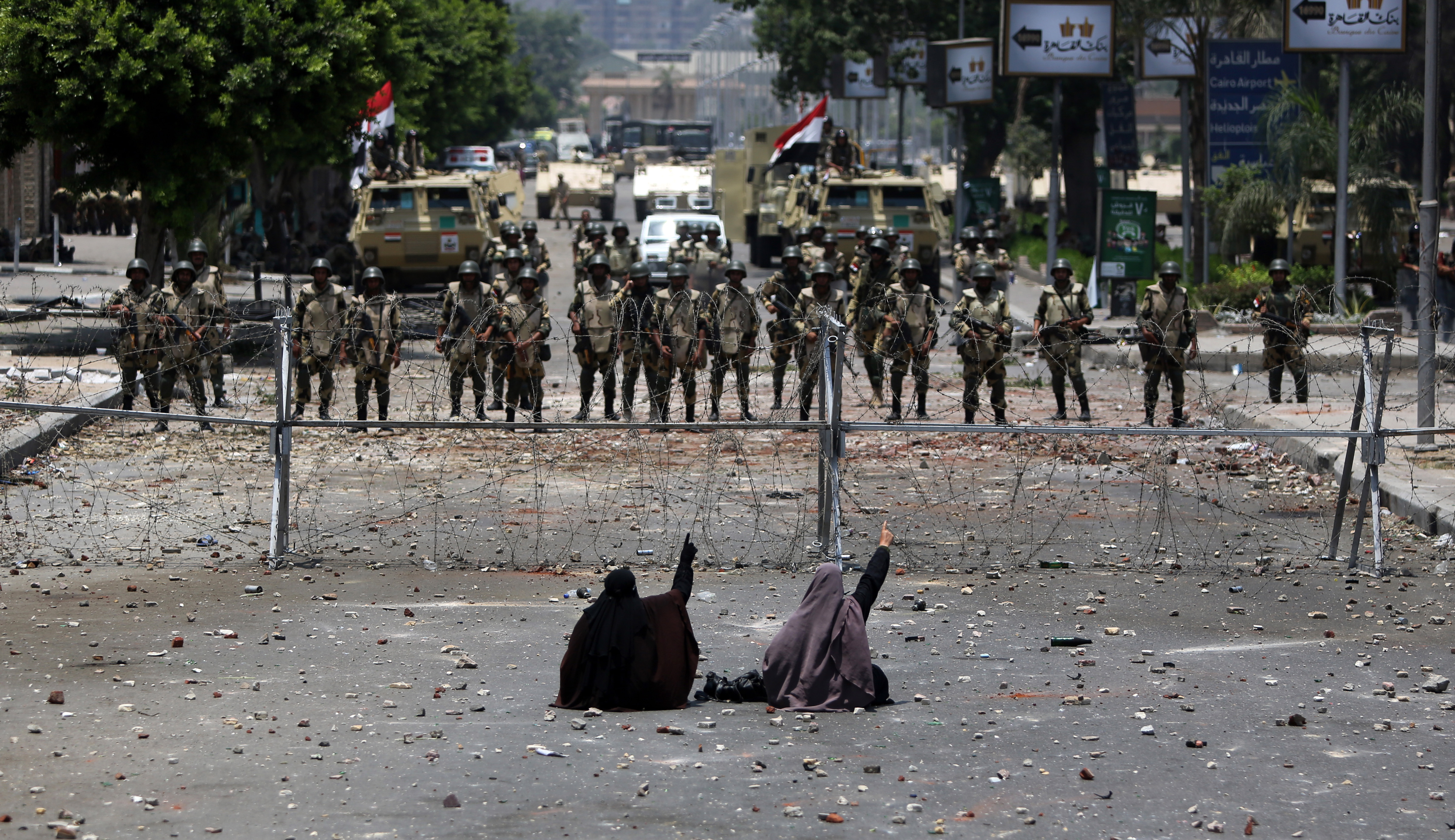
(Photo: Egyptian supporters of deposed president Mohamed Morsi sit in front of barbed wire fencing that blocks the access to the headquarters of the Republican Guard in Cairo on July 8, 2013. Forty-two loyalists of Egypt’s ousted president were killed while demonstrating against last week’s military coup, triggering an Islamist uprising call and dashing the army’s hopes for an interim civilian administration. By Mahmum Hams/AFP/Getty Images)

Massacre In Egypt: Tweet Reax

“A Globalization Of Indifference”

The new Pope coins a phrase:

“Where is your brother?” Who is responsible for this blood? In Spanish literature there is a play by Lope de Vega that tells how the inhabitants of the city of Fuente Ovejuna killed the Governor because he was a tyrant, and did it in such a way that no one knew who had carried out the 447px-Rose_champagne_infinite_bubblesexecution. And when the judge of the king asked “Who killed the Governor?” they all responded, “Fuente Ovejuna, sir.” All and no one! Even today this question comes with force: Who is responsible for the blood of these brothers and sisters? No one! We all respond this way: not me, it has nothing to do with me, there are others, certainly not me. But God asks each one of us: “Where is the blood of your brother that cries out to me?”

Today no one in the world feels responsible for this.

We have lost the sense of fraternal responsibility; we have fallen into the hypocritical attitude of the priest and of the servant of the altar that Jesus speaks about in the parable of the Good Samaritan: We look upon the brother half dead by the roadside, perhaps we think “poor guy,” and we continue on our way, it’s none of our business; and we feel fine with this. We feel at peace with this, we feel fine! The culture of well-being, that makes us think of ourselves, that makes us insensitive to the cries of others, that makes us live in soap bubbles, that are beautiful but are nothing, are illusions of futility, of the transient, that brings indifference to others, that brings even the globalization of indifference. In this world of globalization we have fallen into a globalization of indifference.

(Photo by Gaetan Lee via Wikimedia Commons)

The Massacre In Cairo

Pro-Morsi Supporters Killed In Shooting Incident Outside Presidential Guard Barracks

The bottom line is that we still don’t quite know what happened. Did some Muslim Brotherhood members try to storm the Republican Guards HQ after dawn … or did the military open fire on praying protestors? A helpful summary from the Guardian:

The Egyptian military says gunmen from an “armed terrorist group” and linked to the Muslim Brotherhood – the Islamist organisation with which Morsi is affiliated – tried to storm the building shortly after dawn, firing live ammunition and throwing firebombs, killing one police officer. But the Muslim Brotherhood said troops opened fire at protesters, including women and children, none of whom had attacked the troops. The Guardian’s Patrick Kingsley spoke to a number of witnesses who gave differing accounts of what happened. Accounts from five of the wounded backed the Brotherhood’s version of events.

The NYT has this detail:

Bullet holes in cars, lampposts and corrugated metal barriers indicated that gunfire was coming from the top of a nearby building where the sandbag barriers around makeshift gun emplacements were visible. Bullet casings on the ground and collected by Islamist demonstrators bore the stamp of the Egyptian Army. But Egyptian state television showed film of a pro-Morsi protester firing what appeared to be a homemade handgun at advancing soldiers from behind a corner about 250 yards away. The footage was in daylight, hours after the initial attack began. A witness who lived nearby said he saw two men with similar weapons among the protesters.

The protesters, witnesses and video footage all appeared to portray the pro-Morsi demonstrators as attempting to fight back against the soldiers by throwing rocks.

It seems insane to me that, holding power and needing some Islamist support, the military would then engage in an unprovoked slaughter of protesting Morsi supporters at prayer. And yet the slaughter seems beyond anything we have yet seen since the start of this turbulence. I tend to agree with Juan Cole, until we get further evidence:

Both narratives are problematic. The army’s description of a “terrorist attack” sounds propagandistic. The Brotherhood account doesn’t indicate a motive for the army abruptly to launch an attack on peaceful demonstrators.

But this does, from the army spokesman:

The scene spiralled out of peacefulness at about 4am, he says. An armed group attacked the perimeters around the Republican Guard HQ, and the personnel responsible for securing the premises – from the army and police – were attacked by live ammunition, Ali says.

At the same time other groups started to climb up the buildings nearby and throw stones, molotov cocktails, bombs and heavy objects, Ali says, resulting in the death of one army officer and the injury of 42. Many of them are in a very critical condition, he says.

Stay tuned.

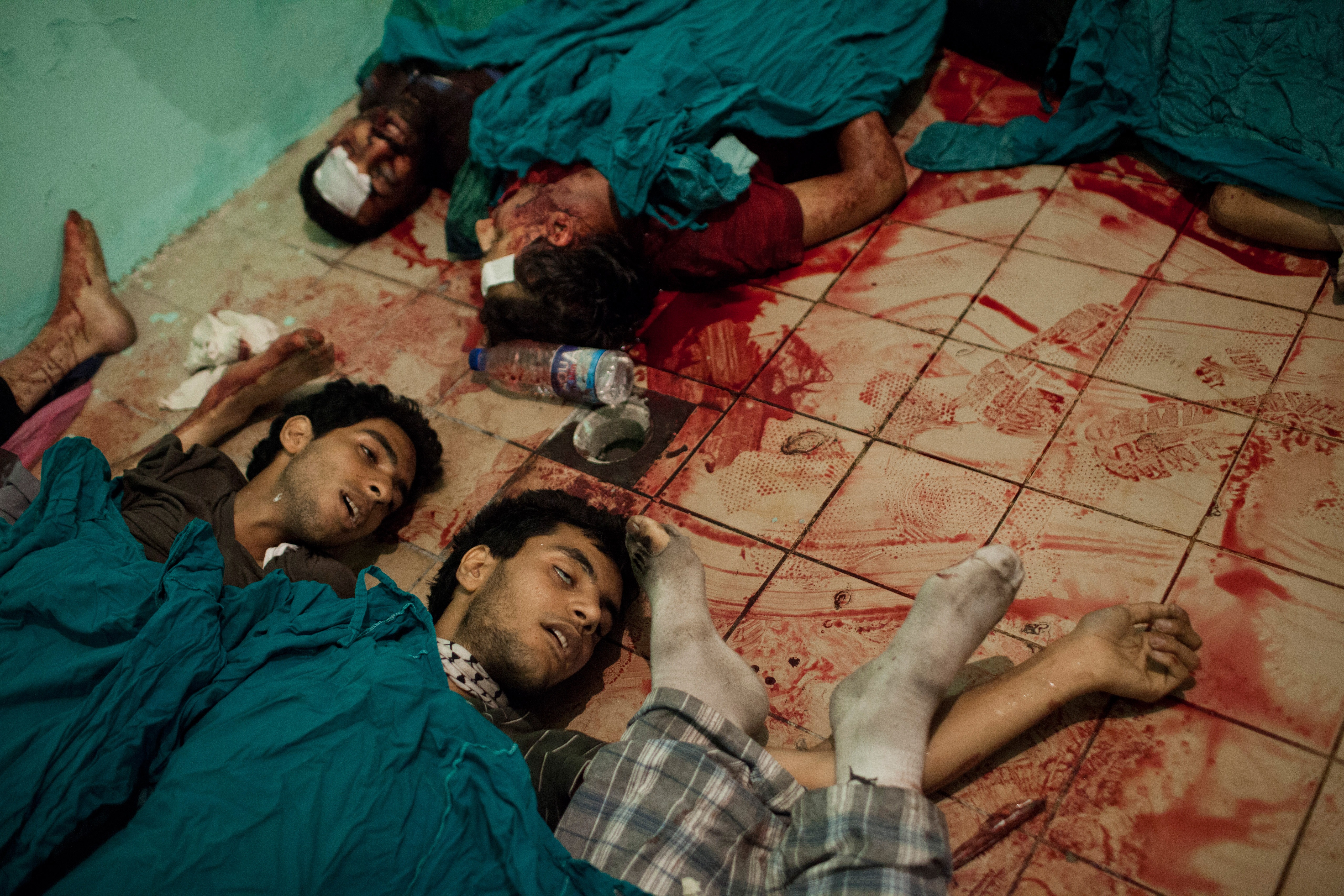
(Photo: The bodies of men lie on the floor of a morgue at the Liltaqmeen al-Sahy Hospital in Cairo’s Nasr City district, after allegedly being killed during a shooting at the site of a pro-Morsi sit-in in front of the headquarters of the Egyptian Republican Guard on July 8, 2013 in Cairo, Egypt. By Ed Giles/Getty.)

Egypt: Fact Of The Day

As the country now seems on the brink of full-scale civil war, this tiny nugget leapt out at me:

The recent 2008 Demographic Health Survey in Egypt (EDHS) reported that the FGM/C prevalence rate among women from ages 15-49 is 91.1 percent, but 74 percent among girls age 15-17.

Declining, perhaps, but still close to ubiquitous. Mark Steyn notes how Morsi’s wife conducted herself while “First Lady”:

President Morsi’s wife, Naglaa Ali Mahmoud, is his first cousin, and covered from head to toe. If you were a visiting foreign minister, you were instructed not to shake hands, or even look at her… Eschewing the title first lady, she preferred to be known as “first servant.”