“A Democracy Of Affection”

Christopher Richards describes his passion for the poetry and personal outlook of Frank O’Hara:

What I love about O’Hara is the way that he is camp, because it’s not too camp. It is not camp at all. What his poems declare, to quote his friend [James] Schuyler, is “I just can’t help it, I feel like this.” Certainly other poets have expressed this democracy of taste, this unbridled attraction before him—particularly Whitman, in his own nineteenth-century queer way. As O’Hara once commented to his roommate and sometimes lover, Joe Lesueur, homosexuality wasn’t just about sex, it was about his love of the freedoms that went with it. O’Hara seized on this and sought out what he wanted when he wanted it. As Lesueur describes in his memoir Digressions on Some Poems by Frank O’Hara, “Frank had at various times both the desire and the determination to make out with a great majority of the people to whom he was attracted, their diversity being truly mind-boggling: big guys, little guys, macho straight men, flagrantly gay men, rough trade, gay trade, friends, friends of friends, offspring of his friends, blonds, blacks, Jews, and—women: Grace Hartigan, for example.” …

His work is filled with unexpected tastes and nearly absent of any sort of hierarchy. Kangaroos? Lovely. Long terrible b-films? Satisfying. Rachmaninoff? Sublime. Drinking coke with a cute guy? The best. O’Hara presides over a democracy of affection.
Focusing Our Revision

“[I]n most parts of literary culture, revision has become as important as inspiration,” writes Craig Fehrman, who traces the current role of revision back to two influences – Modernism and the typewriter:

Most Modernist writers, like Hemingway with The Sun Also Rises, wrote by hand and then painstakingly typed up the results. That took time, but seeing their writing in such dramatically different forms—handwritten in a notebook, typed on a page, printed as a proof—encouraged them to revise it aggressively. “Much as I loathe the typewriter,” W.H. Auden wrote, “I must admit that it is a help in self-criticism. Typescript is so impersonal and hideous to look at that, if I type out a poem, I immediately see defects which I missed when I looked through it in manuscript.”

Twenty-first century technology has made revising easier than ever – maybe even too easy:

Today, most of us compose directly on our computers. Instead of generating physical page after physical page, which we can then reread and reorder, we now create a living document that, increasingly, is not printed at all until it becomes a final, published product. While this makes self-editing easier, [scholar and The Work of Revision author Hannah] Sullivan thinks it may paradoxically make wholesale revision, the kind that leads to radically rethinking our work, more difficult.

“The ideal environment for revision is one where you can preserve several different versions of a text,” Sullivan says. With only one in-progress draft on a computer, we lose the cues that led the Modernists to step back from their work and to revise it. “It’s that moment of typing things up that led to the really surprising and inventive changes,” Sullivan says. “The authors came back to their text, but it seemed estranged.”

Mental Health Break

Rapper Mr. J. Medeiros recently took a stand for marriage equality:

I don’t know what it’s like to be gay. I do know what it’s like to love someone in a way that only a marriage can describe. I do know what it’s like to have an identity. To believe these things should be denied to roughly 9million people living in the US (or the much greater number worldwide) does not sit well with my conscience. The same conscience that brought me to seek my God in the first place. I am a Christian who supports gay rights.

On Literary Translation

In a classic New Republic essay from 1941, Vladimir Nabokov expounds on the necessary qualities of the good translator:

We can deduce now the requirements that a translator must possess in order to be able to give an ideal version of a foreign masterpiece. First of all he must have as much talent, or at least the same kind of talent, as the author he chooses. In this, though only in this, respect Baudelaire and Poe or Joukovsky and Schiller made ideal playmates. Second, he must know thoroughly the two nations and the two languages involved and be perfectly acquainted with all details relating to his author’s manner and methods; also, with the social background of words, their fashions, history and period associations. This leads to the third point: while having genius and knowledge he must possess the gift of mimicry and be able to act, as it were, the real author’s part by impersonating his tricks of demeanor and speech, his ways and his mind, with the utmost degree of verisimilitude.

What not to do:

The … sin of leaving out tricky passages is still excusable when the translator is baffled by them himself; but how contemptible is the smug person who, although quite understanding the sense, fears it might stump a dunce or debauch a dauphin! Instead of blissfully nestling in the arms of the great writer, he keeps worrying about the little reader playing in a corner with something dangerous or unclean. Perhaps the most charming example of Victorian modesty that has ever come my way was in an early English translation of “Anna Karenina.” Vronsky had asked Anna what was the matter with her. “I am beremenna” (the translator’s italics), replied Anna, making the foreign reader wonder what strange and awful Oriental disease that was; all because the translator thought that “I am pregnant” might shock some pure soul, and that a good idea would be to leave the Russian just as it stood.

(Hat tip: buzzwords)

Faces Of The Day

dish_catpic

Tom at Demilked captions the above image:

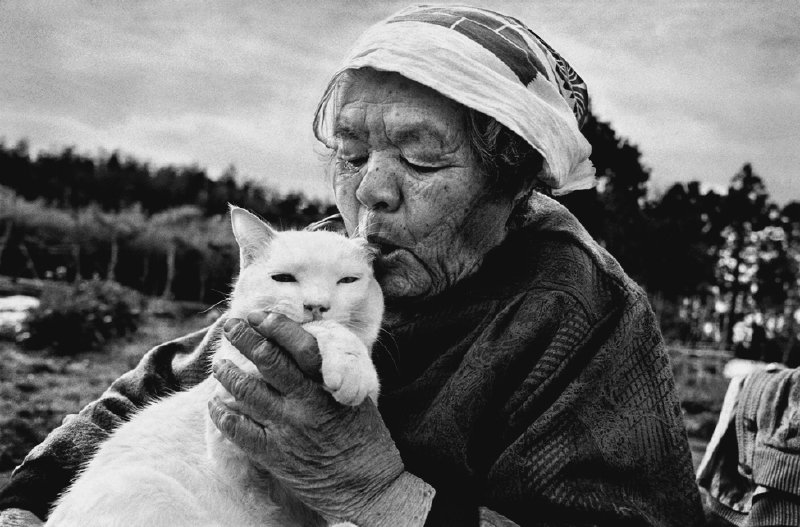
For the last 13 years Japanese photographer Miyoko Ihara has been taking pictures of her grandma, Misao, to commemorate her life. 9 years ago, 88-year-old Misao found a stray odd-eyed cat in her shed: she called it Fukumaru, hoping that “the god of fuku (good fortune) would come and everything will be smoothed over like maru (circle).” Miyoko has been photographing their beautiful friendship and the way they go about their daily routine ever since. The strong bond between the two glows in every shot: “Partly because they are both hard of hearing, my grandmother and Fukumaru are always looking into each other’s eyes. They’re really close,” says Miyoko, who has recently published a hard cover photo album Misao the Big Mama and Fukumaru the Cat.

(Photo by Miyoko Ihara, from Misao the Big Mama and Fukumaru the Cat)

Why Do We Grieve For The Dead?

Julian Baggini considers the question:

There are, of course, plenty of … things about a death to get upset about, most obviously our sadness for the person who has died. However, philosophers have struggled to make sense of this and, as a result, have often concluded that there is simply nothing to be concerned about. The person has died. He cannot suffer in any way. There is no point in feeling sorry about what he might have missed out on because there is no longer anyone there to feel sorry for. The only people who can feel any pain are those who survive.

I think there’s something deeply wrong about this. The sadness that one feels for the deceased is not that he is, in a strange way, still around but unable to appreciate life, but rather that he is no longer around at all. He is not suffering but nor is he enjoying, savouring, loving, laughing, or appreciating either. That is the cause of our sadness, for him or, perhaps more accurately, for what the deceased could still have been.

Many philosophers have been baffled by this, protesting that it is no more rational to feel sad for the unexperienced joys of the deceased than it is for those of the never born. But there is a huge difference between the time two people could have spent together in the real world were it not for an accident, say, and the time two people who had never been born could have spent together in a parallel, imaginary universe. The former did not come to pass when it very nearly could have, while the latter is just one of an infinite number of counterfactual possibilities. It takes a curiously impersonal perspective to assign the same value to both the unrealised experiences of purely hypothetical beings and those of people who lived and breathed. If we can delight in someone’s company, or even just derive enjoyment from a glass of good wine, then there is nothing irrational about feeling sad, perhaps painfully so, that someone we know who would have taken equal pleasure did not have the chance to do so.

The Afterlife Of A Manic Pixie Dream Girl

8647054660_dea68a2106_o

Laurie Penny describes her former life as a MPDG:

I had the raw materials: I’m five feet nothing, petite and small-featured with skin the color of something left on the bottom of a pond for too long and messy hair that’s sometimes dyed a shocking shade of red or pink. At least, it was before I washed all the dye out last year, partly to stop soulful Zach-Braff-a-likes following me to the shops, and partly to stop myself getting smeary technicolor splotches all over the bathroom, as if a muppet had been horribly murdered.

And yes, I’m a bit strange and sensitive and daydreamy, and retain a somewhat embarrassing belief in the ultimate decency of humanity and the transformative brilliance of music, although I’m ambivalent on the Shins. I love to dance, I play the guitar badly, and I also–since we’re in confession mode, dear reader, please hear and forgive – I also play the fucking ukelele. Truly.

Penny dropped the identity “about the time I got rid of the last vestiges of my eating disorder and knuckled down to a career”:

I became successful, or at least modestly so–and that changed how I was perceived, entirely and all at once. I was no longer That Girl. I didn’t have time to save boys anymore. I manifestly had other priorities, and those priorities included writing. You cannot be a writer and have writing be anything other than the central romance of your life, which is one thing they don’t tell you about being a woman writer: it’s its own flavor of lonely. Men can get away with loving writing a little bit more than anything else. Women can’t: our partners and, eventually, our children are expected to take priority. Even worse, I wasn’t writing poems or children’s stories; I was writing reports, political columns. …

[I]n the real world, the very worst thing about being a real-life MPDG is the look of disappointment on the face of someone you really care about when they find out you’re not their fantasy at all–you’re a real human who breaks wind and has a job.

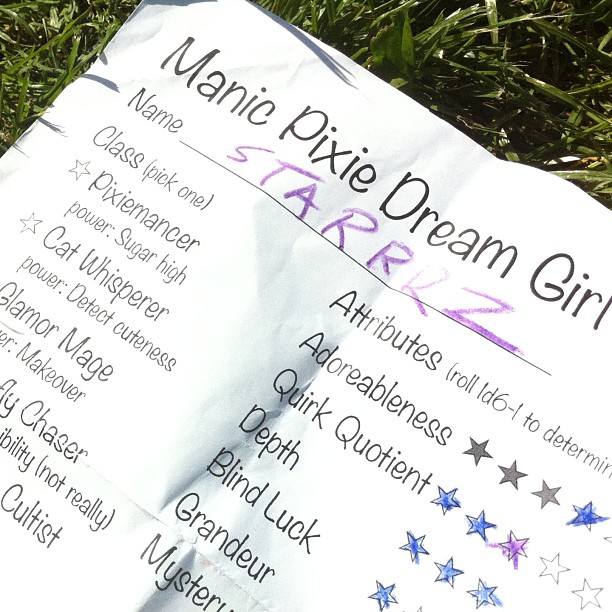
(Photo: Manic Pixie Dream Girl LARP character sheet by Colin Fahrion)

A Poem For Saturday

section_header

From “Song of Myself” (1867) by Walt Whitman:

I think I could turn and live with animals, they are so placid and
self-contain’d;
I stand and look at them long and long.

They do not sweat and whine about their condition,
They do not lie awake in the dark and weep for their sins,
They do not make me sick discussing their duty to God:
Not one is dissatisfied, not one is demented with the mania of owning
things,
Not one kneels to another, nor to his kind that lived thousands of years ago,
Not one is respectable or unhappy over the whole earth.

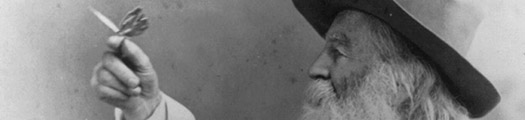
(Photo of Whitman holding a butterfly from the 1889 edition of Leaves of Grass)

The View From Your Window Contest

vfyw_7-6

You have until noon on Tuesday to guess it. City and/or state first, then country. Please put the location in the subject heading, along with any description within the email. If no one guesses the exact location, proximity counts.  Be sure to email entries to contest@andrewsullivan.com. Winner gets a free The View From Your Window book or two free gift subscriptions to the Dish. Have at it.

The Inner Lives Of Animals

Brandon Keim investigates the field of animal consciousness:

The whale biologist Shane Gero is part of a research team that has conducted long-term sperm-whale studies off the island of Domenica in the Caribbean. These studies describe the dynamics of whale families in which children are, in a very real sense, the centre of their lives. Yet Gero told me of being chastised by colleagues for referring to animals by name rather than number. Pressure still exists to think not of individuals, but of general species traits that happen to be manifested in a particular animal. Gero has helped to decode the vocalisations that sperm whales might use as names, something that’s also been observed in dolphins, but this remains controversial.

That’s why a visitor to the ‘Whales: Giants of the Deep’ exhibition at the American Museum of Natural History in New York can learn a lot about their skeletons, heart capacity and navigational abilities, but barely anything about their intelligence and social lives — arguably the most dynamic area of contemporary cetacean research. …

[I]n some respects the general public outpaces much of the scientific community, at least when it comes to the familiar animals we live with and know well. All those cute cat videos, reliably mocked as a symptom of our unintellectual internet habits, bespeak our era’s willingness to acknowledge the inner lives of companion animals. Not that they’re tiny humans in kitten suits, of course — indeed, part of the fun in knowing a cat (not to mention watching those videos) is the obvious disparity between their view of the world and our own. But neither are they entirely incomprehensible, per Ludwig Wittgenstein’s enigmatic statement: ‘If a lion could speak, we would not understand him.’ Wittgenstein probably never saw a pair of lion cubs at play.